即时零售

Search documents
谁在流血,谁在偷笑?三大巨头财报揭示即时零售残酷“三国杀”硝烟正浓丨鱼眼·观察
Sou Hu Cai Jing· 2025-09-02 05:45
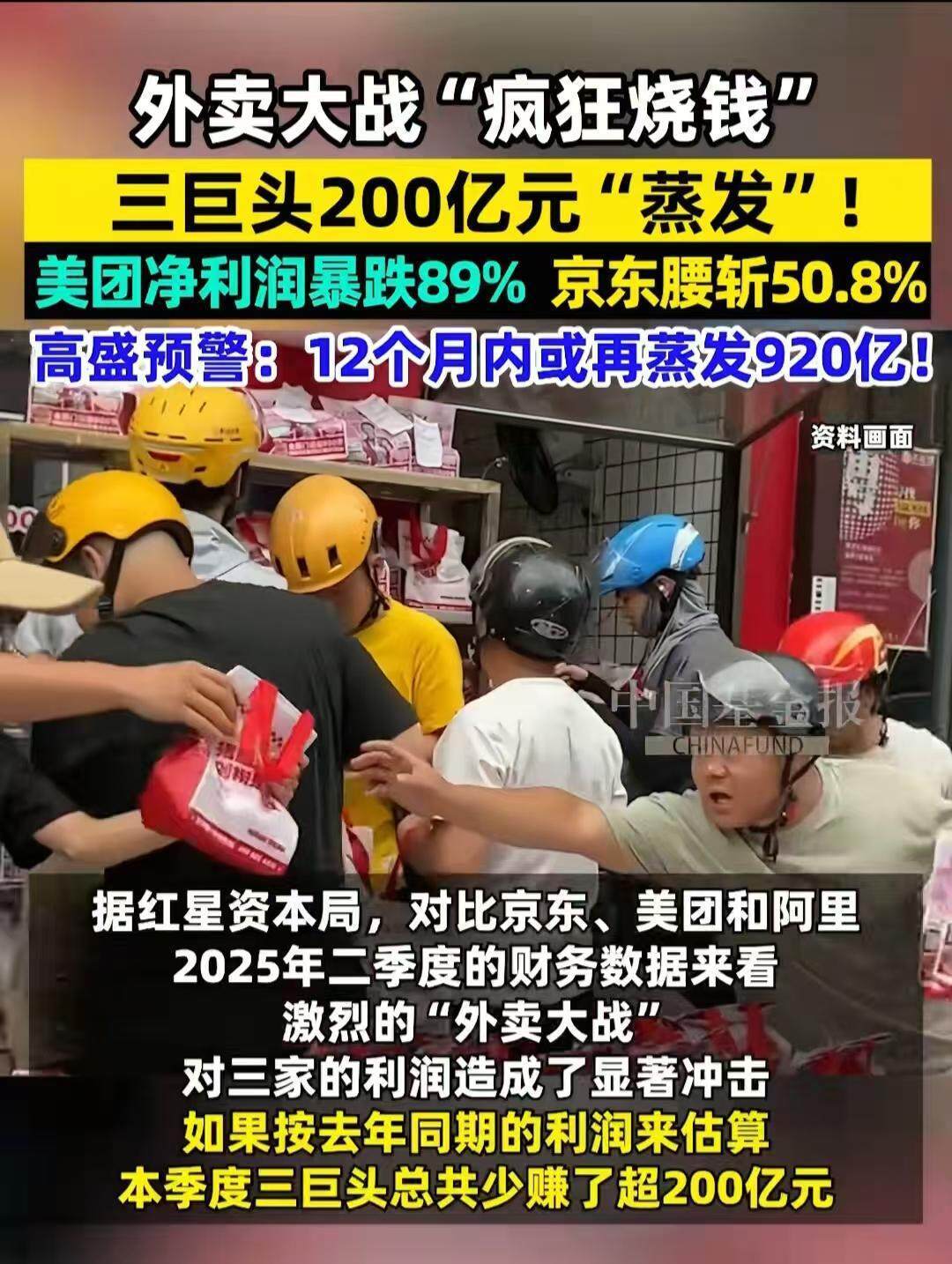
Core Insights - The competitive landscape of instant retail is intensifying, with Meituan, JD.com, and Alibaba engaged in a fierce battle, leading to significant market restructuring [1][2]. Financial Performance - Meituan reported revenue of 91.84 billion yuan, a year-on-year increase of 11.7%, but its operating profit plummeted by 98% to 226 million yuan, with adjusted net profit down 89% to 1.493 billion yuan, far below market expectations [2][4]. - JD.com achieved revenue of 356.7 billion yuan, reflecting a strong year-on-year growth of 22.4%, but its net profit fell by 49% to 7.4 billion yuan [2][5]. - Alibaba's revenue reached 247.6 billion yuan, a 2% year-on-year increase, with net profit of 33.5 billion yuan, down 12% but within expected ranges, leading to a 12.9% surge in its stock price [2][5]. Competitive Strategies - Meituan's aggressive entry into the instant retail sector with the launch of "Meituan Flash Purchase" in April 2023 has intensified competition [4]. - JD.com responded by enhancing its delivery services and committing to full social security payments for delivery personnel, while also accepting significant losses to gain market share [5][7]. - Alibaba initiated a 50 billion yuan subsidy plan to boost its "Taobao Flash Purchase" service, leveraging its vast user base to increase order volumes [5][7]. Market Dynamics - The competition has shifted from price wars to a focus on supply chain efficiency and user experience, with companies needing to integrate local supply chains and improve delivery responsiveness [8]. - The instant retail sector is characterized by low profit margins, with major players struggling to achieve profitability despite significant market shares [8]. - The market is transitioning from growth to a focus on capturing existing market share, as the natural growth of the food delivery sector stabilizes [8]. Future Outlook - Meituan's CEO emphasized the need for rational competition to create value, reflecting on the challenges faced in the current competitive environment [8]. - The ongoing battle will likely require companies to establish a competitive edge through efficiency and user experience rather than relying solely on subsidies [8].


阿里巴巴-SW(09988.HK):FY2026Q1云收入增长加快 看好电商闪购生态协同
Ge Long Hui· 2025-09-02 02:46
Group 1 - The core viewpoint highlights the short-term increase in flash purchase investments and the acceleration of cloud revenue growth, with a long-term positive outlook on ecosystem synergy [1][2] - The company has adjusted its net profit forecasts for FY2026-2028 to 140.5 billion, 162.9 billion, and 189.8 billion yuan, reflecting a year-on-year growth rate of -11.1%, +15.9%, and +16.5% respectively [1] - For FY2026 Q1, the company's revenue was 247.65 billion yuan, a year-on-year increase of 2%, while non-GAAP net profit was 33.5 billion yuan, a year-on-year decrease of 18%, slightly below Bloomberg consensus expectations [1] Group 2 - The Chinese e-commerce segment shows a year-on-year increase of 10% in customer management revenue, with technology service fees contributing to revenue growth and improved site penetration [2] - The international digital commerce segment reported a year-on-year revenue increase of 19%, with adjusted EBITA margin narrowing by 12.5 percentage points [1] - The cloud intelligence group experienced a year-on-year revenue growth of 26%, with an adjusted EBITA margin of 8.8%, indicating accelerated growth that offsets capital expenditure impacts [1][2] Group 3 - The company is focusing on improving the monetization rate of its flash purchase segment, with expectations for continued growth in order volume and main site traffic [2] - The AI strategy includes significant investments in AI and cloud computing infrastructure, with planned capital expenditures of 380 billion yuan over three years [2] - The remaining share repurchase scale is 19.3 billion USD, approximately 6% of the current market value, valid until March 2027 [2]
阿里巴巴-SW(09988.HK):积极投入消费和AI+云两大战略 迈入创业新篇章
Ge Long Hui· 2025-09-02 02:46
Group 1: Overall Performance - The core business of the company remains stable, but profit margins are under pressure due to investments in flash sales. In FY26Q1, Alibaba's revenue was 247.7 billion yuan, a year-on-year increase of 2% [1] - Adjusted EBITA for FY26Q1 was 38.8 billion yuan, down 14% year-on-year, primarily impacted by investments in instant retail. Non-GAAP net profit was 33.5 billion yuan, a decrease of 18% year-on-year [1] - The company repurchased 815 million USD worth of 56 million ordinary shares in this quarter, continuing its commitment to shareholder returns [1] Group 2: E-commerce Group - The instant retail business shows synergy effects, creating a large consumption platform that integrates shopping and life services. In FY26Q1, e-commerce CMR revenue increased by 10% year-on-year, benefiting from technology service fees and improved penetration rates [1] - Instant retail revenue reached 14.8 billion yuan, a year-on-year increase of 12%. The average daily order peak reached 120 million, with monthly active users for flash sales reaching 300 million [1] - The adjusted EBITA margin for the Chinese e-commerce group was 30.6%, down 12 percentage points year-on-year, mainly due to investments in instant retail, with estimated losses exceeding 10 billion yuan for the instant retail business in this quarter [1] Group 3: Cloud Computing - The cloud intelligence group's revenue for FY26Q1 was 33.4 billion yuan, a year-on-year increase of 26%. AI-related product revenue continues to grow at triple-digit rates [2] - The company expects strong demand for cloud services to continue, with a projected CAPEX of 38.7 billion yuan in FY26Q1, an increase of 224% year-on-year [2] - The adjusted EBITA margin for the cloud segment was 8.8%, with a quarter-on-quarter increase of 0.8 percentage points, indicating stable profit margins despite increased depreciation from CAPEX [2] Group 4: Investment Outlook - The company is focused on two historical strategic opportunities: investing in AI and cloud as a core technology platform and integrating shopping with life services. Revenue forecasts for FY2026-FY2028 have been adjusted to 1,063.9 billion, 1,184.4 billion, and 1,297.2 billion yuan, reflecting better-than-expected synergy effects from instant retail [3] - Adjusted net profit forecasts have been revised to 134.5 billion, 166.0 billion, and 191.6 billion yuan, indicating slightly higher-than-expected investments in instant retail [3] - The company is currently trading at a FY2026 PE ratio of 15 times, maintaining an "outperform" rating [3]
阿里巴巴-W(09988.HK):确立AI+即时零售核心地位 云及CAPEX持续加速
Ge Long Hui· 2025-09-02 02:46
Core Viewpoint - The company has demonstrated strong performance in both of its major business lines this quarter, with AI cloud driving accelerated growth in cloud services and record-high CAPEX investments. The food delivery business has manageable losses while contributing positively to the main platform's synergy [1] Group 1: AI and Cloud Business - In FY26Q1, the company achieved cloud revenue of 334.0 billion, a year-over-year increase of 25.8% and a quarter-over-quarter increase of 8.1 percentage points, indicating significant acceleration [2] - AI cloud revenue accounted for over 20% of external revenue, with AI revenue growing at triple digits for eight consecutive quarters, suggesting a peak in domestic AI demand [2] - The company’s capital expenditure reached 387.6 billion, a year-over-year increase of 219.8%, reflecting a strong commitment to its AI strategy [2] - The cloud EBITA margin was 8.8%, up 0.8 percentage points quarter-over-quarter, indicating improved profitability despite increased CAPEX [2] Group 2: E-commerce and Food Delivery - In FY26Q1, the company reported CMR of 892.5 billion, a year-over-year increase of 10.1%, driven by commission adjustments and AI-driven improvements in site penetration [3] - The total loss from food delivery subsidies was estimated to be no more than 150 billion, which did not significantly impact overall group profits [3] - Monthly active users for the food delivery service exceeded 300 million, with weekly orders maintaining above 80 million, indicating a narrowing gap with competitors [3] - The food delivery business has shown a positive synergy effect on the main platform, with increased traffic and advertising revenue contributing to overall growth [3] Group 3: Strategic Focus and Future Outlook - The company is strategically focusing on the dual opportunities presented by instant retail and AI, merging various business units into a unified e-commerce group [1] - Future revenue projections for FY2026-2028 are adjusted to 10049/11256/12129 billion, with net profit estimates of 1405/1866/2091 billion [4] - The estimated market value of the company is 34,772 billion, corresponding to a target price of 200.00 HKD per share, maintaining a "buy" rating [4]
36氪出海·全球化公司|阿里最新财报:跨境稳健、AI 强劲,消费战线全面提速
3 6 Ke· 2025-09-02 01:36
Core Insights - Alibaba's latest quarterly earnings exceeded market expectations, driven by robust e-commerce performance and returns from AI investments, leading to a significant stock price increase [2][6] - The company has restructured its business segments to focus on "big consumption" and "AI + cloud," with notable growth in the International Digital Commerce Group (AIDC) and Cloud Intelligence Group [2][4] Financial Performance - For the quarter ending June 30, 2025, Alibaba reported a net profit of RMB 423.82 billion, a 76% year-on-year increase, while total revenue reached RMB 2,476.52 billion, a 2% increase [6] - AIDC's revenue grew by 19% year-on-year to RMB 34.741 billion, with a significant reduction in adjusted EBITA loss to RMB 59 million, nearing breakeven [2][6] Business Segment Highlights - AIDC's international retail business, including platforms like AliExpress and Trendyol, saw a 20% revenue increase to RMB 28.395 billion, driven by strong cross-border performance [2][3] - The Cloud Intelligence Group reported a 26% revenue increase to RMB 33.398 billion, primarily due to growth in public cloud services and AI-related product adoption [8] Strategic Initiatives - Alibaba is focusing on operational efficiency in key regions, which has led to a significant reduction in losses for AIDC [4] - The company is investing heavily in instant retail, with a RMB 500 billion subsidy plan aimed at enhancing consumer engagement and overall e-commerce performance [5][7] Future Outlook - Alibaba anticipates that instant retail will contribute an additional RMB 1 trillion in transaction volume over the next three years, enhancing overall user engagement and advertising revenue [7] - The company plans to continue investing in AI, with a commitment of RMB 3.8 trillion over the next three years to capitalize on growing demand for AI infrastructure and applications [8][9]
外卖大战打了3个月,一家少赚100亿
3 6 Ke· 2025-09-02 01:24
Fast Reading 8月29日晚,随着阿里财报的发布,持续半年多的外卖大战第一次对外展露了残酷的一面。 这场几乎关系到每一个人日常生活的战争,由京东在2月11日挑起,于5月2日被淘宝闪购推向高潮,美团全力防守。在这几个月里,消费者喝到了2元一杯 的奶茶,商家的外卖订单堆积如山,外卖骑手有送不完的订单,但是参战的三家平台的利润都显著减少了。 雪豹财经社了解到,阿里在与投资人的业绩Preview上表示,Q2淘宝闪购整体亏损为100亿元。一位长期关注阿里的卖方分析师告诉我们,据他测算,淘宝 闪购的实际亏损额约110亿元。 据雪豹财经社了解,在外卖大战开打前夕,阿里的一位高阶业务主管在被问到是否要设定一个投入预算时表示:"打仗不能让别人知道你的底线在哪里, 如果预设亏损底线,仗就没法打。" 巨额投入为淘宝闪购带来了明显的单量增长。 6月23日,淘宝闪购与饿了么联合宣布日单量突破6000万单。7月7日,这一数字跳级到8000万。到8月,淘宝闪购又围绕"秋天的第一杯奶茶",把日订单峰 值进一步推高到1亿单。 在阿里巴巴Q2的财报电话会上,阿里巴巴中国电商事业群CEO蒋凡透露,淘宝闪购8月的日均订单峰值为1.2亿单, ...

重庆百货20250901
2025-09-02 00:42
Summary of Chongqing Department Store Conference Call Company Overview - **Company**: Chongqing Department Store - **Industry**: Retail, specifically focusing on department stores, supermarkets, and automotive trade Key Points and Arguments Financial Performance - **Revenue**: In the first half of 2025, revenue decreased by 10% year-on-year to 80.4 billion CNY, primarily due to adjustments in the automotive trade sector related to fuel vehicle business [2][3][5] - **Net Profit**: The net profit attributable to shareholders increased by 8.74% to 774 million CNY, with a non-recurring profit of 721 million CNY showing single-digit growth [2][3][4] - **Gross Margin**: Gross margin improved to 8.47%, an increase of nearly 2 percentage points [2][3] - **Operating Cash Flow**: Operating cash flow decreased by approximately 20% to 850 million CNY, influenced by revenue decline and payment cycles [2][4] Business Segments Performance - **Department Store**: Revenue fell significantly to 1.2 billion CNY [3] - **Supermarket**: Revenue remained stable at 3.6 billion CNY, with a 15% increase in sales and over 530,000 new customer visits [2][3][9] - **Electronics**: Revenue slightly decreased to 1.55 billion CNY [3] - **Automotive Trade**: Revenue dropped by about 20% to 1.7 billion CNY, but the segment is expected to stabilize by Q4 2025 [2][5][22] Strategic Initiatives - **Store Renovation**: The company has completed renovations on 37 stores, including fresh discount stores and quality stores, leading to significant sales growth [2][8][9] - **Online Business Development**: The company is implementing a "store + warehouse" model, with online sales increasing by nearly 30% in the first half of 2025 [2][12] - **New Store Openings**: Plans to open 20 to 40 new convenience stores this year, leveraging supply chain advantages and digital systems [27][28] Future Outlook - **Profitability Goals**: The automotive trade aims for a profit of 10 million CNY by year-end, while the electronics segment seeks to maintain scale despite challenges from subsidy policies [22][23][25] - **Dividend Policy**: The company aims for a dividend payout ratio of 40% to 50%, emphasizing sustainable growth and long-term returns for investors [17][29] Market Position and Competitive Strategy - **Self-Branding**: The supermarket's private label currently accounts for 7% of sales, with a target to increase to 15% [18] - **Convenience Store Model**: The convenience store segment has maintained a compound annual growth rate of nearly 20% over the past three years [27] - **Strategic Partnerships**: Collaborations with Alibaba and Meituan in the instant retail sector enhance supply chain efficiency and customer reach [13][14] Additional Insights - **Consumer Trends**: The company is focusing on high-frequency customers, with a significant portion of sales coming from lower-priced items [6] - **Urban Outlet Projects**: The urban outlet project has shown significant progress, with sales increasing by nearly 40% [19][20] This summary encapsulates the key insights from the conference call, highlighting the financial performance, strategic initiatives, and future outlook of Chongqing Department Store in the retail industry.

叮咚买菜20250901
2025-09-02 00:42
Summary of Dingdong Maicai Conference Call Company Overview - **Company**: Dingdong Maicai - **Industry**: Instant Retail Key Financial Metrics - **Q2 2025 GAAP Net Profit**: 1.1 billion CNY, up 59.7% YoY, with a net profit margin of 1.8% [2][3] - **GMV (Gross Merchandise Volume)**: 6.5 billion CNY, up 4.5% YoY [3] - **Revenue**: 5.98 billion CNY, up 6.7% YoY [3] - **Monthly Active Users (MAU)**: Over 10 million, with a daily active user (DAU) count of approximately 2.2 million [13] - **Average Revenue Per User (ARPU)**: 308 CNY [4] User Behavior and Market Dynamics - **Monthly Order Frequency**: Users placed an average of 4.4 orders per month, showing a slight increase from 4.3 orders YoY [4] - **Conversion Rate**: 64%, up 3.3 percentage points YoY [4] - **Core User Contribution**: Core users (30% of total) contribute over 68% of GMV, with an average monthly order frequency of 8.1 [6][7] Regional Performance - **Key Market**: Jiangsu, Zhejiang, and Shanghai contribute over 89% of GMV, with Shanghai's GMV growing by approximately 3.5% [5] - **Profit Margins**: Shanghai's net profit margin exceeds 5%, while Jiangsu and Zhejiang's margins are between 1% and 2% [5][11] Strategic Initiatives - **"Four Seasons Strategy"**: Focuses on good products, good users, good service, and good mindset [6] - **SKU Management**: Planned elimination of approximately 4,000 SKUs by mid-2025 to enhance product quality and regional characteristics [12] - **Supply Chain Strength**: Emphasizes direct sourcing (over 85% for fresh products) and has 12 self-operated factories [8][9] Competitive Advantages - **Product Strength**: Fresh products account for over 55% of sales, with a gross margin of 28%-30% [8] - **Supply Chain Efficiency**: Average loss rate is around 1.5%, with fresh product loss below 3% [8] - **Warehouse Strategy**: Over 300 front warehouses in Shanghai, allowing for flexible and efficient supply chain management [8] Future Growth Plans - **Expansion of Front Warehouses**: Plans to open approximately 50 new warehouses annually, with a focus on Jiangsu and Zhejiang regions [17] - **Product Development**: Continued focus on fresh products while expanding into other categories like baby products and baked goods [15] - **ToB Business Growth**: Currently a small portion of revenue, but potential for growth in domestic and international markets [20] International Strategy - **Overseas Markets**: Currently exploring opportunities in Hong Kong, Saudi Arabia, and Dubai, with a focus on partnerships rather than direct warehouse establishment [21] Conclusion Dingdong Maicai demonstrates strong financial performance and user engagement, with strategic initiatives aimed at enhancing product quality and expanding market presence. The company is well-positioned to leverage its supply chain strengths and competitive advantages in the growing instant retail sector.

淘宝闪购日订单峰值1.2亿,蒋凡:同行效率更优,努力缩小差距
Sou Hu Cai Jing· 2025-09-01 23:40
Core Insights - Alibaba has achieved initial success in the first phase of its food delivery battle, focusing on user scale and market presence, as stated by the CEO of Alibaba's China e-commerce division, Jiang Fan [1][2] - Despite a decline in adjusted EBITA and net profit due to increased investment in instant retail, the impact on Alibaba's overall performance is less severe compared to competitors like JD and Meituan [1][2] User and Order Growth - Since its launch four months ago, Taobao Flash has exceeded expectations in order volume, user base, merchant supply, and delivery capacity, leading the industry in home delivery order share [2] - In August, Taobao Flash reached a peak of 120 million daily orders, with an average of 80 million orders on Sundays; monthly active users grew to 300 million, a 200% increase since April [2] - The number of active delivery riders has surpassed 2 million, tripling since April, indicating significant growth in operational capacity [2] Impact on E-commerce - Taobao Flash has positively influenced the overall e-commerce business, with an increase in daily active users (DAU) for the Taobao app by 20% in August due to the higher frequency of purchases [2] - Increased user engagement is expected to lead to higher e-commerce revenue, driven by rising traffic and reduced marketing expenses [2][3] Long-term Strategy - Jiang Fan believes that the positive trends will continue to expand, enhancing e-commerce revenue in the long term; the investment logic for Taobao Flash considers comprehensive returns over different time frames [3] - The company anticipates that Flash and instant retail will generate an additional 1 trillion yuan in transactions over the next three years [7] Operational Efficiency - Alibaba is focusing on improving operational efficiency to reduce losses, including optimizing user structure, order structure, and delivery efficiency [10] - The company aims to halve its unit economics (UE) losses in the short term through enhancements in logistics and order optimization while maintaining current consumer incentives [10] Financial Position - Alibaba has a strong financial position with cash and cash equivalents totaling 585.7 billion yuan, allowing for significant investments in new service-oriented e-commerce markets [10] - The company is committed to investing 50 billion yuan over several years to tap into a market potential exceeding 10 trillion yuan [10] Competitive Landscape - As the food delivery battle continues, Alibaba is positioned to capture a larger share of the "food delivery + instant retail" market [11]

云计算+AI+即时零售三箭齐发,阿里迎来历史新拐点?
美股IPO· 2025-09-01 14:29
Core Viewpoint - Analysts generally believe that Alibaba has entered a period of investment return realization, expecting continuous double-digit revenue growth over the next 12-24 months, with profit growth accelerating as losses in instant retail narrow [1][4]. Group 1: Cloud Computing Business - Alibaba Cloud's revenue reached 33.4 billion RMB in Q1, a year-on-year increase of 26%, significantly exceeding market expectations of 20-25% [5]. - AI-related revenue now accounts for over 20% of external cloud revenue, maintaining triple-digit growth for eight consecutive quarters [5][6]. - The growth is driven by strong demand for AI inference and vertical industry model training, as well as increased penetration of AI in traditional computing and storage services [6][7]. - Management plans to invest 380 billion RMB in AI and cloud infrastructure over the next three years to capture more market share [7]. Group 2: Instant Retail Business - The launch of Taobao Flash Purchase in late April has established a leading position in the competitive market, with monthly active users increasing by 200% to 300 million since April [8]. - Daily average orders peaked at 120 million in August, with a stable weekly average of about 80 million [8]. - Management aims to reduce unit economic losses by half in the short term through improved customer retention and fulfillment efficiency [8]. Group 3: Customer Management Revenue (CMR) - Concerns about a slowdown in CMR growth post-September have been alleviated, with analysts noting that advertising demand has been boosted by the integration of tools and increased traffic from instant retail [9]. - CMR is expected to maintain resilient growth despite high comparative bases, supported by improved monetization rates from the flash purchase business [9][10]. Group 4: Profitability and Valuation - While target prices have been raised, earnings expectations for FY2026 have been lowered due to initial investment costs in the flash purchase business, with HSBC reducing its EPS forecast by 14% [10]. - Analysts believe that short-term profitability pressure is acceptable, as Alibaba has sufficient financial resources for strategic investments [10]. - The valuation recovery potential remains significant as losses in the flash purchase business narrow and cloud business continues to grow [10].