
科技创新

Search documents
招商中国机遇股票A:2025年第四季度利润284.14万元 净值增长率1.04%
Sou Hu Cai Jing· 2026-01-22 12:21
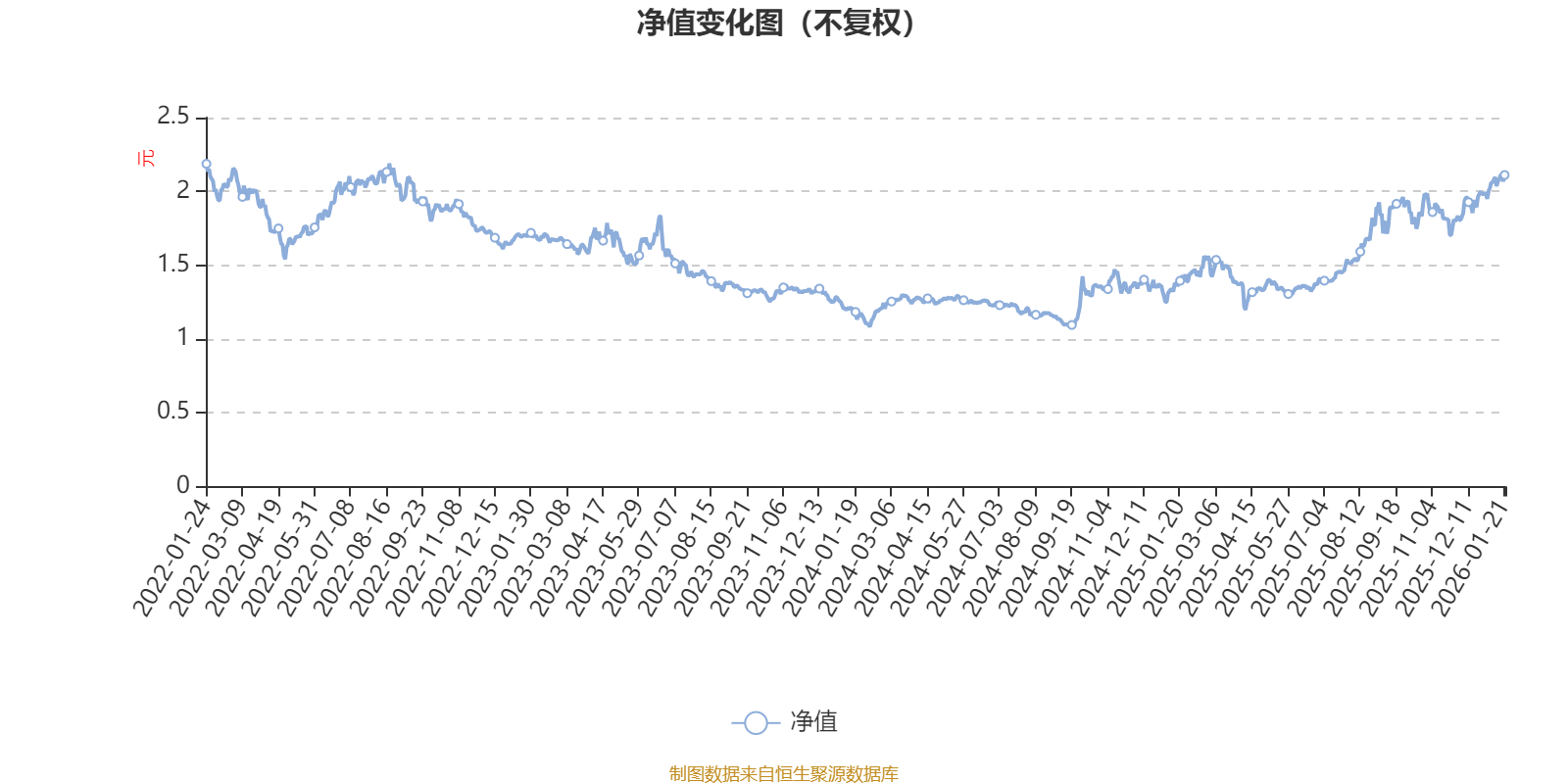
Core Insights - The AI Fund China Opportunity Stock A (001749) reported a profit of 2.8414 million yuan for Q4 2025, with a weighted average profit per fund share of 0.0198 yuan. The fund's net value growth rate for the reporting period was 1.04%, and the fund size reached 291 million yuan by the end of Q4 2025 [3][17]. Fund Performance - As of January 21, the fund's unit net value was 2.111 yuan. Over the past year, the fund achieved a cumulative net value growth rate of 48.66%, the highest among the two funds managed by the fund manager Li Huajian, who has maintained positive returns across both funds [3]. - The fund's performance rankings among comparable funds are as follows: 13.74% growth over the last three months (46/167), 44.99% over the last six months (22/167), and 22.95% over the last three years (81/156) [4]. Investment Strategy - The fund maintained a relatively high position during the reporting period, with an average stock position of 88.52% over the last three years, slightly above the industry average of 88.27%. The highest position reached was 93.14% in mid-2025, while the lowest was 79.84% in mid-2024 [15]. - The fund's investment focus includes sectors such as telecommunications, semiconductors, and electronics, while reducing exposure to media and pharmaceutical stocks. There is an increased allocation towards non-ferrous metals, power equipment, and commercial aerospace [3]. Market Outlook - The fund manager anticipates that the market will continue to experience an upward trend, with technology innovation being the core theme of the current bull market. The telecommunications sector is expected to benefit from the rapid development of the global AI industry, while the domestic semiconductor industry is poised to gain from favorable factors such as AI computing power and domestic production [3]. Top Holdings - As of Q4 2025, the fund's top ten holdings include companies such as Cambricon Technologies, Newyea, Zhongji Xuchuang, and others, indicating a strong focus on technology and innovation [20].

深圳发布保险业三年行动方案,万亿险资瞄准科创与产业升级
Nan Fang Du Shi Bao· 2026-01-22 12:21
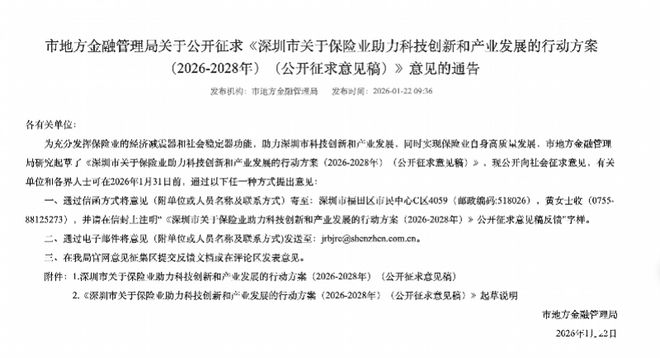
Core Insights - The Shenzhen Municipal Financial Management Bureau has released an action plan for the insurance industry to support technological innovation and industrial development from 2026 to 2028, aiming to address the "long-term capital shortage" and "lack of risk coverage" in technology innovation [1][6] Group 1: Quantitative Goals - The action plan sets clear three-year development goals, including pushing national insurance funds to invest over 1 trillion yuan in Shenzhen and achieving an annual growth rate of over 10% in technology insurance premium income [2][3] - It aims to provide over 5 trillion yuan in risk coverage for technology enterprises annually and to launch at least 30 innovative insurance products each year in emerging fields like low-altitude economy and artificial intelligence [2][3] - By the end of 2028, the total assets of insurance entities in Shenzhen are expected to exceed 11 trillion yuan, with cumulative premium income over 700 billion yuan [2][3] Group 2: Key Support Measures - The action plan outlines eleven key support measures, including optimizing the utilization of insurance funds and establishing a project docking mechanism for insurance capital [3][4] - It encourages the development of technology insurance, promoting innovative product offerings in frontier technology fields and enhancing the talent insurance product system [3][4] - Specific measures include developing insurance products for the first set of equipment, intellectual property, and supporting the establishment of artificial intelligence insurance innovation centers [4][5] Group 3: Industry Collaboration and Innovation - The plan emphasizes the importance of collaboration between insurance institutions and technology companies, particularly in the fields of artificial intelligence and biotechnology [5][6] - It aims to enhance the insurance service system for marine industries and promote cross-border insurance cooperation between Shenzhen and Hong Kong [5][6] - The action plan also highlights the need for a robust reinsurance and co-insurance mechanism to support major strategic sectors [5][6] Group 4: Digital Transformation and Environment Optimization - The action plan supports the establishment of insurance innovation centers and encourages digital transformation within insurance institutions to improve operational management [7][8] - It proposes differentiated, scenario-based support measures tailored to the industrial advantages of different districts in Shenzhen [8] - The plan aims to enhance the digitalization of underwriting and claims services, optimizing customer experience [8] Group 5: Financial Supply-Side Reform - The action plan is rooted in Shenzhen's high-quality insurance development, with premium income growth of 12.8% year-on-year in the first three quarters of 2025 [9][10] - It highlights the successful introduction of significant insurance funds and innovative practices in various fields, providing a reference model for financial supply-side reform in China [9][10] - The unique aspects of the Shenzhen plan include its systematic design aimed at deeply embedding financial tools into the local innovation ecosystem [10]
深圳国资推进基金矩阵建设,大湾区创投引导基金入驻前海
Sou Hu Cai Jing· 2026-01-22 12:17
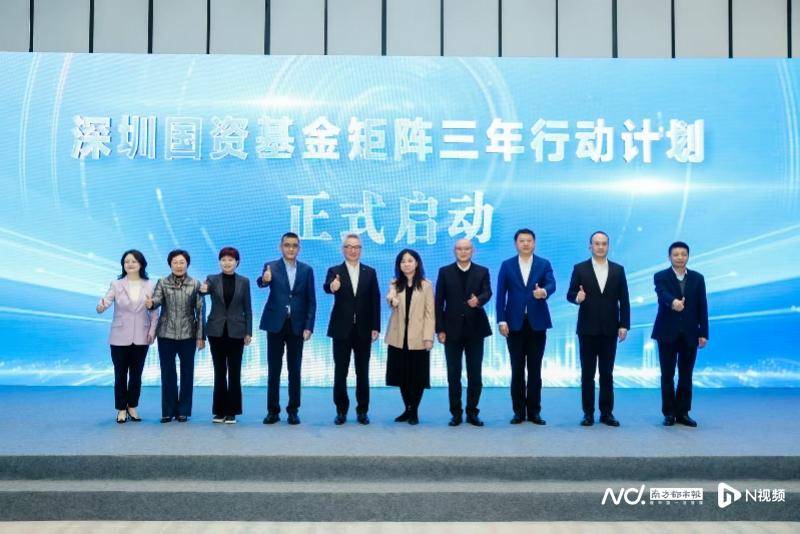
1月22日,"深圳国资基金矩阵三年行动计划发布仪式暨粤港澳大湾区创业投资引导基金入驻仪式"在深圳前海5号 楼举行。活动由深圳市国资委主办,前海管理局协办、深创投承办,市国资委、市委金融办、市发展改革委、前 海管理局及28家市属国企、被投上市企业代表参会,共同推动国有资本赋能科技创新与粤港澳大湾区高质量发 展。 步强化产业链上下游整合与资源协同。被投上市企业越疆科技董事长通过视频分享、市场总监现场发言,生动展 现了在国资基金支持下,企业从技术研发到产业化落地的成长历程,印证了国有资本赋能科技创新企业发展的实 效。 活动最后,8家市属国企负责人签署深圳国资基金矩阵任务书,将深圳国资基金矩阵三年行动计划目标分解为清晰 可量化的具体指标,明确基金规模、投资方向、项目培育等重点任务,标志着深圳国资基金矩阵建设进入任务明 确、分工清晰的实施推进阶段。 此次活动的举办,是深圳国资国企深化改革、服务创新的重要举措。下一步,深圳市国资委将坚守耐心资本功能 定位,坚持"投早投小投长期投硬科技"导向,打造"资本+产业+服务"协同生态体系,推动国有资本与科技创新深 度融合,为深圳建设全球一流的"科技—产业—金融"一体化创新高地、粤港 ...
近期市场连续三万亿成交背后的逻辑思考
Dongguan Securities· 2026-01-22 11:01
Group 1 - The A-share market has shown strong performance, with the Shanghai Composite Index reaching a peak of nearly 4200 points, supported by a significant increase in trading volume, with a record of over 30 trillion yuan in daily transactions during early January 2026 [10][12][39] - The market's upward trend is attributed to multiple factors, including strengthened policy expectations, global capital inflows, and increased domestic liquidity, which have collectively boosted investor confidence [10][12][39] - The economic fundamentals remain robust, with a steady recovery in demand, active service consumption, and resilience in foreign trade, although the recovery foundation still needs to be solidified [13][14][21] Group 2 - Policy expectations have ignited market enthusiasm, with a focus on expanding domestic demand and stabilizing consumption as key tasks for 2026, supported by various policy measures aimed at stimulating demand [13][30][31] - The central bank has indicated potential for further monetary easing, including interest rate cuts, to support economic recovery and market stability, with expectations for a favorable liquidity environment [33][40] - Regulatory measures have been implemented to manage market overheating, transitioning from a liquidity-driven surge to a performance-driven slow bull market, with an emphasis on earnings recovery to sustain high valuations [28][39] Group 3 - The spring market rally is expected to continue, characterized by structural opportunities, with a focus on low-valuation, stable-profit dividend stocks, technology sectors driving new productivity, and domestic demand expansion [41][42] - Key sectors to watch include financials, non-ferrous metals, public utilities, and transportation, as well as technology areas such as semiconductors and AI, which are aligned with national strategic priorities [41][42] - The importance of domestic demand is highlighted, especially in the context of external pressures, with recommendations to focus on sectors benefiting from domestic consumption, such as food and beverage, automotive, and healthcare [41][42]
沙钢连续10年上榜中国钢铁竞争力A+企业
Zhong Guo Jin Rong Xin Xi Wang· 2026-01-22 09:52
Group 1 - The core viewpoint of the article highlights that Shagang Group has been rated A+ (extremely strong) for the tenth consecutive year in the competitiveness ranking of domestic steel enterprises by the Metallurgical Industry Planning and Research Institute [1] - Shagang is focusing on technological innovation to upgrade its product structure, achieving breakthroughs in high-end materials, including low-temperature tempered high-strength steel and high-toughness shipbuilding steel [1] - The company is actively integrating AI into production processes, establishing itself as a smart manufacturing benchmark with various intelligent systems and platforms [1] Group 2 - Shagang is committed to green and low-carbon development, successfully implementing multiple projects in renewable energy and becoming the first private steel enterprise in China to pass the "dual carbon best practice energy efficiency benchmark demonstration" [1] - The brand "Shagang" is widely recognized, with products used in major national projects and exported to high-end markets in Germany, the Netherlands, Thailand, and South Korea [2] - Looking ahead, Shagang aims to build a world-class steel enterprise under its "136" development strategy, focusing on efficiency, talent, and innovation while reinforcing its green advantages [2]

潘功胜:推动金融机构完善内部激励约束机制,提升金融服务的便捷性、有效性、覆盖面
Xin Lang Cai Jing· 2026-01-22 09:44
Core Viewpoint - The People's Bank of China (PBOC) aims to enhance financial support for key areas such as domestic demand, technological innovation, and small and micro enterprises to strengthen domestic circulation and promote high-quality development [1][3]. Group 1: Support for Domestic Demand and Consumption - The PBOC will implement comprehensive measures to meet diverse financial needs in the consumption sector, including a dedicated 500 billion yuan for consumer and elderly care re-loans [1][3]. - Financial institutions will be encouraged to innovate financial products and improve payment services to enhance consumer finance service levels [1][3]. - A one-time personal credit repair policy will be implemented to improve the consumer finance environment [1][3]. - Qualified financial institutions will be supported in issuing financial bonds to increase funding capacity in the consumption sector [1][3]. Group 2: Support for Technological Innovation - The PBOC will continue to increase policy support for technological innovation, including raising the quota for re-loans aimed at technology innovation and technological transformation [1][3]. - Private small and medium-sized enterprises (SMEs) with high R&D investment levels will be included in the support scope [1][3]. - A risk-sharing tool for bonds related to technological innovation and private enterprises will be established to provide re-loan support and promote the development of a "technology board" in the bond market [1][3]. Group 3: Support for Small and Micro Enterprises - The PBOC will enhance the accessibility and convenience of financing for small and micro enterprises by increasing re-loan and rediscount quotas, with a specific allocation of 1 trillion yuan for private enterprises [2][4]. - Financial institutions will be supported in issuing financial bonds for small and micro enterprises, utilizing financing support tools for private enterprises [2][4]. - The credit enhancement system for private SMEs will be improved, leveraging government financing guarantees and information sharing [2][4]. - Collaboration with various departments such as development reform, commerce, industry, and technology will be strengthened to enhance coordination and information sharing [2][4]. - Financial institutions will be encouraged to improve internal incentive mechanisms to enhance the convenience, effectiveness, and coverage of financial services [2][4]. - Coordination between monetary and fiscal policies will be emphasized to amplify the effects of financial support through measures like fiscal interest subsidies, guarantees, and risk compensation [2][4].
统筹顶层设计和问计于民,四川人大开展“十五五”规划纲要和计划报告初审
Mei Ri Jing Ji Xin Wen· 2026-01-22 09:33
Core Viewpoint - The Sichuan Province's "14th Five-Year" planning outline has been preliminarily reviewed, focusing on enhancing economic development, addressing demographic challenges, and promoting technological innovation and infrastructure modernization [1][2]. Group 1: Economic and Social Development - The planning outline includes sections on collaborative enhancement of the Chengdu-Chongqing economic circle, industrial development, technological innovation, and the construction of a modern infrastructure system [1]. - The outline emphasizes strengthening social welfare, particularly in response to demographic changes, highlighting the urgency of addressing aging and declining birth rates [1]. Group 2: Population and Social Services - Recommendations include improving public service systems to cover all demographics and increasing investment in pension projects to enhance the basic pension levels for urban and rural residents [1]. - There is a call for higher targets in disposable income growth, aiming for it to exceed economic growth rates, and for the establishment of a family-friendly society through enhanced childcare services [2]. Group 3: Industry and Innovation - The need to elevate the capabilities of industries such as electronic information, artificial intelligence, and new energy is emphasized, along with the role of universities as innovation hubs [2]. - The construction of a new energy system is highlighted, with a focus on improving infrastructure for demand-side needs, particularly in the context of electric vehicle charging facilities [2]. - The integration of legal frameworks with technological and industrial innovation is seen as crucial for fostering new industries, with a focus on pilot programs to facilitate commercialization [2].
300万元!中信大连分行为本地这家“硬核”机器人研发制造企业放款
Zhong Guo Jin Rong Xin Xi Wang· 2026-01-22 09:19
Core Viewpoint - The article emphasizes the importance of technological innovation in national development and daily life, highlighting the role of financial support in nurturing tech startups like Sofis Intelligent Technology (Dalian) Co., Ltd. [1] Group 1: Company Overview - Sofis Intelligent Technology (Dalian) Co., Ltd. focuses on the research and manufacturing of intelligent robots and is characterized as a typical hard-tech startup [1] - The company is currently in the early stages of preparation and market expansion, with no stable revenue yet but possesses high growth potential and light asset characteristics [1] - Sofis has secured a cooperation order with a large enterprise, creating an urgent need for funding to fulfill the order [1] Group 2: Financial Support and Innovation - CITIC Bank Dalian Branch has addressed the financing challenges of the startup, which include lack of revenue and collateral, by evaluating core technology patents and the strength of the R&D team rather than relying solely on financial statements [2] - The bank has provided a tailored credit solution, simplifying the approval process and enhancing loan efficiency, successfully issuing a 3 million yuan working capital loan to the company [2] - This financial support is aimed at facilitating the company's production startup and integration into the local industrial chain, thereby accelerating the upgrade of Dalian's supply chain [2] Group 3: Strategic Initiatives - CITIC Bank Dalian Branch has established a "1+1+1+N" organizational system for technology finance, launching various innovative financial products such as "Sci-Tech e-loan" and "Inclusive Sci-Tech Scoring Card" [3] - The bank is committed to deepening its strategic layout of "early investment, small investment, and hard technology," enhancing insights into industries and clients, and optimizing credit assessment models for tech startups [3] - Future plans include increasing credit support for seed and early-stage tech companies, aiming to inject continuous financial vitality into industrial innovation and contribute to high-quality economic development in Dalian [3]


守粮安、兴产业、美乡村:山东烟台推进农业农村现代化先行市建设
Zhong Guo Xin Wen Wang· 2026-01-22 08:48
Group 1: Agricultural Development Goals - Yantai aims to establish a modern agricultural production, industry, and management system, striving to be a pioneer in achieving agricultural modernization by 2026 [1] - During the 14th Five-Year Plan period, Yantai has added 410,000 acres of high-standard farmland and has seen continuous grain harvests for five years [1] - The city plans to ensure stable grain planting area and production, targeting 4.55 million acres and over 1.9 million tons by 2026 [3] Group 2: Infrastructure and Disaster Management - The city emphasizes the importance of agricultural infrastructure for disaster prevention and mitigation, advocating for the inclusion of drainage systems in high-standard farmland construction [2] - Representatives highlight the need for a comprehensive agricultural disaster prevention system to transition from passive to proactive disaster management [2] Group 3: Brand and Market Development - There is a significant opportunity to enhance the market recognition and value of Yantai's agricultural products, with suggestions for innovative marketing strategies [3][4] - The city plans to cultivate over 10 agricultural industrialization leading enterprises and certify more than 30 quality agricultural products by 2026 [6] Group 4: Technological Innovation - Technological innovation is deemed crucial for industry upgrades, with a focus on developing resilient and high-quality crop varieties to support sustainable agricultural development [4][6] - The city encourages agricultural research institutions to innovate and support the transition of new varieties and technologies from experimental to productive fields [6] Group 5: Rural Development and Community Building - Yantai aims to create 20 rural revitalization areas by 2026, focusing on building a new type of rural production, living, and ecological community [7] - The city plans to improve rural living conditions by upgrading infrastructure, enhancing public services, and promoting community governance [7]

利好科创!深圳重要发布
Zhong Guo Zheng Quan Bao· 2026-01-22 08:13
Core Viewpoint - The Shenzhen Municipal Financial Management Bureau has solicited public opinions on the "Action Plan for the Insurance Industry to Support Technological Innovation and Industrial Development (2026-2028)", which sets quantitative goals for insurance in technology and emerging industries [1] Group 1: Quantitative Goals - The plan aims for an annual growth rate of over 10% in technology insurance premium income, providing risk protection exceeding 5 trillion yuan for tech companies each year [1] - It targets the launch of at least 30 innovative insurance products annually in emerging industries such as low-altitude economy and artificial intelligence [1] - The total assets of insurance entities in Shenzhen are expected to exceed 11 trillion yuan, with total premium income in the region surpassing 700 billion yuan over three years [1] Group 2: Focus Areas and Support Measures - The plan emphasizes the development of technology insurance, encouraging insurance institutions to research and innovate products in cutting-edge fields like humanoid robots, quantum technology, and commercial aerospace [2] - It proposes the development of specialized insurance products such as major technology equipment insurance, intellectual property insurance, and cybersecurity insurance to precisely serve the real economy and technological innovation [2] - In the realm of artificial intelligence, the plan encourages the establishment of AI insurance innovation centers and the development of comprehensive insurance solutions covering various risk layers [2] Group 3: Sector-Specific Insurance Development - For the biopharmaceutical industry, the plan suggests expanding insurance products to support R&D in pharmaceuticals and medical devices, including liability insurance for clinical trials [3] - It aims to accelerate the development of low-altitude insurance, including mandatory insurance for drones and the establishment of a classification management system [3] - The plan encourages insurance institutions to adapt to the trends of smart driving and collaborate with developers to refine insurance products for intelligent vehicles [3] Group 4: Cross-Border Cooperation and Support - The plan supports cooperation between Shenzhen and Hong Kong insurance institutions to develop medical and pension insurance products tailored to the Greater Bay Area [4] - It promotes the use of trade risk avoidance tools for cross-border e-commerce enterprises and encourages domestic insurance companies to optimize their overseas operations [4] Group 5: Strengthening Insurance Institutions - The plan supports the establishment of legal headquarters for financial enterprises in Shenzhen and encourages both domestic and foreign insurance institutions to set up subsidiaries in various sectors [5] Group 6: Service Improvement and Performance Metrics - The plan emphasizes enhancing underwriting and claims service levels, utilizing advanced technologies to improve efficiency and accuracy in insurance processes [6] - Data shows that Shenzhen's insurance premium income reached 179.74 billion yuan in the first three quarters of 2025, with a year-on-year growth of 12.8%, leading among first-tier cities [6] - As of September, the total assets of insurance entities in Shenzhen reached 9.1 trillion yuan, with a year-on-year growth of 22%, and net profits of 61 billion yuan, reflecting a growth rate of 15.5% [6]