即时零售

Search documents
阿里巴巴:2026财年第一财季电商集团利润缩水103.64亿元,闪购拉动淘宝月活提高25%
3 6 Ke· 2025-08-30 17:46
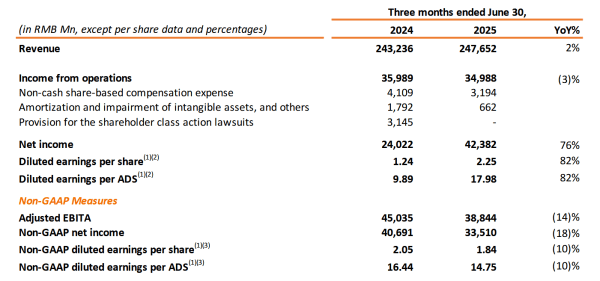
Core Viewpoint - Alibaba reported its Q1 2026 earnings, showing a revenue of 247.65 billion RMB, a 2% year-on-year increase, but a decline in operating profit and net profit [1][2]. Financial Performance - Revenue for the quarter ending June 30, 2025, was 247.65 billion RMB, up 2% year-on-year [1][2]. - Operating profit was 34.99 billion RMB, down 3% year-on-year [2][5]. - Non-GAAP net profit was 33.51 billion RMB, a decrease of 18% year-on-year [1][2]. - Adjusted earnings per ADS were 14.75 RMB [1]. Segment Performance - Alibaba's China e-commerce group revenue was 140.07 billion RMB, a 10% increase year-on-year, with e-commerce business revenue at 118.58 billion RMB [1][2]. - The international digital commerce group generated 34.74 billion RMB, a 19% increase year-on-year, driven by strong cross-border business performance [7]. - The cloud intelligence group reported revenue of 33.40 billion RMB, a 26% increase year-on-year, primarily from public cloud business growth [7][8]. Strategic Developments - The company made significant strategic adjustments to enhance user experience, including the integration of Taotian Group, Ele.me, and Fliggy into the Alibaba China e-commerce group [1][2]. - The launch of "Taobao Flash Purchase" service aimed to meet consumer demand for instant delivery across various product categories [5]. - The 88VIP membership program, representing the highest purchasing power consumer group, exceeded 53 million members, continuing to grow at double-digit rates year-on-year [7]. Market Position and Future Outlook - Alibaba's CEO emphasized a focus on consumer and AI + cloud strategies to achieve strong growth, with significant investments in instant retail and cloud services [9]. - The company repurchased 56 million shares for a total of $815 million during the quarter [9]. - As of the report date, Alibaba's stock was trading at 115.7 HKD per share, with a market capitalization of $285.1 billion [9].


阿里Q2财报:淘宝闪购“快速取得阶段成果” 淘宝活跃消费者增25%
Yang Guang Wang· 2025-08-30 16:33
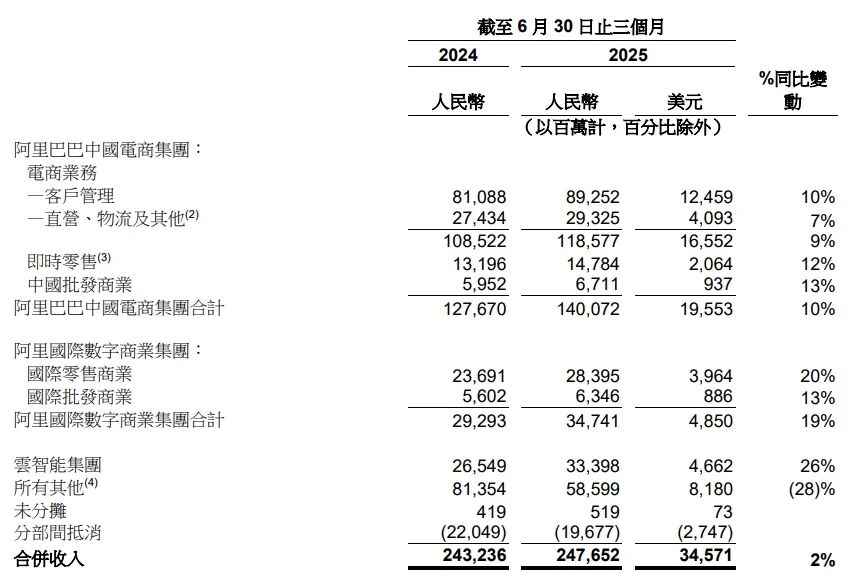
Core Insights - Alibaba Group's Q2 2025 financial report shows a significant growth in its e-commerce segment, driven by the rapid expansion of Taobao Flash Sales, with customer management revenue reaching 89.252 billion yuan, a 10% year-on-year increase, surpassing Bloomberg analysts' expectations [1][2] - The CEO of Alibaba, Wu Yongming, emphasized the company's substantial investment in instant retail, which has led to impressive results and increased consumer engagement, contributing to record-high monthly active consumers and daily order volumes [1] - Taobao Flash Sales achieved a milestone with daily order volumes exceeding 10 million for three consecutive days in early August, positioning itself as a key player in the market with the potential to capture 45% market share according to Goldman Sachs [1] Financial Performance - The total revenue for Alibaba's China e-commerce group reached 140.072 billion yuan in the latest quarter, reflecting a 10% year-on-year growth while maintaining a healthy profit margin [2] - The rational investment in flash sales is seen as a significant factor in altering the competitive landscape and driving steady growth for Alibaba's e-commerce business [2] User Engagement and Market Dynamics - In July, 395 non-food brands achieved over 1 million yuan in monthly transactions on Taobao Flash Sales, with 66 brands surpassing 10 million yuan, indicating that flash sales are becoming a new growth avenue for brands [2] - The integration of flash sales with Alibaba's e-commerce platform is creating a positive feedback loop, reducing operational costs and unlocking incremental value [2] - The number of 88VIP members grew significantly, reaching 53 million, with the launch of a new membership system that integrates benefits across various Alibaba services, enhancing user experience and operational efficiency [2]
七夕消费者涌入淘宝闪购“淘鲜花”!奢品大牌等集体入驻
Yang Guang Wang· 2025-08-30 16:32
Group 1 - The core viewpoint of the article highlights the significant surge in flower sales on Taobao Flash Sale during the Qixi Festival, with a 132% year-on-year increase in pre-sale orders compared to last year, and sales being three times that of the 520 Festival [3] - The most popular flower bundles, including 11, 33, and 52 roses, have all seen growth rates exceeding 100%, with the 52-rose bundle experiencing the highest increase [3] - The trend of ceremonial consumption is evident, with notable increases in orders for gifts such as wine, fragrances, and couple's loungewear [3] Group 2 - Luxury brands like Coach, MCM, and Baccarat have entered Taobao Flash Sale, launching new products and gift sets ahead of the Qixi Festival [3][5] - Coach has introduced a variety of gift-appropriate items, including bags and accessories, and expressed optimism about the potential for new customer growth through the hour-delivery service [5][6] - Baccarat has launched three recommended gifts for Qixi, aiming to meet consumer demand for timely delivery during festive occasions [6] Group 3 - The number of new brands joining Taobao Flash Sale has increased by 110% in July, with over 12,000 new non-food brand stores launched [8] - Major brands from various sectors, including Unilever and natural beauty brand Chando, have opened stores on the platform, contributing to a diverse retail ecosystem [8] - Taobao Flash Sale is building a comprehensive retail ecosystem that covers all categories and scenarios, promoting stable growth for brand merchants [8]

华润啤酒在川断供即时零售 电商平台亟待构建新生态
Zhong Guo Jing Ying Bao· 2025-08-30 13:40
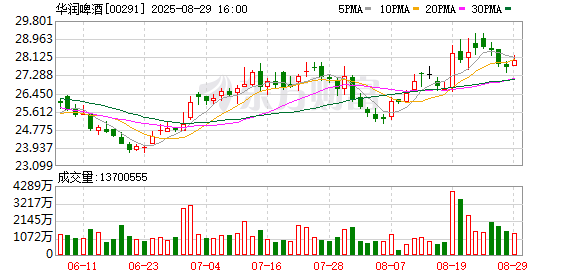
Core Viewpoint - The recent price war among instant retail platforms has led to a significant disruption in the beer market, prompting companies like China Resources Beer to halt sales of certain products in specific regions to stabilize pricing and protect their business model [2][3][4] Industry Overview - The instant retail market in China reached a scale of 650 billion yuan in 2023, with a year-on-year growth of 28.89%, significantly outpacing traditional online retail growth [7] - By 2030, the overall market size of instant retail is expected to exceed 2 trillion yuan, indicating a vast potential for growth and a new competitive landscape for beverage companies [7] Company Actions - China Resources Beer confirmed the suspension of sales for its "Yong Chuang Tian Ya" and "Pure Life" series on instant retail platforms due to price disruptions caused by aggressive competition [2][3] - The company is actively communicating with instant retail platforms to resolve the issues and has resumed sales of certain products, suggesting initial success in negotiations [2] Market Dynamics - The price war has led to a situation where the consumer price for certain products has dropped below acceptable thresholds, causing concerns about market stability and the potential for profit erosion among manufacturers [3][4] - Industry experts highlight that the chaotic competition in instant retail could lead to a decline in product quality and service standards, as companies are forced to absorb high subsidy costs [4][5] Strategic Partnerships - China Resources Beer has established strategic partnerships with major platforms like Alibaba, Meituan, and JD.com, which have become crucial for its online sales, with projections indicating that online business could account for a significant portion of total sales in the near future [6][7] - The collaboration with Meituan's "Yima Songjiu" has been particularly fruitful, with sales on this platform expected to grow significantly in the coming years [6] Future Outlook - Experts suggest that the industry must innovate and adapt to the evolving landscape of instant retail, focusing on product differentiation and enhanced service delivery to meet the demands of younger consumers [7][8] - The need for a balanced approach to pricing and quality control is emphasized, as companies navigate the challenges posed by aggressive competition and strive to build a sustainable market ecosystem [8]

从烟柜到冰柜,便利店的库存正压垮个体老板
虎嗅APP· 2025-08-30 13:32
Core Viewpoint - The retail industry, particularly convenience stores, is facing significant challenges with declining sales and increasing inventory, despite overall market growth in the sector [5][20]. Group 1: Seasonal Performance - The summer season, typically a peak time for sales, has shown disappointing results, with some store owners reporting sales declines of nearly 90% compared to the previous year [6][8]. - Store owners express a sense of hopelessness, often relying on upcoming holidays like the Mid-Autumn Festival and National Day for potential sales recovery [7][8]. - Inventory issues are prevalent, with some store owners holding significant stock that they are reluctant to sell at a loss, leading to increased financial pressure [8][12]. Group 2: Consumer Behavior Changes - Consumers are increasingly price-sensitive, opting for discount stores or online shopping for snacks and beverages, which has led to a decline in in-store purchases [10][14]. - The average transaction size has decreased, with reports of "big orders" becoming rare, indicating a shift in consumer purchasing habits [10][11]. - The overall consumer sentiment is cautious, with many individuals focusing on saving money rather than spending [14][22]. Group 3: Industry Data and Trends - The convenience store sector is experiencing growth in terms of the number of stores, with a reported increase from 182,000 to 196,000 stores in a year, reflecting a 7.7% growth [20]. - Despite the growth in store numbers, the average daily revenue per store has declined by 2.0%, indicating that individual store profitability is under pressure [20]. - The retail environment is characterized by a significant increase in competition, with many new stores opening, leading to market saturation and diluted customer traffic [14][21]. Group 4: Structural Challenges - The convenience store industry is facing structural challenges, including a shift in consumer spending patterns and the rise of online shopping, which has captured over 30% of the market share [22][23]. - Price competition from discount stores is intensifying, with traditional convenience stores unable to match the lower prices offered by these competitors [23][24]. - The need for convenience stores to adapt by offering both convenience and competitive pricing is becoming increasingly critical for survival in the current market [24].

美团和京东拼抢“线下折扣店”,刘强东现身“助阵”
Di Yi Cai Jing· 2025-08-30 12:49
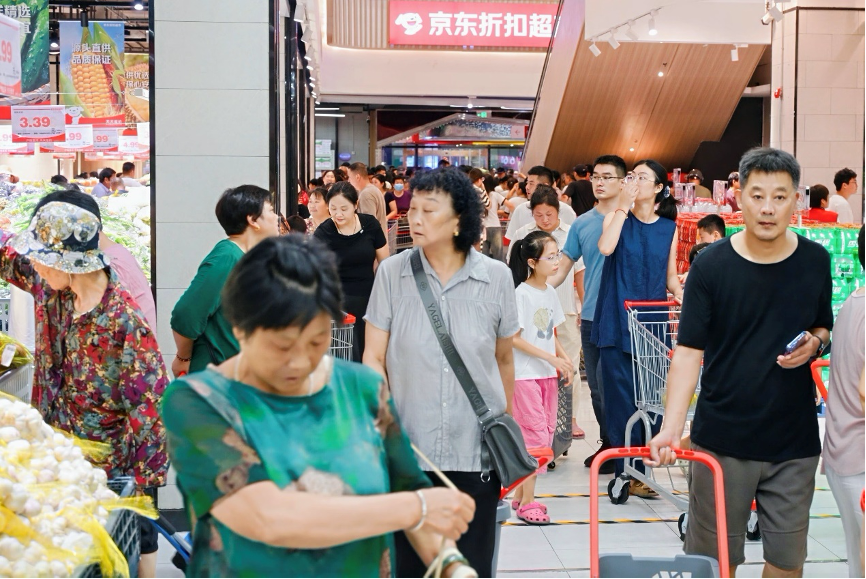
Core Viewpoint - The competition among major internet platforms in the offline discount retail sector is intensifying, transitioning from the previous online food delivery battle [1][3]. Group 1: Company Actions - JD.com opened four discount supermarkets in Suqian, leveraging its supply chain to offer direct-sourced products, eliminating middlemen [1]. - Meituan launched its first self-operated supermarket, Happy Monkey, in Hangzhou, emphasizing affordability [3]. - Hema announced a rebranding to "Super Box Calculation NB" on the same day as Meituan's launch [3]. Group 2: Market Trends - The offline retail landscape has seen a contraction, with the number of top 100 supermarkets in China decreasing by 2,750 stores, a 9.8% year-on-year decline [3]. - The focus of the retail industry is shifting from middle-class consumption to "hard discount" strategies [5]. Group 3: Expert Insights - Experts suggest that the platforms can leverage their proprietary brand development capabilities for differentiated competition in the "hard discount" sector [3][4]. - JD.com's expansion into offline retail is seen as a significant investment rather than a trial, as traditional supermarkets face closures, creating opportunities for online platforms [4]. - The potential for JD.com to open over a hundred discount supermarkets is plausible, depending on the performance of its discount store operations [4]. Group 4: Competitive Landscape - Aldi, a German discount supermarket, has over 50 stores in Shanghai, with a projected 100% year-on-year sales growth and a 10% increase in store count for 2024 [5].


渠道失利 百威亚太营收被华润啤酒反超
Jing Ji Guan Cha Wang· 2025-08-30 12:38
Group 1 - The core viewpoint of the article highlights that Budweiser APAC experienced the largest decline in revenue and net profit among the top six beer companies in China, with decreases of 8.06% and 24.4% respectively [2] - The Chinese beer market is dominated by a few major players, with the top six companies holding over 90% market share for the past three years [2] - Budweiser APAC lost its position as the top revenue earner in the industry to China Resources Beer, with revenues of 22.275 billion and 23.942 billion respectively [2] Group 2 - The Chinese market is crucial for Budweiser APAC, contributing over 70% of its revenue in 2024, but sales volume and net income in the first half of 2025 saw declines of 8.2% and 10.2% year-on-year [2] - The CEO of Budweiser APAC noted that the company's sales in China did not meet industry averages due to weak performance in key markets and channels [2][3] - Budweiser APAC plans to accelerate the expansion of non-drinking channels, which currently account for about 50% of its business in China, compared to the industry average of 60% [4] Group 3 - China Resources Beer has been proactive in adapting to the rise of new retail channels, including e-commerce and instant retail, which are growing rapidly at rates of 30% or higher [5] - The company has established strategic partnerships with major platforms such as Alibaba and Meituan, resulting in significant growth in online and instant retail business, with GMV increasing by nearly 40% and 50% respectively in the first half of 2025 [5]


美团非餐饮即时零售七夕日订单量超2700万
Bei Jing Shang Bao· 2025-08-30 12:06
Core Insights - On August 29, during the Qixi Festival, Meituan's non-food instant retail order volume reached a record high of 27 million, indicating a significant increase in consumer demand during traditional holidays [2][3] - The growth in orders is attributed to a shift in gifting trends towards diversification and quality, with consumers moving from traditional gifts like flowers to a wider range of high-value products [2] - Instant retail has become a crucial growth area for brands and retailers, with over 500 brands experiencing multiple-fold increases in sales on the platform during the Qixi Festival [3] Group 1 - Meituan's instant retail orders on Qixi Festival reached 27 million, marking a significant increase compared to previous years [2] - The platform saw substantial growth in high-value categories such as electronics, beauty products, and jewelry, with sales of electric shavers and children's smartwatches increasing over six times year-on-year [2] - The sales of gold jewelry and pearl accessories also saw significant growth, with gold jewelry sales increasing over six times and pearl sales increasing four times [2] Group 2 - Instant retail is becoming an important business increment for major brands and retailers, with over 500 brands experiencing substantial sales growth on the platform [3] - The trend of gifting has evolved from traditional items like flowers and chocolates to a broader range of products, indicating a shift in consumer behavior [3] - Brands such as Huawei, Sephora, and Watsons reported multiple-fold increases in sales, highlighting the effectiveness of instant retail during festive occasions [3]
Q1财季营销费用增加200亿元!即时零售竞争激烈,阿里大手笔豪赌大消费
Xin Lang Cai Jing· 2025-08-30 11:22
Core Viewpoint - Alibaba's Q1 financial report for the fiscal year 2026 shows a revenue of 247.65 billion yuan, a 2% year-on-year increase, but adjusted EBITA decreased by 14% to 38.84 billion yuan, indicating a shift towards high investment in core businesses like "AI + Cloud" and consumer spending [2][4] Group 1: Financial Performance - Alibaba's free cash flow turned into a net outflow of approximately 18.8 billion yuan, compared to a net inflow of about 17.4 billion yuan in the same period last year, attributed to increased cloud infrastructure spending and investments in Taobao Flash [2] - The adjusted EBITA for Alibaba's China e-commerce group was approximately 38.4 billion yuan, a year-on-year decline of 21%, while sales and marketing expenses rose to 53.18 billion yuan, accounting for 21.5% of revenue, an increase of about 20.4 billion yuan from the previous year [5][6] Group 2: Business Developments - Taobao Flash, Alibaba's instant retail service, achieved a monthly active user count of 300 million, with daily order peaks reaching 120 million and an average daily order volume of 80 million in August [4] - The integration of local life services into Taobao aims to enhance its competitive position against external traffic pressures, consolidating delivery and ride-hailing services [3] Group 3: Cloud Business - Alibaba Cloud's revenue grew by 26% to 33.4 billion yuan, with AI-related product revenue achieving triple-digit growth for the eighth consecutive quarter, and adjusted EBITA also increased by 26% [6][7] - Alibaba plans to maintain a three-year investment plan of 380 billion yuan in AI and cloud infrastructure, with Q1 capital expenditures reaching 38.6 billion yuan [8]

阿里财报亮点:AI+消费战略显成效,淘宝月活激增25%创新高
Sou Hu Cai Jing· 2025-08-30 11:01
Core Insights - Alibaba Group reported a robust performance for the quarter ending June 30, 2025, with a 10% year-over-year revenue growth when excluding specific divested businesses, and a significant 76% increase in net profit, surpassing market expectations [1][2] Financial Performance - Total revenue for the quarter was RMB 247.65 billion (approximately USD 34.57 billion), with a 10% year-over-year growth when excluding disposed businesses [1] - Net income rose to RMB 42.38 billion, reflecting a 76% increase compared to the previous year [2] - Diluted earnings per share increased by 82% to RMB 2.25 [2] - Operating income decreased by 3% to RMB 34.99 billion, primarily due to a reduction in adjusted EBITA [2] Business Segment Performance - Alibaba Cloud showed remarkable growth with a 26% year-over-year revenue increase, marking a three-year high [1] - AI-related product revenue has seen triple-digit year-over-year growth for eight consecutive quarters [1] - The instant retail business contributed to a 25% year-over-year increase in monthly active consumers on the Taobao app during the first three weeks of August [1] Cash Flow and Investments - Net cash flow from operating activities decreased by 39% to RMB 20.67 billion compared to the same quarter last year [3] - Free cash flow experienced a net outflow of RMB 18.81 billion, contrasting with a net inflow of RMB 17.37 billion in the previous year [3] - Total cash and other liquid investments amounted to RMB 585.66 billion as of June 30, 2025 [3] Strategic Focus - The CEO emphasized the focus on consumer and AI + cloud strategies, which have driven strong growth [3] - The CFO highlighted the double-digit revenue growth in core businesses and significant reductions in losses for the AIDC segment, nearing breakeven [3]