
稳定币

Search documents
贵金属日评:美欧达成关税贸易协议,美日达成关税协议提高日本央行加息预期-20250728
Hong Yuan Qi Huo· 2025-07-28 03:29
Report Industry Investment Rating - Not provided in the report Core View - Due to the passage of the US stablecoin - related bill allowing pension funds to invest in gold and other assets, the Trump administration's pressure on Powell increasing the probability of a Fed rate cut in September, continuous gold purchases by global central banks, and unresolved geopolitical risks, the downside space for precious metal prices may be limited. It is recommended that investors mainly lay out long positions on dips. Specific support and resistance levels are provided for London gold, Shanghai gold, London silver, and Shanghai silver [1] Summary by Relevant Data Gold - **Futures Market**: Shanghai gold futures active contract closing price was 777.32 on 2025 - 07 - 21, 778.74 on 2025 - 07 - 25, 781.70 on 2025 - 07 - 24, with a change of - 4.38 compared to a certain reference. Volume decreased from 331217.00 to 216188.00, and open interest decreased by 1605. Inventory (in ten - grams) increased from 29358.00 to 30258.00. COMEX futures active contract closing price was 9392.00 on one date, 9386.00 on another, and 9271.00 on a third, with a change of 6.00. Volume decreased from 1253182.00 to 742060.00, and open interest decreased by 16707. Inventory (in troy ounces) decreased from 37762393.92 to 37143884.29 [1] - **Spot Market**: Shanghai gold spot closing price was 773.61, with a change of - 3.39 compared to a reference. Spot - futures basis was - 3.71 on one date, - 3.64 on another, and - 4.70 on a third, with a change of - 0.07. London gold spot price was 3343.50, 3365.85, and 3318.50 on different dates, with a change of 25.00. SPDR gold ETF holding was 957.09, and iShare gold ETF holding was 449.60 [1] Silver - **Futures Market**: Shanghai silver futures active contract closing price was 9392.00 on one date, 9386.00 on another, and 9271.00 on a third, with a change of 6.00. Volume decreased from 1253182.00 to 742060.00, and open interest decreased by 16707. Inventory (in ten - grams) decreased from 1188721.00 to 1204466.00. COMEX futures active contract closing price was 38.33, 39.29, and 38.44 on different dates, with a change of - 0.11. Volume decreased from 23117.00 to 17478.00, and open interest decreased by 1072. Inventory (in troy ounces) decreased from 3632208.40 to 497804173.90 [1] - **Spot Market**: Shanghai silver spot closing price was 146.00, 9372.00, 9351.00, and 9226.00 on different dates, with a change of 21.00. Spot - futures basis was - 35.00 on one date, 25.00 on another, and - 20.00 on a third, with a change of - 0.07. London silver spot price was 38.74, 39.03, and 37.76 on different dates, with a change of - 0.29. US iShare silver ETF holding was 15230.43, and Canadian PSLV silver ETF holding was 6040.98 [1] Price Ratios - The ratio of Shanghai gold spot price to Shanghai silver spot price was 82.97, 84.32, and 82.76 on different dates, with a change of - 1.55. The ratio of New York gold futures price to New York silver futures price was 87.11, 85.82, and 87.04 on different dates, with a change of 0.07. The ratio of London gold spot price to London silver spot price was 86.32, 86.25, and 87.90 on different dates, with a change of - 1.58 [1] Other Commodities - INE crude oil price was 512.90, 4.00, and 508.90 on different dates, with a change of - 3.90. ICE Brent crude oil price was - 2.05, 68.53, and 67.60 on different dates, with a change of - 0.93. NYMEX crude oil price was 65.07, 66.16, and 66.31 on different dates, with a change of - 1.09. Shanghai copper futures price was 79250.00, 79890.00, and 79700.00 on different dates, with a change of - 450.00. LME copper spot price was 9867.00, - 58.50, and 9796.00 on different dates, with a change of - 71.00. Shanghai rebar price was 3356.00, 3294.00, and 3224.00 on different dates, with a change of 62.00. Dalian iron ore price was 802.50, 811.00, and 809.00 on different dates, with a change of - 8.50 [1] Interest Rates and Exchange Rates - Shanghai inter - bank offered rate (SHIBOR) overnight was 1.52, 1.37, and 1.64 on different dates, with a change of - 0.12. SHIBOR one - year was 1.63, 1.62, and 1.64 on different dates, with a change of 0.01. US 10 - year Treasury nominal yield was 4.4300, 4.4000, and 4.4700 on different dates, with a change of - 0.03. US 10 - year Treasury TIPS yield was 2.0400, - 0.02, and 1.9800 on different dates, with a change of - 0.08. US 10 - year Treasury breakeven inflation rate was 2.4400, 2.4500, and 2.4300 on different dates, with a change of - 0.01. US dollar index was 97.6701, 97.4884, and 98.6419 on different dates, with a change of - 0.97. US dollar - RMB central parity rate was 7.1385, 7.1419, and 7.1522 on different dates, with a change of 0.00. Euro - RMB central parity rate was 8.4077, 8.3228, and 8.4001 on different dates, with a change of - 0.01 [1] Stock Indices - Shanghai Composite Index was 3593.6553, - 12.07, and 3605.7269 on different dates, with a change of 33.86. S&P 500 was 6363.3500, 6388.6400, and 6297.3600 on different dates, with a change of 25.29. UK FTSE 100 was 9120.3100, 9138.3700, and 8972.6400 on different dates, with a change of 147.67. French CAC40 was 7818.2800, 7834.5800, and 7822.0000 on different dates, with a change of 16.30. German DAX was 24217.5000, 24295.9300, and 24370.9300 on different dates, with a change of - 78.43. Nikkei 225 was 41456.2300, 41826.3400, and 39901.1900 on different dates, with a change of - 370.11. South Korean Composite Index was 3192.2900, 3.76, and 3196.0500 on different dates, with a change of 5.60 [1] Important Information - The US and the EU reached a 15% tariff trade agreement, with Trump stating that the EU would increase investment in the US by $600 billion and purchase $750 billion worth of energy products [1] - After the Japan - US agreement, the Bank of Japan may restart interest rate hikes within the year. There are different views on the " $550 billion investment" [1] - The US House of Representatives passed a stablecoin - related bill allowing pension funds to invest in gold and digital currencies. Import tariffs pushed up commodity prices, leading to an increase in the US consumer - end inflation annual rate in June. The initial jobless claims were 217,000, lower than expected. The probability of a Fed rate cut in August increased, but the probability in February decreased [1] - The European Central Bank paused rate cuts in July, keeping the deposit mechanism rate at 2%. The manufacturing PMI in the eurozone, Germany, and France continued to rise in July. The eurozone (Germany) consumer price index annual rate in June was 2% (2%), meeting expectations but higher than the previous value. The market expects the ECB to cut rates about once before the end of 2025 [1] - The Bank of England cut the key interest rate by 25 basis points to 4.25% in May, continuing to reduce government bond holdings from October 2024 to September 2025. The UK consumer price index annual rate in June was 3.68% (3.7%), higher than expected. The manufacturing (service) PMI in July was 48.2 (51.2), higher (lower) than expected. The expectation of a rate cut by the Bank of England in August increased, and it may cut rates 2 - 3 times before the end of 2025 [1] - The Bank of Japan raised the benchmark interest rate by 25 basis points to 0.5% in January and may start reducing quarterly government bond purchases from 400 billion yen to 200 billion yen in April 2026. The core consumer price index annual rate in Japan (Tokyo) in June (July) was 3.3% (2.9%), meeting expectations but lower than the previous value. There is still an expectation of an interest rate hike by the Bank of Japan before the end of 2025 [1] Trading Strategy - Due to the above factors, the downside space for precious metal prices may be limited. Investors are recommended to mainly lay out long positions on dips. The support and resistance levels for London gold are around 3150 - 3250 and 3600 - 3700 respectively, for Shanghai gold around 730 - 760 and 800 - 850, for London silver around 35 - 37 and around 40 - 48, and for Shanghai silver around 8600 - 9000 and 9500 - 10000 [1]
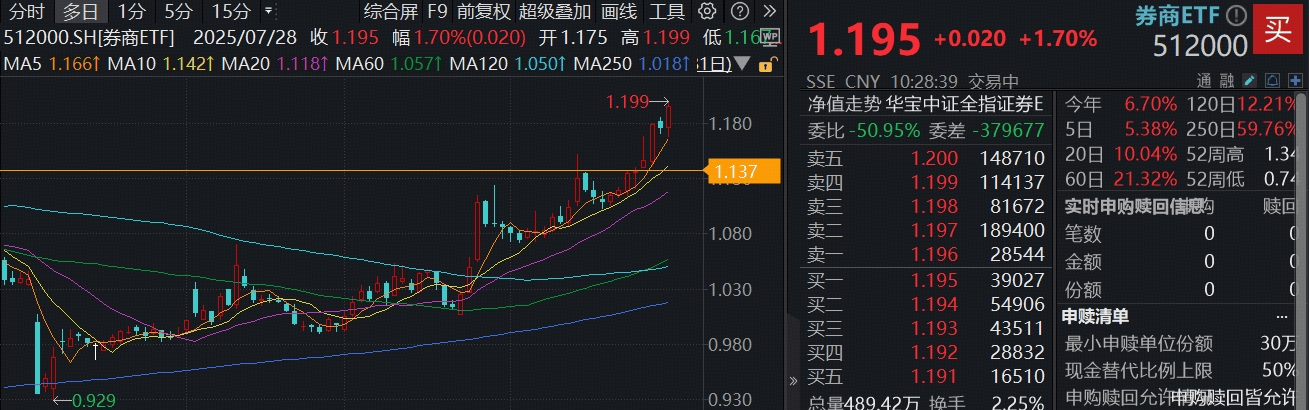
再探年内新高!券商ETF(512000)拉升1.7%,中银证券领涨8%!券商中报超预期,估值低位可关注
Sou Hu Cai Jing· 2025-07-28 03:02
Core Viewpoint - The brokerage ETF (512000) has seen a significant increase in market performance, reaching a near 2% rise and currently up 1.7%, with real-time transaction volume approaching 600 million yuan [1]. Group 1: Market Sentiment and Fund Positioning - Huachuang Securities indicates that the recovery in market sentiment and policies related to virtual assets have led to a marginal increase in public fund holdings in the brokerage sector in Q2, although most of the additional funds are directed towards leading brokerages, leaving the sector underweighted overall [3]. - Multiple listed brokerages have disclosed interim performance forecasts that exceed expectations, suggesting a positive outlook for the sector [3]. Group 2: Investment Recommendations - Minsheng Securities recommends focusing on three main investment opportunities within the brokerage sector: selecting leading brokerages with strong comprehensive capabilities, investing in mid-small brokerages with higher elasticity, and paying attention to financial technology and stablecoin concepts [3]. - The brokerage ETF (512000) and its linked funds track the CSI All Share Securities Company Index, encompassing 50 listed brokerage stocks, with nearly 60% of the portfolio concentrated in the top ten leading brokerages, while the remaining 40% includes mid-small brokerages that exhibit high performance elasticity [3].


香港《稳定币条例》生效在即,机构称蚂蚁集团、京东等大厂有望第一批获得稳定币牌照
Mei Ri Jing Ji Xin Wen· 2025-07-28 03:00
截至7月25日,恒生科技指数ETF(513180)标的指数的最新估值(PETTM)仅21.51倍,处于指数2020 年7月27日发布以来约19.63%的估值分位点,即当前估值低于指数发布以来80%以上的时间。当前指数 仍处于历史相对低估区间,而高弹性、高成长等特性使其具备更大的向上动能。没有港股通账户的投资 者或可通过恒生科技指数ETF(513180)一键布局港股科技龙头。(场外联接A/C:013402/013403) 7月28日,港股三大指数高开高走。盘面上,创新药、稳定币概念股等盘中活跃。A股同赛道规模最大 的恒生科技指数ETF(513180)跟随指数上扬,涨超0.5%,持仓股中,阿里巴巴、腾讯音乐、京东集 团、蔚来、海尔智家(600690)、腾讯控股等涨幅居前。 消息面上,香港《稳定币条例》8月1日生效在即。香港金融管理局计划于本周(7月28日起)公布"稳定 币发行人发牌制度"的摘要说明,申请者将获得更详细的指引,明确稳定币发行人在反洗钱、储备、信 息披露等方面的具体要求。目前,已有三组测试者在稳定币沙盒中,分别是圆币创新科技有限公司;京 东币链科技(香港)有限公司;渣打银行(香港)、安拟集团(Anim ...

兴业银行:要把握数字时代机遇 研究稳定币
news flash· 2025-07-28 02:52
Core Insights - The meeting held by Industrial Bank from July 23 to 25 in Fuzhou focused on leveraging opportunities in the digital era and enhancing confidence to advance towards "smart banking" from "digital banking" [1] Group 1: Strategic Initiatives - The bank aims to research stablecoins as part of its strategy to adapt to the evolving financial landscape [1] - The initiative to implement "Artificial Intelligence +" is intended to enhance operational efficiency and customer service [1] - The promotion of "data elements X" is part of the bank's efforts to improve data utilization and analytics capabilities [1] Group 2: Future Directions - The bank emphasizes the importance of foundational work to support its transition towards smarter operations [1] - The overall goal is to make significant strides in the journey of digital transformation and innovation [1]

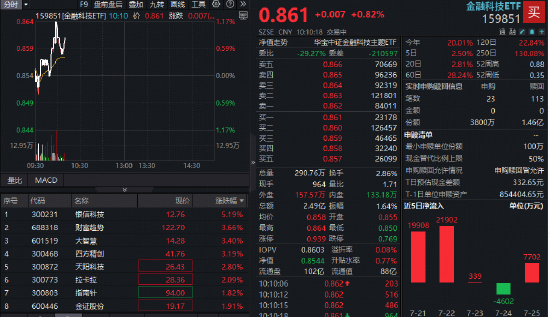
多重概念活跃,金融科技ETF(159851)拉升逾1%!香港稳定币发行“倒计时”,四方精创涨超3%
Xin Lang Ji Jin· 2025-07-28 02:30
7月28日,截至9时59分,金融科技板块表现活跃,中证金融科技主题指数上涨1.11%,金融IT、稳定币 概念、互联网券商等多细分赛道活跃。成份股方面,银信科技上涨超5%,四方精创、财富趋势、大智 慧等纷纷上涨超3%。热门ETF方面,规模、流动性同类断层第一的金融科技ETF(159851)场内价格冲 高逾1%,成交额超2亿元。 多角度把握金融科技机会,建议重点关注金融科技ETF(159851)及其联接基金(A类013477、C类 013478),标的指数全面覆盖了互联网券商、金融IT、跨境支付、AI应用、华为鸿蒙等热门主题。截至 7月23日,金融科技ETF(159851)最新规模超85亿元,近6个月日均成交额超5.5亿元,规模、流动性 在跟踪同一标的指数的3只ETF中断层第一! 数据来源:沪深交易所等。 风险提示:金融科技ETF被动跟踪中证金融科技主题指数,该指数基日为2014.6.30,发布日期为 2017.6.22,该指数2020-2024年年度涨跌幅分别为:10.46%、7.16%、-21.40%、10.03%、31.54%,指数 成份股构成根据该指数编制规则适时调整,其回测历史业绩不预示指数未来表现。文 ...

美股开通流程及费用标准强化XBIT稳定币跨境结算效率提升
Sou Hu Cai Jing· 2025-07-28 02:17
Core Viewpoint - The passage of the GENIUS Act marks a significant regulatory shift for stablecoins in the U.S., establishing a unified framework that enhances transparency and integrates stablecoins into the global dollar clearing network [1][4]. Group 1: Regulatory Developments - The GENIUS Act requires stablecoin issuers to allocate at least 90% of their reserve assets in U.S. dollar cash and short-term U.S. Treasury securities, with monthly audit reports mandated [1]. - Circle announced it will adjust its USDC reserve model to comply with the GENIUS standards, while platforms like Coinbase and Robinhood are removing unregistered stablecoins from their offerings [2]. - The Federal Reserve Chairman emphasized that regulated stablecoins would extend the U.S. dollar settlement system rather than pose a threat, welcoming innovation under controlled risks [2]. Group 2: Market Impact - The global stablecoin payment transaction volume is projected to approach $3 trillion in the first half of 2025, with cross-border business growth exceeding 40% [3]. - Major U.S. brokerages have adopted zero-commission trading policies and streamlined account opening processes, lowering barriers for cross-border capital investment in U.S. assets [3]. - The stablecoin's role is evolving beyond the crypto market, contributing to upgrades in global financial infrastructure for cross-border clearing and asset pricing [2][3]. Group 3: Industry Adaptation - Major Wall Street banks, including Morgan Stanley and Citibank, are developing stablecoin product plans in anticipation of the regulatory framework [4]. - The XBIT decentralized exchange platform is designed to support multi-chain assets and ensure user privacy through on-chain identity protocols, adapting to compliance changes effectively [4]. - The number of global stablecoin-related regulatory updates has surged by 170% year-on-year, indicating a rapid acceleration in the market's compliance practices [5].
下半年超预期机会可能来自“顺周期”!刘煜辉最新交流,详谈稳定币及反内卷
聪明投资者· 2025-07-28 01:55
Group 1 - The core conflict of the current era is the showdown between China's industrial power and the financial power represented by the US dollar, with trade wars and tariff battles being mere surface issues [1][8][20] - The expansion of stablecoins is driven not only by virtual and crypto assets but also by real-world economic and trade dynamics [1][20] - The political will behind the "anti-involution" movement is significant, and its successful implementation could lead to strong upward momentum in cyclical sectors, potentially pushing indices to new heights [1][42] Group 2 - The "Stablecoin Act" passed by the US Congress in May 2024 is seen as a significant attempt at financial restructuring and a self-redemption of the dollar's power [2][5][6] - The core design of stablecoins requires that for every unit issued, there must be an equivalent compliant asset backing it, such as US Treasury bonds, which will increase in demand as the blockchain asset market expands [3][19] - China must adopt a dual approach by not only promoting the digitalization of its currency but also building a market for crypto assets denominated in renminbi to enhance its global financial power [3][21][23] Group 3 - The past two decades have seen a significant rise in China's manufacturing dominance, while the financial power of the US has stagnated, leading to a growing disparity between the two powers [8][10] - The US has attempted to undermine China's industrial power through trade policies, but China's manufacturing output has actually increased by 5 percentage points during this period [9][10] - The future balance between these two powers will depend on how effectively China can elevate the renminbi's status in the global financial system [10][11] Group 4 - The stablecoin act aims to connect the crypto asset market with the fragile US dollar system, attempting to rejuvenate the dollar's credit system to counter China's industrial strength [12][13][20] - The rapid expansion of the blockchain asset market is facilitated by advancements in technology, particularly in AI and distributed ledger systems, which could potentially replace traditional fiat currency mechanisms [15][19] - The global capital market has begun to accept the logic of stablecoin expansion, which is tied to the demand for US Treasury bonds [19][20] Group 5 - The "anti-involution" strategy is positioned as a core economic policy for the second half of the year, aiming to reverse the current deflationary trends in China [30][31][32] - The current deflationary state is characterized by aggressive price competition among manufacturers, which could lead to systemic risks if not addressed [33][34] - The success of the "anti-involution" policy will depend on both supply-side interventions and demand-side stimulus measures to halt the downward price spiral [36][40] Group 6 - The potential for cyclical sectors to gain momentum in the market is significant if the "anti-involution" measures yield positive price effects [42][43] - The current market sentiment reflects skepticism about the effectiveness of these measures, with investors still favoring deflationary assets [41][42] - The complexity of implementing "anti-involution" measures today is greater than a decade ago, as the focus has shifted to final product sectors dominated by private enterprises [39][40] Group 7 - Gold is identified as the best investment asset in the current G2 era, with a strong likelihood of high returns over a longer time horizon [66][68] - The ongoing geopolitical tensions and economic competition between the US and China create a prolonged period of uncertainty, making gold a reliable asset [67][68]
中金:稳定币、金融市场和人民币国际化
中金· 2025-07-28 01:42
Investment Rating - The report does not explicitly provide an investment rating for the stablecoin industry Core Insights - Stablecoins are viewed as a new type of financial infrastructure with the potential to simplify payment processes and enhance the efficiency of financial markets [2][26] - The development of offshore RMB stablecoins is suggested as a priority for China to participate in the stablecoin evolution, while emphasizing that stablecoins are merely a tool for advancing RMB internationalization [1][5] Summary by Sections What are Stablecoins? - Stablecoins are defined as a bridge between the crypto world and the traditional financial system, characterized by a balance of centralization in operation and decentralization in technology [8][9] - They are not considered currency but rather tokens that derive their value from fiat currency reserves [11][12] Recent Attention on Stablecoins - Recent legislative advancements in the US and Hong Kong have heightened interest in stablecoins, alongside significant market events such as Circle's IPO [16][17] - The total market size of stablecoins has surpassed $260 billion, with transaction volumes projected to exceed $15.6 trillion in 2024, surpassing traditional payment platforms like Visa [17][21] Applications and Potential Impact in Financial Markets - Stablecoins enhance payment efficiency, particularly in cross-border transactions, by reducing costs and transaction times compared to traditional systems like SWIFT [40][45] - They also promote financial inclusion, especially in high-inflation economies, by providing a stable asset for savings and transactions [44][46] Impact on the International Monetary System - Stablecoins can increase the penetration of the US dollar while also posing challenges to capital controls in various countries due to their inherent anonymity [4][30] - The rise of stablecoins may lead to increased competition from non-USD stablecoins and central bank digital currencies (CBDCs) [4][5] China's Participation in Stablecoin Development - The report suggests that China should focus on developing offshore RMB stablecoins and creating real-world applications to build a robust ecosystem [5][6] - It emphasizes that the success of RMB as a trusted international currency depends on its legal and functional anchors, rather than solely on stablecoin technology [5][6] Mechanisms and Incentives in the Stablecoin Industry - The stablecoin ecosystem operates on a trust mechanism where the backing of fiat reserves is crucial for maintaining stability and transparency [30][31] - Participants in the stablecoin market, including users, issuers, and custodians, have aligned incentives that drive the ecosystem's growth [31][35] The "Impossible Triangle" of Stablecoins - Stablecoins face a trade-off between price stability, decentralization, and capital efficiency, with most successful stablecoins prioritizing price stability [37][39] - The report highlights that current leading stablecoins are primarily centralized, relying on institutional trust to maintain their value [37][39] Conclusion on Stablecoins as Financial Infrastructure - Stablecoins are positioned as a critical component of the next generation of cross-border digital finance, with the potential to reshape traditional financial systems [26][27] - The report concludes that while stablecoins offer significant advantages, they also introduce new risks and challenges that need to be managed [48][49]
7月28日电,狮腾控股在港交所公告,推出数字金融集团打造亚洲首个多货币、互通稳定币及真实世界资产代币化解决方案生态系统。
news flash· 2025-07-28 00:16
Group 1 - The core viewpoint of the article is that Lion Group has announced the launch of a digital financial group aimed at creating Asia's first multi-currency, interoperable stablecoin and real-world asset tokenization solution ecosystem [1] Group 2 - The initiative signifies a strategic move towards enhancing digital finance capabilities in Asia [1] - The focus on multi-currency and interoperability indicates a response to the growing demand for flexible and integrated financial solutions in the region [1] - The development of real-world asset tokenization solutions could potentially open new avenues for investment and asset management [1]
香港金管局将于本周公布“稳定币发行人发牌制度”的摘要说明;特斯拉机器人即将进入中国市场——《投资早参》
Mei Ri Jing Ji Xin Wen· 2025-07-28 00:04
每经记者|杨建 每经编辑|彭水萍 1、北京时间7月27日,马斯克转发Optimus在好莱坞特斯拉餐厅为顾客递送爆米花的视频,展示其服务 场景应用能力。此前,全球首家特斯拉餐厅Tesla Diner已启用Optimus担任服务生,标志着人形机器人 开始渗透民生服务领域。特斯拉相关人士透露,目前该产品已在美国工厂完成实测,预计2025年面向中 国C端市场推出,2026年实现量产,目标五年内年产百万台。这一消息与近期全球机器人产业动态形成 共振,中国机器人市场正加速从技术突破迈向规模化商用阶段。特斯拉入华将加速中国机器人消费级市 场培育。 点评:特斯拉机器人的技术路径与特斯拉汽车类似,通过高端制造降维打击消费市场。参考特斯拉汽车 在中国市场的渗透率,若Optimus成功落地家庭场景,可能引发服务机器人需求爆发式增长。2025年有 望成为人形机器人开启从0到1阶段的关键时点,尤其是随着宇树、智元等行业头部公司加速推进零部件 性能升级和成本降低,人形机器人产业发展趋势愈发明朗,2025年有望成为行业爆发起点。具身智能作 为人工智能的重要分支,正逐步走向产业应用,推动专用机器人向通用机器人发展。概念股包括东土科 技、汉宇 ...

