AI技术

Search documents
IDC:2025年前三季度全球扫地机器人出货量同比增长18.7%,中国品牌包揽前五
Huan Qiu Wang· 2025-12-05 08:55
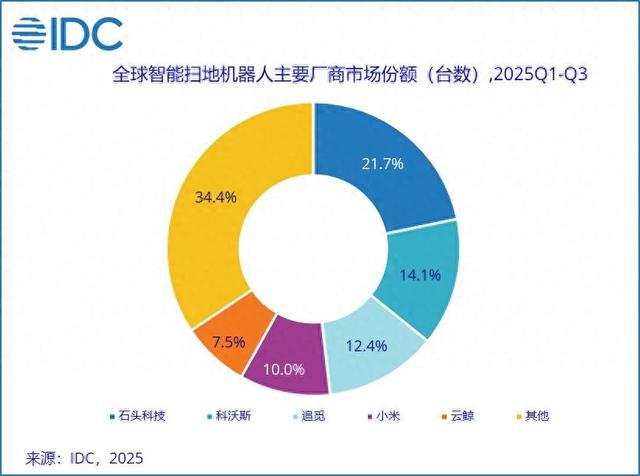
Core Insights - The global smart vacuum cleaner market shipped 17.424 million units in the first three quarters of 2025, representing a year-on-year growth of 18.7% [1] - Chinese manufacturers dominate the global market, with Stone Technology leading in shipments and holding a 21.7% market share [1] Group 1: Market Performance - Stone Technology shipped 3.788 million units in the first three quarters of 2025, maintaining the top position in global shipments [1] - The company has expanded its products to over 170 countries, serving more than 20 million households [3] - In key markets like the US, Germany, and South Korea, Stone Technology ranks first in shipment volume [3] Group 2: Product and Innovation - Stone Technology has enhanced its high-end product line, focusing on ultra-thin designs to address cleaning challenges in low spaces [4] - The company has significantly increased its R&D investment, with R&D expenditure rising from 3.82% to 8.52% of revenue from 2018 to Q3 2025 [4] - The introduction of advanced technologies such as "AI dual-camera vision + 3D structured light" has improved obstacle avoidance and cleaning efficiency [6] Group 3: Future Outlook - The company aims to continue leveraging technological innovation to meet the growing demand for smart home cleaning solutions [7] - Stone Technology plans to deepen its localized operations and enhance product development to drive high-quality industry growth [7]


漫剧满足了群众吃“电子路边摊”的需求
3 6 Ke· 2025-12-05 08:15
Core Viewpoint - The rise of "manhua drama" (漫剧) is rapidly gaining attention, with over 6,000 new releases monthly and a market scale approaching 20 billion, reflecting a shift towards content that caters to the audience's desire for quick, entertaining consumption [1][3][20]. Group 1: Industry Trends - The National Radio and Television Administration has initiated a special governance on substandard animation micro-dramas and short videos, including AIGC and comic-based formats, marking a significant regulatory step [3]. - The demand for "manhua drama" is driven by a growing audience that prefers light, entertaining content, which has become a daily necessity for many [17][20]. - The production of "manhua drama" is less constrained by traditional filming schedules, allowing for quicker releases compared to live-action short dramas, which typically require weeks for production [5][6]. Group 2: Content Characteristics - "Manhua drama" encompasses various forms, including AIGC short dramas, 2D animations, and meme-based animations, allowing for creative freedom that traditional live-action dramas cannot achieve [4][12]. - The genre thrives on themes that are often too risqué or unconventional for live-action adaptations, such as extreme scenarios and fantastical elements, making it a unique visual storytelling medium [8][14]. - The content is characterized by its focus on entertainment value rather than deep emotional resonance, appealing to audiences seeking escapism [19]. Group 3: Market Dynamics - The growth of "manhua drama" is significantly influenced by advancements in AI technology, which have reduced production costs and increased output efficiency, making it an attractive option for creators and investors [15][23]. - Video platforms are leading the charge in promoting "manhua drama," with many introducing dedicated channels and funding initiatives to support content creation [20][23]. - The competitive landscape is evolving, with various platforms, including Baidu and Bilibili, launching initiatives to capitalize on the "manhua drama" trend, indicating a robust market interest [23][25].

虎牙公司:垂类AI深耕与数字产业价值重构
Huan Qiu Wang Zi Xun· 2025-12-05 07:36
Core Insights - The article highlights how Huya is leveraging AI technology to enhance the esports experience, focusing on "vertical deepening" to overcome the limitations of general AI [1][8] - Huya has developed two key products, "Tiger Xiao Ai" and "Huya i Super Body," which create a comprehensive technology system covering intelligent interaction and hardware development [1][8] Group 1: Tiger Xiao Ai - Tiger Xiao Ai has achieved full-cycle empowerment for esports live streaming, integrating real-time AI-generated content into the broadcast [2][4] - During the "League of Legends Legend Cup S3," Tiger Xiao Ai increased user interaction rates in live streams by 47% compared to conventional broadcasts [1][4] - The AI acts as a "strategy microscope" during pre-game phases, a "tactical prophet" during matches, and a "professional coach" during post-game analysis, enhancing viewer engagement [4][8] Group 2: Huya i Super Body - Huya i Super Body is the world's first desktop-level intelligent robot for esports teams, launched in collaboration with Yingzhi Technology, and has garnered significant attention at the 2025 ChinaJoy event [5][7] - The robot integrates advanced software capabilities, including real-time game guidance and emotional recognition, to provide a more immersive user experience [7][8] - It features a modular design that allows for personalized configurations and utilizes AI to create emotional connections with users, enhancing the overall interaction [7][8] Group 3: Industry Impact - Huya's AI practices set a benchmark for digital industry innovation by focusing on specific esports needs rather than competing in the general AI space [8] - The combination of virtual intelligence and physical hardware creates a new ecosystem that enhances both online and offline interactions in esports [8] - The successful integration of AI technology into the esports industry demonstrates the importance of deep coupling between technology and specific market demands to build differentiated barriers and sustainable value [8]


2025-2027年全球经济展望报告:10大核心关切问题解析
Sou Hu Cai Jing· 2025-12-05 06:52
Economic Outlook - The global economy is entering a mild stagflation phase, with growth expected at 2.7% in 2025 and inflation at 3.9% [1] - Major economies like the US and UK are experiencing inflation rates above targets, while the Eurozone is gradually returning to normal [1] - Global trade growth is projected to slow from 2% in 2025 to 0.6% in 2026, with significant impacts on GDP for exporting countries [5] Central Bank Policies - Central banks are facing challenges of weak growth, persistent inflation, and rising fiscal deficits, leading to a divergence in monetary policies [7] - The Federal Reserve is expected to cut rates to a terminal range of 3.25-3.50% by mid-2026, while the European Central Bank will maintain stable rates [7] - The Bank of Japan is anticipated to continue raising rates towards 1.0% due to high core inflation [7] Trade and Investment - The ongoing trade war is primarily impacting exporters, with US consumers facing inflation increases of 0.6 percentage points by mid-2026 [5] - Foreign Direct Investment (FDI) pledges in the US could reach 6% of GDP by 2026-2028, indicating significant costs for source countries [5] - The EU's "Rearm Europe Plan" allocates EUR800 billion over four years for military procurement, but production constraints may hinder rapid capacity increases [11] Corporate Financing - Companies are adapting to high financing costs by enhancing operational efficiency, renegotiating contracts, and exploring alternative financing sources [12] - Despite lower policy rates, corporate loan demand remains muted in the Eurozone, while the US sees an increase in corporate loans [12] - A peak in global business insolvencies is expected in 2027, with increases of 6% and 4% in 2025 and 2026, respectively [13] Emerging Markets - Emerging markets are experiencing rising imbalances, with some countries facing debt and current account deficit risks [15] - Asian exporters are gaining market shares in the US, but the economic outlook is turning grim, leading to accelerated policy rate cuts in many emerging markets [15] - The Chinese economy is expected to slow down into 2026 due to contracting exports and soft domestic demand [15] Risks and Uncertainties - Heightened protectionism poses a 45% probability of leading to a global trade recession, negatively impacting growth and inflation [16] - A potential de-dollarization shock could push the EUR/USD above 1.25, with a 35% probability [16] - Geopolitical tensions, including conflicts involving NATO and Russia, as well as China and Taiwan, present significant risks to the economic outlook [16]
锐世医疗落子东莞,全数字PET技术重构湾区医疗影像产业链
2 1 Shi Ji Jing Ji Bao Dao· 2025-12-05 06:01
Group 1 - The core viewpoint of the article highlights the strategic establishment of Ruisi Medical in Dongguan, leveraging the city's innovative environment to enhance the high-end medical equipment industry through its proprietary digital PET technology [1][2]. - Dongguan is characterized as a vibrant market with over 1.8 million market entities and a strong industrial ecosystem, providing a conducive environment for the development of AI technologies and related industries [2]. - Ruisi Medical's digital PET technology is positioned as a significant advancement in precision medicine, with the company holding the largest number of patents globally in this field, indicating its leadership in the industry [2][3]. Group 2 - Ruisi Medical has developed a diverse product line, including seven PET/CT devices and one brain-specific PET device, making it one of the most comprehensive manufacturers of PET equipment in China [3]. - The DigitMI 930, a fully digital PET/CT developed by Ruisi Medical, received regulatory approval in 2022 and is noted for its rapid imaging capabilities, completing scans in as little as 20 seconds, which is the fastest globally [3]. - The company aims to deepen its core research and promote the large-scale implementation of its products, addressing critical challenges in high-end medical devices and making advanced technology accessible to the public [3].
IDC:前三季度全球智能扫地机器人市场累计出货1742.4万台 同比增长18.7%
智通财经网· 2025-12-05 05:45
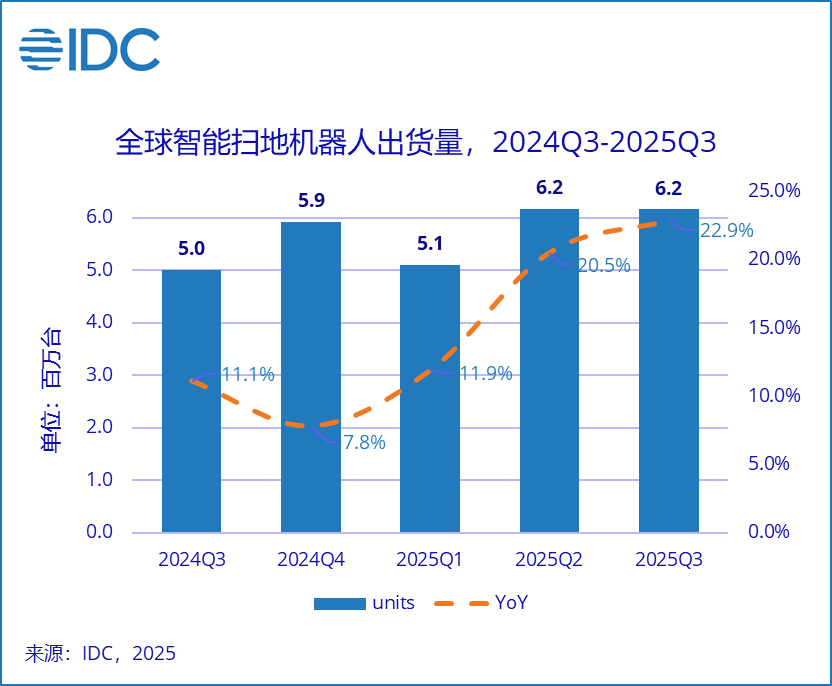
Global Market Overview - The global smart vacuum cleaner market shipped a total of 17.424 million units in the first three quarters of 2025, representing a year-on-year growth of 18.7%, with 6.161 million units shipped in Q3 alone, marking a 22.9% increase [1] - The Middle East, Africa, and Europe have emerged as key growth drivers for the industry [1] Company Performance - Stone Technology (688169.SH) led the global shipment with 3.788 million units in the first three quarters, showing strong performance in the U.S., Germany, South Korea, and Turkey, where it maintained the top position [4] - Ecovacs (603486.SH) shipped 2.453 million units in the first three quarters, achieving a year-on-year growth of 27.7%, and retained the top position in the Chinese market [5] - Dreame ranked first in the European market in the first three quarters, with a market share of 26.8% in Western Europe, although it faced a noticeable decline in its domestic market share [6] - Xiaomi (01810) continues to focus on mid-range value-for-money products while expanding into high-end product lines, performing well in domestic and Asia-Pacific markets [7] - Yunji's global shipment volume ranked among the top five, with significant growth in the U.S. and Asia-Pacific markets, while maintaining a 16.2% market share in the domestic market [8] Chinese Market Insights - The Chinese smart vacuum cleaner market shipped 4.63 million units in the first three quarters, with a year-on-year increase of 27.2%, indicating sustained industry growth [10] - Despite fluctuations in national subsidy policies, leading manufacturers have effectively countered these impacts through product upgrades and AI integration, maintaining steady market growth [10] - The market is experiencing increased competition, with DJI entering the market in August and ranking sixth in shipments, adding new competitive dynamics [10] - The industry faces significant inventory pressure, posing challenges for manufacturers in inventory turnover, profit management, and future product planning [10] Industry Trends - IDC's senior analyst Zhao Siquan noted that the robust growth of the global vacuum cleaner market is attributed to continuous product iteration by Chinese manufacturers, enhanced channel operations, and deepened market demand [11] - Future competition in the industry is expected to escalate, focusing on AI technology empowerment and home ecosystem collaboration, with technological innovation and ecosystem integration becoming key for companies to stand out [11]

中国扫地机器人霸榜全球:石头科技登顶,大疆跨界入局
Feng Huang Wang· 2025-12-05 05:40
Core Insights - The global smart vacuum cleaner market is expected to maintain strong growth, with a significant reshaping of the competitive landscape by 2025 [1][2] - All top five global vendors in terms of shipment volume are Chinese brands, indicating China's leading position in supply chain and technology in this sector [1] Group 1: Market Performance - In the first three quarters of 2025, the global smart vacuum cleaner market shipped a total of 17.424 million units, representing a year-on-year growth of 18.7% [1] - The third quarter alone saw shipments of 6.161 million units, with a year-on-year increase of 22.9% [1] - The Middle East, Africa, and Europe are identified as key growth engines driving the industry's expansion [1] Group 2: Company Performance - Roborock ranked first globally with cumulative shipments of 3.788 million units in the first three quarters, focusing on low-profile cleaning solutions [1] - Ecovacs achieved cumulative shipments of 2.453 million units, marking a year-on-year growth of 27.7%, and is accelerating its international expansion [1] - Dreame performed notably in the European market, holding a 26.8% shipment share in Western Europe, although it faced a decline in domestic market share [1] Group 3: Market Trends and Challenges - Xiaomi is performing well in the Asia-Pacific market due to its mid-range value-for-money strategy and ecosystem advantages [2] - The Chinese market saw shipments of 4.63 million units in the first three quarters, with a year-on-year increase of 27.2% [2] - DJI has entered the vacuum cleaner market, quickly becoming the sixth largest player in China, introducing new competition and uncertainty [2] - The industry faces challenges with high inventory pressure, impacting manufacturers' inventory turnover, profit management, and future product strategies [2]

“中式面馆第一股”挂牌,遇见小面计划将6成募资用于拓展门店
Xin Jing Bao· 2025-12-05 05:33
Core Viewpoint - The company "Yujian Xiaomian" officially listed on the Hong Kong Stock Exchange, becoming the first Chinese noodle restaurant stock, with an initial share price of HKD 7.04, but it opened at HKD 5, reflecting a significant drop of 28.98% on the first day of trading [1] Group 1: Company Overview - Yujian Xiaomian was founded in Guangzhou in 2014, specializing in Chongqing noodles, and offers a range of products including noodles, rice, snacks, and beverages [1] - The company has received multiple rounds of financing, with shareholders including Jiumaojiu, Baifu Holdings, and the founder of Xijia De, among others [1] Group 2: Restaurant Network and Expansion Plans - As of November 18, 2025, Yujian Xiaomian operates 451 restaurants in 22 cities in mainland China and 14 in Hong Kong, with an additional 115 restaurants in preparation [2] - The company plans to open 1-2 new direct-operated restaurants in Singapore by December 31, 2025, and aims to establish 150-180, 170-200, and 200-230 new direct-operated and franchised restaurants in 2026, 2027, and 2028, respectively [2] Group 3: Financial Performance - Revenue increased from CNY 418 million in 2022 to CNY 1.154 billion in 2024, with CNY 703 million in revenue for the first half of 2025 [2] - Net profit rose by 32.2% from CNY 45.91 million in 2023 to CNY 60.70 million in 2024, and increased by 95.8% from CNY 21.37 million in the first half of 2024 to CNY 41.83 million in the first half of 2025 [2] Group 4: Consumer Behavior and Pricing Strategy - The average order value for direct-operated stores decreased from CNY 36.2 in 2022 to CNY 32.1 in 2024, while franchise stores saw a similar decline [3] - The decrease in average order value is attributed to the company's strategy of lowering menu prices to attract customers and increase overall sales [3] Group 5: Use of Proceeds from IPO - Approximately 60% of the net proceeds from the global offering will be used to expand the restaurant network, enhance geographical coverage, and deepen market penetration [3] - Funds will also be allocated for upgrading technology and digital systems across the restaurant network, including the adoption of AI, IoT systems, and big data analytics to support operational growth [3]
亚马逊,战略公布
Xin Lang Cai Jing· 2025-12-05 05:27
Core Insights - Amazon's Global Selling has launched the "Next Generation Global Selling" initiative to support Chinese export e-commerce businesses in achieving high-quality global expansion by 2026 [1][11] - The initiative focuses on four strategic areas: AI-driven product innovation, exploring new growth territories, reshaping global cross-border logistics, and local support for cross-border collaboration [1][11] Group 1: Value Transition in Cross-Border E-Commerce - Cross-border e-commerce is experiencing three significant value transitions: supply chain management is shifting from a cost center to a growth engine, competitive advantages are moving from sales-driven to value-driven, and sellers' organizational capabilities are evolving from regional specialists to global multi-specialists empowered by AI [3][13] Group 2: Next Generation Global Selling Framework - The "Next Generation Global Selling" framework allows export e-commerce businesses to list products once on Amazon and achieve global sales, covering stages from global launch to optimization and deepening logistics solutions [5][15] - The framework includes a global smart hub warehouse (GWD) launched in Shenzhen, set to open in March 2026, enhancing Amazon's supply chain solutions [5][16] Group 3: Logistics and Global Expansion - Amazon Global Logistics (AGL) is expanding its global shipping routes, adding Vietnam as a key hub for Southeast Asia, with plans to extend services to Canada and Australia by 2026 [7][18] - The launch of the "Next Generation Global Selling" coincides with the 25th anniversary of Amazon's third-party seller business and the 10th anniversary of its Global Selling operations in China, marking a new phase for sellers to achieve global sales upon listing [7][18] Group 4: AI Integration and Seller Support - Amazon introduced groundbreaking Agentic AI innovations and a new seller platform aimed at transforming how sellers manage their businesses on Amazon, simplifying tasks and predicting seller needs [8][19] - The Amazon Seller Assistant will integrate features to provide insights into business opportunities, customized suggestions, and an overview of seller performance across global sites [8][19] Group 5: Local Services and Market Growth - Amazon has opened over 20 international sites for Chinese sellers and announced new seller incentive programs in Mexico and Brazil, offering initial sales rewards and benefits for Prime member products [9][20] - Data indicates that by October 2025, sales from Chinese sellers on Amazon's mature sites will have grown over 15% year-on-year, with emerging sites seeing over 30% growth [9][20] Group 6: Performance Metrics - From early 2025 to September, the number of new product listings by Chinese sellers increased by nearly 25%, with significant growth in the number of sellers achieving sales milestones of $200 million, $500 million, and $800 million, all exceeding 20% year-on-year [10][21]


卢伟冰:小米汽车出海首站欧洲市场是全球汽车最难的市场|首席资讯日报
首席商业评论· 2025-12-05 04:14
Group 1 - Xiaomi's first overseas market for its automotive venture is Europe, which is considered the most challenging market globally. The company aims to establish a foothold in this difficult market before expanding to others [2] - Xiaomi's president, Lu Weibing, emphasized the importance of learning from Germany's mature automotive industry during his recent visit [2] Group 2 - Bojie Co., Ltd. reported ongoing collaborations with a major client in robotics and automotive sectors, including testing and assembly of vehicle components [3] - The company is also developing electronic skin testing devices, currently in the experimental phase [3] Group 3 - Eight e-commerce platforms, including JD.com and Meituan, signed a commitment to regulate AI technology applications to address misuse risks and maintain order in the live-streaming industry [4][5] - The commitment includes six key measures to establish self-regulatory norms for AI technology in e-commerce [5] Group 4 - Tencent announced the winter testing recruitment for its auto chess game "King of Glory Chess," which will be a large-scale non-billing test [6] Group 5 - The Chinese esports industry is projected to generate revenues of 29.331 billion yuan by 2025, maintaining its position as the largest esports market globally [7] Group 6 - Hong Kong Investment Management Company reported total assets of 64.007 billion HKD and an investment income of 2.345 billion HKD for 2024, with a significant focus on hard technology investments [11] Group 7 - Alibaba's first talent apartment officially opened in Nanjing, offering 565 rooms with various layouts and rental discounts for local youth [12] Group 8 - The General Administration of Sport of China is reforming the professional league system to enhance market-oriented and public welfare development, aiming for a balanced competitive environment [13] - The number of second-hand residential transactions in first-tier cities reached 49,033 in November, marking a seven-month high and a 20% month-on-month increase [14]