
商业航天

Search documents
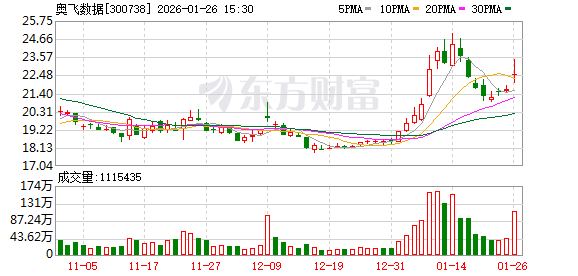
奥飞数据:公司业务暂未涉及商业航天和卫星导航领域
Zheng Quan Ri Bao· 2026-01-26 11:09
Group 1 - The company, AoFei Data, has stated that its business does not currently involve the commercial aerospace and satellite navigation sectors [2] - The company does not hold any shares in Blue Arrow Aerospace [2]


贵金属延续新高
Tebon Securities· 2026-01-26 11:07
Market Analysis - A-share market showed mixed performance with the Shanghai Composite Index closing at 4132.61, down 0.09%, while the Shenzhen Component Index fell 0.85% to 14316.64[2] - Total market turnover increased to 3.28 trillion yuan, up 5.2% from the previous trading day, marking the second consecutive day above 3 trillion yuan[2] Precious Metals Performance - Precious metals led the market with the gold jewelry index rising 7.08%, and international spot gold surpassing 5100 USD/oz, reaching a historical high[5] - Silver futures prices climbed to 100 USD/oz, contributing to rapid valuation recovery in the industry chain[5] Commodity Market Trends - The Nanhua Commodity Index closed at 2829.85, up 1.59%, with silver leading gains at 12.78%, platinum up 9.68%, and gold rising 3.67%[7] - Energy and shipping sectors also saw gains, with fuel prices increasing by 6.81%[7] Bond Market Insights - The bond futures market showed mixed results, with the 30-year contract (TL2603) rising 0.20% to 112.51 yuan, while the 10-year contract (T2603) fell 0.02% to 108.18 yuan[7] - The central bank conducted a net withdrawal of 207.8 billion yuan, indicating a tightening liquidity environment[7] Investment Recommendations - Focus on sectors such as photovoltaic, commercial aerospace, and precious metals, while being cautious of speculative risks in concept stocks[7] - Monitor upcoming performance forecasts and the impact of the Federal Reserve's meeting on January 28[13]
任泽平:中国商业航天深度报告
Sou Hu Cai Jing· 2026-01-26 11:05
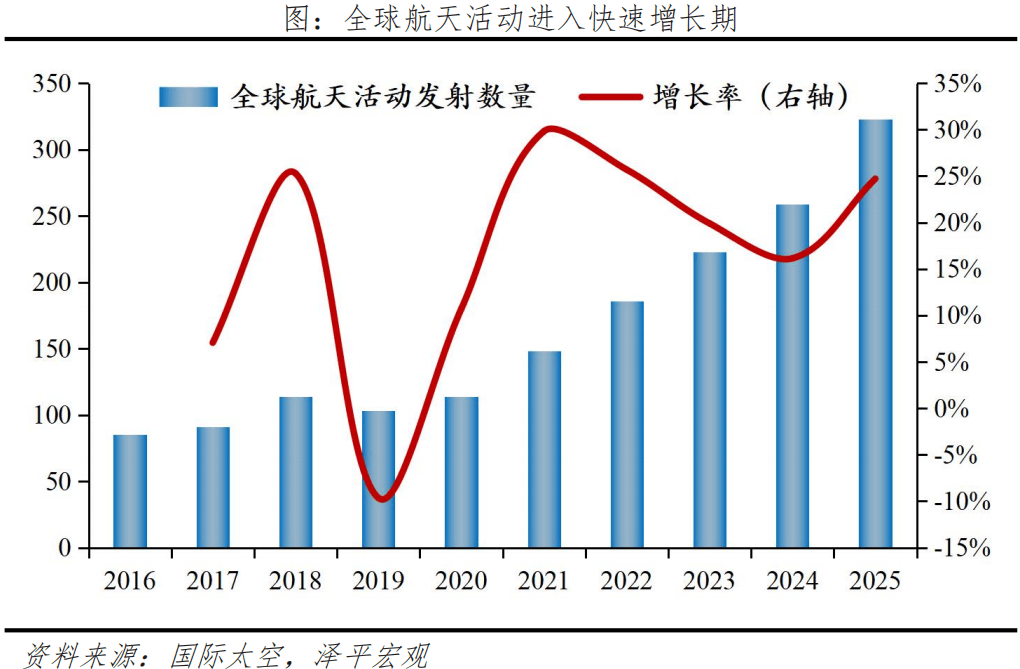
Core Insights - China's commercial space industry is accelerating rapidly, with significant advancements in launch capabilities, recovery technologies, and satellite internet infrastructure [1][2][3] Group 1: Industry Growth and Achievements - Global space launches reached a record high of 337 in 2025, a 28% increase from 263 in 2024, with a success rate of approximately 97% [6][1] - China submitted an unprecedented application for over 203,000 satellite frequency resources, marking a transition from technology validation to large-scale network deployment [1][2] - The establishment of the Commercial Space Administration in November 2025 signifies the elevation of commercial space from pilot projects to a national strategic level [2][10] Group 2: Technological Breakthroughs - The Long March 12 rocket successfully launched as the first 4-meter-class commercial rocket, enhancing low Earth orbit capacity [1][2] - The Zhuque-3 rocket completed a vertical takeoff and landing test, indicating maturity in private recovery technology [1][2] - The use of reusable rocket technology and 3D printing is identified as key cost-reduction strategies, with launch costs decreasing from 115,000 yuan/kg in 2020 to 75,000 yuan/kg in 2024 [19][1] Group 3: Future Applications and Market Potential - The low Earth orbit satellite internet market is projected to be a trillion-dollar opportunity, with SpaceX's Starlink service enabling direct mobile phone connectivity to satellites [26][29] - The potential for deploying AI data centers in space is emerging, leveraging the unique environmental advantages of space for energy efficiency and cooling [35][38] - The commercial space sector is expected to drive significant changes in global communication infrastructure, with low Earth orbit satellites providing coverage for areas lacking terrestrial networks [31][32]
瑞华泰:公司在航天领域的业务多体现为项目合作研发模式,营收占比不足1%
Xin Lang Cai Jing· 2026-01-26 10:37
Group 1 - The core business of the company is the research, production, and sales of high-performance polyimide films [1] - The company is currently engaged in project cooperation and research and development in the aerospace sector [1] - By 2025, the revenue from the aerospace segment is projected to be approximately 1.8 million yuan, accounting for less than 1% of total revenue (unaudited) [1]

8.82亿元资金抢筹网宿科技, 化工ETF连续两周份额大增!
摩尔投研精选· 2026-01-26 10:35
Core Viewpoint - The article highlights the trading activities in the Shanghai and Shenzhen stock markets, focusing on the top traded stocks, sector performances, and ETF transactions, indicating significant capital flows and investment trends in various sectors [1][6][13]. Group 1: Stock Market Trading - The total trading volume of the Shanghai and Shenzhen Stock Connect reached 404.116 billion, with Zijin Mining and Zhongji Xuchuang leading in trading volume for the Shanghai and Shenzhen markets respectively [1]. - The top ten stocks traded on the Shanghai Stock Connect included Zijin Mining (4.857 billion), China Ping An (1.981 billion), and Cambricon Technologies (1.922 billion) [4]. - The Shenzhen Stock Connect's top traded stocks were led by Zhongji Xuchuang (3.650 billion), followed by CATL (3.503 billion) and Xinyisheng (2.747 billion) [5]. Group 2: Sector Performance - The securities sector saw the highest net inflow of capital, amounting to 4.326 billion, with a net inflow rate of 7.63% [7]. - Other sectors with significant net inflows included non-bank financials (4.231 billion), pharmaceuticals (3.102 billion), and banking (2.251 billion) [7]. - Conversely, the electronic sector experienced the largest net outflow, totaling -26.236 billion, indicating a negative sentiment in this area [8][9]. Group 3: ETF Transactions - The chemical ETF (159870) saw a substantial increase in shares, with a growth of 6.3155 billion shares last week, leading the market [16]. - The top ten ETFs by trading volume included the Huashang 300 ETF (510300) with a trading amount of 28.0024 billion, followed by the Huashang 300 ETF (510310) at 22.6808 billion [14]. - The gold stock ETF (517400) recorded a remarkable increase of 159.66% in trading volume compared to the previous trading day, indicating strong investor interest [15]. Group 4: Institutional and Retail Activity - Institutional investors were active, with notable purchases in Wangsu Technology (1.705 billion) and other stocks, reflecting a bullish sentiment [10]. - Retail investors, particularly from major brokerage firms, showed significant activity in stocks like Wangsu Technology, indicating a trend towards speculative trading [22]. - Quantitative funds also participated actively, with substantial purchases in Wangsu Technology (2.06 billion), showcasing a diversified investment approach [23].


智能制造行业周报:SpaceX推进星链升级与IPO进程
Shanghai Aijian Securities· 2026-01-26 10:25
Investment Rating - The mechanical equipment industry is rated as "stronger than the market" [5][29]. Core Views - SpaceX is advancing its Starlink system upgrade and capacity enhancement, with plans to launch a second-generation Starlink system in 2027, aiming to reduce the cost per pound to below $100 [2]. - The capital preparation for SpaceX's IPO is underway, with an estimated valuation of approximately $800 billion [2]. - The PCB equipment sector is highlighted, with recommendations for companies such as Chipbond Technology (688630), Dongwei Technology (688700), and Dazhu CNC (301200) [2]. - The chip manufacturing and packaging technology is evolving towards thinner substrates and finer lines, with high-end PCBs transitioning to "packaging substrate" roles [3]. - The humanoid robot sector is recommended, focusing on core companies in the T-chain, with significant exposure expected from partnerships with major events [3]. - The controlled nuclear fusion sector is also recommended, with expectations of increased procurement and investment in related projects [4]. Summary by Sections Mechanical Equipment Industry - The mechanical equipment sector saw a weekly increase of 2.57%, outperforming the Shanghai and Shenzhen 300 index, which decreased by 0.62% [5][6]. - The best-performing sub-sector was abrasives, with an increase of 8.58% [8]. Commercial Aerospace - Companies to watch include Yingliu Co., Ltd. (603308), Srey New Materials (688102), West Materials (002149), and Shanghai Hanxun (300762) [5]. PCB Equipment - Strong demand for high-end LDI equipment from Chipbond Technology, with high capacity utilization and ongoing deliveries to major clients [3]. - Dongwei Technology is making progress in the HDI and mSAP fields, with advanced plating needs expected to become a significant growth source [3]. Humanoid Robots - The upcoming mass production of Optimus V3 is anticipated to drive focus on core enterprises within the T-chain [3]. - Partnerships with major events are expected to catalyze growth in the robotics sector [3]. Controlled Nuclear Fusion - The BEST project is accelerating procurement, with a budget of 45 million yuan for superconducting wire materials [4]. - The annual procurement plan for fusion projects is expected to exceed 10 billion yuan, indicating strong order potential [4].
尾盘异动!601899,现巨额压单!
证券时报· 2026-01-26 10:23
Core Viewpoint - The A-share market experienced fluctuations with significant movements in various sectors, particularly in precious metals and biotechnology, while the commercial aerospace sector faced a sharp decline [1][12]. Group 1: A-share Market Overview - The Shanghai Composite Index closed at 4132.61 points, down 0.09%, while the Shenzhen Component and ChiNext Index fell by 0.85% and 0.91%, respectively [1]. - A total trading volume of approximately 3.28 trillion yuan was recorded, an increase of over 160 billion yuan from the previous day [1]. - Over 3700 stocks in the A-share market closed in the red, with notable declines in the commercial aerospace and semiconductor sectors [1]. Group 2: Precious Metals Sector - The precious metals sector showed strong performance, with silver and gold stocks gaining significantly. Silver Youse rose to a 5-day limit, while companies like Hunan Gold and Zhaojin Gold also hit the limit [3][4]. - Spot gold prices reached a historic high of $5100 per ounce, driven by factors such as moderate U.S. inflation data and geopolitical uncertainties [5]. - Institutional analysis indicates that the ongoing rise in gold prices is supported by increased investment demand and central bank purchases, suggesting a robust long-term outlook for gold and silver [5]. Group 3: Biotechnology Sector - The biotechnology sector saw a surge, with companies like Hualan Biological and Jindike hitting the 20% limit, and others like Zhifei Biological rising nearly 15% [7][8]. - The rise in the sector is partly attributed to the emergence of the Nipah virus in India, prompting increased demand for related testing products [9][10]. Group 4: Commercial Aerospace Sector - The commercial aerospace sector experienced a significant drop, with companies like Shaoyang Hydraulic and Haoshi Electromechanical falling by approximately 14% [12]. - China Satellite issued a risk warning, indicating that its stock price had risen significantly without fundamental changes, highlighting the risks of market speculation [12][14].


猜想谁是2026年"易中天"系列——国博电子
Ge Long Hui A P P· 2026-01-26 10:21
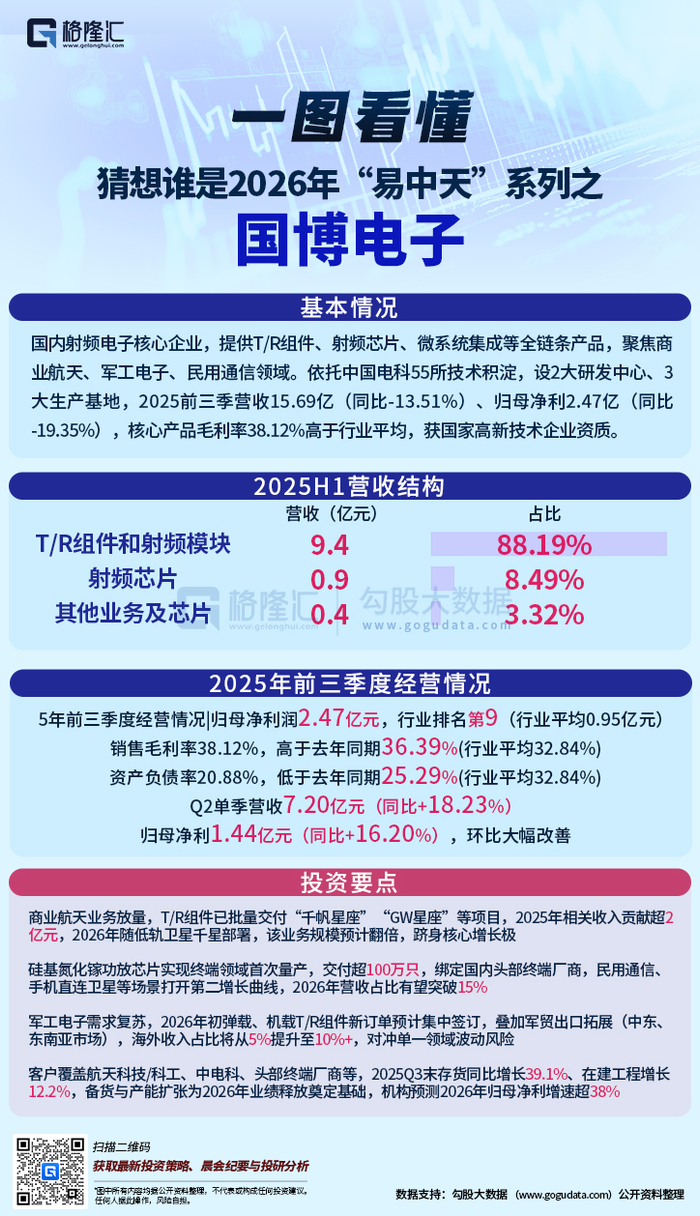
Core Viewpoint - The commercial aerospace industry is entering a critical fulfillment period in 2026, with a significant demand surge for satellite T/R components as companies like China Star Network must complete their satellite deployments by the end of the year [1][6] Group 1: Company Performance - GuoBo Electronics reported revenue of 1.569 billion yuan and a net profit of 247 million yuan in the first three quarters of 2025, showing a narrowing decline compared to 2024, with an improved gross profit margin [1] - The company has a strong financial health with a debt-to-asset ratio of only 20.88%, and an inventory turnover rate of 2.70 times, indicating improved operational efficiency [11] Group 2: Market Opportunities - The demand for satellite T/R components is expected to explode as the industry approaches the 2027 deadline for low-orbit satellite frequency resource fulfillment [6] - The application of silicon-based gallium nitride technology is expanding, particularly in mobile direct satellite communication scenarios, creating growth opportunities for upstream suppliers [1][8] Group 3: Competitive Advantages - GuoBo Electronics possesses a unique "chip + component + microsystem" full-stack layout, with T/R components meeting international advanced standards, providing a significant technological barrier against competitors [12] - The company has established a diverse growth matrix that includes commercial aerospace, military electronics, and emerging scenarios, ensuring both short-term performance resilience and long-term growth potential [9] Group 4: Future Outlook - The company is expected to see substantial revenue and net profit improvements as the commercial aerospace fulfillment peak arrives in 2026, with current valuations not fully reflecting the industry benefits and technological barriers [13] - Long-term, the commercial aerospace sector aligns with national strategic directions, and GuoBo Electronics is positioned as a core player in the RF segment, benefiting from industry growth and expanding applications of silicon-based gallium nitride in various fields [14]

瑞华泰(688323.SH):在航天领域的业务多体现为项目合作研发模式,该板块占总营业收入比例不足1%
Ge Long Hui A P P· 2026-01-26 10:19
Core Viewpoint - The market is currently focused on the commercial aerospace sector, with the company primarily engaged in the research, production, and sales of high-performance polyimide films [1] Company Overview - The company's main business involves high-performance polyimide film, with a small portion of revenue coming from aerospace-related projects, expected to generate approximately 1.8 million yuan in 2025, accounting for less than 1% of total revenue (unaudited) [1] Stock Performance - Since January 1, 2026, the company's stock has seen a cumulative increase of 38.12%, with a notable rise of 44.00% over the last two trading days [1] - The short-term stock price increase has significantly outpaced the growth of the Sci-Tech Innovation Index, the Sci-Tech 50, and the industry average, indicating potential short-term pullback risks [1]
瑞华泰:在航天领域的业务多体现为项目合作研发模式,该板块占总营业收入比例不足1%
Ge Long Hui· 2026-01-26 10:14
Core Viewpoint - The market is currently focused on the commercial aerospace sector, with the company engaged in the research, production, and sales of high-performance polyimide films [1] Company Overview - The company's main business involves high-performance polyimide film, with a small portion of revenue coming from aerospace-related projects [1] - Revenue from the aerospace sector is projected to be approximately 1.8 million yuan in 2025, accounting for less than 1% of total revenue (unaudited) [1] Stock Performance - Since January 1, 2026, the company's stock has seen a cumulative increase of 38.12% [1] - In the last two trading days, the stock has surged by 44.00%, significantly outpacing the growth of the Sci-Tech Innovation Index, the Sci-Tech 50, and the industry average [1] - The short-term stock price increase raises concerns about potential pullback risks [1]