关税

Search documents
德法怒批欧美贸易协议,经济担忧再度笼罩欧洲市场
Jin Shi Shu Ju· 2025-07-29 02:13
Group 1 - The recently announced US-EU trade agreement has faced strong criticism from Germany and France, with warnings that it could harm the EU economy and lead to increased inflation [1][2] - The agreement, described by EU Commission President Ursula von der Leyen as the "largest trade agreement in history," covers nearly 44% of global GDP and aims to prevent a transatlantic trade war [2] - The agreement secures a lower tariff rate for the EU compared to the threatened 30% tariffs by the US, but the new 15% tariff is still three times higher than the average tariffs prior to Trump's "Liberation Day" announcement in April [3] Group 2 - European stock markets reacted negatively to the agreement, with the German DAX index falling by 1% and the French CAC40 index down by 0.4%, as initial optimism was overshadowed by concerns over the EU's economic outlook [3] - The automotive sector, significantly impacted by the tariffs, saw a decline of 1.8% in the Stoxx Europe 600 index after an initial rise [3] - The US Chamber of Commerce welcomed the agreement but noted that the 15% tariff still represents a significant increase in trade costs, suggesting that more industries should be included in the zero-tariff list [4]
铜冠金源期货商品日报-20250729
Tong Guan Jin Yuan Qi Huo· 2025-07-29 01:32
1. Report Industry Investment Rating There is no information provided in the report regarding the industry investment rating. 2. Core Viewpoints of the Report - The global trade situation is stabilizing as the US reaches trade agreements with major economies, leading to a high - risk appetite in the market, a stronger US dollar index, record - high US stocks, and price adjustments in various commodities [2][4]. - In China, the introduction of a parenting subsidy system is expected to boost rural birth rates and consumption. Market sentiment has shifted after the exchange introduced risk - control measures, and prices are back to being driven by fundamentals. There is a need to be vigilant about short - term market adjustments and to focus on economic data and trade negotiation progress [3]. - Different commodities are affected by various factors such as trade policies, supply - demand relationships, and market sentiment, resulting in different price trends and outlooks [4][6][8]. 3. Summary by Related Catalogs 3.1 Macro - Overseas: Trump plans to impose tariffs on drugs and keep global tariffs at 15 - 20%. The US and China are negotiating to extend the tariff and export - control truce for 90 days. Many countries are seeking tariff concessions from the US. The US is increasing pressure on Russia, causing oil prices to rise by over 2% [2]. - Domestic: The central government has introduced a parenting subsidy system, with each child receiving 3600 yuan per year until the age of 3. Market sentiment has changed after the exchange's risk - control measures, and the stock market is experiencing a volume - shrinking shock. There is a need to be cautious about short - term market adjustments and focus on economic data and trade negotiation progress [3]. 3.2 Precious Metals - International precious - metal futures prices continued to decline on Monday. The US has reached trade agreements with Japan, the EU, and China, and the US - EU new trade agreement has alleviated trade - war concerns. The market expects the Fed to keep interest rates unchanged this week but anticipates a possible rate cut in September. Short - term precious - metal prices are expected to be weak, but the downside is limited [4][5]. 3.3 Copper - On Monday, the main contract of Shanghai copper slightly declined, and the London copper faced resistance at the 10,000 - dollar mark. The market expects that Chile may get a copper - tariff exemption from the US, causing a significant drop in US copper prices. First Quantum's copper production in the second quarter decreased year - on - year. The copper price is expected to adjust in the short term, and attention should be paid to the China - US trade talks [6][7]. 3.4 Aluminum - On Monday, the main contract of Shanghai aluminum declined, and the London aluminum was flat. The US - EU trade agreement boosted the US dollar index, and the aluminum social inventory increased. The aluminum price is expected to fluctuate and adjust, and inventory trends should be monitored [8]. 3.5 Alumina - On Monday, the main contract of alumina futures decreased significantly. The market sentiment continued to decline, and the futures contract saw a large - scale reduction in positions. The supply is stable recently, and the consumption side is cautious. Alumina is expected to be in a stalemate and fluctuate at a high level [9]. 3.6 Zinc - On Monday, the main contract of Shanghai zinc was weak. The market's optimistic sentiment cooled down, and the fundamentals remained weak. High prices inhibited downstream purchases, and inventories increased. The zinc price is expected to adjust in the short term, and attention should be paid to trade talks and domestic policies [10]. 3.7 Lead - On Monday, the main contract of Shanghai lead fluctuated weakly. The supply of lead is increasing marginally, but the consumption improvement in the peak season is insufficient, and inventories have slightly increased. The lead price is under pressure but supported by costs, and it is expected to fluctuate weakly [11]. 3.8 Tin - On Monday, the main contract of Shanghai tin was weak. The market's optimistic sentiment cooled down, and the consumption in the off - season was poor. The supply increased while the demand was weak, and inventories increased for two consecutive weeks. The tin price is expected to adjust at a high level, but the adjustment space is relatively limited [13]. 3.9 Industrial Silicon - On Monday, the main contract of industrial silicon declined significantly. The supply is in a contraction trend, and the demand is weak overall. The futures price is expected to adjust in the short term to seek lower support [14][15]. 3.10 Carbonate Lithium - On Monday, the carbonate - lithium futures price was weak, while the spot price rose significantly. The market is affected by anti - involution policies, and the short - term price is mainly driven by sentiment, showing a wide - range oscillation [16][17]. 3.11 Nickel - On Monday, the nickel price fluctuated. The tariff risk is cooling down, but the domestic anti - involution policy is still uncertain. The terminal market is weak, and the nickel price is expected to fluctuate in the short term, and domestic policies need to be monitored [18]. 3.12 Crude Oil - On Monday, crude oil fluctuated weakly during the day and opened higher at night. The acceleration of sanctions against Russia and the improvement of the macro - sentiment are pushing up oil prices. The oil price is expected to fluctuate strongly in the short term [19]. 3.13 Steel (Screw and Coil) - On Monday, steel futures fluctuated. Spot trading declined, and the fundamentals are in a weak balance. The futures price is expected to maintain a fluctuating trend [20][21]. 3.14 Iron Ore - On Monday, iron - ore futures fluctuated at a high level. Overseas shipments increased, and arrivals decreased. The demand remains resilient, and the market is in a weak balance. The iron - ore price is expected to fluctuate [22]. 3.15 Bean and Rapeseed Meal - On Monday, bean and rapeseed meal futures declined. The good growth conditions of US soybeans, Argentina's reduction of soybean export tax rates, and the increase in domestic bean - meal inventories are factors affecting the market. The domestic bean - meal price is expected to fluctuate widely in the short term [23][24]. 3.16 Palm Oil - On Monday, palm - oil futures rose, while soybean and rapeseed oil futures declined. The production of Malaysian palm oil increased in July, and the export demand decreased. The palm - oil price is expected to fluctuate in the short term [25][26][27]
日本财务大臣加藤胜信:消费税对社会保障体系至关重要,下调消费税税率是不合适的。在关税问题上寻求美国行政命令对日本很重要。
news flash· 2025-07-29 01:09
Group 1 - The Japanese Finance Minister, Kato Katsunobu, emphasized the critical importance of consumption tax for the social security system, stating that lowering the consumption tax rate is inappropriate [1] - There is a significant focus on seeking U.S. executive orders regarding tariff issues, which is deemed important for Japan [1]
贸易战警报降级!美国关税冲击小于预期,华尔街松了一口气
智通财经网· 2025-07-29 00:46
Group 1 - The core viewpoint is that the recent tariff rates imposed by the U.S. are lower than initially feared, alleviating concerns about a severe economic recession [1][2] - The actual tariff rates are expected to stabilize between 15% and 20%, which is significantly higher than earlier low single-digit levels but lower than the previously anticipated 25% [1][2] - Economists have reduced the recession risk from 60% to 40%, indicating a less pessimistic outlook due to strong global economic growth and a more relaxed financial environment [1][2] Group 2 - Despite the reduction in recession risk, there are still concerns that tariffs could suppress economic growth significantly [2] - The final outcome of the trade negotiations remains uncertain, with critical issues needing resolution before the August 1 deadline [2] - The Federal Reserve is expected to consider the impact of tariffs on inflation in their upcoming discussions, with a potential interest rate cut in September if economic conditions weaken [3]


降息!特朗普再喊话!美联储,重磅即将来袭
Zheng Quan Shi Bao· 2025-07-29 00:27
本周美股迎来"超级周"。 当地时间7月28日,美股三大股指收盘涨跌不一,道指跌0.14%,纳指涨0.33%,标普500指数涨0.02%。 纳指与标普500再创历史新高。 本周美股迎来"超级周",市场静待众多重磅事件、数据,包括多家科技巨头财报、美联储议息会议、特 朗普政府8月1日关税最后期限、非农就业数据及关键通胀数据等。 纳指、标普500指数创新高 特朗普再喊话降息 当地时间7月28日,美股三大股指收盘涨跌不一,纳指与标普500再创历史新高。截至收盘,道指跌 64.36点,跌幅为0.14%,报44837.56点;纳指涨70.26点,涨幅为0.33%,报21178.58点;标普500指数涨 1.13点,涨幅为0.02%,报6389.77点。 | 代码 | 名称 | 现价 | 涨跌 | 涨跌幅 | | --- | --- | --- | --- | --- | | DJI | 道琼斯工业指数 | 44837.56c | -64.36 | -0.14% | | IXIC | 纳斯达克指数 | 21178.58c | 70.26 | 0.33% | | SPX | 标普500 | 6389.77c | 1.13 | ...


特朗普关税大升级:非协议国税率15%-20%,远超“解放日”水平
Jin Shi Shu Ju· 2025-07-29 00:23
Core Viewpoint - President Trump announced that most trade partners not negotiating separate trade agreements will soon face export tariffs to the U.S. ranging from 15% to 20%, significantly higher than the previously set 10% tariff in April [1] Group 1: Tariff Rates and Implications - The proposed tariff rates of 15% to 20% are a notable increase from the 10% baseline tariff announced earlier this year, potentially impacting smaller countries that were expecting lower rates [1] - The U.S. Secretary of Commerce indicated that smaller nations, including those in Latin America, the Caribbean, and many in Africa, would face a baseline tariff of 10% [1] - Trump emphasized the need for a global tariff rate for countries wishing to do business with the U.S., indicating a preference for setting tariffs over negotiating multiple agreements [1] Group 2: Ongoing Trade Negotiations - As the deadline for tariffs approaches, many countries have yet to negotiate trade agreements with the U.S., and the Trump administration is not feeling pressured to finalize more agreements [1] - The U.S. Trade Representative noted that Trump prefers to set tariffs through a letter rather than through negotiations [2] - Recent agreements with major trade partners include a significant trade deal with the EU, imposing a 15% tariff on most EU goods, and a $550 billion trade agreement with Japan [3]
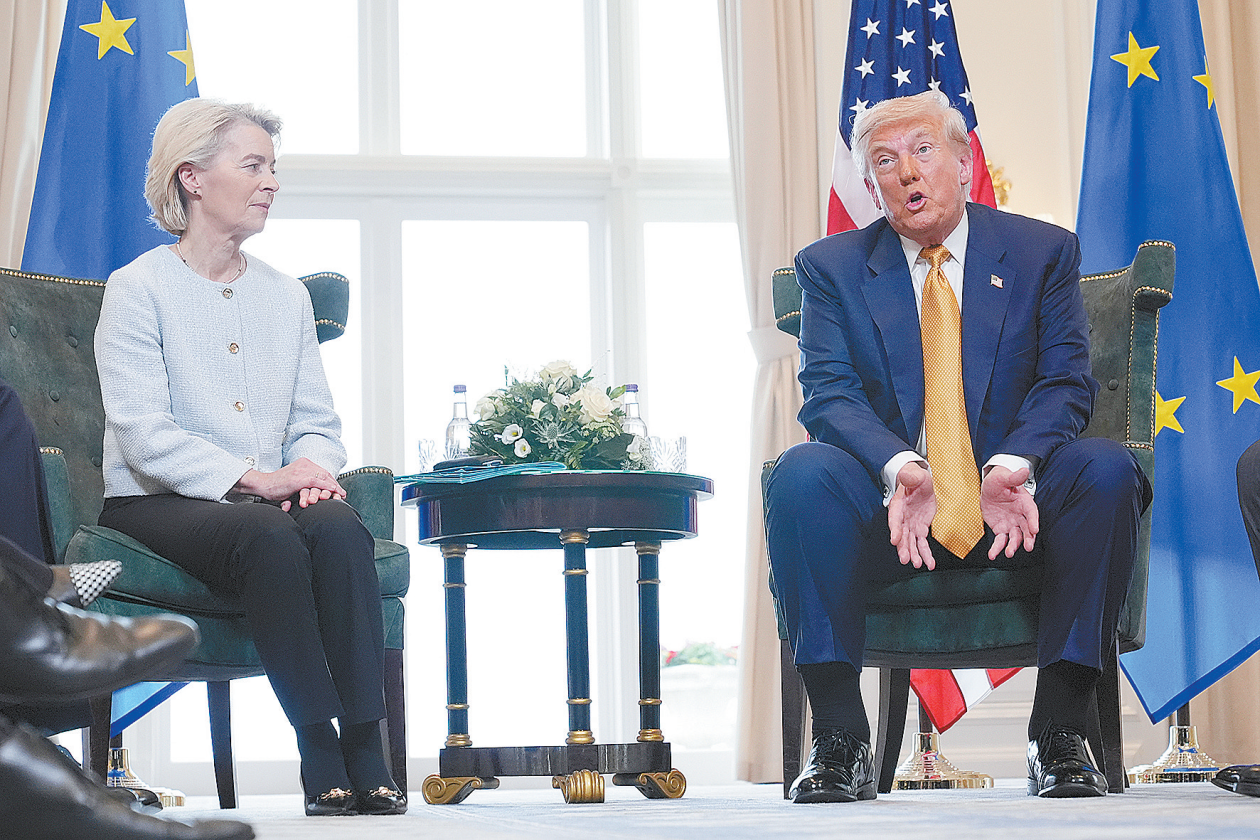
美欧签“史上最大”关税协议,欧盟官员:这“不是互利共赢贸易合作,而是单方面屈服”
Huan Qiu Shi Bao· 2025-07-28 23:07
Group 1 - The core of the agreement is a 15% tariff on EU goods exported to the US, along with a commitment from the EU to invest an additional $600 billion in the US and purchase $750 billion worth of US energy products [1][3][4] - The agreement is perceived by some European leaders as a one-sided concession rather than a mutually beneficial trade cooperation, with criticism from figures like Bernd Lange and Marine Le Pen highlighting its negative implications for the EU [1][6][7] - The US maintains a 50% global tariff on steel and aluminum, while the EU's interpretation suggests that pharmaceuticals will also be subject to the 15% tariff, which could impact EU exports significantly [4][5] Group 2 - The agreement has been met with cautious optimism from some US officials, who view it as a significant opening of the EU market, but there is a notable lack of enthusiasm from European leaders [5][6] - European media and business sectors have expressed strong criticism, arguing that the agreement could harm local employment and industry, with concerns about the imbalance in trade terms [6][7] - The new tariff structure represents a significant increase from previous averages, with the EU's average tariff on US goods being 1.32% compared to the newly established 15% [7]
金十数据全球财经早餐 | 2025年7月29日
Jin Shi Shu Ju· 2025-07-28 23:07
Group 1 - The U.S. stock market showed mixed results, with the Dow Jones down 0.14%, while the Nasdaq rose by 0.33% and the S&P 500 saw a slight increase [4] - Nvidia (NVDA.O) increased nearly 2%, Tesla (TSLA.O) rose 3%, and Super Micro Computer (SMCI.O) surged 10% [4] - The Hang Seng Index closed up 0.68% at 25,562.13 points, while the Hang Seng Tech Index fell 0.24% to 564.02 points, with a total market turnover of 250.3 billion HKD [5] Group 2 - The international oil market saw a rebound, with WTI crude oil rising 2.85% to $66.70 per barrel, marking a two-week high, and Brent crude oil increasing 2.91% to $69.57 per barrel [3][6] - Gold prices fell for four consecutive days, closing down 0.68% at $3,314.63 per ounce, while silver prices remained unchanged at $38.17 per ounce [3][6] - The U.S. dollar index rose significantly, closing up 1% at 98.633 points, while U.S. Treasury yields mostly increased, with the 10-year yield at 4.417% [3][6]