
产业升级

Search documents
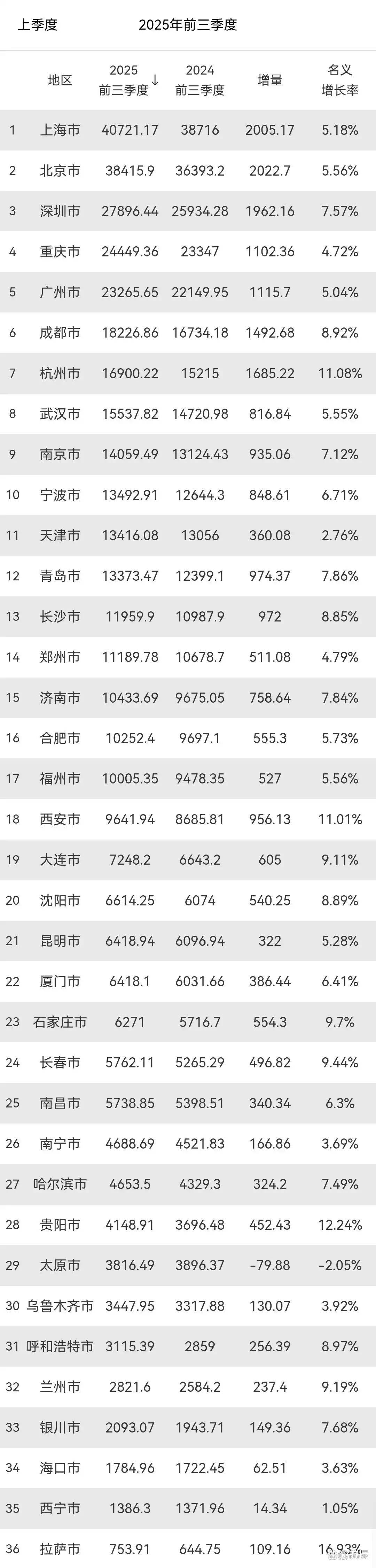
我国36个主要城市GDP更新:成都增速约9%,福州首破万亿,沈阳逆袭昆明!
Sou Hu Cai Jing· 2025-11-22 02:11
| | 地区 | 2025 | 2024 | 増量 | 名义 | | --- | --- | --- | --- | --- | --- | | | | 前三季度 | 前三季度 | | 增长率 | | | 1 上海市 | 40721.17 | 38716 | 2005.17 | 5.18% | | 2 | 北京市 | 38415.9 | 36393.2 | 2022.7 | 5.56% | | 3 | 深圳市 | 27896.44 25934.28 1962.16 | | | 7.57% | | 4 | 重庆市 | 24449.36 | 23347 | 1102.36 | 4.72% | | 5 | 广州市 | | 23265.65 22149.95 | 1115.7 | 5.04% | | 6 | 成都市 | | 18226.86 16734.18 | 1492.68 | 8.92% | | 7 | 杭州市 | 16900.22 | 15215 | 1685.22 | 11.08% | | 8 | 武汉市 | | 15537.82 14720.98 | 816.84 | 5.55% | | 0 | 南京市 ...

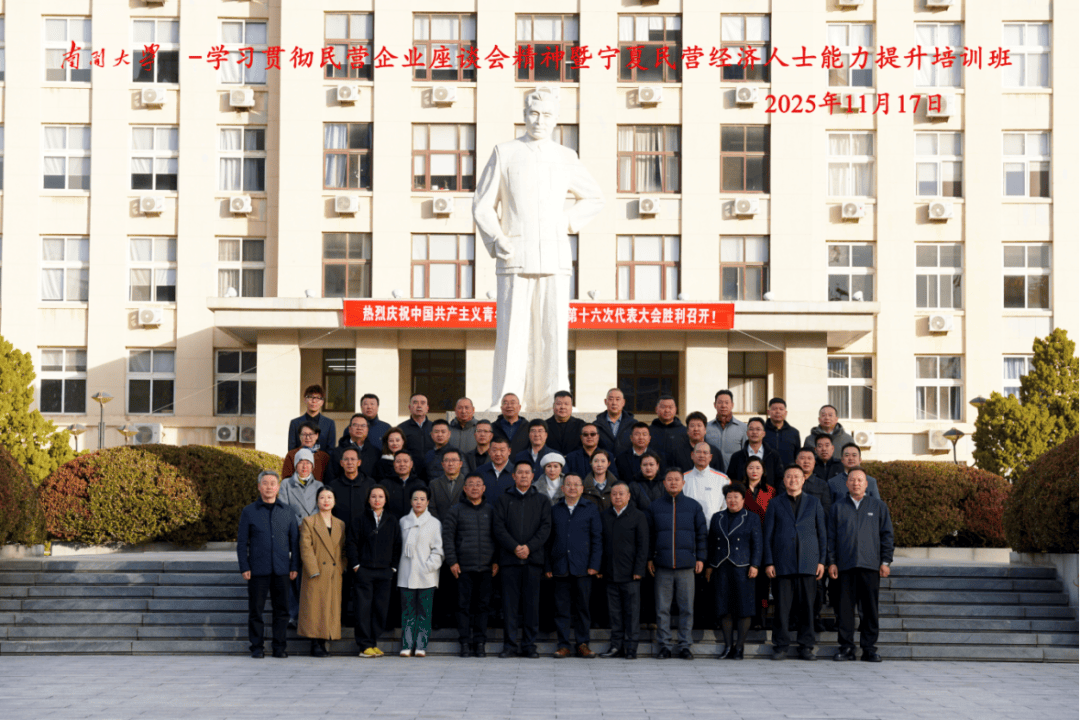
自治区工商联学习贯彻民营企业座谈会精神暨民营经济人士能力提升培训班在南开大学举办
Sou Hu Cai Jing· 2025-11-21 15:15
Core Insights - The training program aims to enhance the capabilities of private entrepreneurs and business association leaders in the region, focusing on the implementation of the spirit of the 20th National Congress and the private enterprise symposium [1][3][5] Group 1: Political Guidance and Policy Orientation - The training emphasizes political construction as a priority, integrating the spirit of the 20th National Congress and the private enterprise symposium throughout the program [3] - It aims to help participants understand their important role as "insiders" in the private economy, aligning with national policies [3] Group 2: Comprehensive Course System - The training features a three-dimensional teaching system comprising theoretical explanations, case analyses, and on-site observations [5] - Courses include topics such as the spirit of the 20th National Congress, macroeconomic analysis, enterprise management innovation, and AI technology [5] - Participants visit leading companies in advanced manufacturing, biomedicine, and digital information sectors to learn about modern management and technological innovation [5] Group 3: Platform Functionality and Empowerment - The program adopts an innovative "training + trade" model, facilitating economic exchange meetings alongside the training [7] - Entrepreneurs and association leaders discuss upgrading regional industries and enhancing economic cooperation [7] - Initial cooperation intentions are established between various enterprises and chambers, laying the groundwork for future collaboration [7] Group 4: Training Outcomes and Future Directions - The training receives positive feedback for its precise course design and practical engagement mechanisms [7] - Participants express commitment to applying their learning to drive innovation and development in their enterprises [7] - The organization plans to continue collaborating with universities and businesses to ensure the training's effectiveness and support high-quality development in the private economy [8]
创新实业(02788)暗盘大涨超30%,顶级机构扎堆认购,港股IPO受热捧
智通财经网· 2025-11-21 11:41
与此同时,创新实业本次IPO亦获得17名重量级基石投资者的鼎力加持,高瓴、中国宏桥、泰康人寿等 基石投资者豪掷3.51亿美元入局,豪华阵容与雄厚资金实力,进一步印证了公司在行业内的核心地位与 投资价值。 财务方面,创新实业的表现同样可圈可点。招股书显示,2022年至2024年期间,创新实业收入由人民币 134.90亿元提升至151.63亿元,年内利润由人民币9.13亿元提升至26.30亿元。根据大宗商品研究机构 CRU的报告,公司管理每吨铝现金成本的能力在中国所有电解铝冶炼公司中处于前5%之列,充沛的现 金流与高效的运营管理为其持续推进产能扩张与产业升级提供了有力支持。 智通财经APP获悉,11月21日,创新实业(02788)下午暗盘交易两大交易场辉力和富途均大幅上涨,其中 辉立暗盘收涨30.57%,收报14.35港元,富途收涨26.02%,收报13.85港元,合计成交金额6.5亿港元,对 应约8300万美金,交投非常活跃。作为中国电解铝行业的出海领军者,公司此次 IPO 不仅凭借豪华基 石投资阵容与火爆超额认购表现点燃市场热情,更以清晰的全球化战略、充沛的现金流及显著的估值优 势,成为今年港股市场极具潜力的 ...
2035年的 “财富信号”:人民币越值钱,你的房子、工资越值钱
Sou Hu Cai Jing· 2025-11-21 10:24
你有没有想过,到2035年,我们每个人的生活会是什么样? 这不是什么空想,而是一个已经被写进国家规划的明确目标:到2035年,中国人均GDP要冲进"中等发达国家"的行列。 这是什么概念? 一个被普遍引用的数字门槛是人均GDP突破2万美元。 就在上个月,新鲜出炉的《"十五五"规划建议》再次强调了这一点,这已经不是愿景,而是正在执行的路线图。 但问题来了,我们现在在哪? 那么,实现这一跨越的"隐藏快捷键"是什么? 答案可能就藏在你每天都在用的东西里——人民币。 一个越来越清晰的信号正在释放: 人民币的"价值重估",将是未来十年最大的财富风口。 根据国家统计局和外汇管理局的最新数据,结合今年前三季度的经济表现, 我们预计2025年底中国人均GDP大概在1.45万美元左右。 从1.45万到2万,这中间的5500美元差距,怎么补? 很多人第一反应是"拼经济,加油干,把蛋糕做大"。 没错,但不够。 如果我们还走"人海战术、资源堆砌"的老路, 未来十年,就算我们拼尽全力维持每年4%-5%的增长,也只是勉强够到门槛。 更何况,人口结构的变化和全球供应链的重组,让这条老路越来越难走。 一提到人民币升值,很多人的老观念就跳出来了 ...
全力打造“智造高地”,上海奉贤2024年规上工业产值突破2775亿元
Di Yi Cai Jing· 2025-11-21 08:42
Core Insights - In 2024, the industrial output value of Shanghai's Fengxian District is projected to exceed 277.5 billion yuan, with an average annual growth rate of 9.9% [2] - The district is focusing on "energy conversion" to achieve new economic growth, with fixed asset investment in industrial sectors reaching 17.96 billion yuan in 2024, up from 11.4 billion yuan in 2020, reflecting an annual growth rate of 12% [2] - The service sector is also expanding, with revenue from regulated service industries expected to reach 48.49 billion yuan in 2024, nearly doubling since the end of the 13th Five-Year Plan [2] Industrial Development - The four key industries of beautiful health, green new energy, general new materials, and intelligent new equipment now account for over 80% of the district's total industrial output [2] - The industrial output value in the Fengxian area has increased from 25.97 billion yuan in 2020 to 83.05 billion yuan, with an impressive annual growth rate of 33.7% [3] Innovation and Ecosystem - Fengxian has cultivated 56 national-level specialized and innovative small giant enterprises and 1,860 national high-tech enterprises, with 68 enterprises recognized as technology centers at the municipal level or above [3] - The district is actively integrating into the Lingang New Area, enhancing policy collaboration and promoting industrial synergy [3] Infrastructure and Urban Development - Significant improvements in public services and transportation infrastructure have been made, including the opening of major hospitals and cultural landmarks, as well as the completion of key transportation projects [4] - The district is developing a "smart manufacturing highland" and has established a comprehensive investment system covering various types of funds [4] Future Plans - Looking ahead to the 15th Five-Year Plan, Fengxian aims to transition from an "industrial district" to a "strong industrial district" by enhancing manufacturing capabilities and focusing on advanced manufacturing and modern services [5] - The district plans to create a spatial layout that promotes differentiated development across its eastern, central, and western regions, with a focus on collaboration with the Lingang New Area [5]
BOSS直聘Q3营收21.6亿,蓝领与下沉市场成增长主轴
Xin Lang Cai Jing· 2025-11-21 08:30
Core Insights - BOSS Zhipin's Q3 2025 financial report highlights significant growth in the blue-collar job market, particularly in lower-tier cities and the manufacturing sector [1][2] Revenue Growth - In Q3, BOSS Zhipin reported revenue of 2.16 billion yuan, a year-on-year increase of 13.2%, primarily driven by online recruitment services for corporate clients [1] - The revenue from blue-collar jobs reached a historical high as a percentage of total income, indicating a robust demand in this segment [2] Blue-Collar Job Market Trends - The manufacturing sector shows the highest demand for blue-collar workers, with revenue growth leading among sub-industries for five consecutive quarters [2] - There is a notable shift towards technical positions in the blue-collar job market, with increasing demand for roles such as assembly engineers and mechanical engineers in high-end and smart manufacturing [4] Downstream Market Dynamics - Revenue from third-tier cities and below is on the rise, driven by industrial migration and local service sector growth [5] - The demand for local services in lower-tier cities, such as housekeeping and retail, is increasing, aligning well with the efficient nature of online recruitment platforms [5] Trust Mechanisms in Recruitment - The blue-collar recruitment market faces challenges such as information opacity and distrust between job seekers and employers [6] - BOSS Zhipin's "Conch Plan" aims to enhance the authenticity of job postings and build trust, which is crucial for standing out in a competitive market [7] - The success of the "Conch Preferred" initiative demonstrates the importance of trust in improving recruitment efficiency and employer branding [7]
晶采观察丨有“量”有“质” 中西部地区外贸“新”潮涌动
Yang Guang Wang· 2025-11-21 06:33
Core Insights - The article highlights the significant growth of cross-border exports in Zhengzhou, with a nearly fourfold increase in value in the first ten months of the year, reflecting the robust development of foreign trade in China's central and western regions [1] - The total import and export value of goods in the central and western regions reached 6.68 trillion yuan, leading the national foreign trade growth rate [1] - The regions are focusing on both quantity and quality improvements in foreign trade, supported by upgraded logistics and favorable policies [1][2] Group 1: Quantity Growth - The central and western regions are experiencing a notable increase in foreign trade volume, driven by continuous upgrades in transportation and logistics [1] - Zhengzhou has established an efficient cross-border logistics network through the "Air Silk Road" and the China-Europe Railway Express, enhancing trade efficiency [1] - Policy incentives, such as the establishment of cross-border e-commerce pilot zones, have simplified customs processes and reduced operational costs for businesses [1] Group 2: Quality Improvement - The transformation of foreign trade in the central region is shifting from quantity to quality, with a focus on industrial upgrades and brand development [2] - Local industries are moving from passive order-taking to proactive international expansion, exemplified by brands like Xuchang wigs and Luoyang steel cabinets [2] - The export structure is optimizing, with "new three types" of products seeing a 47.35% increase, and electric vehicles experiencing a remarkable growth rate of 125.39% [2]
中汽咨询委专家小组赴陕汽、法士特调研 解码产业高质量发展密码
Zhong Guo Qi Che Bao Wang· 2025-11-21 05:42
Group 1: Shaanxi Automobile Group (陕汽) - Shaanxi Automobile Group has transformed from a third-tier enterprise into a leading large-scale commercial vehicle group in China over 57 years, emphasizing its commitment to innovation and high-quality development in the new energy and intelligent connected vehicle sectors [5][7][9] - The company aims to become a "century-old enterprise" and is encouraged to focus on quality improvement and efficiency enhancement while avoiding blind investments [7][8][9] - Experts from the China Automotive Industry Consulting Committee recognize Shaanxi Automobile as a "hardcore" contributor to China's commercial vehicle industry, highlighting its successful blend of independent innovation and open cooperation [7][8] Group 2: Fawer Automotive Parts Group (法士特) - Fawer aims to create a world-class enterprise by focusing on technological and institutional innovation, targeting sales revenue of 40 billion yuan by 2030 [10][12] - The company has successfully evolved from a small gear factory to a globally recognized player in the automotive transmission system sector, driven by comprehensive reforms and a strong corporate culture [12][13] - Experts emphasize the importance of maintaining a crisis awareness and leveraging strategic opportunities to convert challenges into development resources [13] Group 3: Industry Insights - The rise of Shaanxi Automobile and Fawer reflects the broader transformation of the Chinese automotive industry, showcasing a shift from domestic exploration to global competitiveness [14][16] - The automotive industry in Shaanxi has seen rapid expansion and quality improvement, with a strong focus on new energy vehicles, supported by government strategies and effective policy execution [16] - Key recommendations for the industry include fostering technological innovation, expanding market presence both domestically and internationally, and embracing cultural values to maintain strategic focus during industry changes [16]

资本蓄力强产业 绘就大连区域发展新图景|决胜“十四五” 擘画“十五五”·地方资本市场高质量发展
证券时报· 2025-11-21 01:56
Group 1 - The article emphasizes the successful integration of capital markets in Dalian, which has facilitated significant advancements in local industries, particularly in the port and petrochemical sectors [1][3][4] - Dalian's capital market has played a crucial role in optimizing port resources, with the first domestic listed company merger through stock swap occurring in 2021, resulting in Liaoport's total assets exceeding 55 billion yuan and a significant increase in its market position [3][4] - The article highlights the strategic importance of capital markets in supporting the transformation and upgrading of industries, with a focus on high-quality development and innovation [2][5] Group 2 - Dalian's capital market has supported technology innovation by facilitating financing of 50.355 billion yuan, with 11.628 billion yuan from the stock market and 38.727 billion yuan from the bond market, enhancing the growth of new productive forces [6][7] - The article notes the successful issuance of the first technology innovation corporate bond in Dalian, raising 7.5 billion yuan for renewable energy projects, showcasing the effectiveness of capital markets in driving industry upgrades [7] - The local government has implemented measures to enhance the role of government investment funds in supporting high-quality industrial development, focusing on ten key industrial clusters [4][6] Group 3 - The article discusses the stringent regulatory measures in place to prevent systemic financial risks, with Dalian's regulatory bodies actively addressing illegal financial activities and enhancing compliance within the private equity sector [9][10] - Dalian's regulatory authorities have established a collaborative mechanism with local government departments to share information and manage risks effectively, ensuring the stability of the financial environment [9][10] - The article highlights the importance of maintaining investor rights and the proactive measures taken to address issues related to private fund management and compliance [10]




金发科技(600143):公司深度报告:从材料到平台,科技浪潮下验证成长逻辑
Donghai Securities· 2025-11-20 11:24
Investment Rating - The report assigns a "Buy" rating for the company, marking its first coverage [6]. Core Insights - The company has evolved from a modified plastics manufacturer to a global chemical new materials platform, successfully applying its products in cutting-edge industries such as AI servers, humanoid robots, and new energy vehicles [6]. - The modified plastics business remains a solid foundation, with a leading gross margin in the industry due to its integrated supply chain and material solutions [6]. - The company is well-positioned to benefit from domestic substitution and technological upgrades in the new materials sector, with significant growth potential in specialty engineering plastics and biodegradable plastics [6]. - The earnings forecast indicates a steady increase in EPS from 0.54 to 0.85 yuan from 2025 to 2027, with corresponding PE ratios decreasing from 35.01 to 22.16 [6]. Summary by Sections 1. Performance Overview: Healthy Profit Structure and Expected Profitability - The company has shown robust revenue growth, achieving 49.62 billion yuan in revenue in the first three quarters of 2025, a 22.62% year-on-year increase, and a net profit of 1.065 billion yuan, up 55.86% [6][17]. - The profit structure is now driven by sustainable growth areas such as automotive materials and high-end specialty engineering plastics, rather than relying on sporadic medical products [17]. 2. Integrated Supply Chain Builds Competitive Advantage in Modified Plastics - The modified plastics segment has consistently accounted for over 50% of revenue since 2020, with sales volume reaching 2.0908 million tons in the first three quarters of 2025, a growth of 18.16% [40]. - The company’s total production capacity for modified plastics is set to reach 3.72 million tons per year by the end of 2024, maintaining a leading position in the industry [40]. 3. "Domestic Substitution" and "Industry Upgrade" Drive New Materials Business - The new materials segment, including specialty engineering plastics and biodegradable plastics, is expected to grow significantly, with sales volume of 20,080 tons in the first three quarters of 2025, a 22.36% increase [6]. - The company is actively developing high-performance biodegradable plastics and specialty engineering plastics, which are crucial for emerging industries [6]. 4. Earnings Forecast and Valuation - The company’s revenue is projected to grow from 60.51 billion yuan in 2024 to 67.31 billion yuan in 2025, with a compound annual growth rate of approximately 14.62% from 2020 to 2024 [5][75]. - The report highlights a favorable valuation compared to peers, with an average PE of 44.74 and 30.10 for 2025 and 2026, respectively [75].
