安全边际

Search documents
股坛传奇退场:解码巴菲特跨越时代的财富思维密码
Sou Hu Cai Jing· 2025-05-06 03:54
Core Insights - Warren Buffett's resignation as CEO of Berkshire Hathaway has drawn global investor attention, marking the end of an era for the investment giant [1] - Under Buffett's leadership, Berkshire Hathaway transformed from a struggling textile company into a massive conglomerate with a market value of $1.16 trillion by 2024, showcasing a remarkable growth trajectory [3] - The company's stock price has increased over 55,000 times over the past 60 years, with an annualized return of 19.9%, significantly outperforming the S&P 500's 10.4% during the same period [3] Investment Philosophy - Buffett's investment philosophy is characterized by several key principles: the "circle of competence" which emphasizes focusing on familiar sectors, a "contrarian investment" strategy that involves buying during market panic, and the "margin of safety" concept that prioritizes risk management [3] - His long-term holding strategy has led to enduring partnerships with high-quality companies like Coca-Cola and Wells Fargo, allowing him to witness the power of compounding returns [3] Learning Resources - Classic literature documenting Buffett's investment thoughts provides insights into the underlying logic of value investing, while biographies detailing his partnership with Charlie Munger reveal the human dynamics behind their strategies [5] - Professional stock analysis software can assist in tracking financial data, while investment portfolio management tools help investors maintain a balanced asset allocation [5] - Developing an investment mindset is crucial, with meditation tools aiding in maintaining composure during market fluctuations and efficiency manuals enhancing research and decision-making processes [5]

时报观察丨巴菲特留给投资界的珍贵启示
证券时报· 2025-05-06 00:20
Core Viewpoint - Warren Buffett announced his retirement as CEO of Berkshire Hathaway, passing the role to Greg Abel by the end of the year, which has garnered global investor attention [1][2] Group 1: Investment Philosophy - Buffett's investment philosophy can be summarized in four key concepts: circle of competence, contrarian investing, margin of safety, and long-term holding [2] - He emphasizes the importance of understanding one's investment area and being patient, which has become a universal wisdom in the investment community [2] Group 2: Company Achievements - Since taking over in 1965, Berkshire Hathaway's market value has grown from $4.7 million to $1.16 trillion, with over 80 subsidiaries across key sectors [1] - The company's stock price has increased by more than 55,000 times over the past 60 years, achieving an annualized return of 19.9%, significantly outperforming the S&P 500's 10.4% [1] Group 3: Legacy and Transition - Greg Abel will inherit not only the CEO position but also a well-honed business philosophy developed over more than half a century [2] - Buffett's teachings highlight the importance of maintaining rationality and patience in a noisy market, which is a valuable lesson for future investors [2]

巴菲特留给投资界的珍贵启示
Zheng Quan Shi Bao· 2025-05-05 17:26
Core Insights - Warren Buffett announced that he will hand over the CEO position of Berkshire Hathaway to Greg Abel by the end of the year, drawing global investor attention [1] - Buffett's investment career is marked by a remarkable wealth creation story, with Berkshire Hathaway's market value soaring from $4.7 million in 1965 to $1.16 trillion today, and a stock price increase of over 55,000 times over the past 60 years [1] - The investment philosophy of Buffett emphasizes value investing, focusing on "buying great companies at reasonable prices" and incorporating intangible assets into valuation frameworks [1][2] Investment Philosophy - Buffett's investment philosophy can be summarized in four key concepts: circle of competence, contrarian investing, margin of safety, and long-term holding [2] - He prefers to invest in areas he understands and maintains a disciplined approach, especially in the face of technological trends like AI, where he admits to not fully understanding the technology [2] - The transition of leadership to Greg Abel signifies the continuation of Buffett's well-honed business philosophy, which emphasizes rationality and patience in investing [2]
暴赚5.5万倍!刚刚,巴菲特最新洞见来了
Ge Long Hui· 2025-05-03 16:34
Core Insights - The 2025 Berkshire Hathaway annual meeting is considered one of the most significant, potentially marking Warren Buffett's last full participation [1][3] Group 1: Cash Reserves and Investment Strategy - Berkshire Hathaway's cash reserves have reached a record high of $347.7 billion, up from approximately $334 billion at the end of 2024, as Buffett remains cautious in waiting for suitable investment opportunities [3] - The company has been a net seller of stocks for ten consecutive quarters, with a net sale of $4.7 billion in the first quarter of this year [4] Group 2: Economic Concerns and Market Dynamics - Buffett expressed concerns about U.S. fiscal policy, stating it systematically undermines currency value, a phenomenon observed globally [4] - He noted that the current market volatility does not compare to historical crashes, emphasizing the importance of adapting investment philosophies to market realities [5] Group 3: Investment Philosophy and Historical Performance - Berkshire's stock price has seen a compound annual growth rate of 19.9% from 1965 to 2024, significantly outperforming the S&P 500's 10.4% [8] - Buffett's investment strategy emphasizes the importance of patience and the need to wait for the right opportunities, as demonstrated by his historical investments in companies like Coca-Cola and Apple [12][14] Group 4: Personal Insights and Advice - Buffett highlighted the significance of working in a place one enjoys and surrounding oneself with capable individuals, which can influence personal and professional growth [7] - He reiterated that successful investing requires time, patience, and a focus on understanding businesses rather than reacting to market fluctuations [19][20]

股票的安全边际
雪球· 2025-04-30 08:44
风险提示:本文所提到的观点仅代表个人的意见,所涉及标的不作推荐,据此买卖,风险自负。 作者: 酒金岁月 来源:雪球 大家认为的安全边际要么是买的便宜 , 要么是高股息率 , 要么是高成长性 , 其实都说了一部 分 , 但没有说到关键上 。 最好的安全边际来自于最好的生意 , 买股票就是买企业 。 茅台为什么好 , 因为他可以逆行周期 , 最差的年景依然独善其身 。 看不透这一点你会认为房 产跟白酒一样 。 招行为什么好 , 因为别的银行通过增发补充资本金时 , 他可以通过利润本身 完成内生增长 。 看不透这一点你会认为民生和招行无差异 。 买的便宜取决于企业业绩未来向上 , 不然股价可以更便宜 , 扇贝可以来回跑 。 高股息率取决 于高股息的长期性和确定性 , 这正是很多企业静态股息率超高我们敬而远之的原因 。 高成长性 取决于成长的确定性和差异性 , 无差异的高成长会迎来价格内卷 , 无确定性的高成长只能昙花 一现 。 好生意可以给人提供巨大的容错空间 , 长期的高确定性可以弥补操作上的高错误率 , 当然这也 取决于你的资金的期限和性质 。 拿短期资金做长期价投 , 这是失败的不二法门 , 加上杠杆加 速了 ...
或有职位变动?知名基金经理鲍无可管理产品近期密集增聘
Sou Hu Cai Jing· 2025-04-29 15:52
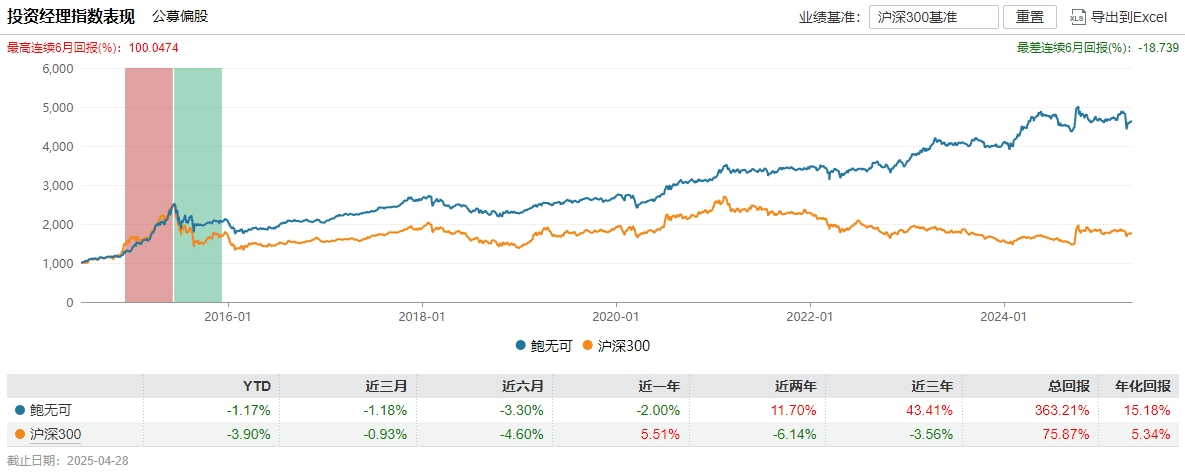
Core Viewpoint - The recent appointment of additional fund managers for funds managed by Bao Wuke has sparked discussions about potential changes in his position, although the company has confirmed that no such changes have been communicated yet [1][11]. Group 1: Fund Manager Profile - Bao Wuke has 17 years of experience in the securities and fund industry, having joined Invesco Great Wall Fund in December 2009 and becoming a fund manager in June 2014 [2]. - Since becoming a fund manager, Bao Wuke has achieved an annualized return of 15.18%, with six out of eight funds under his management yielding over 10% [3]. - His investment style is characterized by a focus on risk control, with a maximum drawdown of only 15% over the past three years, particularly during the volatile A-share market from 2022 to 2024 [6]. Group 2: Investment Philosophy - Bao Wuke emphasizes the importance of "safety margin" in his investment philosophy, stating, "I would rather gain less than lose more" [9]. - He prefers a steady investment approach, likening it to "warm water" that values consistent returns over fleeting market trends [6]. Group 3: Fund Manager Appointments - The recent appointments of four experienced fund managers to Bao Wuke's funds are seen as a strategy to enhance management capabilities, with all new appointees having over 14 years of experience in the securities industry [10]. - The new managers have diverse investment styles, which may lead to potential strategy conflicts, raising questions about how the company will maintain its investment approach [10]. Group 4: Industry Trends - The trend of co-managing funds and appointing additional fund managers is becoming more common in the public fund industry, reflecting the need for adaptability in a competitive market [11]. - This co-management model is believed to mitigate investment risks, enhance management flexibility, and provide a more diversified investment strategy [11].
私募大佬杨东罕见发声:当前股票是理想选择,内需仍是主线
华尔街见闻· 2025-04-28 11:48
以下文章来源于资本深潜号 ,作者资本深潜号 资本深潜号 . 专注资本背后的硬核故事 作者孙建楠 编辑袁畅 原标题《私募大佬杨东重磅发声:这个时代,少做把握不大的投资》 4月28日下午,宁泉资产创始人杨东参加一场圆桌论坛,透露了未来权益投资的策略。 杨东是兴业全球基金的首任总经理,培养了董承非、谢治宇、乔迁等明星基金经理。2018年初,他正式"奔私",通过宁泉资产的平台展开私募投资。 如今,杨东的私募规模达到500亿元,与中国最头部的量化私募机构规模,不相上下。 一直非常低调的杨东,甚少参与公开活动,此次他在这场圆桌论坛上依然"惜字如金",依然有一些"干货"值得关注。 以下为杨东的发言要点,整理如下,以飨读者。 当前股票是理想选择 我们对"可为"的理解,主要基于其最简单、最基本的意义。在当前众多可投资资产中, 股票投资仍是一个较为理想的选择。 换言之,在中国股市中,投资者若能合理布局,获取比存款、国债、银行理财等更为可观的收益并非难事,这是我们对当前投资环境的基本判断。 世界格局演变是长期核心问题 从短期来看,关税问题及其未来演变对市场的影响不容忽视。此外,为了应对相关冲击,政府有望出台一系列强有力的政策以提振 ...
投资小知识:四个原则,帮你快速掌握价值投资的精髓
银行螺丝钉· 2025-04-19 12:32
文 | 银行螺丝钉 (转载请注明出处) 便宜,是不是值得买入。 (3) 市场先生 市场先生是一个狂躁的、精力旺盛的、喜 怒无常的人,他每天的工作,就是跑过来 给你报价格。 明白了这一点,我们在投资股票资产的时 候,关注的重点,就会从股价短期涨跌, 变成了背后公司的经营状况。 股票背后的公司赚了钱,时间拉长后,我 们投资的股票也是赚钱的。 (2) 要有安全边际的意识 安全边际用一句话来总结就是,用6毛钱, 买价值1块钱的东西。 如果是1块钱买价值1块钱的东西,那也没 有什么赚头。 那么,我们怎么知道公司值多少钱呢?这 就是我们常说的估值指标了。 市盈率是估值指标的一种。除此之外还有 市净率等其他指标;也有现金流折现等绝 对估值法。 估值可以帮助我们大概判断,现在是不是 很多时候,投资者亏了钱,往往是因为不 了解一个品种,只是看到短期大涨,就贸 然投入过多的资金。 换句话说,投资超出自己的能力圈范围。 在股票市场,想要建立自己的能力圈,确 实是需要花费很多精力的。 •有的时候他非常的乐观,给你报一个很高 的价格; ·有的时候他非常的悲观,给你报一个非常 低的价格。 当市场短期充满了非理性的贪婪或恐慌, 同时市场成 ...
疯王与关税
雪球· 2025-04-13 04:07
Group 1 - The article discusses the basic principles of trade, emphasizing that trade surplus is a means while trade deficit is an end goal, ultimately for spending money [2] - It highlights that in international trade, the U.S. has maintained a trade deficit for decades, which is unsustainable in the long run [7][10] - The article points out that the U.S. dollar's status as the world's reserve currency allows the country to print money and maintain a trade deficit, but this creates a looming risk if the dollar's credibility is questioned [8][10] Group 2 - The article argues that the U.S. faces two major problems: the credibility of the dollar is under scrutiny, and the manufacturing sector is being pressured by global competition, particularly from China [10][13] - It suggests that the current administration's contradictory policies aim to maintain the dollar's international status while also seeking a trade surplus, which is inherently impossible [15] - The article emphasizes that high tariffs may increase trade friction costs but will not necessarily lead to the intended outcomes due to issues like transshipment and smuggling [18][19] Group 3 - The article discusses the implications of rising U.S. Treasury yields, noting that a sudden increase could lead to higher borrowing costs for companies and potentially trigger widespread bankruptcies [26][27] - It warns that a significant drop in Treasury prices could undermine the dollar's credibility, leading to a feedback loop where countries start selling off U.S. debt [29][30] - The article concludes that investors should focus on valuation rather than being swayed by political rhetoric, as the complexities of the global economy are far more significant than any single political figure [20][21]

用“安全边际”的思维做债券投资,招商基金刘万锋最新分享:今年债市整体较为复杂,团队的重要性远远高于个人
聪明投资者· 2025-04-10 05:33
Core Viewpoint - The article emphasizes the importance of having a "margin of safety" in investments, particularly in the context of fixed income, as articulated by Liu Wanfeng, the director of fixed income investment at China Merchants Fund [2][67][71]. Group 1: Investment Philosophy - Liu Wanfeng's investment philosophy is heavily influenced by Seth Klarman's book "Margin of Safety," which stresses the necessity of risk management and maintaining a margin of safety to survive extreme market conditions [2][67]. - The concept of long-term compounding is highlighted, indicating that short-term decisions can jeopardize long-term gains, thus discipline in trading is crucial [3][68]. - Liu emphasizes the need for patience and long-term commitment in fixed income products, prioritizing steady returns over short-term gains [7][68]. Group 2: Team Structure and Decision-Making - The fixed income team at China Merchants Fund operates under a collective decision-making mechanism, ensuring thorough discussions and research support for investment decisions [4][5][6]. - The team consists of nearly 40 professionals, including 22 fund managers with an average experience of over 11 years, organized into specialized groups to enhance collaborative efforts [6][41]. - This structured approach has allowed the team to navigate market volatility effectively, as demonstrated in 2016 and post-2020 adjustments in the real estate bond market [5][40]. Group 3: Performance Metrics - As of the end of 2024, Liu manages eight funds with a total scale of approximately 35 billion, with a notable performance record of achieving positive returns for the flagship fund over ten consecutive years [7][8]. - The flagship product, "Zhaoshang Shuangzhai LOF," has maintained a maximum drawdown of no more than 2% in each complete year from 2016 to 2024, showcasing its stability [7][8]. - Liu's strategy involves adjusting the portfolio based on macroeconomic cycles, ensuring that the right types of bonds are held at the appropriate times [7][8]. Group 4: Market Outlook and Strategy - Liu forecasts a challenging bond investment environment characterized by low yields and high volatility, necessitating a more refined approach to investment strategies [11][56]. - The current macroeconomic landscape is described as a new phase where policy and investor behavior significantly influence the bond market, with a focus on maintaining stability amid low yields [20][21][22]. - Liu suggests that in the current market, attention should be directed towards the balance of policies and investor behavior, as these will dictate bond market fluctuations [21][22]. Group 5: Risk Management and Future Considerations - Liu advocates for a cautious approach to investment, emphasizing the importance of risk control and the need to avoid overexposure to market speculation [9][11][49]. - The article discusses the potential for passive investment strategies to gain traction in the current market, as they offer lower costs and clearer risk profiles compared to active management [51][53]. - Liu expresses the belief that the bond market will require a rational perspective moving forward, particularly in light of recent market adjustments and the need for careful analysis of macroeconomic indicators [62][56].