AI科技

Search documents
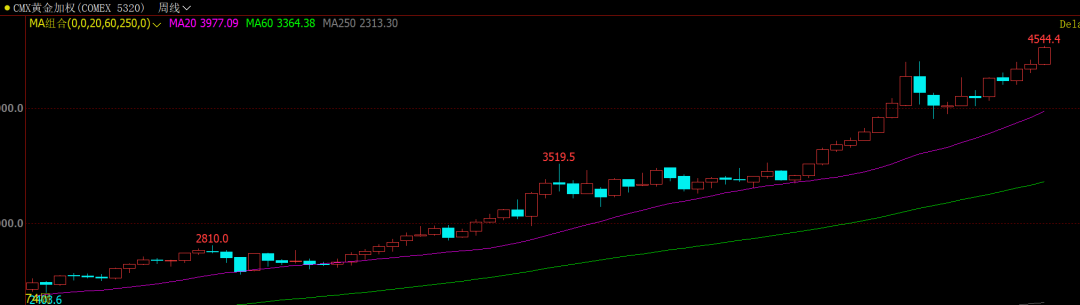
金、银、铜价齐创新高!特朗普:不同意其观点的人不会成为美联储主席
Qi Huo Ri Bao· 2025-12-23 23:52
Group 1: U.S. Stock Market Performance - The U.S. stock market showed strength with all three major indices rising for four consecutive days, with the S&P 500 reaching a record high of 6909.79 points [1] - The Dow Jones index increased by 0.16% to 48442.41 points, while the Nasdaq composite index rose by 0.57% to 23561.84 points, driven by gains in large tech stocks [1] - The "fear index" VIX fell to 14, marking its lowest level in a year [1] Group 2: Economic Indicators - The U.S. GDP for Q3 grew at an annualized rate of 4.3%, surpassing both Q2's growth of 3.8% and market expectations of 3.2% [1] - The probability of a 25 basis point rate cut by the Federal Reserve in January is 13.3%, with an 86.7% chance of maintaining the current rate [1] Group 3: Precious Metals Market - Gold and silver prices reached historical highs, with COMEX gold futures rising by 1.02% to $4515 per ounce and silver futures increasing by 4.44% to $71.61 per ounce [2] - The price of platinum rose by 7.46% to $2289.54 per ounce, while palladium increased by 4.43% to $1857.46 per ounce [2] Group 4: Base Metals Market - LME copper futures rose by $136 per ton to $12060 per ton, marking a new historical high [5] - Other base metals showed mixed performance, with LME aluminum down by $2 per ton, while LME zinc, lead, and nickel saw increases [5] Group 5: Market Drivers for Precious Metals - The recent surge in precious metals is driven by a loose monetary environment and signals from the Federal Reserve indicating potential rate cuts and quantitative easing [10] - The demand for gold is supported by central bank purchases, institutional investment, and industrial applications, creating a robust demand structure [12] - Supply constraints in gold production are expected to persist, with known reserves diminishing and production growth slowing [12] Group 6: Future Outlook for Precious Metals - Short-term catalysts for precious metals include ongoing Federal Reserve rate cuts and geopolitical uncertainties [14] - Long-term structural support is anticipated from continued central bank gold purchases and increasing technological demand for gold [15] - Predictions suggest gold prices could rise from $4400 per ounce to $5000 per ounce in the next 1-2 years, reflecting a cumulative increase of 13.6% [15]

结构性亮点增多 公募把脉2026年投资新机遇
Zhong Guo Zheng Quan Bao· 2025-12-23 22:02
● 本报记者 魏昭宇 近期,国泰基金、招商基金、汇丰晋信基金、长城基金等多家公募机构召开了2026年度策略会,多位基 金经理围绕AI科技、消费、创新药等热门板块的后续投资机遇展开深度探讨。 展望2026年,有业内人士表示,市场值得乐观期待,上涨动力或将从单一的估值驱动逐渐转向"盈利 +估值"双重驱动。2026年作为"十五五"开局之年,相关产业政策及宏观经济支持政策值得期待。明年上 市公司整体业绩有望进一步改善,结构性亮点大概率增多,有利于提高市场风险偏好。当前A股自由流 通市值与居民存款的比值仍然处于相对较低的水平,股票市场或迎来更多新增资金。此外,当前市场估 值结构较为健康,并未出现整体过热的情况。 企业整体业绩大概率提升 从宏观层面来看,招商基金研究部首席经济学家李湛认为,中国经济增长模式逐渐转向创新驱动,基建 和高技术产业拉动经济增长。权益方面,市场目前开启了一轮估值修复与资产轮动逻辑驱动的行情。综 合来看,2026年消费有望缓慢抬升,出口有韧性,商品价格温和走高,进而带动名义GDP上行,企业业 绩或持续修复,这将成为市场的基本面支撑。A股行情或逐渐过渡至公司业绩支撑的"缓而慢"的格局。 国泰基金宏观策 ...
公募把脉2026年投资新机遇
Zhong Guo Zheng Quan Bao· 2025-12-23 20:18
Core Viewpoint - The investment outlook for 2026 is optimistic, with expectations of a shift from valuation-driven to a dual driver of "profit + valuation" for market growth [1][2] Group 1: Overall Market Performance - The overall corporate performance is expected to improve in 2026, supported by a transition to an innovation-driven economic growth model, with infrastructure and high-tech industries driving growth [1][2] - The A-share market is anticipated to gradually shift towards a "slow and steady" performance supported by corporate earnings, with structural highlights likely to increase [1][2] - The current ratio of A-share free float market value to household deposits is relatively low, indicating potential for more new funds entering the stock market [1] Group 2: Sector-Specific Insights - The AI technology sector is expected to continue its growth, with long-term opportunities outweighing short-term risks, focusing on the AI industry chain's weak links [2] - The consumer sector is poised for a turning point, driven by rising resident income expectations and a recovery in consumer goods prices, with investment strategies focusing on leading companies with improved cash flow and competitive positioning [3] Group 3: Fixed Income and Bond Market - The macroeconomic environment in 2026 is expected to be stable, with fixed asset investment from state-owned sectors contributing to growth, and a focus on long-term bond investment opportunities following recent declines [4] - The bond market is anticipated to experience a balance between supply and demand, providing support for overall valuation in the convertible bond market [4]
关于明年A股 基金经理最新研判
Zhong Guo Zheng Quan Bao· 2025-12-23 15:14
Group 1 - Multiple fund managers express optimism for the equity market in 2026, highlighting investment opportunities in AI technology, consumption, and innovative pharmaceuticals [1] - The market is expected to transition from a valuation-driven to a dual-driven model of profit and valuation, with a healthy valuation structure currently in place [1] - The Chinese economy is shifting from a real estate-driven growth model to an innovation-driven one, with infrastructure and high-tech industries taking over [2] Group 2 - The supply-side pressure in the manufacturing sector is expected to ease by 2026, leading to improved profitability for companies [3] - The AI technology sector is still in a "big infrastructure era," with long-term opportunities outweighing short-term risks [4] - The consumption sector is anticipated to experience a turning point, driven by rising resident income expectations and supportive monetary policies [4] Group 3 - The innovative pharmaceutical sector is expected to have significant growth potential in 2026, with many products entering critical clinical phases that could enhance market confidence [5] - Investment strategies will focus on optimizing competition in traditional consumption and selecting high-quality new consumption stocks with strong fundamentals [4][5]
关于明年A股,基金经理最新研判
Zhong Guo Zheng Quan Bao· 2025-12-23 15:07
Group 1 - Multiple fund managers express optimism for the equity market in 2026, highlighting investment opportunities in AI technology, consumption, and innovative pharmaceuticals [1] - The market is expected to transition from a valuation-driven to a dual-driven model of profit and valuation, with a healthy valuation structure currently in place [1][2] - The Chinese economy is shifting from a real estate-driven growth model to an innovation-driven one, with infrastructure and high-tech industries taking over [2] Group 2 - The supply-side pressure in the manufacturing sector is expected to ease by 2026, leading to a potential reversal in supply-demand dynamics and improved corporate profitability [3] - The AI technology sector is still in a "big infrastructure era," with long-term opportunities outweighing short-term risks, despite challenges in the industry [4] - The consumption sector is anticipated to experience a turning point in investment opportunities, driven by rising resident income expectations and a recovery in consumer goods prices [4][5] Group 3 - The innovative pharmaceutical sector, which showed strong performance in 2025, is expected to regain momentum in 2026, supported by significant clinical developments and market confidence [5]
招商基金2026年投资策略展望:A股有望从估值抬升进入盈利支撑 三重多元化推动再平衡
Zhong Guo Zheng Quan Bao· 2025-12-23 13:45
Macro Economy - The GDP growth in 2025 was 5.2%, exceeding the 5% target, supported by domestic consumption and manufacturing investment [1] - The "new steady state" reflects a shift from real estate-driven growth to innovation-driven growth, focusing on quality and structural adjustments for long-term development [1] - The economic transformation emphasizes consumption and technological innovation as the main drivers, moving towards a mature stage of economic development [1] Equity Market - The equity market has entered a phase of valuation recovery and asset rotation, with expectations for a stabilization in investment in 2026 [2] - Consumer spending is expected to gradually increase, with resilient exports and moderate price improvements supporting nominal GDP growth and corporate earnings recovery [2] - A-shares are anticipated to transition from valuation-driven rallies to earnings-supported trends [2] Investment Strategy - The investment strategy for 2026 is characterized by "threefold diversification driving rebalancing": 1. Diversification in resident asset allocation, shifting from real estate to equities, with equity market value growth expected to exceed M2 growth [3] 2. Global diversification in asset allocation, with a favorable outlook for Chinese assets as the dollar index is expected to remain weak [3] 3. Structural rebalancing driven by economic convergence, with potential profit inflection points in industries benefiting from improved supply-demand dynamics [3] Sector Focus - Key investment themes include AI post-cycle investments and high-end manufacturing, particularly in midstream sectors such as power equipment, chemicals, machinery, and military industries [4] - The AI technology sector is expected to experience strong long-term growth, with a focus on infrastructure investment and commercial validation of AI applications [5][6] - The global AI industry is projected to see significant capital expenditure, with a shift towards commercialized AI services and opportunities in China's semiconductor industry [6][7] Real Estate Sector - The real estate sector is a crucial macroeconomic factor, with expectations for a recovery in demand in the second half of 2026 [7] - Investment opportunities in the real estate industry chain include real estate intermediaries, building materials, property management, and home-related sectors [7] - Specific opportunities in the renovation demand for residential and public sectors are highlighted, with leading companies expected to gain market share and stabilize revenues [7]
长江有色:23日锡价下跌 锡价高企现货“有价无市”
Xin Lang Cai Jing· 2025-12-23 08:47
Core Viewpoint - The tin market is experiencing a complex interplay of supply constraints and structural demand growth, influenced by macroeconomic factors and geopolitical risks [2][3]. Group 1: Market Performance - The Shanghai tin contract 2602 saw an increase, closing at 344,750 yuan/ton, up by 1,890 yuan, or 0.55% [1]. - The trading volume for the main contract was 228,643 lots, with an open interest of 61,161 lots, an increase of 4,662 lots from the previous day [1]. - The spot tin price in the Yangtze River market reported a decline, with an average price of 339,400 yuan/ton, down by 1,500 yuan from the previous day [1]. Group 2: Supply and Demand Dynamics - Supply constraints are significant, primarily due to slow resumption of tin mining in Myanmar and geopolitical conflicts in the Democratic Republic of Congo, leading to tight resource circulation [3]. - Major exporting country Indonesia faces policy and resource quality issues, affecting export stability, while global tin resources are limited and new capacity additions are slow [3]. - Demand is structurally growing, driven by strong needs in AI servers and semiconductor packaging, while traditional sectors like home appliances and automotive electronics show slower growth [3]. Group 3: Industry Leaders and Strategies - Leading companies in the tin industry are adapting to changes by emphasizing resource strategic value and expanding into emerging demand areas [4]. - Companies like Tin Industry Co. are experiencing steady growth, while Xingye Silver Tin is advancing mining projects to enhance self-sufficiency [4]. - Overall, leading firms are strengthening resource control and expanding into high-value downstream sectors to address supply anxieties and capitalize on structural demand opportunities [4]. Group 4: Short-term Price Outlook - The macro sentiment is cautious, leading to a bearish outlook, but the tight supply and low inventory levels are expected to support a potential price increase in the short term [5].

长江有色:23日铅价小涨 下游谨慎观望刚需补库
Xin Lang Cai Jing· 2025-12-23 08:47
Core Viewpoint - The lead market is experiencing a "tight balance" in supply and a "structural transformation" in demand, influenced by various factors including geopolitical risks and technological shifts in battery applications [3]. Group 1: Market Performance - Today's Shanghai lead futures saw a slight increase, with the main contract opening at 16,920 yuan, reaching a high of 17,025 yuan and closing at 16,995 yuan, up 40 yuan or 0.24% [1]. - The latest price for London lead is reported at 1,977.5 USD, an increase of 7.5 USD [1]. - The average price for domestic lead in the ccmn market is reported at 16,950 yuan, with a slight increase of 10 yuan [1]. Group 2: Supply and Demand Dynamics - The supply side is affected by a sharp reduction in imported lead concentrate, leading to tight resource availability, while high prices of by-products like silver and antimony are driving smelters to maintain high operating rates [3]. - The recycling of lead from waste batteries faces challenges due to an inefficient recovery system, resulting in a year-on-year contraction in production [3]. - Traditional demand from lead-acid batteries remains stable but is under pressure from the technological advancements of lithium batteries [3]. - Emerging demand from the photovoltaic glass industry is rapidly increasing, becoming a key structural increment in lead demand [3]. Group 3: Short-term Outlook - In the short term, the lead market is expected to maintain a weak and stable oscillation, with northern regions experiencing tightened supply and southern markets showing limited demand [4]. - Traders are cautious, with a reluctance to sell, leading to relatively firm pricing, while downstream buyers are primarily focused on essential purchases [4].
中金财富吴显鏖:以买方投顾破局 共赴财富管理3.0新征程
Shang Hai Zheng Quan Bao· 2025-12-22 18:23
Core Insights - The article discusses the transformation of wealth management from product sales to wealth planning, with CICC Wealth adopting a "buy-side advisory" model to differentiate itself in a competitive market [1] - This shift is characterized as a move towards a 3.0 era of wealth management, focusing on a comprehensive, goal-oriented approach that prioritizes client needs over perfect products [2] Strategic Transformation - Wealth management has evolved from "selling products" (1.0) to "configuring assets" (2.0), and now to "planning" (3.0), emphasizing a client-centric approach [2] - The new model aligns the interests of wealth management firms with those of investors by charging fees based on the size of client assets, moving away from transaction-based commissions [2] Assessment Framework - The company is enhancing its assessment standards by focusing on "asset retention" and diversifying its product offerings, including global investments in U.S. bonds and alternative strategies [3] - Upgrading advisory capabilities is crucial, with a shift from sales to becoming true advisors who understand clients and products [3] Dual Empowerment - AI technology and globalization are key drivers for the accelerated development of the buy-side advisory model [4] - AI enhances service precision and accessibility, while globalization broadens investment options, forming the core competitive advantage in the 3.0 era [4][5] Ecosystem Development - The company aims to promote a shift in the industry from "sell-side sales" to "buy-side advisory," fostering a sustainable wealth management ecosystem [6] - Recent regulatory changes are expected to lower investor costs and encourage longer holding periods, supporting the growth of the buy-side advisory model [6]
广发刘晨明:拒绝传统宏观,从债务化解与盈利结构变化,看2026布局窗口 | Alpha峰会
华尔街见闻· 2025-12-22 11:39
Core Viewpoint - The unique phenomenon of "AI tech stocks and resource commodities (gold, copper) rising simultaneously" in 2025 reflects a common pricing strategy among major economies addressing the core issue of debt. The resolution of debt relies on technological advancements to enhance total factor productivity (AI path) or through inflation to dilute debt (resource path), representing two sides of the same macroeconomic logic [1][8]. Group 1: Changes in Profit Structure - The profit structure of China's A-share market has fundamentally changed, evolving from a previous "80/20" model to a current "60% traditional domestic demand + 40% emerging industries and overseas" model. The overseas segment shows higher profit quality than domestic operations, becoming a core support for market resilience [1][9]. - The overseas revenue share of A-share companies has exceeded 20% and continues to rise, with overseas business margins significantly higher than domestic ones, indicating that overall profitability will not experience systemic decline even if domestic profits remain under pressure [9]. Group 2: Market Trends and Predictions - A-share ROE is expected to show a clearer upward trend, transitioning from a "fast bull" to a healthier "slow bull" market due to valuation constraints, enhanced regulatory oversight, and the entry of long-term incremental funds [1][16]. - The period from December to January is identified as a critical "buy the dip" window, with expectations of a "spring rally" in February to March, suggesting a favorable environment for investment in sectors that have undergone sufficient adjustments [4][22]. Group 3: Global Market Review - The performance of major markets, including the US, Germany, China, Japan, and South Korea, has shown a strong correlation in the rise of technology and resource sectors, particularly in non-ferrous metals, driven primarily by earnings growth rather than mere valuation expansion [5][6]. - The simultaneous rise of technology and resource assets, particularly gold and AI stocks, reflects a dual pricing strategy addressing the global debt issue, with both sectors benefiting from the same macroeconomic conditions [7][8]. Group 4: Supply Constraints and Industry Trends - Supply constraints are becoming a dominant variable in various industries, including AI computing power, semiconductors, and resource sectors, indicating that as long as supply cannot be rapidly expanded, industry trends are unlikely to change [20][21]. - The copper price is expected to replicate the upward trajectory of gold, driven by historically low global inventories and anticipated recovery in manufacturing due to fiscal and monetary easing [3][14][15]. Group 5: Funding Sources and Market Dynamics - Three relatively certain sources of incremental funds are identified: long-term funds represented by state-owned enterprises, insurance funds with increasing equity allocation, and high-net-worth individuals reallocating from low-yield fixed income to equities [18][19]. - The current market environment suggests a "slow bull" rather than a rapid bull market, with traditional macro indicators losing significance while industry trends, global demand, and supply constraints become more critical pricing factors [23].