自动驾驶

Search documents
沸腾了!大利好,全线暴涨!
Zhong Guo Ji Jin Bao· 2026-01-06 08:21
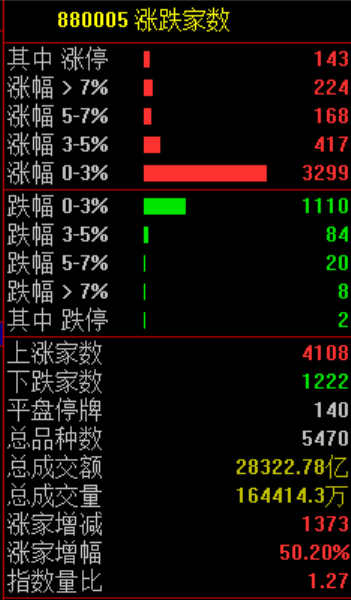
Market Performance - The A-share market experienced a significant surge, with the Shanghai Composite Index closing at its highest point, marking a record of 13 consecutive daily gains [1] - The total trading volume exceeded 2.8 trillion yuan, an increase of over 260 billion yuan compared to the previous trading day, with more than 4,000 stocks rising [1][2] - The Shanghai Composite Index rose by 1.5%, the Shenzhen Component Index by 1.4%, and the ChiNext Index by 0.75% [1] Stock Performance - A total of 4,108 stocks increased in value, with 13 stocks hitting the daily limit up, while 1,222 stocks declined [2] - Notable stocks in the medical and technology sectors, such as Sanbo Brain Science and Innovation Medical, saw significant gains, with some stocks reaching their daily limit up [4][5] - Financial stocks, including Huazhong Securities and Huazhong Securities, also experienced substantial increases, with both hitting the daily limit up [6][7] Sector Highlights - The brain-computer interface concept stocks continued to rise, driven by news from Elon Musk's Neuralink about plans for large-scale production of brain interface devices by 2026 [4] - The non-ferrous metals sector showed strength, with companies like Luoyang Molybdenum and Zijin Mining reaching historical highs [8] - The commercial aerospace sector remained active, with Beidou Star and China Satellite Communications achieving multiple trading limits [8] Autonomous Driving and AI Developments - The autonomous driving sector saw a batch of stocks hitting the daily limit up, indicating strong investor interest [10][11] - NVIDIA announced new AI models and tools aimed at accelerating the development of autonomous vehicles, with a platform named Alpamayo designed to enhance vehicle reasoning capabilities in real-world scenarios [12][13] - The first vehicles equipped with NVIDIA technology are expected to hit the roads in the U.S. in the first quarter, followed by Europe in the second quarter and Asia later in the year [13]


沸腾了!大利好,全线暴涨!
中国基金报· 2026-01-06 08:17
Core Viewpoint - The A-share market experienced a significant surge, with the Shanghai Composite Index closing at its highest point, marking a record of 13 consecutive days of gains [3][5]. Market Performance - On January 6, the Shanghai Composite Index rose by 1.5%, the Shenzhen Component Index increased by 1.4%, and the ChiNext Index gained 0.75% [3]. - The total market turnover exceeded 2.8 trillion yuan, an increase of over 260 billion yuan compared to the previous trading day, with more than 4,000 stocks rising [3][4]. Stock Highlights - The brain-computer interface concept stocks continued to rise, with companies like Sanbo Brain Science and Innovation Medical reaching their daily limit [4]. - Financial stocks, including Huashan Securities and Hualin Securities, also saw significant gains, with both stocks hitting their daily limit [6]. - The non-ferrous metal sector strengthened, with companies like Luoyang Molybdenum and Zijin Mining reaching historical highs [7]. Sector Trends - The commercial aerospace sector remained active, with Beidou Star and China Satellite Communication achieving multiple daily limit increases [8]. - The autonomous driving sector saw a batch of stocks hitting their daily limit, driven by Nvidia's announcement of new AI models and tools aimed at accelerating the development of autonomous vehicles [9][10]. Nvidia's Developments - Nvidia introduced the Alpamayo vehicle platform at CES, which allows cars to perform reasoning in real-world scenarios, enhancing autonomous driving capabilities [11][12]. - The first vehicles equipped with Nvidia technology are expected to hit the roads in the US in the first quarter, followed by Europe in the second quarter and Asia later in the year [12][13].

汽车ETF(516110)涨超1.3%,连续4日迎资金净流入,政策与自动驾驶进展提振行业预期
Mei Ri Jing Ji Xin Wen· 2026-01-06 07:40
Core Insights - The automotive ETF (516110) has risen over 1.3%, with net inflows for four consecutive days, driven by policy support and advancements in autonomous driving [1] - Dongwu Securities indicates that the automotive parts industry will experience weak overall beta due to domestic total volume impacts by 2026, but structural opportunities are expected to outperform total opportunities [1] - Companies with high competitiveness that can enhance market share and those that can strategically enter high-value sectors through internal and external growth are recommended [1] Industry Trends - The global trend favors automotive parts companies that prioritize capacity expansion in Europe, North America, and Southeast Asia, enhancing growth potential and risk resilience [1] - With profit recovery and deeper customer engagement, these companies are expected to evolve into global Tier 1 or platform leaders between 2026 and 2030 [1] - The robotics sector, particularly in relation to humanoid robots, will benefit supply chains for actuators and reducers, with leading automotive parts companies having advantages due to technological synergies and manufacturing collaboration [1] ETF Overview - The automotive ETF (516110) tracks the 800 Automotive Index (H30015), which selects listed companies from the Chinese A-share market involved in vehicle manufacturing and parts supply, reflecting the overall performance and development trends of the automotive industry [1]
自动驾驶巨头放大招,产业迎加速期
Huan Qiu Wang· 2026-01-06 07:33
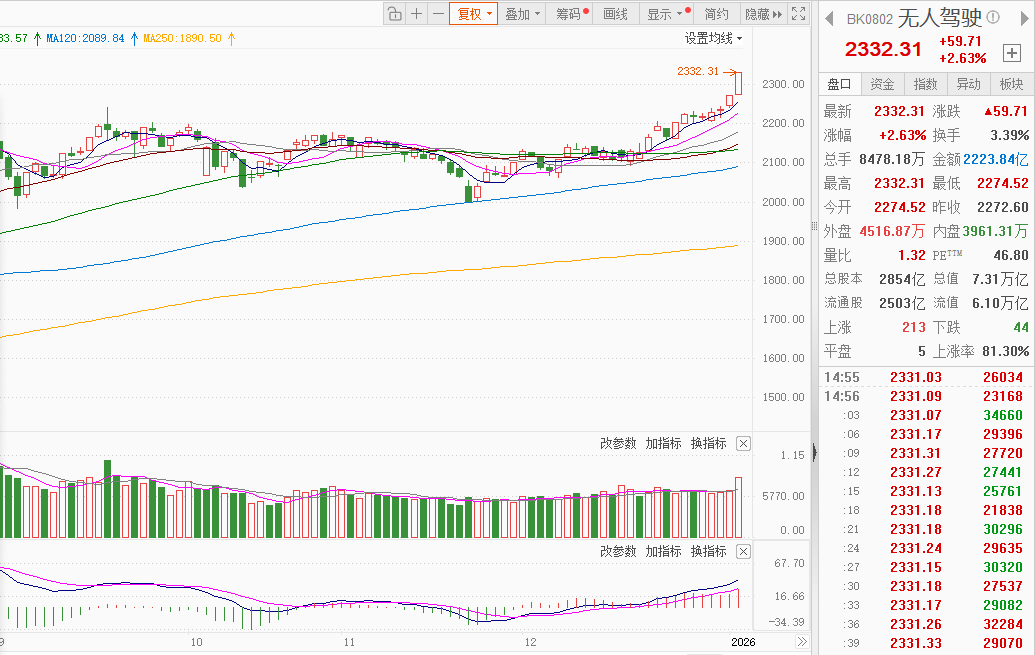
Group 1: Market Performance - The A-share market's autonomous driving sector experienced a strong surge, with multiple stocks hitting the daily limit in a short time, indicating high investor interest and willingness to invest [1] - Companies such as Hezhong Zhizhuang and Zhejiang Shibao quickly reached their daily limits within minutes of market opening, showcasing robust market activity [1] Group 2: Technological Advancements - Nvidia announced the launch of the Alpamayo series of open-source AI models and simulation tools at CES 2026, focusing on the development of reasoning-based assisted driving and autonomous driving systems [3] - The Alpamayo 1 model features 10 billion parameters, enabling autonomous vehicles to not only perceive but also logically reason and act in complex traffic scenarios [3][4] - Nvidia's new Rubin platform boasts a 3.5 times improvement in training performance and a 5 times enhancement in running AI software performance, with plans for delivery in the second half of the year [3] Group 3: Industry Developments - Nvidia's founder, Jensen Huang, highlighted the critical reasoning capabilities brought by Alpamayo, allowing autonomous vehicles to drive safely in complex environments, with major companies like Lucid and Uber adopting the platform [4] - In China, the autonomous driving industry is set to achieve significant breakthroughs by 2025, with the Ministry of Industry and Information Technology granting the first L3-level conditional autonomous driving vehicle licenses [4] - The issuance of L3-level licenses marks a pivotal shift from testing to commercial application in China's autonomous driving sector, with companies like Pony.ai exceeding their operational targets for Robotaxi fleets [4] Group 4: Future Outlook - Analysts suggest that the continuous empowerment from tech companies like Nvidia is breaking through the computational and algorithmic reasoning bottlenecks in autonomous driving, significantly shortening the timeline for L4-level commercialization [5] - The transition of responsibility from drivers to vehicle manufacturers or system suppliers in L3-level autonomous driving will raise the technical and risk management requirements for car manufacturers [5] - Companies with advanced intelligent technology, strong system engineering capabilities, and effective supply chain management are expected to benefit first from the upcoming industry wave [5]
禾赛科技激光雷达主体外观专利获授权,可用于自动驾驶等领域
Qi Cha Cha· 2026-01-06 07:16
(原标题:禾赛科技激光雷达主体外观专利获授权,可用于自动驾驶等领域) 企查查APP显示,近日,上海禾赛科技有限公司"激光雷达的主体(33)"专利获授权。企查查专利摘要显示,本外观设计产品是用于自动驾驶、 通讯、无人机、智能机器人、能源安全检测、资源勘探等领域的激光雷达,其设计要点在于形状。 游戏ETF (产品代码:159869) ★ 跟踪:中证动漫游戏指数 相关ETF 食品饮料ETF (产品代码: 515170) ★ 跟踪:中证细分食品饮料产业主题指数 近五日涨跌: -1.06% 市盈率: 20.24倍 资金流向: 最新份额为103.4亿份,减 少了1350.0万份,净申 赎-740.1万元。 估值分位:19.16% 近五日涨跌:4.00% 近五日涨跌: - 0.06% 市盈率: 37.26倍 资金流向: 最新份额为87.6亿份, 增加 了0.0份,净申赎0.0元。 估值分位:55.98% 科创50ETF (产品代码: 588000) ★ 跟踪:上证科创板50成份指数 市盈率:167.30倍 资金流向: 最新份额为537.1亿份, 增 加了6.2亿份, 净申赎8.8亿 元。 估值分位: 96.90% 云计算5 ...
隆基机械(002363.SZ):已参与 L3 级自动驾驶汽车制动部件产品供应
Ge Long Hui A P P· 2026-01-06 07:01
Core Viewpoint - Longi Machinery (002363.SZ) has engaged in supplying braking components for L3 level autonomous vehicles, marking its participation in the domestic market for conditional autonomous driving models [1] Group 1: Company Developments - The company has participated in the supply of braking components for the first batch of L3 level conditional autonomous driving vehicles in China [1] - Longi Machinery implements stringent quality control standards throughout the entire production process, from raw material intake to finished product delivery, adding multiple inspection points at each stage [1] - The production process utilizes higher precision manufacturing techniques to ensure that products meet the safety application requirements for advanced autonomous driving [1]

隆基机械(002363.SZ):已为我国首批 L3 级有条件自动驾驶车型长安深蓝 、北汽极狐阿尔法提供制动部件配套
Ge Long Hui A P P· 2026-01-06 07:01
Core Viewpoint - Longi Machinery has established itself as a leader in the field of autonomous driving components by successfully providing braking parts for China's first batch of L3 conditional autonomous driving vehicles, showcasing its strong technical capabilities and competitive product offerings [1] Group 1: Company Achievements - Longi Machinery has supplied braking components for the L3 level conditional autonomous driving models Chang'an Deep Blue and BAIC Arcfox Alpha [1] - The company has passed rigorous performance and safety validations from major manufacturers, demonstrating its high standards and compliance in the industry [1] - The successful entry into the autonomous driving component market highlights Longi Machinery's leading position and product competitiveness [1]
简历直推 | 清华大学全国重点实验室招聘工程师/博后/实习生(世界模型/重建/感知等)
自动驾驶之心· 2026-01-06 06:52
自动驾驶车端世界模型方向 招工程师/博后/实习生 点击下方 卡片 ,关注" 自动驾驶之心 "公众号 戳我-> 领取 自动驾驶近30个 方向 学习 路线 清华大学智能绿色车辆与交通全国重点实验室招聘工程师/博后/实习生,感兴趣的可以联系柱哥投递简历或邮 箱自行投递简历。 【岗位目标】 面向端到端自动驾驶核心技术需求,从事车端世界模型的研究与工程化落地。构建融合物理先验、时序一致 性与行为预测能力的世界模型架构,实现复杂驾驶场景的理解、预测与生成,支撑自动驾驶系统的感知、预 测、规划一体化能力建设,推动端到端自动驾驶技术的工程化应用。 【核心职责及次要职责】 核心职责: 次要职责: 1. 研究与开发车端世界模型核心架构,融合物理先验、因果推理、时序一致性与行为预测能力; 2. 构建驾驶场景时空表征与预测模型,实现交通参与者行为预测、场景演化推理与长期规划; 3. 研发基于Transformer、Diffusion、Neural Fields等前沿架构的场景生成与仿真模型; 4. 设计多模态输入融合方案,实现图像、点云、地图、轨迹等多源信息的统一编码与推理; 5. 完成世界模型在车端平台的部署优化,满足实时性与资源 ...

英伟达宣布自动驾驶领域多项进展,发布汽车平台Alpamayo
Huan Qiu Wang Zi Xun· 2026-01-06 06:22
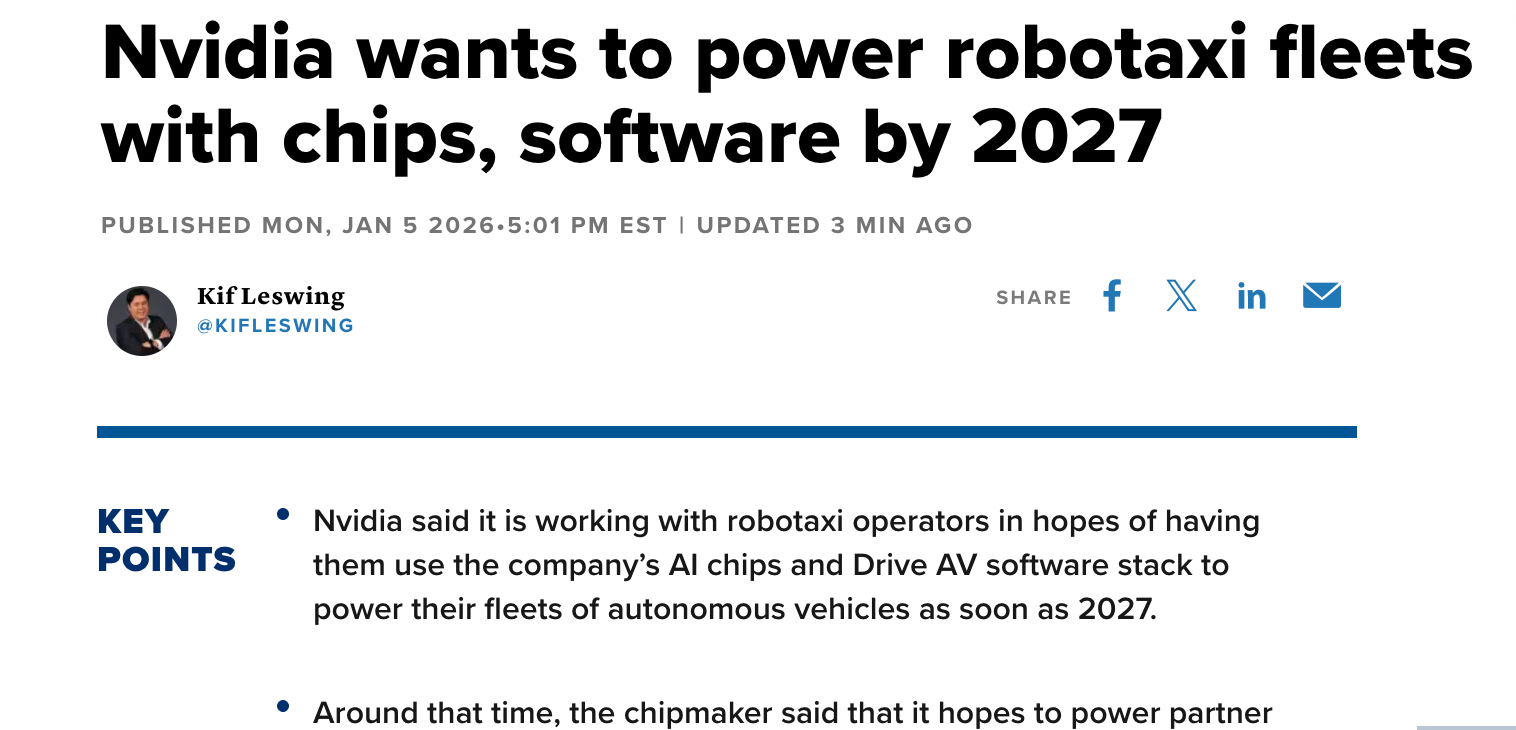
Group 1 - Nvidia's CEO Jensen Huang envisions a future where a billion autonomous vehicles will be on the roads, offering options for both ride-hailing and personal ownership of self-driving cars [1] - Nvidia is actively collaborating with autonomous taxi operators to implement its AI chips and Drive AV software stack, aiming to support autonomous fleets by 2027 [3] - The company aims to assist partners in deploying Level 4 (L4) autonomous taxis, which can operate without human intervention in predefined areas, significantly advancing the commercialization of autonomous driving technology [3] Group 2 - Nvidia has launched a series of AI models and tools to accelerate the development of autonomous vehicles and support next-generation robotics, including a new automotive platform named "Alpamayo" [3] - The "Alpamayo" platform allows vehicles to perform reasoning in real-world scenarios, enabling potential users to retrain the model for handling unexpected situations [3] - As of October, Nvidia's automotive and robotics chip sales amounted to $592 million, representing only 1% of the company's total revenue [4]
这不是显卡,是一座2吨重的AI工厂
华尔街见闻· 2026-01-06 03:53
Core Insights - NVIDIA has announced the full production of the Vera Rubin platform, which weighs nearly 2 tons and integrates six new chips, significantly enhancing inference cost and training efficiency, achieving AI computations at a trillion operations per second, marking it as a true AI factory [2] - The company has also open-sourced its first inference VLA (Vision-Language-Action) model, Alpamayo 1, designed for vehicles to "think" and solve problems in unexpected situations, utilizing a 10 billion parameter architecture [3] - The first vehicles equipped with NVIDIA technology are set to hit the roads in the US in Q1, Europe in Q2, and Asia later in the year [4][17] Production and Performance - The new Rubin platform has a performance increase of 5 times compared to the previous Blackwell version, with training performance being 3.5 times better [5][8] - The Rubin platform can reduce inference token generation costs by up to 10 times and decrease the number of GPUs required for training mixture of experts models by 4 times [8] - The Vera CPU in the Rubin platform features 88 cores, providing double the performance of its predecessor, and is designed for agent inference, making it the most energy-efficient processor in large-scale AI factories [8] Ecosystem and Deployment - Major cloud providers, including Microsoft, are expected to be among the first to deploy the new hardware in the second half of the year, with Microsoft’s next-generation Fairwater AI super factory set to utilize NVIDIA's Vera Rubin NVL72 systems [6] - NVIDIA maintains a long-term bullish outlook, predicting the total market size could reach several trillion dollars despite concerns about increasing competition and sustainability of AI spending [7] Innovations and Technologies - The Rubin platform incorporates five innovative technologies, including the sixth-generation NVLink interconnect technology and a third-generation transformer engine, which provides 50 petaflops of NVFP4 computing power for AI inference [9] - The platform's modular design allows for faster assembly and maintenance, with an 18 times quicker process compared to Blackwell [9] Open Source Initiatives - NVIDIA has released the Alpamayo model as part of a complete open ecosystem for autonomous driving development, which includes simulation frameworks and datasets [14][21] - The Alpamayo model is designed for the autonomous driving research community, allowing developers to adapt it for vehicle development and as a foundational tool for autonomous driving technology [15][18] - NVIDIA has also launched various open-source models and tools across different sectors, including the Nemotron family for agent AI and the Cosmos platform for physical AI [26][27]