
智能驾驶

Search documents
华丰科技(688629):联合研究|公司点评|华丰科技(688629.SH):华丰科技(688629):AI业务加速推进,盈利持续改善
Changjiang Securities· 2025-11-16 09:46
丨证券研究报告丨 [Table_scode 联合研究丨公司点评丨华丰科技( Msg1] 688629.SH) [Table_Title] AI 业务加速推进,盈利持续改善 报告要点 [Table_Summary] 作为国内高速数通连接器的核心厂商之一,公司有望持续受益于国产算力建设浪潮,深度参与 国产算力机柜方案渗透。 分析师及联系人 [Table_Author] 于海宁 王贺嘉 刘泽龙 SAC:S0490517110002 SAC:S0490520110004 SAC:S0490525040002 SFC:BUX641 SFC:BUX462 请阅读最后评级说明和重要声明 %% %% %% %% research.95579.com 1 [Table_scodeMsg2] 华丰科技(688629.SH) cjzqdt11111 [Table_Title2] AI 业务加速推进,盈利持续改善 [Table_Summary2] 事件描述 华丰科技发布 2025 年第三季度报告。报告期内,公司实现营业收入 16.59 亿元,同比增长 121.47%;实现归属母公司股东的净利润 2.23 亿元,同比增长 558.51 ...
港股周报:关注港股财报季,看好港股科技估值持续提升-20251116
Minsheng Securities· 2025-11-16 09:17
Market Overview - The Hang Seng Index rose by 1.26% this week, with a trading volume of HKD 1.16 trillion[1] - The Hang Seng Technology Index decreased by 0.42%, while the Hang Seng China Enterprises Index increased by 1.41%[1] - Net inflow from southbound trading was HKD 22.6 billion this week, totaling HKD 1,214.3 billion year-to-date, which is 164.5% of the total net inflow for 2024[1] Sector Performance - The top two performing sectors this week were Consumer Staples and Paper & Packaging, with weekly gains of 10.27% and 6.66% respectively[1] - Notable stocks in the Consumer Staples sector included Jiangsu Hongxin, Alpha Enterprises, and JD Health, with increases of 13.21%, 11.54%, and 6.59% respectively[1] - Other strong performing sectors included Pharmaceuticals & Biotechnology (5.4%) and Durable Goods (5.03%)[1] AI Developments - GPT-5.1 was officially released on November 13, featuring enhanced models for improved communication and reasoning capabilities[2] - Baidu launched the Wenxin 5.0 model, which supports multimodal input and output, boasting over 2.4 trillion parameters[2] Company Earnings - Tencent reported Q3 2025 revenue of HKD 192.9 billion, a 15% year-on-year increase, with a net profit of HKD 63.1 billion, up 19%[8] - JD Group achieved Q3 2025 revenue of HKD 299.1 billion, a 14.9% increase year-on-year, but net profit fell to HKD 5.3 billion from HKD 11.7 billion in the previous year[8] - Bilibili's Q3 2025 revenue was HKD 7.69 billion, a 5% increase, with adjusted net profit soaring 233% to HKD 0.79 billion[8] Investment Recommendations - The report suggests focusing on platform-based internet companies with computational resources and model capabilities, including Tencent, Kuaishou, Alibaba, Xiaomi, Baidu, and Meituan[4] - AI ecosystem companies with model or application capabilities are also recommended, such as Qunar, Meitu, JD Health, and Zhihu[4] Risks - Geopolitical risks may impact overseas revenue and competitiveness, potentially affecting stock prices[26] - Regulatory risks in the internet sector could influence industry and individual stock performance[26] - Consumer recovery may not meet expectations, posing a risk to the consumer sector[26]




汽车和汽车零部件行业周报20251116:宇树科技完成上市辅导,关注国产机器人IPO进程-20251116
Minsheng Securities· 2025-11-16 05:42
Investment Rating - The report maintains a positive investment outlook for the automotive and automotive parts industry, particularly focusing on companies involved in intelligent driving and electric vehicles [3][4]. Core Insights - The automotive sector has shown weaker performance compared to the market, with a decline of 1.7% in the A-share automotive sector from November 10 to November 16, 2025, ranking 27th among sub-industries [29]. - Key companies to watch include Geely, Xpeng Motors, BYD, Xiaomi Group, Li Auto, Berteli, Top Group, New Spring, Hu Guang, and Chunfeng Power, as they are expected to benefit from the ongoing transformation in the automotive industry [9][10]. - The report highlights the importance of Tesla's production progress and technological iterations as a core theme, alongside the upcoming IPOs of domestic robot manufacturers like Yushu Technology, which could serve as strong catalysts for the industry [10][16]. Summary by Sections 1. Weekly Insights - Yushu Technology has completed its IPO guidance and plans to submit its IPO application between October and December 2025, with a post-investment valuation exceeding 12 billion yuan [10]. - The report emphasizes the significance of Tesla's advancements and the upcoming IPOs of domestic robot manufacturers as key drivers for the market [10][16]. 1.1 Passenger Vehicles - The report recommends focusing on high-quality domestic brands that are accelerating in intelligence and globalization, specifically naming Geely, Xpeng, BYD, Xiaomi, Li Auto, and Seres [13]. 1.2 Intelligent Electric Vehicles - The report anticipates long-term growth acceleration in the intelligent electric vehicle sector, highlighting the importance of intelligent driving technologies and the increasing market share of domestic brands [14][15]. 1.3 Robotics - The report notes that leading companies are accelerating their entry into the robotics sector, marking the beginning of a new era in embodied intelligence, with significant developments expected in 2026 [15][17]. 1.4 Liquid Cooling - The report discusses the rising demand for liquid cooling solutions driven by AI technology, predicting a compound annual growth rate of 27.6% from 2024 to 2030, with the market expected to reach 21.3 billion USD by 2030 [20][21]. 1.5 Motorcycles - The report highlights the rapid expansion of the large-displacement motorcycle market, with sales showing significant year-on-year growth, particularly in the 500cc to 800cc segment [22][24]. 1.6 Heavy Trucks - The report indicates that the expansion of the old-for-new subsidy policy will stimulate demand for heavy trucks, with a notable increase in sales observed in October 2025 [24][25]. 1.7 Tires - The report emphasizes the ongoing globalization of the tire industry, recommending leading companies that are well-positioned for growth and have strong manufacturing capabilities [26][27].



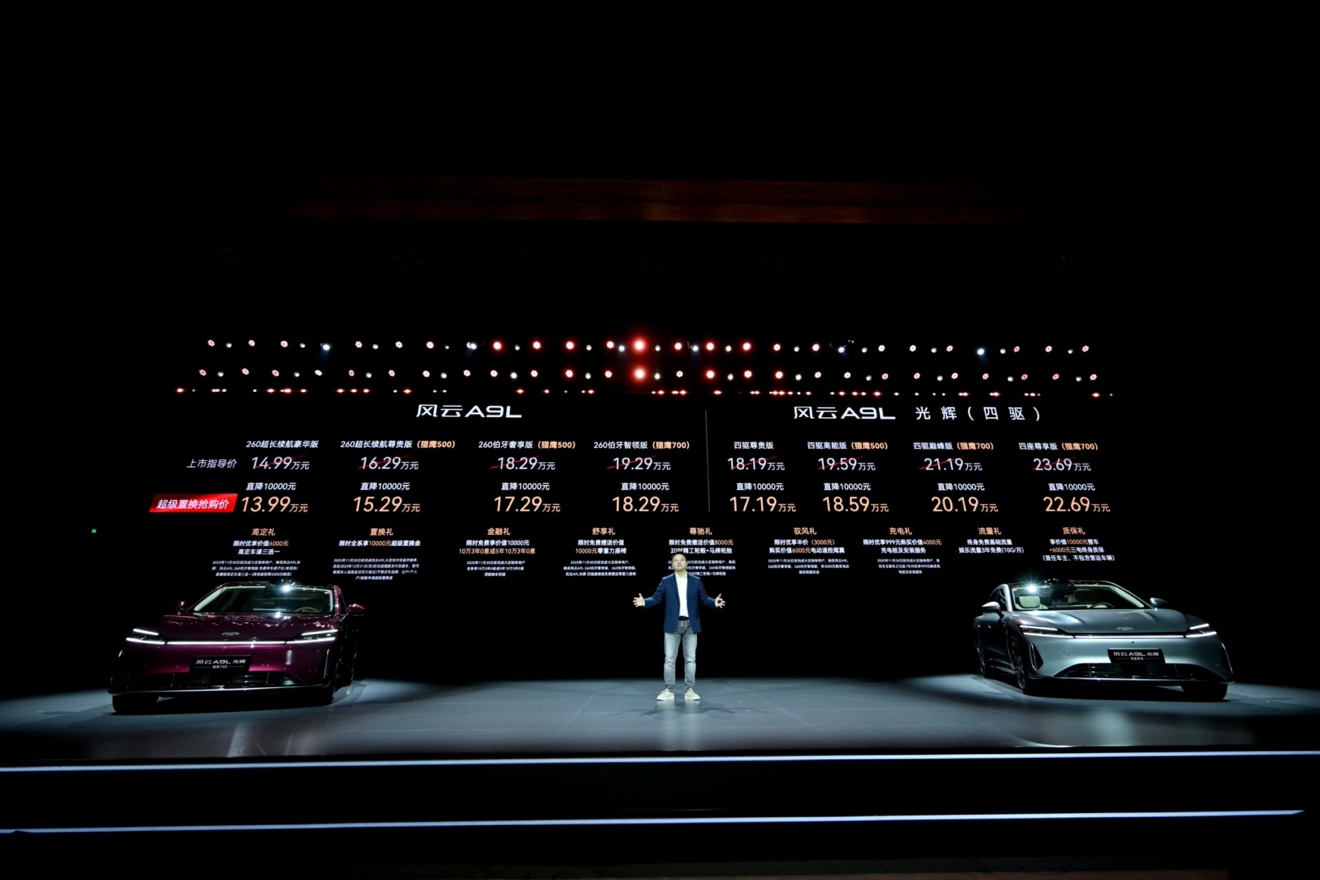
超级置换抢购价17.19万元起,风云A9L光辉(四驱)全球上市
Zhong Guo Qi Che Bao Wang· 2025-11-15 13:24
Core Insights - The launch of the Fengyun A9L Glorious (4WD) marks a significant milestone for Chery, introducing four versions with prices starting from 171,900 yuan, setting a new benchmark in the luxury car market in China [1][14] - The Fengyun A9L has achieved over 10,000 deliveries for three consecutive months, positioning it among the top in the mid-to-large sedan category [3][14] - The vehicle features advanced intelligent driving capabilities and luxurious interior design, aiming to redefine user experience in the luxury segment [5][9] Pricing and Models - The Fengyun A9L Glorious (4WD) is available in four versions: - 4WD Premium Version: 171,900 yuan - 4WD High-Energy Version (Falcon 500): 185,900 yuan - 4WD Peak Version (Falcon 700): 201,900 yuan - 4WD Exclusive Version (Falcon 700): 226,900 yuan [1] - The launch includes nine purchase benefits, enhancing the overall value proposition for consumers [1] Intelligent Driving Features - The Fengyun A9L Glorious Falcon 700 incorporates a self-developed high-level intelligent driving system based on the Momenta R6 model, capable of learning from 20 million kilometers of real-world data daily [5][7] - The system demonstrates advanced decision-making capabilities in various challenging driving scenarios, ensuring a smooth driving experience [7] Luxury Experience - The Fengyun A9L Glorious Exclusive Version offers a spacious interior with a 3000mm wheelbase and luxurious seating features, including electric adjustments and massage functions [9] - The vehicle integrates smart amenities such as a temperature-controlled refrigerator and various connectivity options, creating a versatile mobile space [9] User Engagement and Feedback - The development of the Fengyun A9L Glorious involved extensive user feedback, with 1,278 suggestions implemented from over 18,800 collected [11] - The vehicle has received positive endorsements from users and brand ambassadors, highlighting its value and comfort [11] Technical Specifications - The Fengyun A9L Glorious is built with 88% high-strength steel and aluminum, ensuring safety and durability [11][12] - It features a hybrid power system with a thermal efficiency of 45.79%, offering a pure electric range of 260 km and a combined range exceeding 1200 km [11] - The vehicle's braking and handling capabilities are enhanced by advanced suspension and braking systems, ensuring confident control [11] Industry Recognition - The Fengyun A9L has received multiple industry accolades, including NESTA six-dimensional electric safety certification and recognition for its chassis and energy efficiency [12] - The vehicle aims to establish a new standard for health and safety in the automotive sector, reinforcing its position as a flagship model [12]

希迪智驾第三次递表港交所,上半年营收约4.08亿元
Ju Chao Zi Xun· 2025-11-15 02:54
Core Insights - Xidi Intelligent Driving Technology Co., Ltd. has submitted its third application to the Hong Kong Stock Exchange, with joint sponsors including CICC, CITIC International, and Ping An Securities (Hong Kong) [2] - The company is a leading provider of intelligent driving products and solutions for commercial vehicles in China, focusing on autonomous mining and logistics vehicles, V2X technology, and intelligent perception solutions [2] - Xidi ranks sixth among all intelligent driving commercial vehicle companies in China, holding a market share of approximately 5.2% [2] Financial Performance - Revenue is projected to increase from RMB 31.1 million in 2022 to RMB 410.0 million in 2024, representing a compound annual growth rate (CAGR) of 263.1% [3] - Revenue for the six months ending June 30, 2024, is expected to rise by 57.9% from RMB 258.5 million to RMB 408.0 million for the six months ending June 30, 2025 [3] - Gross profit is anticipated to grow from RMB 26.8 million in 2023 to RMB 101.4 million in 2024, with a gross profit increase of 57.1% from RMB 44.4 million for the six months ending June 30, 2024, to RMB 69.7 million for the six months ending June 30, 2025 [3] Market Position - Xidi has delivered 56 autonomous mining trucks to a mining area in China, operating alongside approximately 500 manned trucks, forming the world's largest mixed-operation mining vehicle fleet [2] - The company has also delivered China's first fully autonomous electric mining vehicle fleet, ranking first in the autonomous mining truck solution market based on projected product sales revenue for 2024 [2] - Xidi is among the first companies in China to launch commercial V2X products [2]
乔锋智能(301603):助力公司开启第二增长极(首次覆盖):中高端数控机床领域专精特新“小巨人”企业,新兴产业市场开拓顺利
Jianghai Securities· 2025-11-14 13:17
Investment Rating - The report assigns a "Buy" rating for the company with a target price of 123.50 CNY, based on a current price of 75.54 CNY and a target timeframe of 12 months [1]. Core Insights - The company, Qiaofeng Intelligent Equipment Co., Ltd., is recognized as a national-level specialized and innovative "little giant" enterprise in the high-end CNC machine tool sector, with a comprehensive layout across the entire industry chain [6][15]. - The company has demonstrated robust growth in revenue and profit, with a projected revenue of 1.76 billion CNY in 2024, reflecting a year-on-year increase of 21.02%, and a net profit of 205.24 million CNY, also up by 21.33% [8][41]. - The demand in the terminal market is continuously releasing, which is driving the company's steady growth in performance [41]. Summary by Sections Company Overview - Qiaofeng Intelligent was established in 2009 and focuses on the R&D, production, sales, and service of high-end CNC machine tools, serving various industries including automotive, aerospace, and consumer electronics [15][19]. - The company has over 200 patented technologies and a diverse product range that meets the varied needs of its clients [19][20]. Market Demand and Performance - The company has seen a significant increase in performance, with a revenue of 1.87 billion CNY in the first three quarters of 2025, marking a year-on-year growth of 56.71% [41]. - The growth is attributed to the continuous improvement in downstream industry conditions and the successful introduction of new products [41]. Financial Forecast - The financial projections indicate a revenue increase to 2.49 billion CNY in 2025, with a growth rate of 41.25%, and a net profit of 382.57 million CNY, reflecting an 86.40% increase [8][9]. - The report anticipates that the company's earnings per share (EPS) will reach 3.17 CNY in 2025, with a price-to-earnings (P/E) ratio of 23.84 [8][9]. Industry Trends - The rapid development of AI and the consumer electronics industry is expected to support the company's performance, with global smartphone shipments projected to increase by 1% in 2025 [6][41]. - The growth of the new energy vehicle sector, driven by advancements in smart driving and solid-state batteries, is also anticipated to boost equipment demand [41][42]. Strategic Initiatives - The company is actively expanding into the humanoid robot market, with a forecasted global market size of 63.39 billion CNY by 2025 [9][41]. - Collaborations with universities and other companies are enhancing the company's technological capabilities and market reach [19][20].
全系皆Ultra!上汽旗舰智己LS9准备掀翻30万级大六座SUV市场
Xin Lang Cai Jing· 2025-11-14 12:21
Core Viewpoint - The launch of the IM LS9 aims to reshape the market for large six-seat SUVs priced around 300,000 yuan, featuring advanced technology and premium configurations [2][9]. Group 1: Product Features - The IM LS9 is available in two versions: the 52 Ultra version priced at 322,800 yuan and the 66 Ultra version at 352,800 yuan, with a focus on a "full series Ultra" configuration strategy [2]. - It features a unique dual-direction 24° smart four-wheel steering system, achieving a turning radius of only 4.95 meters, providing maneuverability comparable to smaller vehicles despite its length exceeding 5 meters [2]. - The vehicle is equipped with an 800V architecture and dual-motor vector four-wheel drive, delivering a maximum output of 390 kW and 670 N·m, enabling acceleration from 0 to 100 km/h in under 4 seconds [4]. Group 2: Technology and Innovation - The IM LS9 incorporates the Lingxi Digital Chassis 3.0, Stellar Super Range Extender system, and L3-level intelligent driving hardware, achieving multiple breakthroughs in performance and comfort [2]. - It features 520-line ultra-vision lidar and the Nvidia Thor chip, supporting L3-level perception capabilities, along with advanced driver assistance systems developed in collaboration with Momenta [6]. - The vehicle's Stellar Super Range Extender technology addresses the performance degradation issues of traditional range-extended electric vehicles, maintaining stable output in extreme conditions [4]. Group 3: Interior and Comfort - The interior design boasts an 86% space utilization rate, with all three rows of seats supporting zero-gravity mode and convertible layouts for enhanced comfort [6]. - The IM LS9 includes a high-end Danish B&O audio system and 4D mechanical massage seats, with massage intensity seven times that of pneumatic systems [6]. - A unique outdoor luxury package is available, providing 24-hour water access for cleaning after outdoor activities [6]. Group 4: Market Positioning - The IM LS9 aims to carve out a new niche in the competitive market dominated by models like the Ideal L9 and AITO M9, with a product strategy of "entry-level is peak" [9]. - The vehicle offers over 150 premium features as standard, including four-wheel steering and advanced safety technologies, with limited-time free upgrades available during the launch period [8].

魔视智能拟港股上市 中国证监会要求补充说明境外生产经营具体情况等
Zhi Tong Cai Jing· 2025-11-14 12:07
11月14日,中国证监会公布《境外发行上市备案补充材料要求(2025年11月10日—2025年11月14日)》。 中国证监会国际司公示10家企业补充材料要求,其中,公示提到要求魔视智能补充说明发行人历史沿 革、境外生产经营的具体情况等。据港交所9月26日披露,魔视智能科技(上海)股份有限公司(简称"魔视 智能")向港交所主板递交上市申请书,国泰君安国际、国信证券(香港)为其联席保荐人。 中国证监会请魔视智能补充说明以下事项,请律师核查并出具明确的法律意见: 一、关于发行人历史沿革:(1)请进一步说明发行人提交境外发行上市备案申请前12个月内新增股东所 涉股权转让定价依据、与同期增资定价差异原因及其合理性,以及上述股权转让环节相关转让方所得税 缴纳情况;(2)请就发行人设立及历次股权变动是否合法合规出具明确结论性意见。 六、请说明本次拟参与"全流通"股东所持股份是否存在被质押、冻结或其他权利瑕疵的情形。 二、发行人及下属公司经营范围包含"佣金代理(拍卖除外)""集成电路芯片及产品制造""集成电路制 造""雷达及配套设备制造",请说明具体业务开展情况。 招股书显示,魔视智能是一家由人工智能创新驱动的智能驾驶解决方 ...
宇瞳光学(300790) - 2025年11月14日投资者关系活动记录表
2025-11-14 07:58
Group 1: Financial Performance - In the first three quarters of 2025, the company achieved revenue of 2.362 billion CNY, a year-on-year increase of 18.49% [8] - Net profit attributable to shareholders reached 188 million CNY, up 40.99% year-on-year, with a non-recurring net profit of 186 million CNY, increasing by 49.29% [8] - In Q3 2025, revenue grew by 27.06% year-on-year, with a net profit of 80 million CNY, reflecting a 64.91% increase year-on-year and a 36.96% increase quarter-on-quarter [8] Group 2: Growth Drivers - Revenue growth is driven by increased sales, optimized product structure, rising overseas revenue share, rapid growth in new consumption business, and a 1.7 percentage point increase in gross margin compared to the previous year [8] - The new consumption business includes applications in glasses, benefiting from demand for non-spherical lenses in panoramic cameras, action cameras, consumer drones, and AI [8] Group 3: Production and Capacity - The company plans to expand its production capacity of molded glass (non-spherical glass lenses) from 6 million pieces per month to 8 million pieces by the end of the year due to high demand [9] - The current production is at full capacity, with a significant portion of output being sold and some retained for internal use [9] Group 4: Strategic Partnerships and Future Outlook - The company has a close partnership with Yujing Optoelectronics, which is a key player in the AI camera market for major clients like Meta, Apple, and Google [9] - The automotive sector shows promising growth, with a 34% increase in revenue from vehicle-mounted lenses and a 160% increase in revenue from HUD and laser radar optical components [9] - Future growth areas include the widespread application of molded glass in new consumption fields, upgrades in intelligent driving technologies, and potential new products in mobile phone camera lenses [9]
希迪智驾3年半累亏超15亿 收入高增之下亏损同步扩大
Zhong Guo Jing Ji Wang· 2025-11-14 06:01
Core Viewpoint - Hidi Intelligent Driving Technology Co., Ltd. has submitted an application to the Hong Kong Stock Exchange for an IPO, despite accumulating losses exceeding 1.5 billion yuan over three and a half years [1][2] Financial Performance - The company's revenue has shown significant growth from 31.06 million yuan in 2022 to 410 million yuan in 2024, with the first half of 2025 achieving approximately 410 million yuan, nearing the total revenue of 2024 [2] - Despite the revenue growth, the company recorded increasing losses, with losses of 263 million yuan in 2022, 255 million yuan in 2023, 581 million yuan in 2024, and 455 million yuan in the first half of 2025 [1][2] Business Focus - Hidi Intelligent Driving specializes in intelligent driving products and solutions for commercial vehicles, focusing on autonomous mining and logistics vehicles in closed environments, as well as V2X technology and intelligent perception solutions [1]