
通胀

Search documents
2026年,存款多的人要“偷着乐”?4个原因,普通人越早知道越赚
Sou Hu Cai Jing· 2026-01-03 07:56
Core Viewpoint - The current economic environment suggests that having more savings is advantageous due to low inflation and declining prices, allowing individuals to maintain purchasing power and avoid investment risks [1][3][5]. Group 1: Economic Context - As of November 2025, the broad money supply (M2) in China reached 336.99 trillion yuan, growing by 8.0% year-on-year, indicating potential inflation risks in the future [1]. - The current bank deposit interest rates have dropped significantly from 3.25% to 1.75%, a decline of over 40%, with further decreases anticipated [1]. Group 2: Purchasing Power - The purchasing power of savings remains stable, with the Consumer Price Index (CPI) showing no growth year-on-year, indicating that prices for essential goods like housing, vehicles, and food are decreasing [3][5]. - For example, the price of pork has decreased, allowing individuals to buy more with the same amount of money, enhancing the value of savings [5]. Group 3: Investment Risks - Investment risks are rising, with many investors experiencing losses in funds, and 81.1% of retail investors in the A-share market reporting losses in 2025 [8]. - Holding cash allows individuals to avoid these investment risks, as the principal and interest on savings remain secure despite low rates [8]. Group 4: Financial Security - Having savings provides a buffer against unexpected events such as job loss or medical emergencies, allowing individuals to manage crises without immediate financial pressure [11]. - Business owners can use their savings to cover operational costs during downturns, ensuring stability in challenging economic conditions [11]. Group 5: Opportunities in a Downturn - In a deflationary environment, individuals with substantial savings have the opportunity to invest in undervalued assets once market bubbles burst, positioning themselves for future gains [13]. - The ability to acquire shares in struggling companies at low prices can lead to significant wealth accumulation when the economy rebounds [13].

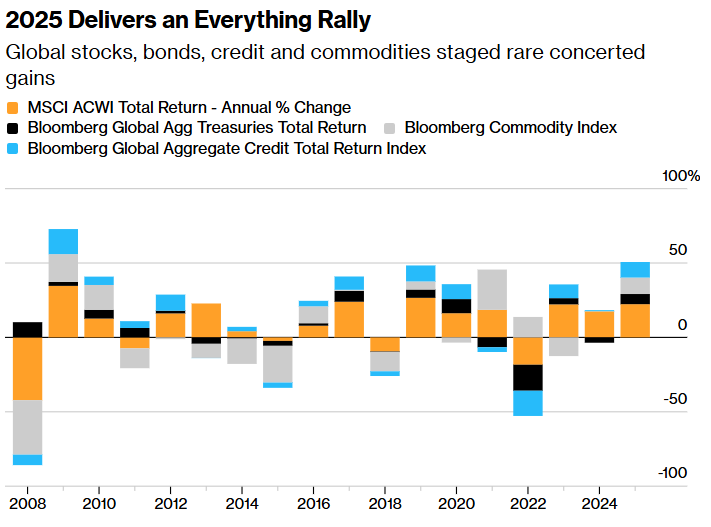
全球市场强劲开局 人工智能热潮引领多资产同步上涨
Xin Lang Cai Jing· 2026-01-03 05:12
2025年,全球各类资产的强劲表现是自2009年以来最强劲的,当时正值金融危机后期,各国政府采取了 广泛的政策干预。当年,跨资产的同步上扬使得多元化投资似乎变得轻而易举,但也引出了对市场未来 走势的担忧。当原本旨在互相抵消的资产一致上涨时,投资组合的保护能力可能下降。 随着市场步入2026年,人们的担忧主要不是去年上涨是否非理性,而是这种上涨势头是否难以为继。华 尔街的预期继续基于人工智能巨额投资、强劲的经济增长以及政策制定者能够适当放松货币政策而不引 发通胀的前景。来自多家机构的预测显示,这些因素的持续存在得到了普遍认同。 尽管如此,市场情绪中仍存在谨慎成分。鉴于某些行业快速扩张,尤其是与人工智能和核能相关的股 票,投资者对持续性持谨慎乐观态度,担心未来的回报可能会因快速增长而减弱。同时,投资者对通胀 隐忧仍未消散,部分认为能源价格的上升或政策失误可能会逆转通胀压力缓解的趋势。 2026年初,市场对人工智能的乐观情绪推动股市开局强劲,其中新兴市场尤其受到在人工智能崛起的助 推,显示出巨大的投资潜力。这一趋势反映了投资者在经济背景与科技进步中对新兴市场的热情。 总而言之,尽管2026年市场环境中依旧存在各种阻 ...
全球“股债商”创下2009年来最强牛市后,华尔街带着高预期开启2026年
Zhi Tong Cai Jing· 2026-01-03 04:29
Group 1 - The market has continued its upward momentum from the end of last year, with global stock markets rising and investor confidence remaining high, driven by factors such as the AI boom, easing inflation, and supportive central bank policies [1] - The synchronized performance across various asset classes, including stocks and bonds, is notable, with credit spreads narrowing and commodity prices rising despite easing inflationary pressures [1] - The financial environment is approaching its loosest level since 2025, indicating rising valuations and a consensus among investors regarding economic growth and AI expectations [1] Group 2 - Concerns have been raised about the sustainability of the past year's strong performance, with some experts warning that the factors driving returns may not remain constant [2] - The strong performance of the stock market has contributed to a 18% return in the US stock market and a 23% increase in global stock markets, with government bonds also rising nearly 7% due to the Federal Reserve's rate cuts [5] - The volatility in the market has significantly decreased, with the bond market experiencing its largest annual decline in volatility since the financial crisis, and investment-grade bond spreads narrowing for the third consecutive year [5][8] Group 3 - There is a prevailing optimism among asset allocators regarding economic growth and policy support, which they believe can offset high valuations [9] - The traditional 60/40 investment strategy has seen a resurgence, with a return of 14%, while risk parity strategies have achieved a 19% increase, marking the best annual performance since 2020 [8] - Despite the overall positive sentiment, there are warnings about potential inflationary pressures, particularly from rising energy prices, which could reverse recent progress [6]
银行职员透露:2026年起,手里有定期存款的人,尽量做好这4个准备
Sou Hu Cai Jing· 2026-01-02 04:38
Core Viewpoint - The increasing enthusiasm of depositors to save money is driven by concerns over unemployment and health emergencies, as well as the perceived risks associated with higher-yield investment products like stocks and funds [1]. Group 1: Deposit Trends - In the first eleven months of 2025, residents' deposits increased by 120.6 billion yuan [1]. - The decline in deposit interest rates has been noted since 2023, with the three-year fixed deposit rate dropping from 3.25% to 1.75%, resulting in a decrease of 1,500 yuan in annual interest income for a 100,000 yuan deposit [6]. Group 2: Recommendations for Depositors - Depositors should consider moving funds to joint-stock banks, which typically offer higher interest rates than state-owned banks, while still being safer than village and commercial banks [6]. - For deposits exceeding 200,000 yuan, purchasing large-denomination certificates of deposit (CDs) is advisable, as they offer higher rates and transferability [6]. - A diversified asset allocation strategy is recommended to counteract the inability of deposit rates to outpace inflation, with examples provided for conservative investors [9]. Group 3: Liquidity and Safety - Maintaining liquidity is crucial; depositors are advised to avoid locking all funds in long-term deposits to prevent losses from early withdrawals due to emergencies [12]. - A suggested strategy includes keeping a portion of funds in short-term large-denomination CDs while locking the remainder in longer-term deposits [12]. Group 4: Bank Stability Concerns - The number of small bank failures is expected to rise, with recent examples including Baoshang Bank and Liao Yang Rural Commercial Bank [17]. - Depositors should ensure their banks display deposit insurance symbols, diversify their deposits across multiple banks, and understand the difference between deposits and investment products to ensure coverage in case of bank failures [17].

土耳其上调燃油、烟草及酒精饮品定额消费税
Xin Lang Cai Jing· 2026-01-01 13:38
土耳其政府上调燃油、烟草及酒精饮品的定额消费税,此次涨幅低于生产者通胀水平。政策制定者此举 旨在支持央行放缓物价上涨的努力。 根据周三《官方公报》发布的一项决议,政府将汽油和柴油的定额税提高6.95%,烟草与酒精饮品的定 额税提高7.95%。 土耳其官方通讯社阿纳多卢通讯社援引财政部消息称,土耳其每年1月和7月会根据前六个月生产者价格 指数(PPI)的变动情况,对所谓的"定额消费税"进行两次调整。此次最新加税幅度小于同期生产者价 格涨幅,核心目的是为抑制通胀提供支持。 责任编辑:陈钰嘉 土耳其政府上调燃油、烟草及酒精饮品的定额消费税,此次涨幅低于生产者通胀水平。政策制定者此举 旨在支持央行放缓物价上涨的努力。 根据周三《官方公报》发布的一项决议,政府将汽油和柴油的定额税提高6.95%,烟草与酒精饮品的定 额税提高7.95%。 土耳其官方通讯社阿纳多卢通讯社援引财政部消息称,土耳其每年1月和7月会根据前六个月生产者价格 指数(PPI)的变动情况,对所谓的"定额消费税"进行两次调整。此次最新加税幅度小于同期生产者价 格涨幅,核心目的是为抑制通胀提供支持。 责任编辑:陈钰嘉 ...
美国:通胀降温难缓解物价压力 民众被迫改变购物习惯
Sou Hu Cai Jing· 2026-01-01 09:38
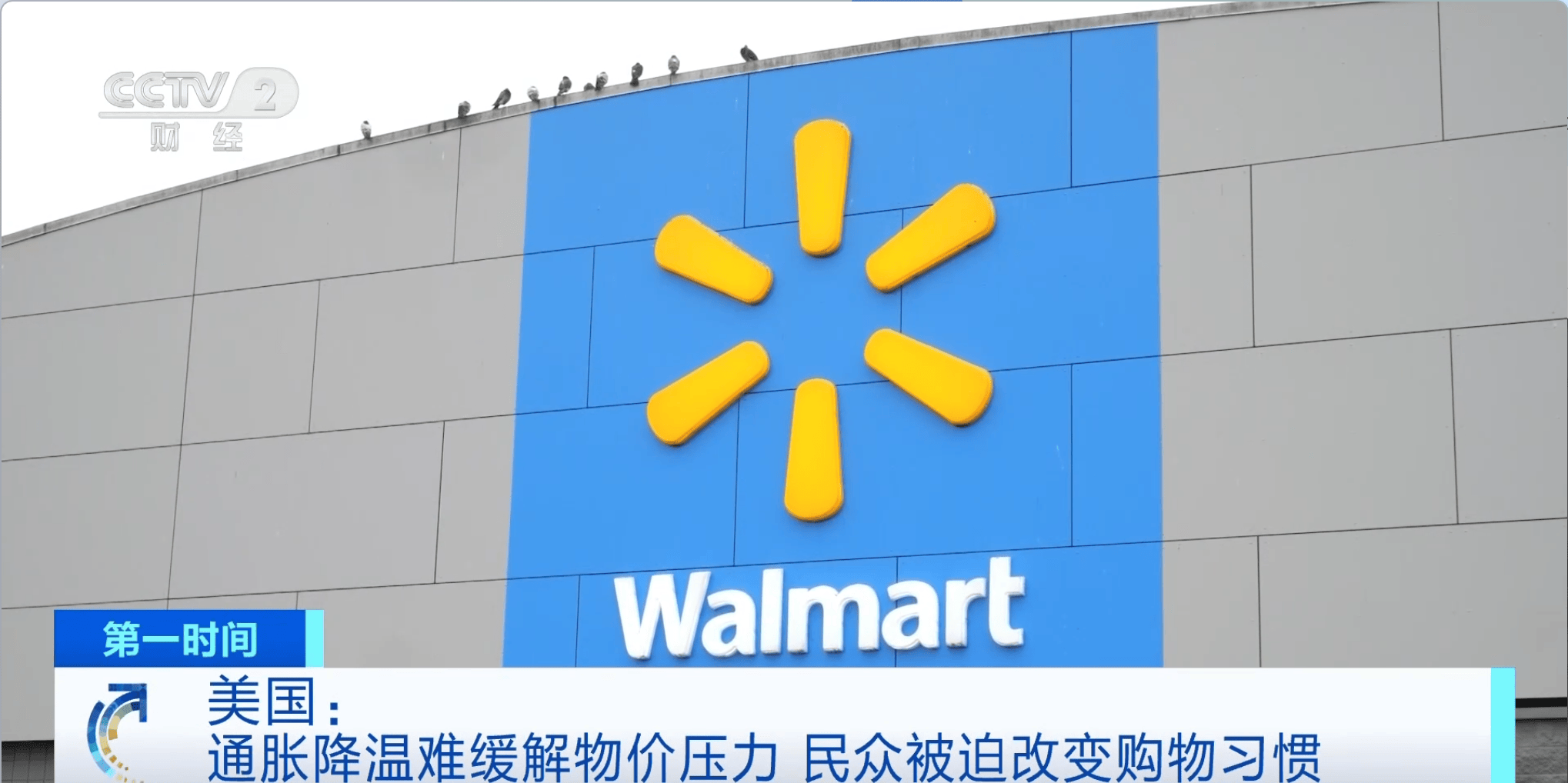
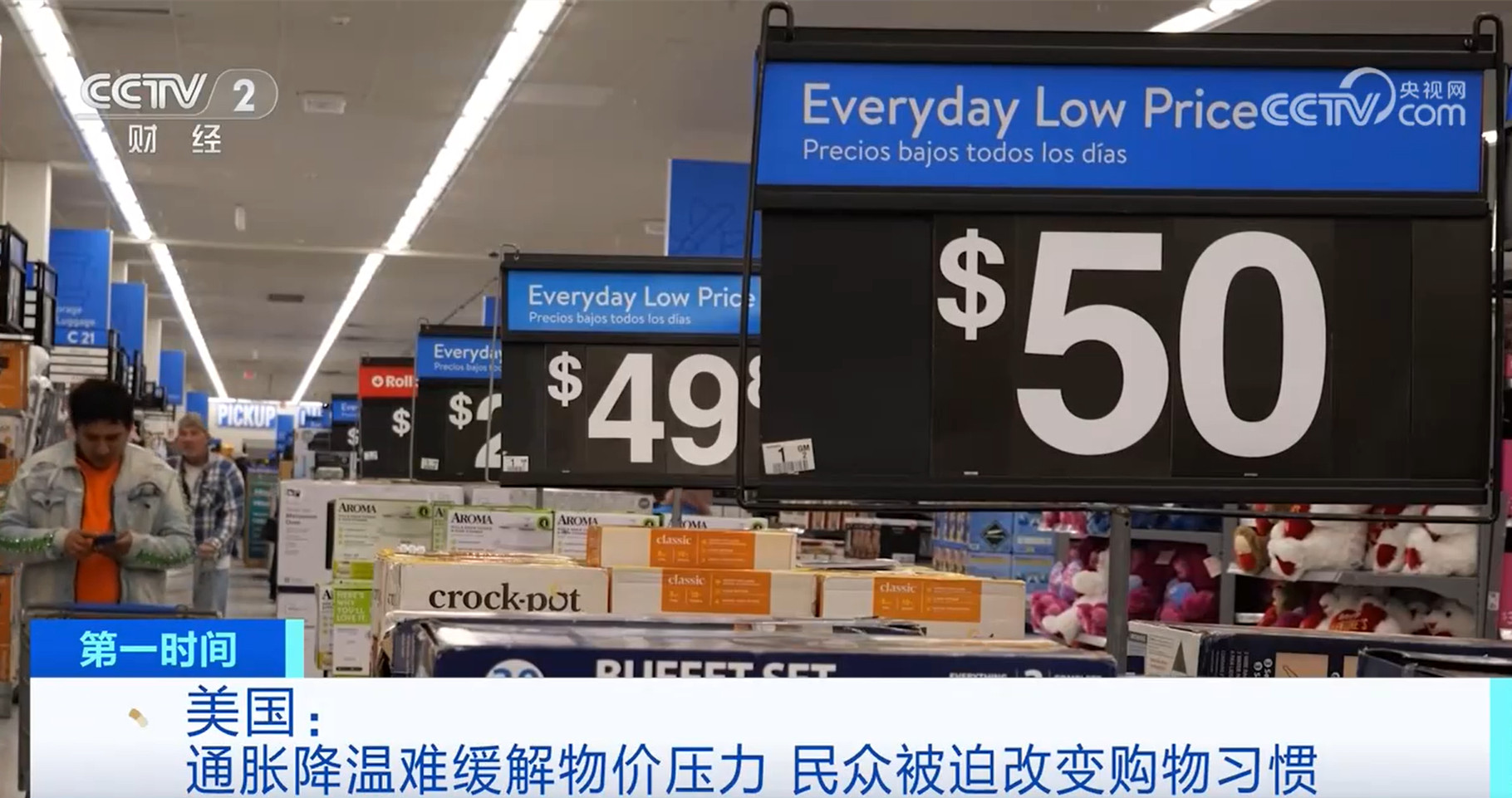
Group 1 - The core viewpoint of the articles highlights the impact of U.S. tariffs on consumer prices, leading to increased costs for American households and a shift in purchasing habits [1][5] - In 2025, the average retail price of coffee in the U.S. has risen by nearly 35% year-on-year, with Walmart's private label coffee priced at $6.98 for 12 ounces, resulting in an additional annual cost of nearly $100 for a typical family [1] - The price of ground beef has increased by approximately 16% year-on-year, while the price of beef round has surged by about 25%, forcing consumers to consider alternatives like chicken and plant-based proteins [3] Group 2 - The Consumer Price Index (CPI) in the U.S. rose by 2.7% year-on-year in November 2025, showing signs of easing inflation compared to 3% in September and below market expectations of 3.1% [3] - Economic experts predict that the costs associated with tariffs will gradually be passed on to consumers, indicating a prolonged and gradual process [5]
物价上涨 美国消费者被迫改变购物习惯
Yang Shi Wang· 2026-01-01 06:16
Group 1 - The core viewpoint of the articles highlights the impact of U.S. tariffs on consumer prices, leading to increased costs for American households and changes in shopping habits [1][4] - Walmart, as a major player in the U.S. retail industry, emphasizes its low-price strategy, which has become crucial for consumers prioritizing value for money amid rising prices [3] - The average retail price of coffee in the U.S. has increased by nearly 35% year-on-year, with Walmart's private label coffee priced at $6.98 for 12 ounces, resulting in an additional annual cost of nearly $100 for a typical American household [3] Group 2 - The price of ground beef has risen by approximately 16% year-on-year, while the price of beef round has increased by about 25%, forcing consumers to seek alternatives like chicken or plant-based proteins [3] - The Consumer Price Index (CPI) in the U.S. rose by 2.7% year-on-year in November 2025, indicating a cooling of inflation compared to 3% in September and below market expectations of 3.1% [3] - Economists predict that the costs associated with tariffs will gradually be passed on to consumers, suggesting a prolonged and gradual process of price increases [4]

2026年度固收策略电话会议
2025-12-31 16:02
Summary of the 2026 Fixed Income Strategy Conference Call Industry Overview - The conference call focused on the fixed income market and monetary policy outlook for 2026, emphasizing government bonds and credit strategies. Key Points and Arguments Monetary Policy Expectations - A moderate easing of monetary policy is anticipated in 2026, with a potential interest rate cut likely after the Spring Festival, although the probability of a January cut is low [1][3] - The central bank may maintain liquidity through reverse repos or reserve requirement ratio cuts to support government bond issuance [1][4] Inflation and Economic Indicators - Inflation is expected to rebound in 2026, with CPI averaging around 0.5%, PPI at approximately -1.1%, and GDP deflator at about 0.3% [1][5] - This inflation rebound is projected to raise the 10-year government bond yield by nearly 10 basis points, keeping the annual interest rate around 1.8-1.85% if a 10 basis point cut occurs [1][5] Investment Strategies - A 2-3 year credit carry strategy is recommended, with a net carry of over 40 basis points, potentially yielding returns of 2-2.1% [1][10] - Focus on low-frequency, high-probability, high-reward strategies, particularly in the context of rising interest rate expectations for 5-year and 10-year bonds [1][10] Government Bond Supply and Fiscal Policy - Government bond supply pressure is expected to peak in the first quarter, May-June, and August-September, with the central bank likely providing liquidity support during these periods [1][18] - Fiscal expansion is anticipated, but at a slower pace than the previous year, with total fiscal scale projected to reach around 15 trillion yuan [1][16] Credit and Local Government Bonds - Local government bonds should be monitored for issuance rhythm and supply pressure, with a recommendation to increase allocation under a loose monetary policy [6][18] - Credit bonds should be selected based on corporate fundamentals and industry outlook, with a focus on high-quality enterprises during economic recovery [6][38] Convertible Bonds and Equity Strategies - The convertible bond market is expected to exhibit institutional characteristics, with high premium new bonds favored [3][27] - Strategies should adapt to equity market performance, increasing exposure to high-conversion value convertible bonds when market conditions are favorable [7][8] Risk Management and Market Environment - The overall market environment in 2026 is expected to remain stable, with limited upward movement in interest rates unless inflation significantly exceeds expectations [12][19] - Emphasis on capturing opportunities through logical, high-probability strategies, particularly around anticipated interest rate cuts [12][10] Specific Investment Recommendations - Short-term strategies should focus on short-end government bonds, policy financial bonds, and certificates of deposit, particularly 2-3 year credit bonds and 5-year government bonds [11][19] - Long-end active bonds may be considered if the central bank exceeds expectations in rate cuts or bond purchases; otherwise, short-term high-frequency trading is advised [11][19] Conclusion - The 2026 fixed income market is characterized by a cautious yet optimistic outlook, with strategies focusing on credit carry, local government bonds, and convertible bonds, while maintaining vigilance against potential risks in the credit market [12][38]
外资行美债&汇率2026展望汇总
2025-12-31 16:02
Summary of Key Points from the Conference Call Records Industry Overview - The conference call records focus on the U.S. Treasury market and interest rate outlook for 2026, with insights from various financial institutions including Barclays, HSBC, Morgan Stanley, Deutsche Bank, and Bank of America Merrill Lynch. Core Insights and Arguments U.S. Treasury Market Outlook 1. **Yield Curve Dynamics**: - Barclays predicts a steepening of the yield curve, with 2-year yields expected to drop to 3.1% and 30-year yields remaining around 4.7%, resulting in a 2s30s spread of 160 basis points [6][10]. - HSBC anticipates a bear steepening of the yield curve, projecting a 10-year yield of 4.30% by the end of 2026 [15][19]. - Morgan Stanley suggests that the Fed's rate cuts may be less than market expectations, with a forecast of only 50 basis points of cuts [25][26]. 2. **Federal Reserve Policy**: - The new leadership at the Federal Reserve is expected to adopt a more dovish stance, potentially lowering rates below neutral levels [6][7]. - The Fed is projected to end quantitative tightening (QT) and begin purchasing T-bills to maintain adequate reserves, with an estimated purchase of $330 billion in T-bills in 2026 [10][31]. 3. **Fiscal Deficit and Inflation**: - The fiscal deficit is expected to remain around 6% of GDP, approximately $1.9 trillion, with inflation projected to stabilize around 2% [6][10][25]. - Concerns about inflation resurgence due to fiscal expansion and tariff impacts are highlighted, with core PCE inflation expected to remain above 2% [41][48]. Supply and Demand Dynamics 1. **Net Supply Projections**: - A significant reduction in net supply of U.S. Treasuries is anticipated, with a decrease of approximately $470 billion to $1.2 trillion in 2026 [6][58]. - Investment-grade corporate bonds are expected to see an increase in net supply, driven by mergers and acquisitions [58]. 2. **Market Demand**: - Bank demand for mid-term Treasuries is expected to rebound due to regulatory changes [9]. - Continuous inflows into bond funds are supporting demand, particularly for MBS, which are favored due to their attractive spreads [58][62]. Investment Recommendations 1. **Asset Recommendations**: - Barclays recommends going long on 2-year Treasuries to capitalize on anticipated rate cuts [10]. - HSBC suggests positioning in the belly of the curve (5-year Treasuries) for lower structural risk and positive carry [21]. - Deutsche Bank advises a cautious approach to long-dated Treasuries, predicting underperformance relative to swaps [39]. 2. **Strategic Themes**: - "Carry is king" is emphasized as a core investment strategy, focusing on high-yield bonds and leveraged loans due to their attractive coupon rates in a stable interest rate environment [41][47]. - The potential for a bear steepening of the yield curve is noted, with strategies to exploit this dynamic [21][47]. Other Important Insights - The reports highlight a complex economic landscape characterized by resilient growth, sticky inflation, and the dual risks of fiscal deterioration and inflation rebound [7][17]. - The impact of AI-driven capital expenditures and fiscal stimulus from legislation like the One Big Beautiful Bill Act (OBBBA) is noted as a potential growth driver [41][48]. - The need for caution regarding economic recession risks and policy uncertainties is emphasized, particularly in relation to tariffs and Fed independence [26][37]. This summary encapsulates the key points from the conference call records, providing a comprehensive overview of the U.S. Treasury market outlook and associated investment strategies for 2026.
深夜!美股跳水,黄金拉升!特朗普概念股,大涨!
Sou Hu Cai Jing· 2025-12-31 15:45
Market Performance - The three major U.S. stock indices opened slightly higher but turned to decline, with the Dow Jones down 0.03%, S&P 500 down 0.05%, and Nasdaq down 0.08% [1] - Individual stocks showed mixed results, with Nvidia opening up over 1% after announcing a $5 billion acquisition of Intel shares through a private placement [1] - Nike shares rose over 2% following news that Apple CEO Tim Cook significantly increased his stake in the company by purchasing approximately 50,000 shares, raising his ownership by 90% [1] - Trump Media & Technology Group saw a rise of over 6% after announcing plans to distribute digital tokens to shareholders [1] - Chinese stocks showed a mixed performance, with the Nasdaq Golden Dragon China Index declining over 1%, and NIO dropping over 8% while XPeng and Li Auto fell more than 4% [1] Economic Indicators - International precious metals experienced volatility, with spot gold rising slightly while silver's decline narrowed to 2.95% [2] - The U.S. Department of Labor reported that initial jobless claims fell by 16,000 to 199,000, marking one of the lowest levels this year, which reflects the typical volatility during the holiday season [2] - The Federal Reserve's December meeting minutes indicated that most officials believe further rate cuts would be appropriate if inflation decreases as expected, although some officials suggested maintaining rates for a period [2] - The minutes from the December 9-10 Federal Open Market Committee (FOMC) meeting highlighted internal divisions within the Fed and the challenges faced in recent decision-making [2]