绿色低碳

Search documents
浙江衢州:秸秆“变”地膜 再生有新招
Huan Qiu Wang Zi Xun· 2025-09-01 08:36
Core Insights - Agricultural waste, specifically straw, is being transformed into valuable resources through innovative research, particularly in the development of biodegradable agricultural films and renewable aviation fuel [1][2] Group 1: Biodegradable Agricultural Films - The biodegradable agricultural film made from straw is a promising renewable resource that can replace traditional polyethylene films, significantly reducing environmental pollution from plastic products [1] - The cost of straw-based biodegradable film is approximately 10,000 yuan per ton, which is 20% to 30% lower than the market price of conventional biodegradable films [1] - Current field demonstrations of this biodegradable film are taking place in provinces such as Yunnan, with a complete degradation time of about two months, although further adjustments are needed for different crops and environmental conditions before large-scale promotion [1] Group 2: Renewable Aviation Fuel - The research team is also exploring the production of renewable aviation fuel from straw, providing a zero-carbon alternative for the aviation industry [2] - The team has successfully reduced the number of operational units and energy requirements, significantly lowering fixed and operational costs while achieving high yields of renewable aviation fuel [2] - A pilot-scale facility has been designed and built, with all performance indicators meeting design requirements, and the next step is to accelerate the industrialization of this technology to replace fossil fuels in the aviation sector [2]
【联合发布】新能源商用车周报(2025年8月第4周)
乘联分会· 2025-09-01 08:36
Core Insights - The article discusses the significant growth and trends in the new energy commercial vehicle market, particularly focusing on the sales performance of new energy light trucks in China, which saw a year-on-year increase of 40.9% in the first seven months of 2025, reaching a penetration rate of 23.7% [20][23][28]. Policy and Regulations - The establishment of the Xinjiang-Tibet Railway Company marks a substantial advancement in the Xinjiang-Tibet Railway project, with a registered capital of 95 billion yuan and a total investment expected to exceed 400 billion yuan [9][11]. - The Central Committee of the Communist Party of China emphasizes the importance of promoting green and low-carbon transformation and strengthening the national carbon market [15][16]. Market Insights - In the first seven months of 2025, the domestic sales of new energy light trucks reached 62,000 units, with a notable concentration of sales in the East China region, particularly in cities like Kunming and Shenzhen [20][23][28]. - The market is primarily driven by pure electric vehicles, with battery capacity gradually increasing, and the leading brands include Farizon and Chery, with the fastest growth seen in Ruichi [20][23][28]. Company Monitoring - FAW Jiefang reported total assets of 79.663 billion yuan in the first half of 2025, reflecting a year-on-year increase of 9.5% [32][37]. - China National Heavy Duty Truck Group achieved a net profit growth of 8.1% in the first half of 2025, with a total sales volume of 81,000 heavy trucks, marking a 14.1% increase [42][43]. - Foton Motor's revenue grew by 26.7% to 30.37 billion yuan, with a net profit increase of 87.6% in the first half of 2025 [48][49].

物流运行稳中有进,物流总额保持增长
Sou Hu Cai Jing· 2025-09-01 07:38
Core Insights - The logistics sector in China has shown steady growth in the first seven months of the year, with a total social logistics volume of 201.9 trillion yuan, reflecting a year-on-year increase of 5.2% [1] - The logistics demand in high-end manufacturing, digital intelligence, and green low-carbon sectors has become a significant driver for logistics demand upgrades [2] - International logistics has emerged as a new growth point, with substantial increases in cross-border transportation and e-commerce logistics [3] - Overall, the logistics market is expanding, and the structure is further optimizing, supported by stable and flexible policies [4] Logistics Performance - From January to July, the total logistics volume for industrial products grew by 5.7%, with logistics demand across 35 industries increasing year-on-year [1] - The logistics volume for units and residential goods increased by 6.2%, with online retail sales of physical goods growing by 6.3%, outpacing the retail sales growth of consumer goods by 1.5 percentage points [1] - The total revenue of the logistics industry reached 8.2 trillion yuan, marking a year-on-year growth of 4.9% [2] Sector-Specific Growth - In July, logistics demand for high-tech manufacturing industries grew by 9.3%, with logistics volumes for advanced products like simulation chips and 3D printing equipment exceeding 20% growth [2] - The logistics demand for new energy products, including electric vehicles and lithium-ion batteries, also saw growth rates around 20% [2] Regional Dynamics - The logistics demand in the central and western regions of China is gaining momentum, with business volume indices of 52.3 and 50.9, respectively, surpassing the national average [2] - The eastern region maintained a steady growth trend with an index of 50.3, indicating a developing pattern of regional coordination [2] International Logistics - The China-Europe Railway Express has operated 8,526 trains, reflecting a year-on-year increase of 23.2%, while international air cargo transport volume reached 38.8 million tons, up 21.5% [3] - Cross-border e-commerce has driven significant growth in international logistics, supporting the smooth operation of supply chains [3] Consumer and Energy Logistics - E-commerce logistics, particularly in rural areas, has shown strong growth, with indices of 130.9 and 131.5 for overall and rural e-commerce logistics, respectively [3] - The railway sector has effectively ensured the transportation of essential energy supplies, with coal transport reaching 1.196 billion tons in the first seven months [3]
卡博特上海工厂利旧改造项目投运
Zhong Guo Hua Gong Bao· 2025-09-01 02:53
Core Insights - Cabot's Shanghai plant renovation project has officially commenced operations, expected to generate 120 million kWh of green electricity annually, reducing greenhouse gas emissions by approximately 119,700 tons [1] - The project has a total investment of about 70 million RMB, maintaining an annual output value of 1.4 billion RMB while providing stable steam supply to surrounding enterprises [1] - The project exemplifies resource reutilization and injects new vitality into the circular economy model of the Shanghai plant [1] Company Development - Cabot's Vice President and General Manager for China, Wang Weicheng, emphasized the company's growth in China is supported by a favorable business environment and policy backing in Minhang [1] - The company plans to continue its commitment to technological innovation and manufacturing upgrades in the region, contributing to local economic development [1] Regional Impact - Minhang District's Deputy Mayor, Zhang Xian, highlighted the significance of the renovation project in setting a benchmark for green and low-carbon development in Minhang [1] - Cabot has established multiple functional institutions in Minhang, including a regional headquarters and foreign-funded R&D center, making it a crucial operational base globally [1] - The transformation of manufacturing towards digitalization and greening is closely linked to the empowerment of new energy and new materials, with an invitation for Cabot to expand its operations in Minhang [1]

卓然股份(688121):反内卷有望驱动炼化老旧设备更新
Xin Lang Cai Jing· 2025-09-01 00:36
Core Viewpoint - The company reported a significant decline in revenue and net profit for the first half of 2025, indicating challenges in its operational performance and market conditions [1] Financial Performance - In the first half of 2025, the company achieved operating revenue of 966 million yuan, a year-on-year decrease of 28.92% [1] - The net profit attributable to shareholders was -21.90 thousand yuan, a year-on-year decline of 100.62% [1] - The net profit excluding non-recurring items was 1.71 million yuan, down 95.30% year-on-year [1] - In Q2 2025, operating revenue was 797 million yuan, a year-on-year decrease of 39.00% but a quarter-on-quarter increase of 373.60% [1] - The net profit attributable to shareholders in Q2 was 8.11 million yuan, down 89.29% year-on-year but up 197.37% quarter-on-quarter [1] - The net profit excluding non-recurring items in Q2 was 9.36 million yuan, down 87.85% year-on-year but up 222.31% quarter-on-quarter [1] Order and Revenue Structure - The sales revenue from refining equipment accounted for 2.02% of the main business revenue, while petrochemical equipment sales accounted for 2.40% [2] - Engineering general contracting services made up 12.57% of the main business revenue, with other products and services contributing 83.00% [2] - The company has a total of 5.868 billion yuan in orders above 20 million yuan, which will gradually confirm revenue from 2025 to 2026, likely increasing the proportion of engineering general contracting services [2] Industry Trends - The Ministry of Industry and Information Technology announced a new round of policies aimed at stabilizing growth in key industries, including petrochemicals, which will drive the replacement of outdated equipment [3] - The "Implementation Plan for the Innovative Development of the Fine Chemical Industry (2024-2027)" emphasizes the importance of fine chemicals and new chemical materials for high-quality development in the petrochemical sector [3] - The industry is expected to increase investment in new technologies and processes, promoting technological advancement and industrial upgrading towards green and low-carbon development [3] Company Strategy - The company is actively investing in green and low-carbon technologies, aligning with national strategies for sustainable development [4] - It is focusing on clean energy, low-carbon processes, and green products, while exploring high-end, intelligent, and green implementation paths in the petrochemical sector [4] - The company aims to expand its market presence in petrochemical equipment, refining equipment, EPC general contracting services, and related products, while also extending its business into new materials and new energy [4] - The projected net profit for the company from 2025 to 2027 is estimated at 130 million yuan, 150 million yuan, and 200 million yuan, with corresponding PE ratios of 27.4X, 24.0X, and 17.5X based on the closing price on August 29, 2025 [4]

瑞茂通集团优化全球战略布局 打造绿色再生铜产业链
Qi Huo Ri Bao· 2025-08-31 23:09
Core Insights - The article highlights the strategic importance of the recycling copper industry for ensuring the security of China's critical metal supply chain amid increasing global competition for copper resources [1][2][3]. Group 1: Company Strategy - Rui Mao Tong Group has established a comprehensive recycling copper supply chain, from overseas waste copper collection to cross-border processing and domestic sales, with a projected import and transshipment volume of nearly 50,000 tons and a trade value exceeding $470 million in 2024 [2]. - The company has set up a recycling copper base in Thailand, which is part of its strategic layout to create a self-sufficient recycling copper industry system [1][2]. - The establishment of a recycling copper processing base in Thailand allows the company to convert high-quality waste copper from developed countries into products that meet Chinese import standards, thus enhancing its competitive edge [2][6]. Group 2: Industry Context - China's copper consumption accounts for over 55% of global demand, yet the country only possesses 4% of the world's proven copper reserves, leading to a high dependency on imports, with refined copper import reliance reaching 83.7% in 2024 [2][3]. - The global competition for copper resources has intensified, with major copper-producing countries facing disruptions due to natural disasters and geopolitical tensions, making the development of the recycling copper industry crucial for China [3][4]. - The Chinese government has recognized the importance of recycling materials, with a target set for recycled metal production to account for 30% of total output by 2025, including a goal of 4 million tons for recycled copper [5][6]. Group 3: Environmental Impact - The production of recycled copper consumes only 20% of the energy required for primary copper production and reduces carbon emissions by 65%, positioning it as a key driver for the green transformation of the industry [5][6]. - The company's strategy aligns with China's carbon neutrality goals, as the overseas processing of waste copper can significantly lower domestic energy consumption and carbon emissions [6][7]. - The establishment of a recycling copper industry not only addresses the supply gap but also supports the sustainable development of the economy by providing cost-effective raw materials for small and medium-sized enterprises [6][7].

济南轨道交通4号线、8号线空载试运行启动
Qi Lu Wan Bao Wang· 2025-08-31 04:56
Group 1 - The core point of the article is the commencement of the empty test operation for Jinan Metro Line 4 and Line 8, marking a critical phase in the preparation for their operational launch by the end of the year, which will significantly enhance the transportation structure in Jinan [1] Group 2 - Line 4 spans 40.3 kilometers with 33 underground stations, covering 80% of the passenger flow in densely populated areas along Jinan's Jing10 Road, and will connect with multiple existing metro lines and the high-tech eastern district [3] - Line 8 covers 25.3 kilometers with 3 underground and 11 above-ground stations, linking key areas such as the China (Shandong) Pilot Free Trade Zone and various educational and technological institutions, facilitating travel for residents and promoting coordinated development [3] Group 3 - The empty test operation is a crucial transition from construction to operational phase, involving a three-month period of simulating real operational conditions and testing core systems such as vehicles, tracks, signals, and power supply [4] Group 4 - The construction of Lines 4 and 8 emphasizes the integration of technology and green low-carbon practices, with Line 4 overcoming complex geological conditions and Line 8 aiming to be a national model for green urban rail transit [5] - The underground stations on Line 8 utilize advanced green construction techniques, achieving a reduction of approximately 3,400 tons of CO2 emissions per station, while the Shandong University station is designed for solar energy generation, expected to produce 180,000 kilowatt-hours annually [5] - During the empty test operation, Jinan Metro Group will conduct system debugging, operational drills, and safety assessments to ensure high standards for the lines' opening, contributing to the modernization of the province [5]
壹探轨道|济南轨道交通4号线、8号线空载试运行启动
Qi Lu Wan Bao· 2025-08-31 04:38
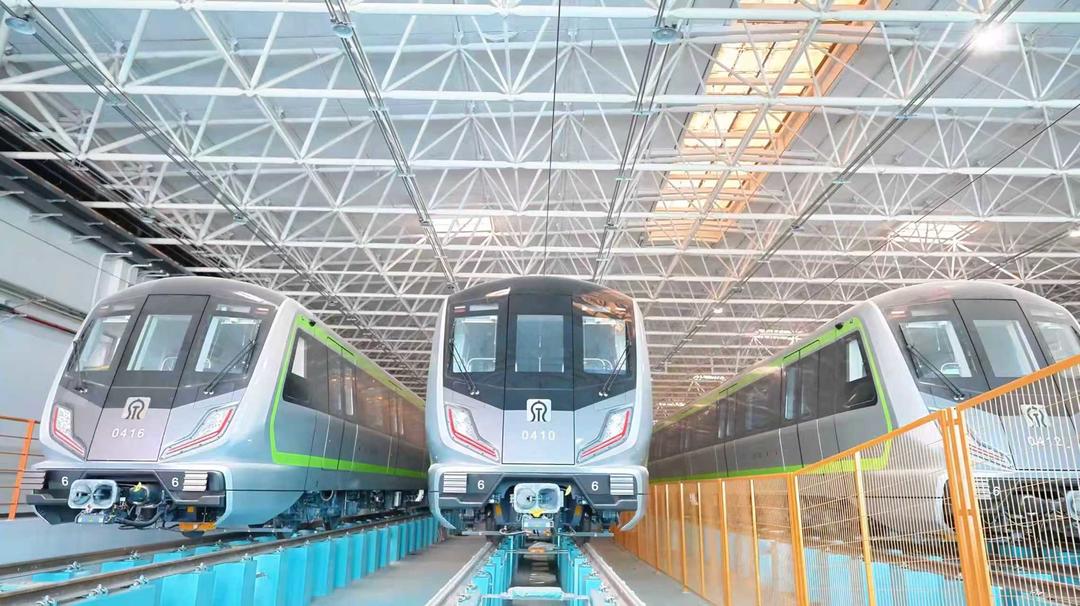
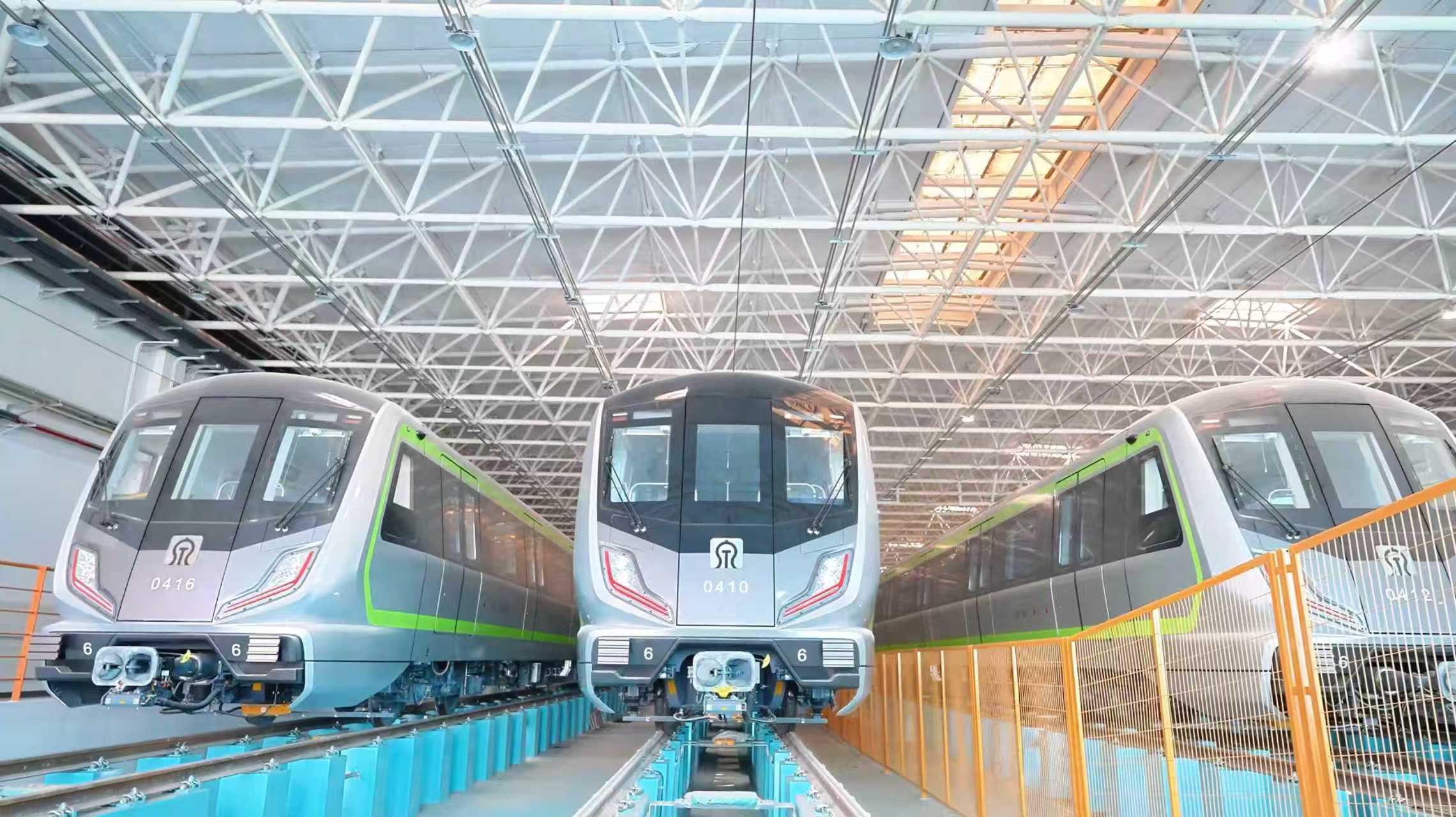
Core Points - The launch of the empty test run for Jinan Metro Line 4 and Line 8 marks a critical phase in the preparation for operation, with plans to officially open by the end of the year [1][7] - The empty test run will last for three months, simulating real operational conditions and testing various systems including vehicles, tracks, signals, and power supply [1][7] Group 1: Line Details - Line 4 spans 40.3 kilometers with 33 underground stations, connecting five districts and covering 80% of the passenger flow along Jinan's main thoroughfare, significantly alleviating traffic pressure [3] - Line 8 covers 25.3 kilometers with 3 underground and 11 above-ground stations, linking key areas such as the China (Shandong) Free Trade Zone and various educational and technological institutions [3] Group 2: Construction Features - Both lines emphasize the integration of technology and green low-carbon practices, with Line 4 overcoming complex geological conditions and Line 8 aiming to be a national model for green urban rail transit [5] - The construction of underground stations on Line 8 utilizes advanced green building technologies, resulting in a CO2 reduction of approximately 3,400 tons per station, and the design of Shandong University Station includes photovoltaic integration expected to generate 180,000 kWh annually [5] Group 3: Operational Goals - During the empty test run, Jinan Metro Group will coordinate system debugging, operational drills, and safety assessments to ensure high standards for the opening of both lines [7] - The goal is to provide citizens with more convenient, efficient, green, and safe transportation services, contributing to the modernization of the province [7]
【大宗周刊】瑞茂通集团优化全球战略布局,打造绿色再生铜产业链
Qi Huo Ri Bao· 2025-08-30 23:57
Group 1: Core Insights - The article highlights the strategic importance of recycling copper to ensure the security of China's critical metal supply chain amid increasing global competition for copper resources [1][2][3] - The establishment of a recycling copper base in Thailand by Rui Mao Tong Group is a key step in creating a comprehensive industrial chain from overseas copper recovery to domestic processing and sales [1][2] - The shift in China's waste copper import policy, allowing for the import of high-quality recycled copper with zero tariffs, has opened new opportunities for companies like Rui Mao Tong Group [2][3] Group 2: Industry Context - China consumes over 55% of the world's copper, yet its domestic copper resources are limited, with only 4% of global reserves and an import dependency of 83.7% for refined copper in 2024 [2][3] - The global competition for copper resources has intensified due to disruptions in major copper-producing countries, making the development of the recycled copper industry crucial for China [3][4] - The Chinese government aims to increase the share of recycled metals to 30% by 2025, with a target of producing 4 million tons of recycled copper [5] Group 3: Environmental and Economic Benefits - Recycled copper production consumes only 20% of the energy required for primary copper production and reduces carbon emissions by 65%, aligning with China's carbon neutrality goals [4][6] - The cost advantages of recycled copper, along with its environmental benefits, are driving demand from small and medium-sized enterprises in the copper component manufacturing sector [6][7] - The establishment of a recycling base in Thailand allows for reduced logistics losses and lower energy consumption in domestic processing, supporting China's dual carbon strategy [6][7] Group 4: Future Developments - Rui Mao Tong Group is actively pursuing partnerships with downstream manufacturers to build a green supply chain and enhance the recycling industry's transformation and high-quality development [2][6] - The cooperation mechanism between China and neighboring countries in the recycled non-ferrous metal industry is being accelerated, with preliminary agreements reached with Thailand [7] - The article emphasizes the importance of continuous monitoring of international trade policies and market dynamics to adapt to the evolving landscape of the recycled metal industry [4][7]
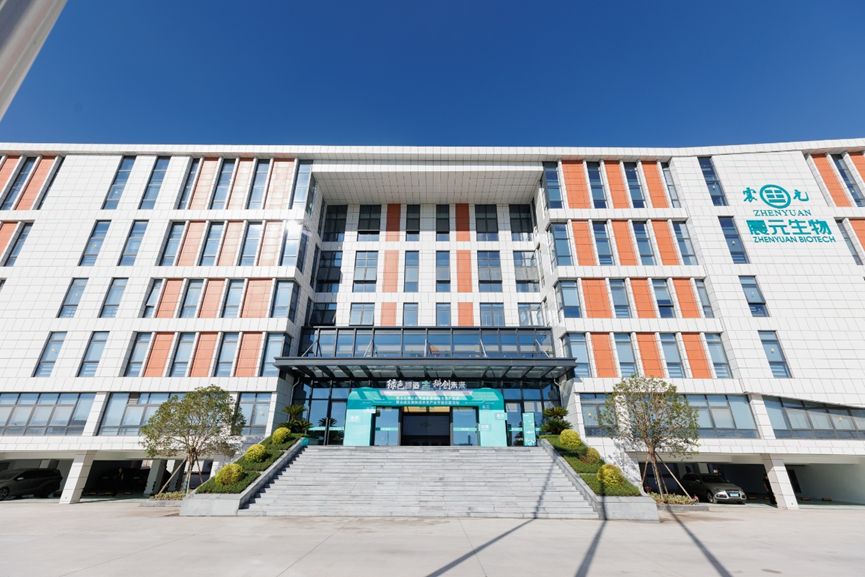
震元生物上虞产业化基地正式投产 聚力合成生物新赛道赋能高质量发展
Zheng Quan Shi Bao Wang· 2025-08-30 04:56
Core Viewpoint - The establishment of the Zhenyuan Biological Industrialization Base in Shaoxing marks a significant step in the development of synthetic biology, aiming to drive high-quality economic growth in the region [1][3][4]. Group 1: Project Overview - The Zhenyuan Biological Industrialization Base, a key project in the synthetic biology field, commenced construction in February 2023 and has now been officially launched [3]. - The project utilizes advanced synthetic biology and fermentation engineering technologies to create the first large-scale (thousand-ton level) histidine biosynthesis industrialization facility in China [3]. - The base aims to produce high-end amino acid products using green processes to replace traditional high-pollution and high-energy consumption methods [5]. Group 2: Government Support and Strategic Importance - The Shaoxing municipal government has identified synthetic biology as a core area for fostering new productive forces and promoting high-quality development [4]. - The local government has implemented various policies and established funds exceeding 10 billion yuan to support the growth of high-energy innovation platforms [4]. - The project has been recognized as a significant industrial project in Zhejiang Province and is part of the first batch of "green low-carbon advanced technology demonstration projects" by the National Development and Reform Commission [3][5]. Group 3: Collaboration and Future Prospects - The base has established partnerships with top domestic research institutions to enhance innovation and industrial integration [4]. - The first phase of production is planned to yield 2,400 tons of hydrochloric acid histidine, 1,000 tons of levodopa, and 1,000 tons of tyrosine annually, which is expected to create significant economic benefits [6]. - The project is seen as a model for the development of the synthetic biology manufacturing industry in Shaoxing and Zhejiang, contributing to the region's economic transformation [5].