量子科技

Search documents
A股五张图:你们管这些猛男叫“老登”?
Xuan Gu Bao· 2025-10-20 10:34
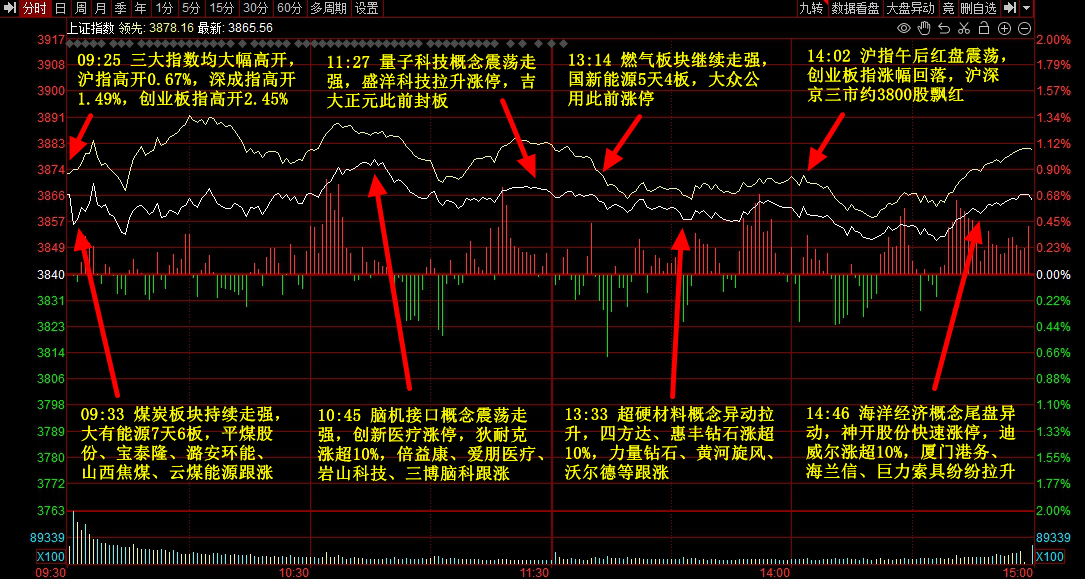
Market Overview - The market opened higher but experienced a slight decline throughout the day, with the Shanghai Composite Index, Shenzhen Component Index, and ChiNext Index closing up by 0.63%, 0.98%, and 1.98% respectively, with over 4,000 stocks rising and more than 1,200 falling [4]. Superhard Materials - The superhard materials sector saw significant gains, with companies like Huifeng Diamond (+29.98%), Sifangda (+19.98%), and Liliang Diamond (+18.71%) reaching their daily limits [5][6]. - The rise in this sector is attributed to the export control of superhard materials, which include synthetic diamonds and cubic boron nitride, crucial for high-end manufacturing and technology [7]. - China's industrial diamond production accounts for 95% of the global market share, bolstered by the demand from the photovoltaic sector [7]. Coal Industry - The coal sector experienced a strong performance, with companies such as Daya Energy achieving seven consecutive trading limits, and both Liaoning Energy and Zhengzhou Coal Power hitting their daily limits [11]. - The tightening of supply in the coal industry is becoming a key investment theme, with expectations of improved coal prices due to increased demand in the fourth quarter [11]. Banking Sector - The banking sector has seen a rebound, particularly among local banks like Chongqing Bank and Xiamen Bank, while Agricultural Bank of China remains the largest in market capitalization, with a cumulative increase of over 17% in the past two weeks [10]. - Agricultural Bank of China has outperformed Industrial and Commercial Bank of China, marking a significant recovery in its stock performance [10]. Emerging Concepts - The "deep earth economy" concept emerged in the market, with stocks like ShenKai Co. and Petrochemical Machinery hitting their daily limits, indicating a growing interest in this area [3].


知名国际投行释放利好!海外机构近期关注这些股 多股业绩预增
Zheng Quan Shi Bao Wang· 2025-10-20 06:08
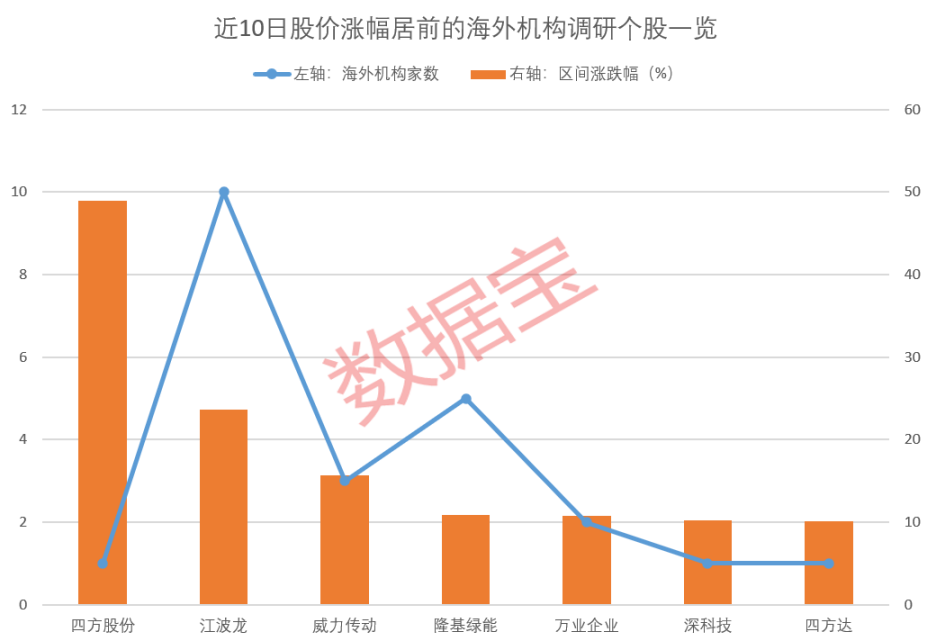
Core Viewpoint - The article highlights the performance increase of overseas institution-researched stocks, with a focus on companies that have shown promising earnings forecasts and market activity in various sectors, particularly in optical modules and storage chips [1][4]. Group 1: Market Activity - The A-share market saw a strong performance in the entrepreneurial board, with significant gains in computing hardware stocks and brain-computer interface concepts [1]. - The optical module sector experienced a surge, with companies like New Ease and Zhongji Xuchuang seeing intraday increases of over 9% and 12% respectively, driven by positive demand forecasts from Citibank [1]. - The storage chip sector also became active, with Sanfu Co. hitting the limit up and achieving a four-day consecutive rise, following news of Micron Technology's plans to halt server chip supplies to Chinese data centers [1][2]. Group 2: Overseas Institutional Research - A total of 321 companies were researched by institutions in the past 10 days, with 66 of them being visited by overseas institutions [4]. - Mindray Medical was the most researched company, with 124 overseas institutions participating, indicating strong interest in its international capital operations [4]. - Inovation Technology was also highlighted, with 51 overseas institutions involved in its research, showcasing its new energy management platform that aims to optimize electricity costs and enhance operational efficiency [4]. Group 3: Earnings Forecasts - Seven companies that received attention from overseas institutions released their earnings forecasts, with six expecting positive results [7]. - Orbi Medtech is projected to turn a profit with an estimated net profit of approximately 108 million yuan, benefiting from the growth in the 3D vision perception industry [7]. - Gigabit's net profit forecast ranges from 1.032 billion to 1.223 billion yuan, reflecting a year-on-year increase of 57% to 86% [7][8].






前三季度GDP同比增长5.2%,A500ETF基金(512050)涨近1%,成交额超31亿居同类第一
Xin Lang Cai Jing· 2025-10-20 05:23
Group 1 - The A500 index (000510) increased by 0.90%, with significant gains from stocks such as Silan Microelectronics (600460) up 9.85% and Siyuan Electric (002028) up 8.50% [1] - The A500 ETF fund (512050) rose by 0.80%, with a latest price of 1.14 yuan and a trading volume of 31.82 billion yuan, indicating active market participation [1] - As of October 17, the A500 ETF fund had an average daily trading volume of 49.89 billion yuan over the past month, ranking first among comparable funds [1] Group 2 - According to the National Bureau of Statistics, China's GDP for the first three quarters reached 1,015,036 billion yuan, with a year-on-year growth of 5.2% [1] - In the third quarter, China's GDP was 354,500 billion yuan, reflecting a year-on-year growth of 4.8% [1] Group 3 - Dongfang Securities noted that the recent market pullback was primarily due to strong profit-taking motives and uncertainty regarding Sino-U.S. relations, but long-term investor confidence remains intact [2] - The A500 index includes 500 securities selected from various industries based on market capitalization and liquidity, representing the overall performance of major listed companies [2] - As of September 30, 2025, the top ten weighted stocks in the A500 index accounted for 19% of the index, including companies like CATL (300750) and Kweichow Moutai (600519) [2]
知名国际投行释放利好,“易中天”大涨!海外机构近期关注这些股,多股业绩预增
Zheng Quan Shi Bao· 2025-10-20 04:37
Core Insights - The overseas institutional research stocks have shown significant interest, with 321 companies being investigated in the past 10 days, indicating a robust market engagement [3] - The storage chip sector is experiencing a supply shortage, which is viewed as a positive signal for the industry, especially following Micron Technology's announcement to cease supplying server chips to Chinese data centers [2][6] - Several companies have reported positive earnings forecasts for the third quarter, with six out of seven companies expecting improved performance [6] Group 1: Market Trends - The A-share market has seen a rise in sectors such as computing hardware and quantum technology, while precious metals and certain food sectors have declined [1] - The optical module industry is anticipated to experience increased demand, with potential growth in industry requirements from 8 million units to over 20 million units by 2026 [1] - Citibank has highlighted that the optical module sector may present buying opportunities due to recent price adjustments [1] Group 2: Company Performance - Mindray Medical has attracted the most attention from overseas institutions, with 124 firms participating in its research, and it expects positive revenue growth by Q3 2025 [3] - Inovance Technology has introduced a new energy management platform, which aims to optimize electricity usage and reduce costs significantly [4] - Seven overseas-researched stocks have released earnings forecasts, with notable predictions from GigaDevice Semiconductor, expecting a net profit increase of approximately 57% to 86% compared to the previous year [6]

恒生科技ETF天弘(520920)盘中走强涨超2%,上市8日持续“吸金”累计超15亿元,阿里巴巴设立香港总部
2 1 Shi Ji Jing Ji Bao Dao· 2025-10-20 02:20
Group 1 - The Hang Seng Technology ETF Tianhong (520920) has shown strong performance, rising 2.29% with a trading volume exceeding 190 million yuan and a premium rate of 0.76% [1] - Major constituent stocks such as NIO-SW and NetEase-S have increased over 5%, while Alibaba-W and Bilibili-W have risen over 4% [1] - Since its listing on September 30, the Hang Seng Technology ETF Tianhong has attracted over 1.5 billion yuan in net inflows over 8 trading days [1] Group 2 - The Hang Seng Technology Index, which the ETF closely tracks, consists of the top 30 Hong Kong stocks related to technology, covering sectors like information technology, consumer discretionary, and communication services [1] - Alibaba and Ant Group announced a joint investment of 925 million USD (approximately 6.6 billion yuan) to acquire a commercial office building in Hong Kong, aiming to establish their headquarters and expand international business [1] Group 3 - Dongfang Securities highlighted that investment opportunities are primarily focused on technology growth, with short-term attention on low-positioned self-controllable sectors (like software) and technology related to the "14th Five-Year Plan" [2] - The report indicated that recent pullbacks in equipment and previously high-performing tech companies could enhance the attractiveness of core companies within these sectors, potentially leading to a reallocation of funds [2]


中国国际大学生创新大赛(2025)收官
Ren Min Ri Bao Hai Wai Ban· 2025-10-20 00:51
Core Points - The China International College Students Innovation Competition (2025) finals were held in Zhengzhou, Henan from the 13th to the 15th, with Tsinghua University winning the championship for their project on "Next-Generation General Models and Intelligent Agent Ecosystems Based on Brain-like Architecture" [1] - Zhejiang University secured the runner-up position with their project "Yizhi Intelligent - AI Large Model Interactive Marketing Service Industry Leader" [1] - Four projects received third place: The Chinese University of Hong Kong's "Light-speed Intelligent Connection - Neuromorphic Optical Processor for Next-Generation Data Center Interconnection," Nanjing University of Science and Technology's "Light Shield - High-Speed Cable Electromagnetic Shielding Membrane for AI Training," and projects from Oxford University and Nanyang Technological University [1] Event Overview - The competition was co-hosted by the Ministry of Education and 11 other departments, along with the People's Government of Henan Province, and organized by Zhengzhou University and the Zhengzhou Municipal Government [1] - Since its launch in April, the competition attracted 6.19 million projects and 24.43 million participants from 161 countries and regions [1] - This year, the competition aligned with national strategic needs by adding five new project categories: "Low-altitude Economy," "Biotechnology," "Quantum Technology," "New Energy," and "New Materials" [1] International Expansion - The competition introduced a Hong Kong and Macau regional contest for the first time and expanded its global reach by hosting seven regional competitions in Europe, Africa, and other locations [2] - During the event, the World College Students Innovation Conference was held, releasing the "World College Students Innovation Index Report (2025)" and the "Innovation Code in the Era of Smart Education: World College Students Innovation Development Report (2025)" [2]
科技大时代,AI产业链融合再重塑
2025-10-19 15:58
Summary of Key Points from Conference Call Records Industry Overview - The conference call discusses the **AI industry** and its integration within the **technology sector** during the **14th Five-Year Plan** and the upcoming **15th Five-Year Plan**. The rise of **AIGC** marks the end of the visual dividend era, with the **Transformer architecture** becoming the core technological engine [1][2]. Core Insights and Arguments - **Transition to AIDC**: Data centers are shifting from traditional **IDC** to **AIDC**, with a significant increase in electricity cost proportion, leading to a shift in pricing power towards energy-related sectors [2][4]. - **Fiscal Technology Spending**: Expected growth in fiscal technology spending from **9%** during the 14th Five-Year Plan to **12%-14%** during the 15th Five-Year Plan, focusing on AI-related fields [4][5]. - **Special Bonds**: Continuous issuance of long-term special bonds starting in **2025** to support technological innovation and industrial upgrades, particularly in semiconductor and AI sectors [4][5]. - **Millisecond Computing Network**: The goal to establish a millisecond-level city computing network by **2027**, aiming for interconnectivity of computing centers under **1 millisecond** [4][5]. - **Investment Focus**: Emphasis on investing in computing infrastructure (domestic chips, edge computing), AI applications, and upgrading SaaS to **SaaS 2.0** [5][6]. Industry Growth and Achievements - The **electronics industry** in China is expected to accelerate during the 15th Five-Year Plan, with opportunities for domestic substitution in the semiconductor industry and growth in consumer electronics driven by AI [3][9]. - **Export Growth**: Despite trade tensions, the electronics manufacturing sector has seen continuous growth in exports, with integrated circuits being the highest export product [7][8]. - **Leading Companies**: Companies like **SMIC** and **Huahong** are expected to make significant advancements in advanced processes and AI capacity expansion [9][12]. Potential Risks and Considerations - **Policy Changes**: Monitoring the impact of fiscal policies and the issuance of special bonds on the technology sector is crucial [6][11]. - **AI Integration**: The integration of AI into consumer electronics is expected to drive growth, but companies must navigate the challenges posed by external sanctions [10][12]. Additional Insights - **Investment Opportunities**: Key areas for investment include core technologies in chip manufacturing, wafer foundries, and emerging AI-related products [11][12]. - **Long-term Trends**: The conference highlights the importance of focusing on long-term trends in technology, particularly in AI and quantum technology, which are expected to see significant developments in the coming years [22][23]. This summary encapsulates the essential points discussed in the conference call, providing a comprehensive overview of the current state and future outlook of the AI and electronics industries in China.
策略周报20251019:调整空间有限,保持信心-20251019
Orient Securities· 2025-10-19 14:14
Group 1 - The report concludes that the adjustment space for the index is limited, maintaining a judgment of sideways fluctuations and continued strength. The recent market pullback is attributed to strong short-term profit-taking motivation and a cautious stance amid uncertainties between China and the US. However, the report believes that the factors driving profit-taking are temporary, and the attractiveness of the equity market and long-term investor confidence remain unchanged. It is anticipated that the situation between China and the US will stabilize, with limited adverse effects on the market [3][12]. Group 2 - The report emphasizes continued high attention to technology as the main theme for investment opportunities. It suggests focusing on low-positioned self-controlled sectors (such as software), technology related to the 14th Five-Year Plan (including quantum technology, deep-sea economy, and brain-computer interfaces), and innovative pharmaceuticals. The report advises avoiding equipment-related sectors and previously high-performing technology companies, which have seen significant pullbacks recently. This ongoing correction is expected to enhance the attractiveness of core companies within these sectors, gradually attracting funds for reallocation [4][13]. Group 3 - In non-technology sectors, the report expresses a positive outlook on strategic metals, ranking them as follows: gold > rare earths and other minor metals > copper. For gold, the dual benefits of deteriorating fiat currency credit and safe-haven demand are expected to continue driving prices, despite short-term pullback risks. The strategic value of rare earths is anticipated to rise due to upgraded export controls on items and technologies. In the case of copper, demand is expected to increase in the medium term due to global grid upgrades, data center expansions, and the proliferation of electric vehicles, while ongoing disruptions in upstream mining will significantly exacerbate supply shortages, leading to a potential rise in copper prices [5][14].
科创板首批三季报出炉 前沿赛道企业引领增长
Xin Hua Cai Jing· 2025-10-19 09:33
Core Viewpoint - The performance of several companies listed on the Sci-Tech Innovation Board has shown significant growth in Q3, particularly in emerging industries such as AI computing chips and optical communication, highlighting the board's role in fostering strategic emerging and future industries [1] Group 1: AI Computing Chip Sector - Domestic chip design companies, such as Haiguang Information and Cambricon, have reported outstanding Q3 performance, contributing to the foundational construction of China's AI industry [2] - Haiguang Information achieved total revenue of 9.49 billion yuan, a year-on-year increase of 54.65%, and a net profit of 1.961 billion yuan, up 28.56%, driven by deepened cooperation with key industry partners [2] - Cambricon's revenue reached 4.607 billion yuan, a dramatic increase of 2300%, with a net profit of 1.605 billion yuan, up 321.49%, attributed to market expansion and support for AI application implementation [2] Group 2: Optical Communication Sector - The optical communication sector is identified as a key infrastructure for future information industries, with companies like Shijia Photonics and Tengjing Technology showing remarkable growth [3] - Shijia Photonics reported revenue of 1.56 billion yuan, a year-on-year increase of 113.96%, and a net profit of 299 million yuan, up 727.74%, driven by AI development and increased product orders [3] - Tengjing Technology achieved revenue of 425 million yuan, a 28.11% increase, and a net profit of 64 million yuan, up 15%, benefiting from the growing demand for optical communication components [3] Group 3: Frontier Technology and Future Industries - Companies are strategically positioning themselves in frontier technologies, with significant growth in quantum technology and future energy sectors [4] - GuoDun Quantum reported revenue of 190 million yuan, a 90.27% increase, and a reduced net loss of 26 million yuan, driven by growth in quantum communication and computing [4] - Rongbai Technology is advancing in solid-state battery materials, achieving ten-ton level shipments and maintaining a leading position among top battery manufacturers [4][5]


研判2025!中国量子模拟器行业发展历程、相关政策及市场规模分析:从理论突破到市场增长,迈向前沿应用的新征程[图]
Chan Ye Xin Xi Wang· 2025-10-19 01:21
Core Insights - The quantum simulator industry in China is projected to reach a market size of approximately 1.506 billion yuan in 2024, reflecting a year-on-year growth of 15.23% [10][11] - Key challenges facing the quantum simulator sector include quantum noise accumulation and system scalability [10] - The development of modular architectures in quantum simulators, such as the nano-electronic quantum simulator by a US-UK joint team, enhances scalability from single units to large networks [10][11] Industry Overview - Quantum simulators are specialized computational tools based on quantum mechanics principles, primarily used to simulate the behavior of quantum systems [2] - They are categorized into digital quantum simulators and analog quantum simulators [2] Industry Development History - The concept of quantum simulation was established in 1982 by Richard Feynman, with significant milestones achieved in subsequent years, including the realization of the Fermi-Hubbard model by the University of Science and Technology of China in 2024 [4][5] - The development trajectory showcases a complete evolution from theoretical foundations to technological breakthroughs [4] Relevant Policies - Quantum technology has been included in China's "14th Five-Year Plan," emphasizing its importance as a core future industry [6] - The government has introduced various policies to support the research and industrialization of quantum technology, enhancing its global competitiveness [6] Industry Value Chain - The upstream of the quantum simulator industry includes essential components such as quantum chips, dilution refrigerators, and quantum light sources [8] - The midstream focuses on the manufacturing of quantum simulators and software development, while the downstream applications span finance, pharmaceuticals, logistics, and energy sectors [8] Market Size - The quantum simulator market in China is expected to grow significantly, with a projected size of 1.506 billion yuan in 2024, driven by advancements in quantum technology and government support [10][11] - Investment in quantum technology has surged, with 29 financing events recorded in the first eight months of 2025, marking a 93.33% increase year-on-year [10][11] Key Companies' Performance - The competitive landscape of the quantum simulator industry is characterized by leading hardware companies like GuoDun Quantum and Benyuan Quantum, which have established significant technological barriers [11] - GuoDun Quantum reported a revenue of 121 million yuan in the first half of 2025, a 74.54% increase year-on-year, with R&D investment also rising [11][12] Industry Development Trends 1. **Technological Integration and Hardware Breakthroughs**: The next five years will see deep integration of quantum simulators with AI and digital twin technologies, enhancing performance and reducing error rates [14] 2. **Deepening Application Scenarios**: Quantum simulators will penetrate core sectors such as manufacturing and finance, optimizing processes and improving returns [14] 3. **Accelerated Standardization**: China aims to lead in establishing international standards for quantum simulators, enhancing compatibility and competitiveness on a global scale [15]