
全球央行购金

Search documents
避险情绪升温推动金价走高 国际金价突破每盎司4200美元
Jing Ji Ri Bao· 2025-10-16 22:16
Group 1 - The core viewpoint is that international gold prices continue to rise, having surpassed $4200 per ounce for the first time, with a year-to-date increase of over 50%, making it one of the best-performing assets globally [1][2] - The rapid increase in gold prices began in late August, with a rise of over 25% from August 21 to October 15, driven by increased global risk aversion and declining confidence in the US dollar [1][2] - The Federal Reserve's interest rate cuts are identified as a triggering factor for the gold price surge, with multiple risk factors contributing to heightened market anxiety and increased demand for gold [1][2] Group 2 - Central banks around the world have been key drivers of rising gold prices, with a reported increase of 166 tons in global official gold reserves in Q2 of this year, maintaining a historical high [2] - It is expected that central banks and investors will continue to increase their gold holdings due to ongoing geopolitical uncertainties and weakening confidence in the dollar system, providing ongoing support for gold prices [2] - Long-term predictions suggest that gold will maintain its unique advantages in risk aversion and inflation protection, with Goldman Sachs raising its forecast for gold prices to $4900 per ounce by December 2026 [2] Group 3 - Short-term gold price increases may be driven by various risk sentiments, but underlying factors such as worsening US federal debt and ongoing central bank gold purchases provide strong support for the gold market [3] - Despite current favorable conditions, there is a cautionary note regarding potential profit-taking and demand exhaustion that could lead to price corrections [3] - Investors are advised to be aware of potential negative factors, such as competition from other metals and the rise of digital currencies, which may challenge gold's status as a safe-haven asset [3]
避险情绪升温推动金价走高
Jing Ji Ri Bao· 2025-10-16 21:57
Group 1 - The international gold price has surged, breaking the $4200 per ounce mark for the first time, with a year-to-date increase of over 50%, making it one of the best-performing assets globally [1] - The rapid rise in gold prices began in late August, with a more than 25% increase from August 21 to October 15, driven by rising global risk aversion and declining confidence in the US dollar [1] - The Federal Reserve's interest rate cuts are identified as a triggering factor for the gold price increase, with multiple risk factors contributing to heightened market anxiety and increased demand for gold [1] Group 2 - Central banks around the world have been key drivers of the rising gold prices, with a reported increase of 166 tons in global official gold reserves in Q2, maintaining a historical high [2] - It is expected that central banks and investors will continue to increase their gold holdings due to ongoing geopolitical uncertainties and weakening confidence in the dollar system, providing ongoing support for gold prices [2] - Long-term projections indicate that gold will continue to be favored for its unique attributes in risk aversion and inflation protection, with Goldman Sachs raising its gold price forecast for December 2026 from $4300 to $4900 per ounce [2] Group 3 - Short-term gold price increases may be driven by various risk sentiments, but underlying factors such as the worsening US debt situation and central bank gold purchases provide strong support for the gold market [3] - Despite favorable conditions, the rapid rise in gold prices may lead to profit-taking and potential downward pressure, necessitating caution among investors [3] - Potential challenges to gold's long-term high prices include competition from other low-priced metals and the rise of digital currencies, which may affect gold's appeal as a safe-haven asset [3]
两年牛市征程:黄金的崛起与未来高点展望
Sou Hu Cai Jing· 2025-10-16 05:14
Core Viewpoint - The gold market has experienced a significant rise from early 2023 to October 2025, reflecting deep changes in the global economic landscape, with prices expected to continue rising towards $5000 per ounce by the end of 2026 [1][7]. Market Dynamics - In 2023, gold prices fluctuated between $1800 and $2000 per ounce, influenced by the Federal Reserve's aggressive interest rate hikes and concerns over inflation and economic recession. Domestic gold prices remained stable at 500-550 RMB per gram, with moderate growth in physical consumption and investment demand [4]. - 2024 marked a turning point as expectations for interest rate cuts grew, alongside increased geopolitical tensions, leading to a rise in gold's safe-haven appeal. International gold prices surpassed $2500 per ounce, while domestic gold T+D prices exceeded 700 RMB per gram [4]. - By 2025, gold entered a "super bull market," with prices rising from approximately $2667 per ounce at the beginning of the year to over $4000 by October. Domestic gold T+D prices reached 968 RMB per gram, marking a nearly 20% increase since the start of the year [5]. Influencing Factors - The shift in U.S. monetary policy, particularly the expectation of interest rate cuts, has been a key driver for gold prices. By September 2025, the market anticipated further rate cuts, reducing the opportunity cost of holding gold [5][6]. - Increasing U.S. fiscal risks and concerns over dollar credit have enhanced gold's appeal as a hedge against currency uncertainty. The ongoing accumulation of gold by central banks, including China, has further supported gold prices [6]. - Investment demand has surged, with significant increases in gold recycling and inflows into gold ETFs, compensating for weaker physical consumption [6]. Market Predictions - Market institutions generally maintain an optimistic outlook for gold prices, with several banks projecting prices to reach $5000 per ounce by the end of 2026. Goldman Sachs has raised its target to $4900, while some analysts predict prices could hit $10,000 by 2030 [7]. - However, there are differing views on short-term price movements, with some banks forecasting potential corrections and a return to below $3000 in the coming quarters [7][8]. - The long-term narrative supporting gold's rise remains intact, driven by the restructuring of the international monetary system and ongoing central bank purchases, although unexpected strong economic data or easing geopolitical tensions could signal a peak in prices [7][8].


广州期货:避险需求升温,黄金延续涨势
Qi Huo Ri Bao· 2025-10-16 00:56
Core Viewpoint - The current market environment is characterized by heightened risk aversion due to ongoing trade tensions, the U.S. government shutdown, recession fears, and the Federal Reserve's shift towards interest rate cuts, which have collectively driven gold and silver prices to new highs [1][4]. Group 1: Market Dynamics - Gold and silver have shown remarkable performance year-to-date, with Shanghai gold rising approximately 55% and Shanghai silver increasing about 57%, while COMEX gold and silver prices have surged around 59% and 75% respectively [1]. - The renewed trade tensions have acted as a catalyst for increased market risk aversion, leading to a preference for gold and silver as safe-haven assets [1][4]. - The Federal Reserve's decision to lower interest rates has made precious metals more attractive as non-yielding assets, further boosting their demand [1][4]. Group 2: Central Bank Activities - Global central banks are strategically increasing their gold reserves, providing structural support for gold prices. As of September, China's central bank reported a gold reserve of 74.06 million ounces, up from 74.02 million ounces in August, marking eleven consecutive months of gold accumulation [2]. - The World Gold Council indicates that by August 2025, seven countries, including China, are expected to increase their gold holdings by 2 tons or more, driven by strategic security and asset allocation needs [2]. Group 3: Geopolitical and Economic Factors - Recent geopolitical developments, such as the easing of tensions in the Middle East, have not significantly reduced global geopolitical risks, which remain elevated due to ongoing conflicts in Ukraine and the Pakistan-Afghanistan border [2]. - The market anticipates a strong likelihood of the Federal Reserve adopting a more aggressive easing policy in response to potential economic downturns, with a 95.67% probability of a 25 basis point cut in October and a cumulative 50 basis point cut by December [3]. Group 4: Investment Outlook - Multiple favorable factors are contributing to a strong outlook for precious metals, including persistent geopolitical uncertainties, the Federal Reserve's easing stance, and ongoing strategic accumulation by global central banks [4]. - Despite potential technical corrections, the mid-term upward trend in precious metal prices is expected to continue, with a focus on monitoring key driving factors [4].
黄金年内飙涨超50%,后市如何?
Jing Ji Ri Bao· 2025-10-15 06:07
Core Viewpoint - The international gold price continues to rise, recently surpassing $4,100 per ounce, with a year-to-date increase of over 50%, making it one of the best-performing assets globally [1] Group 1: Price Movement and Influencing Factors - The rapid increase in gold prices began in late August, with a rise of over 23.2% from August 21 to October 14 [1] - The main drivers of this gold price surge are increased global risk aversion and a decline in the credibility of the US dollar [1] - The Federal Reserve's interest rate cuts are seen as a triggering factor for the rise in precious metals, with expectations of further cuts strengthening since August [3] Group 2: Central Bank Actions and Market Sentiment - Global central banks have been key players in driving up gold prices, with a reported increase of 166 tons in official gold reserves in Q2 of this year, reaching historical highs [3] - The annual gold purchase volume by central banks is expected to exceed 1,000 tons from 2022 to 2024, reflecting ongoing uncertainty in global trade and geopolitical risks [3][4] - The demand for gold as a safe-haven asset has intensified due to rising geopolitical tensions and concerns over the US government's fiscal situation [3][5] Group 3: Future Outlook and Predictions - Most market institutions predict that gold prices may continue to strengthen, supported by factors such as further Fed rate cuts and increasing geopolitical risks [4] - Goldman Sachs has raised its forecast for the international gold price in December 2026 from $4,300 to $4,900 per ounce, anticipating increased ETF holdings driven by diversification [4] - The long-term trend of central banks increasing gold reserves is unlikely to change, given gold's unique advantages in risk aversion and inflation protection [4] Group 4: Market Dynamics and Investor Considerations - Despite the positive outlook, there are concerns about potential profit-taking and speculative pressures that could lead to price corrections [6] - Investors are advised to remain cautious of potential negative factors, such as the performance of other metals and the rise of digital currencies, which may challenge gold's safe-haven status [6]
宝城期货贵金属有色早报(2025年10月15日)-20251015
Bao Cheng Qi Huo· 2025-10-15 01:35
Group 1: Report's Industry Investment Ratings - No industry investment ratings are provided in the report [1][3][4] Group 2: Report's Core Views - Gold is expected to be strong in the long - term, with short - term and medium - term upward trends and an intraday view of being oscillatingly strong. The driving factors include global monetary policy shifts, geopolitical risk, and structural demand changes [1][3] - Copper is also considered strong in the long - term, with short - term and medium - term upward trends and an intraday view of rising. Although it has experienced short - term fluctuations, it is expected to remain relatively strong [1][4] Group 3: Summaries by Related Catalogs Gold - **Price Performance**: International gold prices have been rising, with New York gold approaching $4200 and Shanghai gold approaching 960 yuan [3] - **Driving Factors**: Global monetary policy shift (especially market expectations of Fed rate cuts), geopolitical risks (Sino - US trade friction, Ukraine crisis, US government debt concerns), and structural demand changes (central bank gold purchases and high enthusiasm of institutional and individual investors) [3] - **Short - term Outlook**: Sino - US trade friction accelerates price increase, gold may be stronger than silver, and the gold - silver ratio may rise. Use the 5 - day moving average as the short - term strength dividing line [3] Copper - **Price Performance**: The copper price dropped by over 2000 yuan/ton in the afternoon yesterday and rebounded at night [4] - **Driving Factors**: Short - term fluctuations are mainly due to Sino - US tariff news and strong willingness of short - term long - position holders to close positions at high prices. After the market digests trade disturbances, copper is in a context of macro - easing and demand contraction [4] - **Short - term Outlook**: Expected to remain relatively strong, pay attention to the technical pressure at the post - holiday high. If gold and silver weaken, copper prices may decline [4]
宝城期货贵金属有色早报-20251014
Bao Cheng Qi Huo· 2025-10-14 01:40
Report Summary 1) Report Industry Investment Rating No information provided. 2) Report's Core View - Gold and copper are both rated as long - term strong, with short - term and medium - term upward trends. Gold shows an intraday trend of being oscillating and strengthening, while copper is oscillating and stabilizing [1]. 3) Summary by Related Catalogs Gold - **Price Performance**: International gold prices have been rising, with New York gold breaking through $4100 per ounce and domestic Shanghai gold rising above 930 yuan per gram [3]. - **Driving Factors**: The upward trend is driven by global monetary policy shifts, increased geopolitical risk aversion, and structural demand changes. Market expectations of the Fed's interest rate cuts, geopolitical risks such as Sino - US trade friction and the Ukraine crisis, and concerns about the US government's debt problem have led to a continuous influx of safe - haven funds. Global central banks' large - scale gold purchases and strong investment demand from institutions and individuals, as shown by the record inflow of funds into global gold ETFs in September 2025, are also important factors [3]. - **Short - term Outlook**: Sino - US trade friction may accelerate the upward movement of gold prices, with gold likely to be stronger than silver and the gold - silver ratio rising. The 5 - day moving average can be used as a short - term strength or weakness dividing line [3]. Copper - **Price Performance**: On Monday, domestic copper prices oscillated and stabilized, and the night - session prices continued to rebound, recovering from the decline caused by the short - term intensification of Sino - US trade relations [5]. - **Driving Factors**: After the market digests trade disturbances, copper prices are in a context of macro - economic easing and shrinking demand. Attention should be paid to whether the demand side can accept high copper prices [5]. - **Short - term Outlook**: Copper prices are expected to continue to be strong, and attention should be paid to the technical pressure at the post - holiday high [5].
年内涨约50%!金价为何一路高歌?
Sou Hu Cai Jing· 2025-10-12 19:11
Core Insights - International gold prices have surged over 51% this year, marking 2025 as potentially the year with the highest price increase since 1979 [1][2] - Domestic gold prices have also risen, with brands like Chow Tai Fook reporting prices around 1168 RMB per gram, an increase of 45 RMB since the end of September [1] Price Trends - After an 8-day market closure, gold trading resumed on October 9, with prices on the Shanghai Gold Exchange reaching 911.5 RMB per gram, up over 4.5% from September 30 [1] - The international gold price has increased from approximately 3300 USD per ounce to 4000 USD, a rise of over 20% since late August [1] Contributing Factors - Multiple factors are driving the rise in gold prices, including geopolitical changes, global economic uncertainty, Federal Reserve interest rate cuts, and increased gold purchases by central banks [3] - The recent U.S. government shutdown has heightened concerns over dollar credibility and U.S. sovereign debt, further pushing up gold prices [3] Investment Behavior - There is a noticeable shift in consumer behavior, with physical gold sales showing weakness while investment in gold bars is strong, indicating a market driven by investment rather than consumption [5] - During the recent holiday period, the market saw a higher proportion of out-of-town customers, primarily seeking to allocate assets [6] Future Outlook - Experts suggest that while there is medium to long-term support for gold prices, the rapid short-term increases may exceed expectations, leading to potential volatility [7] - Gold is viewed as a long-term asset allocation tool rather than a short-term speculative investment, emphasizing the need for investors to understand the risks associated with different gold-related products [7]
金价3年猛涨123%,买100g黄金一年多花3万!还能买吗
2 1 Shi Ji Jing Ji Bao Dao· 2025-10-12 02:09
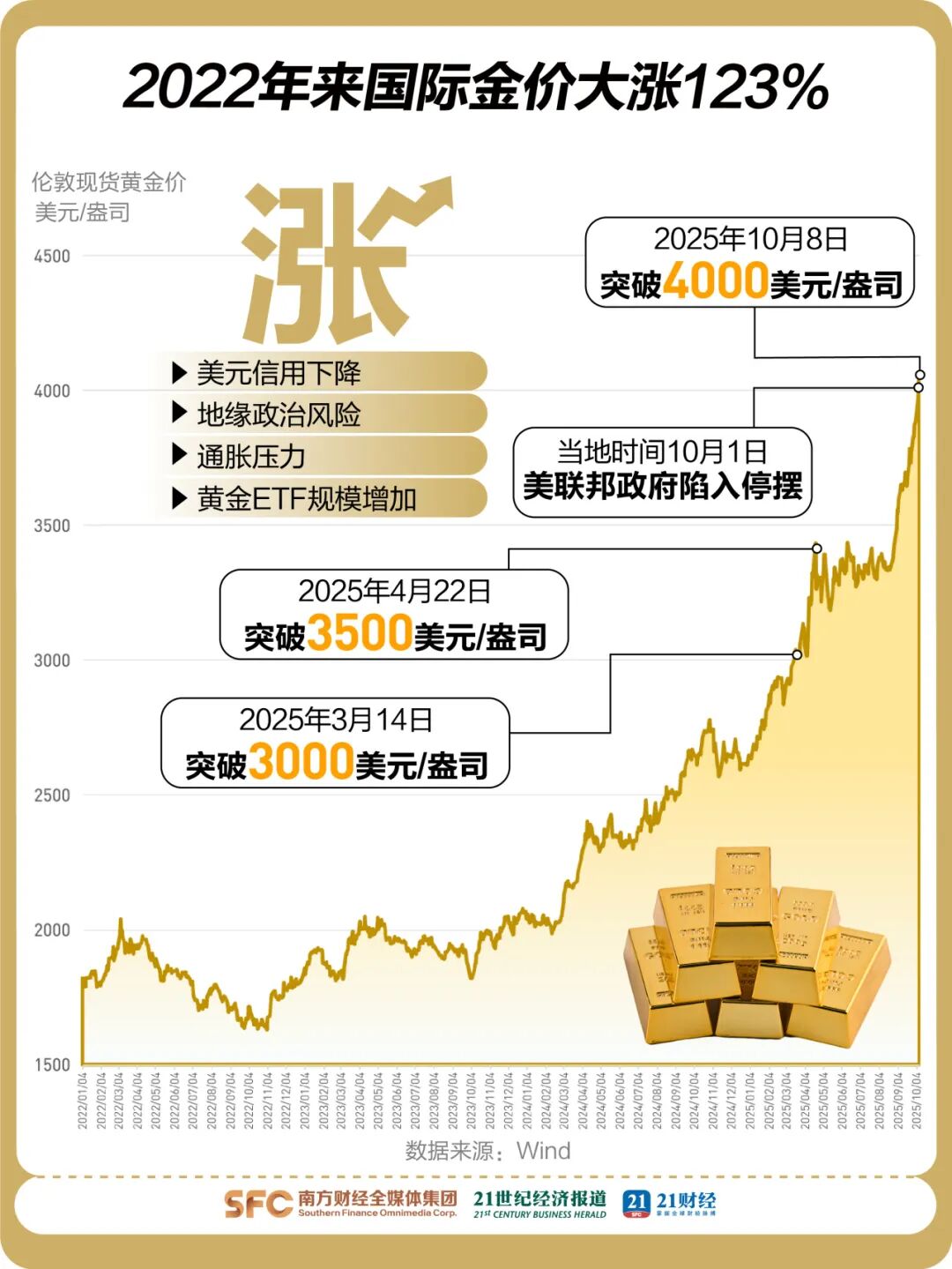
Core Viewpoint - A global wave of risk aversion is driving the precious metals market to unprecedented heights, with gold prices surpassing $4000 per ounce for the first time in history [1] Group 1: Gold Price Surge - As of October 10, gold prices have seen a cumulative increase of 123% since 2022, with a year-to-date rise of over 53% in 2025 [1] - Gold prices broke the $3500 per ounce mark on April 22, 2023, and reached $4000 in just 169 days, marking an extraordinary "rocket-like" increase [1] - The current price of gold in China has reached approximately 1180 RMB per gram, translating to around $11,000 for 100 grams, reflecting a significant increase in consumer costs [4][6] Group 2: Silver Market Dynamics - The silver market has outperformed gold, with prices rising over 70% this year, surpassing $50 per ounce [3] Group 3: Investment Trends - Global central banks have been net buyers of gold for 19 consecutive quarters since Q3 2020, indicating a strong institutional demand [12] - In September, global gold ETFs saw a record inflow of $17.3 billion, marking the highest monthly inflow ever [12] - A significant 95% of surveyed central banks plan to increase their gold holdings in the next year, with predictions of monthly purchases reaching 70 tons by 2026 [16] Group 4: Market Sentiment and Predictions - Market opinions are divided regarding the sustainability of gold's price increase, with some analysts predicting prices could exceed $4500 per ounce in the near future [16][18] - The long-term bullish outlook for gold is supported by ongoing central bank purchases, geopolitical uncertainties, and a decline in confidence in traditional currency systems [18]
财经聚焦 | 年内涨约50%!金价为何一路高歌?
Shang Hai Zheng Quan Bao· 2025-10-10 12:02
Core Viewpoint - The international gold price has surged over 51% this year, marking 2025 as potentially the year with the highest price increase since 1979, driven by geopolitical changes, economic uncertainties, and central bank gold purchases [1][2][3]. Price Movement - The international gold price recently broke through significant thresholds of $3000 and $4000 per ounce, with a notable increase of over 20% since late August, reaching a historical high of $4000 on October 8 [1][3]. - Domestic gold prices have also risen, with brands like Chow Tai Fook reporting prices around 1168 RMB per gram, an increase of 45 RMB since the end of September [1]. Contributing Factors - Key factors driving the gold price increase include geopolitical tensions, global economic uncertainties, the U.S. Federal Reserve's interest rate cuts, and increased gold purchases by central banks [3][4]. - The recent U.S. government shutdown has heightened concerns over the dollar's credibility and U.S. sovereign debt, further pushing up gold prices [3]. Market Dynamics - There is a noticeable shift in consumer behavior, with a decline in gold jewelry sales but a surge in investment demand for gold bars [6][7]. - The market is seeing a significant influx of out-of-town buyers looking to allocate assets, while gold buyback activities have been subdued due to the lack of price stabilization [7]. Future Outlook - Experts suggest that while there is medium to long-term support for gold prices, the rapid short-term increases may lead to volatility [8]. - Gold is viewed as a long-term asset allocation tool rather than a short-term speculative investment, emphasizing the need for investors to understand the risks associated with different gold investment products [8].