
市场多元化

Search documents
全国外贸十强市又变了!这座小城一直在默默发财...
Sou Hu Cai Jing· 2025-08-07 05:35
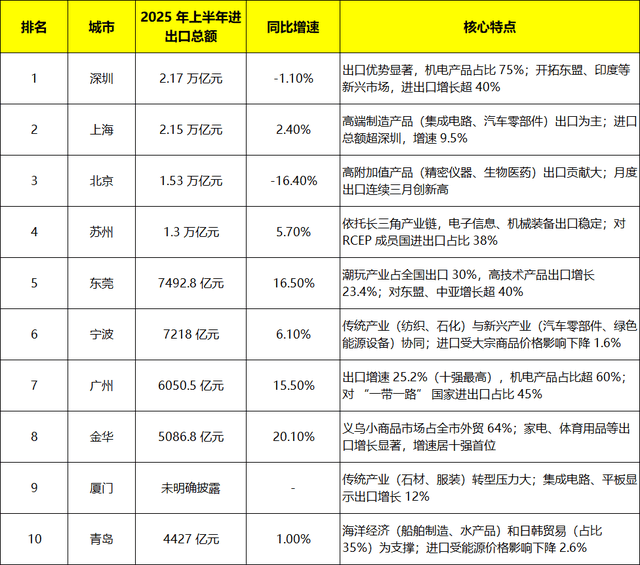
Core Insights - The top ten foreign trade cities in China for the first half of 2025 have been released, showcasing a stable position for leading cities while new contenders are emerging [1] Group 1: Trade Performance - Shenzhen ranks first with a total import and export value of 2.17 trillion yuan, accounting for 9.9% of the national foreign trade value, despite a slight decline of 1.1% year-on-year [2][3] - Shanghai follows closely with 2.15 trillion yuan, showing a year-on-year increase of 2.4%, with a notable 9.5% growth in imports [2][3] - Beijing's trade value is 1.53 trillion yuan, down 16.4% year-on-year, but it has seen three consecutive months of record-high exports [2][3] - Suzhou's trade reached 1.3 trillion yuan, growing by 5.7%, benefiting from the Yangtze River Delta industrial chain [2][3] Group 2: Sector Contributions - Dongguan's trade value is 749.28 billion yuan, with a significant year-on-year growth of 16.5%, driven by the trendy toy industry, which accounts for 30% of national exports [4][5] - Ningbo's trade reached 721.8 billion yuan, growing by 6.1%, with traditional industries collaborating with emerging sectors [4][5] - Guangzhou's trade value is 605.05 billion yuan, with the highest export growth rate of 25.2%, supported by machinery and electrical products [4][5] - Yiwu's trade reached 508.68 billion yuan, growing by 20.1%, with the small commodity market playing a crucial role [4][5] Group 3: Market Dynamics - The competition between Shenzhen and Shanghai for the top position is expected to continue, influenced by global demand recovery in the second half of the year [6] - The combined trade value of Shanghai, Suzhou, Ningbo, and Jinhua exceeds 4.7 trillion yuan, representing 21.6% of the national total [5][6] - Emerging markets are becoming the main growth drivers, with significant increases in trade with ASEAN and Central Asia [5][6]

中国纺织品进出口商会:上半年我国纺织服装出口同比微增0.8%
智通财经网· 2025-08-06 08:31
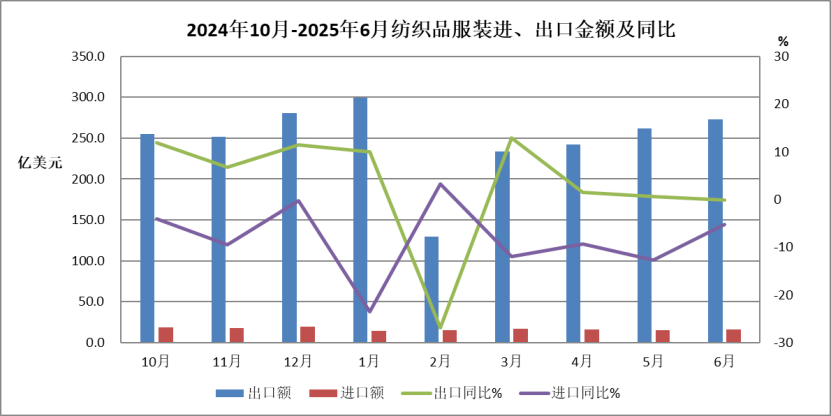
Core Viewpoint - China's textile and apparel exports in the first half of the year reached nearly $144 billion, showing a year-on-year growth of 0.8%, despite challenges from global consumption downturn and U.S. tariff policies [1][3][6]. Export Performance - The textile and apparel export value for the first half of the year was $1,439.8 billion, with textile exports at $705.2 billion (up 1.8%) and apparel exports at $734.6 billion (down 0.2%) [6][20]. - In June, textile and apparel exports amounted to $273.1 billion, a slight decrease of 0.1% year-on-year [6][20]. - The U.S. market saw a 5.1% decline in textile and apparel exports, while exports to the EU and Japan grew by 8.1% and 1.2%, respectively [6][14][17]. Impact of U.S. Tariff Policies - The U.S. imposed new "reciprocal tariffs" affecting nearly 70 countries, with rates varying by country, which has created significant uncertainty for Chinese exporters [1][7]. - The U.S. tariffs have led to a cautious approach from American buyers, resulting in a decrease in orders compared to the previous year [2][12]. Market Diversification - Despite challenges, there is a shift towards market diversification, with emerging markets in Africa and Latin America, as well as stable demand from the EU and Japan, providing positive momentum for exports [2][19]. - Exports to "Belt and Road" countries reached $830.8 billion, reflecting a year-on-year growth of 0.8% [19]. Regional Performance - Key regions such as Zhejiang, Jiangsu, Shandong, and Shanghai saw export growth, while Guangdong, Fujian, and Xinjiang experienced declines [22]. - In June, the export performance varied significantly across regions, with some regions showing resilience while others faced challenges [22]. Import Trends - Textile and apparel imports totaled $92.5 billion in the first half of the year, down 10.5% year-on-year, with significant declines in yarn and fabric imports [24][25]. - The import of cotton saw a dramatic decrease, with June imports at a 20-year low, reflecting broader trends in the textile supply chain [26].
2025年全球印刷电路板(PCB)市场预计呈现增长态势,泉果基金调研崇达技术
Xin Lang Cai Jing· 2025-08-05 03:59
Core Viewpoint - The company is experiencing strong demand for its products, particularly in the mobile phone, server, and communication sectors, which is expected to drive significant sales growth in 2025 [3][4]. Group 1: Company Performance and Market Outlook - The global printed circuit board (PCB) market is projected to grow by 6.8% in value and 7.0% in shipment volume in 2025 according to Prismark report [2]. - The company currently has an overall capacity utilization rate of approximately 85% [4]. - The company plans to enhance its production capacity by optimizing and expanding its facilities, including the construction of new plants in Zhuhai and Thailand [4][6]. Group 2: Sales Strategy and Customer Focus - The company aims to deepen its marketing strategy targeting major clients in key industries such as mobile phones, automotive, and servers, focusing on high-value orders [3][5]. - The company is actively managing its sales structure by eliminating loss-making orders and optimizing customer relationships to improve profit margins [5]. Group 3: Cost Management and Profitability - The company is implementing various measures to improve its gross profit margin, including enhancing material utilization and optimizing production processes [9]. - Strategies to mitigate rising raw material costs include dynamic cost monitoring, improving material efficiency, and selectively raising prices based on market conditions [9][8]. Group 4: Response to Tariffs and Market Diversification - Currently, approximately 10% of the company's revenue comes from the U.S. market, and the company is adapting to the changing tariff landscape by diversifying its market presence [10][11]. - The company is accelerating the establishment of overseas production bases to reduce tariff and logistics costs, thereby enhancing competitiveness in international markets [12].

波黑外贸商会介绍上半年外贸情况
Shang Wu Bu Wang Zhan· 2025-08-02 15:53
Group 1 - Bosnia's total foreign trade in the first half of 2025 reached 23.6 billion marks, a year-on-year increase of 4.83% [1] - Exports amounted to 8.65 billion marks, reflecting a growth of 5.42% compared to the previous year, while imports were 14.95 billion marks, up by 4.5% [1] - The trade deficit stood at 6.3 billion marks, indicating a significant reliance on imports due to domestic production not meeting internal demand, particularly in food, electronics, and automotive sectors [1] Group 2 - The European Union remains Bosnia's most important trading partner, with exports to the EU totaling 6.36 billion marks, accounting for over 66% of total exports [2] - Imports from the EU reached 9.91 billion marks, making up nearly 68% of total imports [2] - Exports to CEFTA countries were 1.42 billion marks, while imports from CEFTA countries were 2.34 billion marks, indicating active trade within the region [2] Group 3 - Future trade is expected to remain stable without significant fluctuations, with potential growth in imports driven by wage increases, remittances, and moderate inflation [2] - Export growth is anticipated to be modest, with a need for increased exports of high-value-added products such as food, textiles, automotive, and IT sectors to achieve greater overall export growth [2]
Interface (TILE) Q2 EPS Jumps 50%
The Motley Fool· 2025-08-02 10:10
Core Viewpoint - Interface significantly outperformed Wall Street expectations in Q2 2025, reporting non-GAAP EPS of $0.60 and GAAP revenue of $375.5 million, indicating strong sales momentum and improved profitability [1][5]. Financial Performance - Non-GAAP EPS was $0.60, exceeding the estimate of $0.47, and up 50% from $0.40 in Q2 2024 [2]. - GAAP revenue reached $375.5 million, surpassing the estimate of $360.74 million and reflecting an 8.3% increase from $346.6 million in Q2 2024 [2]. - Gross profit margin improved to 39.4%, up 4.0 percentage points from 35.4% in the previous year [2][7]. - Operating income was $52.0 million, a 36.1% increase from $38.2 million in Q2 2024 [2]. - Net income rose to $32.6 million, up 44.3% from $22.6 million in the same quarter last year [2]. Business Model and Focus Areas - Interface specializes in modular carpet tiles and resilient flooring products, focusing on design innovation and sustainability [3]. - The company prioritizes sustainability leadership, market diversification, innovative product design, robust supply chain management, and expanding its resilient flooring portfolio [4]. Market Performance - The Americas segment led revenue growth with an 11.4% year-over-year increase, while operating income for this segment rose 82.2% [5]. - The EAAA segment saw a 3.4% revenue growth, but operating income fell 71.8%, indicating regional economic challenges [6]. Profitability Drivers - Gross margin expansion contributed significantly to profitability, driven by higher pricing, better product mix, and increased manufacturing volumes [7]. - SG&A expenses increased by 10.8%, attributed to higher commissions and compensation linked to sales performance [7]. Order and Backlog Trends - Consolidated currency-neutral orders increased by 2.9% year-over-year, with a 12% rise in backlog at the end of Q1 [8]. - Key market segments such as healthcare and education saw billings grow by 28% and 11% respectively, supporting market diversification efforts [11]. Balance Sheet Strength - Cash holdings rose to $121.7 million, a 22.6% increase since December 2024, while net debt decreased to $182.7 million, resulting in a net leverage ratio of 0.9 times [9]. Sustainability and Product Strategy - Sustainability is central to Interface's strategy, with a goal to become carbon-negative by 2040 [10]. - The company continues to invest in product innovation, launching new styles in its modular carpet and resilient flooring lines [12][13]. Future Guidance - Management raised full-year guidance for net sales to between $1.37 billion and $1.39 billion, and adjusted gross profit margin to 37.7% [14]. - For Q3, expected GAAP net sales are between $350 million and $360 million, with an adjusted gross margin of 38.0% [14].


【环球财经】专家倡导巴西加快市场多元化布局
Xin Hua Cai Jing· 2025-07-31 22:59
对于巴西国内关于是否应对美方举措进行报复性征税的讨论,夏华声分析,巴西当前对美贸易处于逆差 状态,在反制工具有限的背景下,更关键的是在谈判中坚持自身立场,捍卫主权。 谈及未来全球贸易环境,夏华声表示,关税与政策不确定性将成为新常态,企业需调整国际市场战略, 减少对单一市场依赖。"这是对全球企业的一次风险教育,尤其是对依赖美国市场的出口商。" 在服务出口方面,他看好巴西金融科技的发展潜力。"巴西央行推出的即时支付系统Pix具有高效、低成 本、监管完善等优势,值得对外推广。"他说,"巴西应该出口的不只是农产品,也包括金融服务。" 新华财经圣保罗7月31日电(记者杨家和)针对美国总统特朗普正式对部分巴西进口商品征收50%关税 一事,巴西瓦加斯基金会金融专家夏华声(Hsia Hua Sheng)近日在接受巴西媒体Estado采访时表示, 尽管美方对橙汁、纸浆、石油和飞机等部分产品给予关税豁免,整体措施依然是基于美国本身利益考 量,与巴西无关。 "特朗普这么做是出于美国自身的通胀压力,不是考虑巴西的利益,"夏华声指出。眼下美国政府最担忧 的是高关税对国内物价的影响,而非与巴西的经贸关系。豁免某些商品关税实则服务于美国自 ...
维珍妮2025财年筑底企稳:收入增长11.7%至78.4亿港元,运动板块大涨26.9%成增长引擎,越南产能占比85%应对贸易挑战
Jin Rong Jie· 2025-07-28 06:57
Core Viewpoint - The company, Viginie, has shown a recovery in its fiscal year 2025 performance, with an 11.7% increase in revenue to HKD 7.84 billion, despite challenges from macroeconomic fluctuations and uneven consumer recovery [1] Group 1: Business Performance - The intimate apparel segment generated revenue of HKD 4.243 billion, a modest increase of 3.0% year-on-year, accounting for 54.2% of total revenue, with a gross margin improvement of 1.0 percentage points to 24.7% [3] - The sports products segment emerged as a growth highlight, with revenue of HKD 2.934 billion, a significant increase of 26.9% year-on-year, representing 37.4% of total revenue, driven by a global sports trend and strong demand for sports bras [3] - The consumer electronics accessories segment, although smaller, saw robust growth with revenue of HKD 409 million, a substantial increase of 43.2% year-on-year, primarily driven by new product orders from core brand partners [3] Group 2: Operational Optimization - The company is advancing its smart transformation through vertical integration, intelligent management, automation, and localized supply chains to enhance production efficiency and cost control [4] - As of October 2024, the total output value from the Vietnam base accounted for 85% of total revenue, with approximately 31,900 employees in Vietnam compared to about 4,900 in mainland China [4] - The company's China operations generated revenue of HKD 1.966 billion in fiscal year 2025, a 4.4% increase year-on-year, with a net profit of HKD 85.6 million, benefiting from localized innovation and strong e-commerce performance [4] Group 3: Future Outlook - The company faces multiple challenges in fiscal year 2026 due to increased global market uncertainty from trade tariffs, leading to cautious order placements from brand partners [5] - The company is implementing cost-reduction measures across R&D, production, and operations to enhance organizational efficiency and effectiveness [5] - The company aims to leverage its leading Bonding technology to expand its successful cross-category initiatives from intimate apparel to sports and clothing segments, showcasing strong market potential [5]
“在美生意已无利可图” 塞尔维亚铝制品企业遭美关税绞杀
Yang Shi Xin Wen· 2025-07-26 02:29
Group 1 - The U.S. President Trump announced a 35% tariff on Serbian imports starting August 1, raising concerns among Serbian export companies, particularly those in the aluminum sector already facing a 50% tariff [1] - The general manager of a major Serbian aluminum company stated that 90% of their products are for export, with 70% of that going to the U.S., and the new tariffs could eliminate all profits from U.S. sales, making business unprofitable [2] - The Serbian Chamber of Commerce criticized the U.S. tariffs as unreasonable, highlighting a trade deficit with the U.S. of 60 million euros, contrary to U.S. claims of a trade surplus [3] Group 2 - The Serbian aluminum company is exploring alternative markets outside the U.S., focusing on nearby European markets, the Balkans, and local markets, while also signing contracts with Chinese companies [2] - The Serbian Chamber of Commerce emphasized the unpredictability of U.S. tariff policies, which could deter investment and negatively impact consumers [3] - The Serbian Chamber of Commerce called for a diversified market strategy to reduce reliance on the U.S. market, as unpredictability is detrimental to businesses [3]
菲律宾贸易部长:我们不能对糖、大米实行零关税。不能只依赖单一市场。希望将对美关税从19%降至更低水平。
news flash· 2025-07-25 07:37
Group 1 - The Philippine Trade Secretary stated that the country cannot implement zero tariffs on sugar and rice, indicating a need for a balanced approach to trade policy [1] - There is an emphasis on not relying solely on a single market for agricultural products, suggesting a diversification strategy in trade [1] - The Trade Secretary expressed a desire to reduce tariffs on imports from the United States from the current 19% to a lower level, highlighting ongoing trade negotiations [1]
欧盟反制美国关税“以拖待变”
Jing Ji Ri Bao· 2025-07-21 22:06
面对美国关税施压,欧盟一面强调要采取措施维护自身利益,表现出些许强硬;一面又因经济对美依存 度高、内部分歧大以及地缘政治等因素,声称谈判仍是优先选项。面对这些复杂因素,欧盟当前的"摇 摆不定"可以视为基于现实的理性选择。不过欧盟"不战不和不守"的暧昧只会等来美国更加肆无忌惮的 霸凌。 7月中旬,美国在关税问题上再度对欧盟发难。面对美国施压,欧盟一面强调要采取措施维护自身利 益,一面又声称谈判仍是优先选项。欧盟摇摆不定的态度,反映出其决策受到多方因素掣肘,也体现出 试图"以拖待变"的绥靖心态。 当地时间7月12日,美国总统特朗普宣布,将自8月1日起对从欧盟、墨西哥进口的商品分别征收30%的 关税。美方声称,欧盟的关税和非关税贸易壁垒导致美国出现对欧巨额贸易逆差,双方关系"远非互惠 互利"。欧盟及其成员国领导人对此表示强烈不满。欧盟委员会主席冯德莱恩当天发表声明称,"欧盟将 采取一切必要措施维护自身利益,包括在必要时对等反制"。欧盟委员会负责贸易和经济安全等事务的 委员谢夫乔维奇14日表示,如果美欧贸易谈判失败,欧盟准备对价值720亿欧元(约合840亿美元)的美 国进口商品征收额外反制关税。 此外,欧盟还面临安全 ...