
国产替代

Search documents
布局2026年 科技成长仍是主角?公募最新投资策略来了
天天基金网· 2026-01-05 08:41
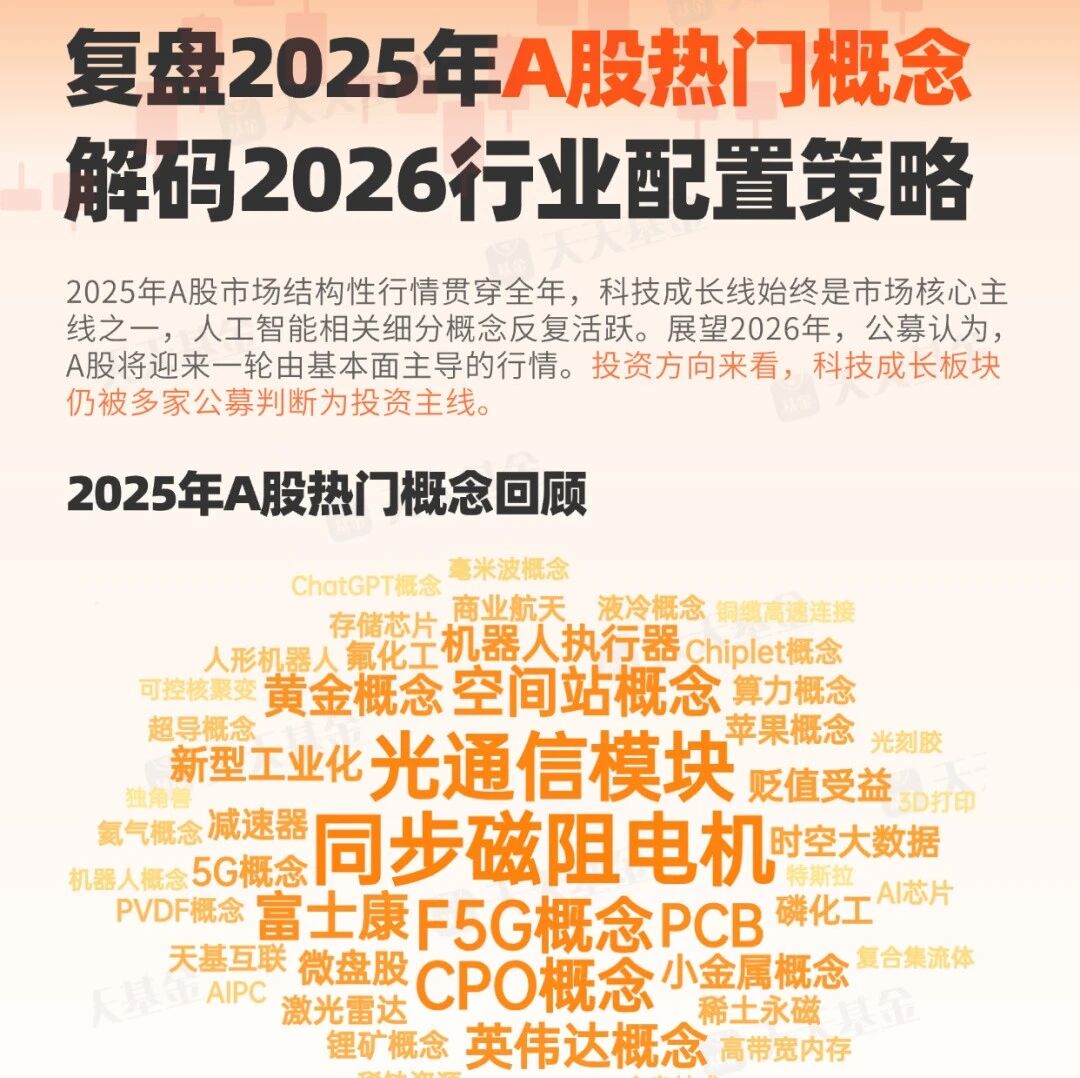
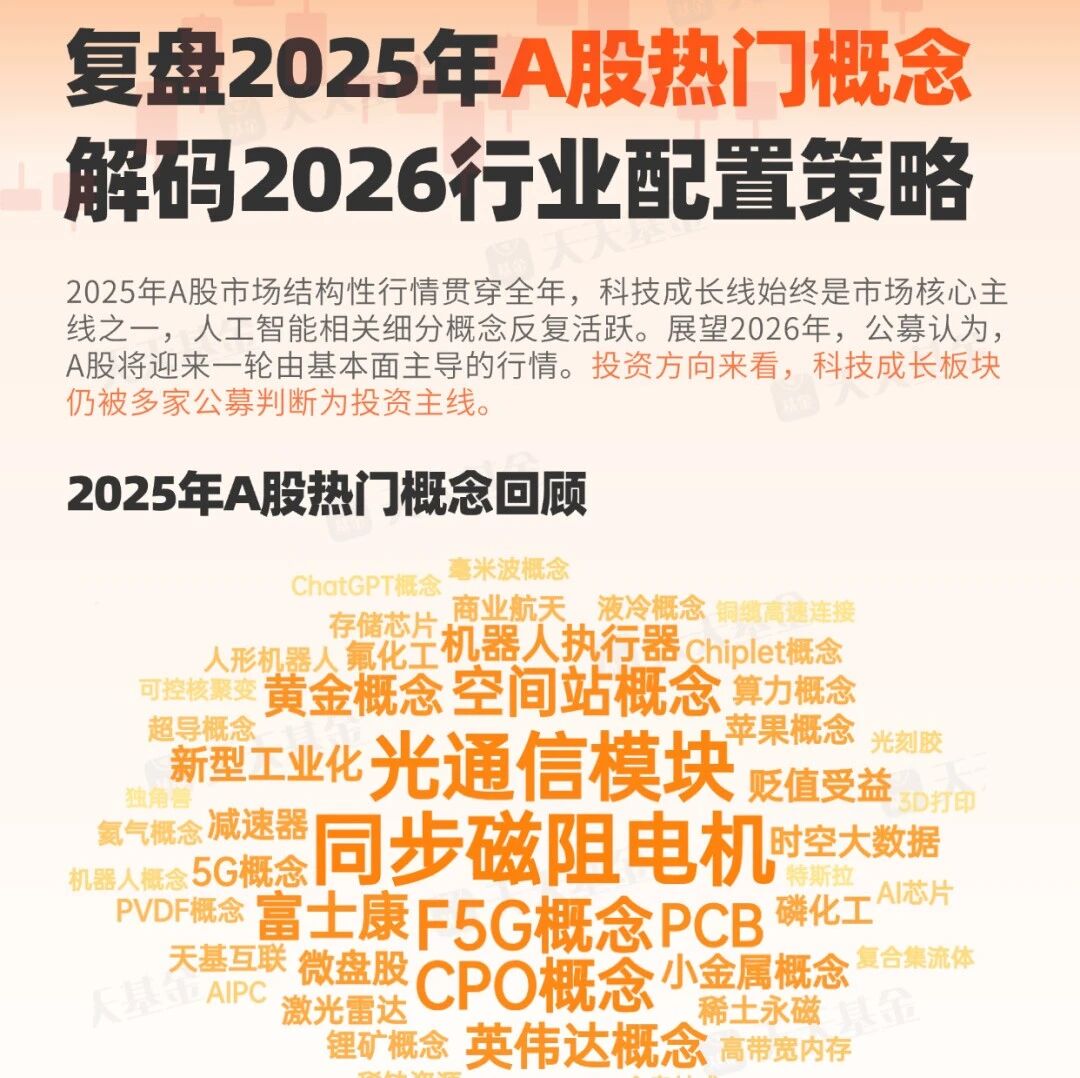
Core Viewpoint - The A-share market in 2025 experienced a structural trend with technology growth as a core theme, particularly in artificial intelligence-related sectors. Looking ahead to 2026, public funds anticipate a market driven by fundamentals, with technology growth remaining a key investment focus [1][8]. Summary by Sections 2025 A-share Market Overview - The A-share market in 2025 was characterized by a clear rotation of concept sectors, with major themes alternating and a rapid iteration of hotspots. Over 90% of concept indices saw an increase, with the synchronous reluctance motor achieving the highest growth at 165.05%, followed by optical communication modules at 156.02% [11]. 2026 Investment Outlook - Public funds predict a fundamental-driven market in 2026, with technology growth sectors still viewed as the main investment line. HSBC Jintrust Fund suggests a potential market rebalancing, shifting from TMT to lower-positioned industries with profit recovery potential. Investors focusing on safety margins should consider midstream manufacturing, consumption, and cyclical sectors [9][11]. Sector-Specific Insights - CITIC Prudential Fund indicates that a solid growth style may persist throughout the year, but broad market rallies may end. Companies with genuine technological barriers and commercialization capabilities in AI applications, domestic substitution, and overseas expansion are expected to attract market attention due to their high growth potential [12]. - Zhongjia Fund emphasizes that technology, particularly AI, remains a focus for aggressive sectors in 2026, combining short-term performance with long-term narratives. Other sectors of interest include event-driven stocks and stable, defensive attributes in Hong Kong dividends, finance, agriculture, and precious metals [12].

存储芯片涨声再起!美光新高,AI算力引爆需求,国产替代加速?
Jin Rong Jie· 2026-01-05 08:33
Group 1: Market Performance - The storage chip sector has shown active performance, with multiple stocks experiencing significant increases, such as Silan Microelectronics rising over 14% and Shannon Semiconductor increasing over 10% [1] - Overnight, the U.S. stock market saw strong performance in the storage chip sector, with Micron Technology's stock rising by 10.51%, reaching a historical high, and SanDisk's stock increasing by 15.95% [1] Group 2: Demand Drivers - The demand for storage chips is driven by substantial investments in global AI infrastructure, with major North American cloud service providers like Google, Meta, Microsoft, and Amazon expected to increase capital expenditures by 2026, further boosting demand for high-performance storage products [1] - The global storage chip market is projected to remain in a state of supply shortage, with server DRAM and NAND flash consumption expected to surge by 40% to 50% year-on-year, particularly in the AI server sector [2] Group 3: Price Trends - According to reports, storage contract prices are expected to continue rising in Q1 2026, with increases potentially reaching 30% to 40%, and DDR5 RDIMM memory prices anticipated to rise over 40% [2] - The ongoing price increases for DRAM and NAND Flash are significantly improving the profitability of related companies [3] Group 4: Industry Expansion - The expansion of the storage chip industry is expected to drive demand for upstream semiconductor equipment and materials, with increased requirements for etching, thin film deposition, cleaning, and measurement equipment due to the advancement of technology nodes [2] - Domestic leading companies like Changxin Storage and Yangtze Memory Technologies are advancing their production plans, which will enhance capital expenditure certainty in the domestic storage industry [2] Group 5: AI Infrastructure - Storage chips are essential components of AI computing infrastructure, as AI training and inference tasks require high-speed access to massive data, directly impacting the overall efficiency of computing clusters [3] - The upgrade and price increase of storage chips reflect the high intensity and sustainability of downstream AI computing investments, which will further stimulate demand across various related industries, including AI servers and advanced packaging [3]


“国产GPU四小龙”上市潮下的生态协同:AI巨头企业牵头构建国产AI芯片全适配网络
Mei Ri Jing Ji Xin Wen· 2026-01-05 08:11
Group 1 - The domestic GPU industry is experiencing a capital surge, with the "Four Little Dragons" of domestic GPUs—Biran Technology, Moore Threads, Muxi Co., and TianShu ZhiXin—actively pursuing capital market opportunities [1] - Biran Technology officially listed on the Hong Kong Stock Exchange on January 2, 2026, becoming the leading domestic GPU stock, with an opening price increase of 82% and a market capitalization exceeding 100 billion HKD [1] - The four leading domestic GPU companies are long-term strategic partners of SenseTime, collaborating based on a "computing power supply-algorithm demand" logic, aiming for a domestic substitution strategy [1] Group 2 - The successful listing of Biran Technology marks a significant moment for domestic GPU companies, highlighting the value of their collaboration with AI software vendors [2] - SenseTime has launched the first multi-episode generative AI agent, Seko2.0, which has successfully adapted to the domestic AI chip Cambricon, achieving a critical leap in domestic computing power across various AIGC core scenarios [2] - SenseTime has established a comprehensive domestic ecosystem by deeply adapting with over ten top chip companies, including Biran Technology and Cambricon, promoting the transition of domestic AI chips from "usable" to "user-friendly" [2] Group 3 - SenseTime has built a full-link cooperation system from computing power supply to scene implementation, collaborating with various domestic partners to provide high-performance domestic computing power at low costs [3] - The MTT S series GPU from Moore Threads has completed full adaptation with SenseTime's SenseCore large device, undergoing industrial-grade testing in training and inference of large models [3] - SenseTime has also launched the industry's first real-time video generation inference framework, LightX2V, which supports multiple domestic chips through a highly compatible plugin model [3] Group 4 - SenseTime's ability to act as a "connector" for domestic chip adaptation is rooted in its comprehensive technical capabilities, from computing power scheduling to application optimization [4] - The collaboration with Cambricon has led to significant enhancements in inference performance, with improvements exceeding three times through hardware-friendly innovations [4] - SenseTime's proprietary heterogeneous interconnection technology and scheduling platform have achieved unified training capabilities across various acceleration cards, significantly shortening training cycles [4] Group 5 - The technological advancements in domestic adaptation have translated into accessible product experiences, such as the Seko multi-episode generative AI agent showcasing efficient video creation capabilities [5] - Applications like Xiaohuanxiong are optimized for personal PCs and domestic terminals, providing secure and high-precision AI services [5] - New products like the Daxiao robot and RuYing marketing AI agent leverage the collaborative advantages with domestic chips to promote the domestic substitution process in various fields [6]
布局2026年 科技成长仍是主角?公募最新投资策略来了
天天基金网· 2026-01-05 07:46
第一大事会 链接您与财富 型盘2025年A股热门槛 解码2026行业配置等 2025年A股市场结构性行情贯穿全年,科技成长线始终是市场核心主 线之一,人工智能相关细分概念反复活跃。展望2026年,公募认为, A股将迎来一轮由基本面主导的行情。投资方向来看,科技成长板块 仍被多家公募判断为投资主线。 2025年A股热门概念回顾 ir Chipleting 晨 优志 半刻胶 First JI→4 步被旧目 n 时空大数据 ■ IR 磷化工Al芯片 GTIFF 元来 令小金属概念 微信元 稀土永德 英伟达概念 高带宽内存 汽车热量理 光通信模块 156.02% 165.05% No. F5G概念 128.33% N No. CPO概念 124.50% 同步磁阻电机 No. No. No. 空间站概念 PCB 富士康 5 0 112.11% 115.95% 111.68% No. No. No. 机器人执行器 英伟达概念 黄金概念 00 9 10 86.54% 104.45% 97.35% 注:字号越大表示2025年板块涨幅越大 2025年概念涨幅TOP10 No. l ( No. 展望2026年,公募行业主流观点认 ...
估值140亿,深圳将跑出“国产DPU第一股”
3 6 Ke· 2026-01-05 07:20
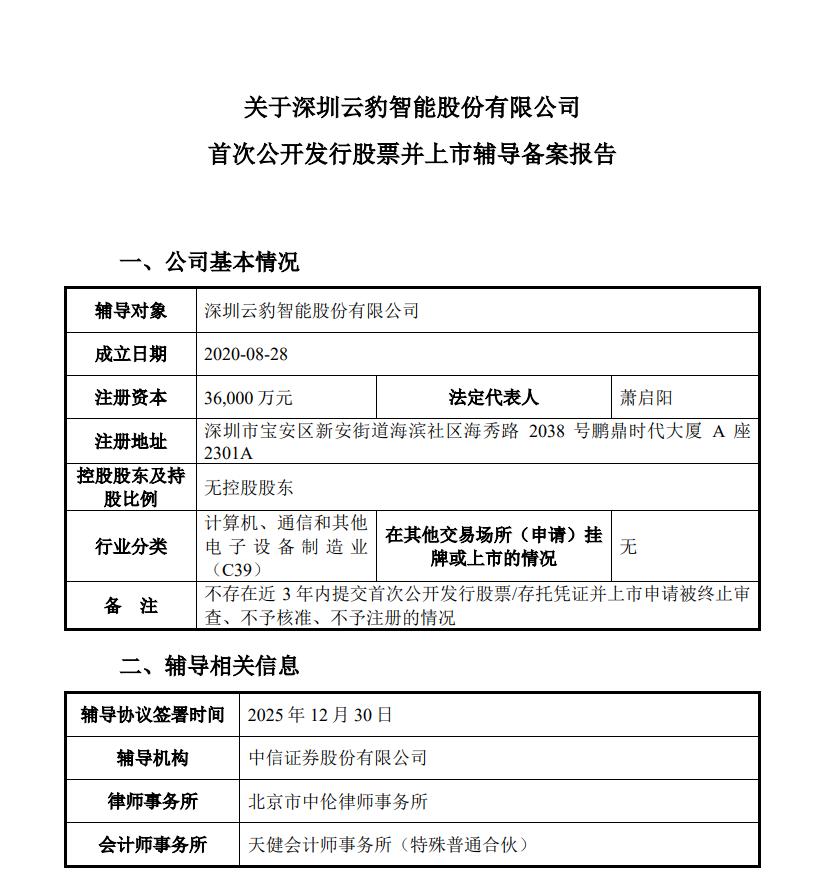
Core Viewpoint - The article discusses the rise of Shenzhen Cloud Leopard Intelligent Co., Ltd. as a leading player in the domestic DPU (Data Processing Unit) market, highlighting its potential to become the first publicly listed DPU company in China by 2025, backed by significant investments and a strong founding team [1][4][11]. Company Overview - Shenzhen Cloud Leopard Intelligent Co., Ltd. was established on August 28, 2020, with a registered capital of 360 million yuan [2]. - The company currently has no controlling shareholder, and its industry classification falls under electronic device manufacturing [2]. - The company has not faced any termination or disapproval of its IPO applications in the past three years [2]. Founding and Leadership - The founder, Xiao Qiyang, holds a Ph.D. in Electrical Engineering from Stanford University and has a notable background in AI research, having received the National Science Foundation Young Investigator Award [5][7]. - Xiao Qiyang has previously founded RMI, a company known for developing multi-core processors, which were widely used in major communication network equipment [8][9]. Market Position and Growth - Cloud Leopard Intelligent is recognized as the first industry unicorn in the domestic DPU sector, achieving a valuation of 14 billion yuan after its latest funding round [4][12]. - The company has completed eight rounds of financing, with notable investors including Tencent, Sequoia Capital, and IDG Capital, among others [13][14]. Product Development and Innovation - In December 2021, the company launched its first full-featured cloud-native DPU card, which supports various service resources and significantly enhances service quality and operational efficiency for cloud service providers [15]. - By 2023, the company successfully produced a 6nm DPU chip, marking a significant technological advancement in the domestic market [16]. Market Share and Future Goals - As of 2024, Cloud Leopard Intelligent is projected to hold approximately 15.3% of the domestic DPU market, with key clients including China Mobile and Tencent [16]. - The company's strategy focuses on achieving the highest cost-performance ratio in DPU technology, aiming to dominate market share while enhancing operational efficiency and reducing costs [16].
半导体产业多重利好共振,存储涨价预期全面上修,泰康半导体量化选股股票发起式(A:020476;C:020477)一键把握半导体行业增量机遇
Sou Hu Cai Jing· 2026-01-05 06:52
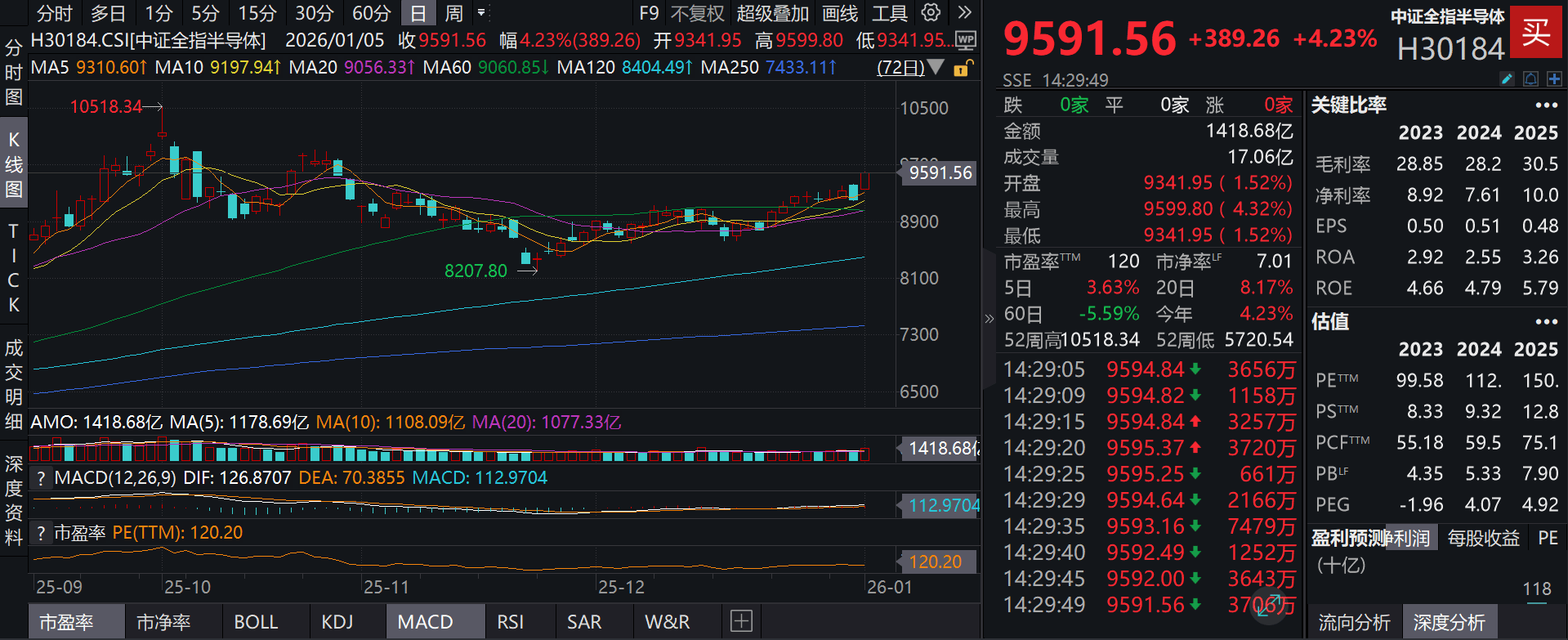
Group 1 - The semiconductor sector experienced significant gains, with companies like Zhongwei rising over 14%, Yandong Micro over 12%, and Shanghai Xinyang over 11% [1] - The semiconductor industry is benefiting from multiple favorable catalysts, including increased government support for domestic chip development and a substantial rise in the shareholding of the National Integrated Circuit Industry Investment Fund in SMIC from 4.79% to 9.25% [3] - TrendForce has revised its price expectations for memory chips, forecasting a 55-60% increase in DRAM and a 33-38% increase in NAND contract prices for Q1, which is significantly higher than previous predictions [3] Group 2 - CITIC Construction Investment reports that the semiconductor equipment sector is entering a growth cycle, with equipment orders expected to maintain high growth rates [4] - The Taikang Semiconductor Quantitative Stock Fund has achieved over 100% returns since its inception in May 2024, with a 1.28% increase in net value on the previous day [5] - Zhejiang Securities anticipates that the semiconductor equipment index will significantly outperform the market in 2025, with current valuations at the 28th percentile, indicating strong growth in front-end equipment revenue and explosive growth in back-end equipment [5]





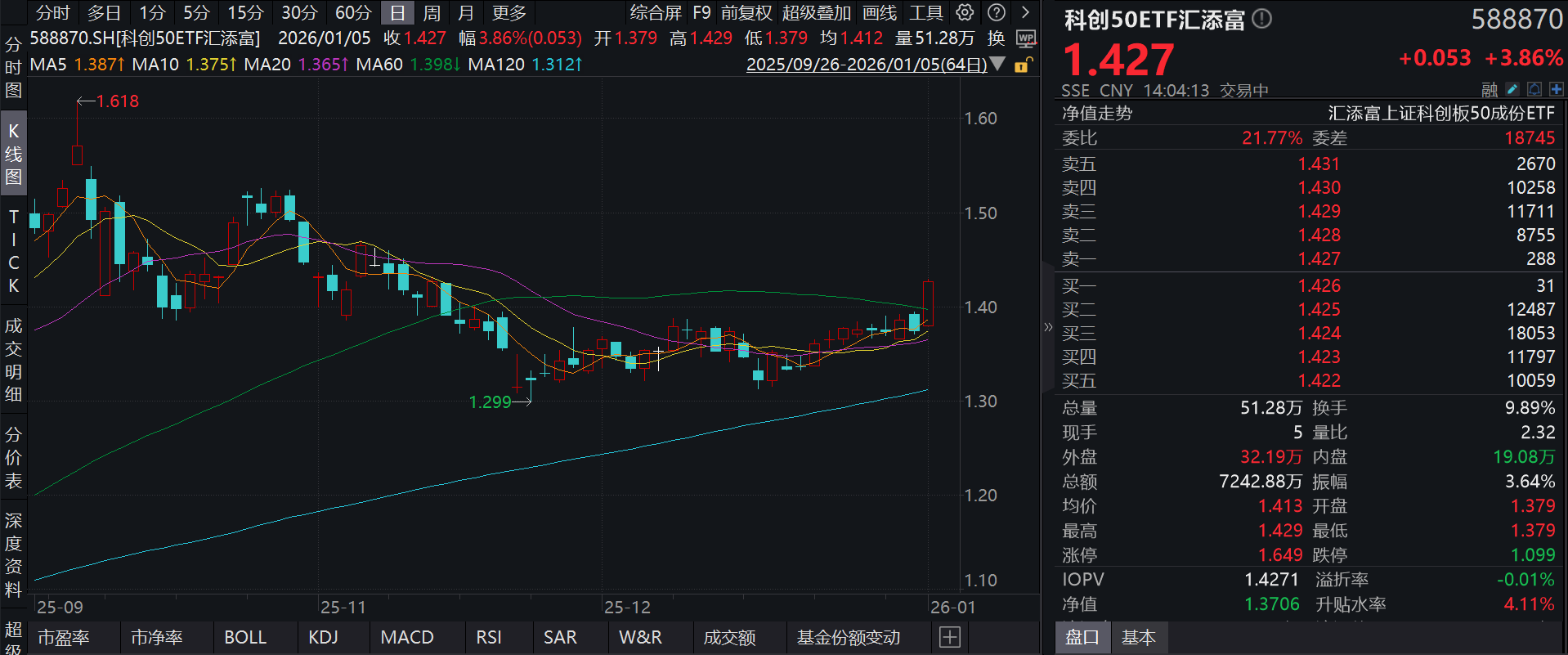
三大半导体龙头齐发公告,重大资产重组迎新进展!科创板开门红,中微公司涨超14%,科创50ETF汇添富(588870)放量涨近4%!
Xin Lang Cai Jing· 2026-01-05 06:32
截至2026年1月5日 14:04,上证科创板50成份指数(000688)强势上涨4.16%,成分股中微公司(688012)上涨14.09%,澜起科技(688008)上涨8.41%,柏楚电子 (688188)上涨7.96%,佰维存储(688525),拓荆科技(688072)等个股跟涨。科创50ETF汇添富(588870)上涨3.86%,最新价报1.43元。拉长时间看,截至2025年 12月31日,科创50ETF汇添富近2周累计上涨2.84%。(以上所列股票仅为指数成份股,无特定推荐之意) 流动性方面,科创50ETF汇添富盘中换手9.89%,成交7242.88万元。拉长时间看,截至12月31日,科创50ETF汇添富近1年日均成交5445.20万元。 份额方面,科创50ETF汇添富近半年份额增长2.64亿份,实现显著增长。(数据来源:Wind) 数据显示,杠杆资金持续布局中。科创50ETF汇添富最新融资买入额达174.94万元,最新融资余额达808.45万元。(数据来源:Wind) 20CM抓反弹,首选"硬科技龙头"科创50ETF汇添富(588870)!资料显示,科创50ETF汇添富(588870)跟踪科创50指 ...
2026年A股牛市逻辑或将发生变化
Sou Hu Cai Jing· 2026-01-05 06:12
(本文作者付一夫为苏商银行特约研究员) 刚刚过去的2025年,可谓是A股市场历史性的"跃升之年",在制度改革与产业趋势的双重驱动下,实现 了一系列标志性突破。 从指数层面看,市场走出了一轮特征鲜明的"慢牛"行情,上证指数中枢从年初的3200点左右稳步上行, 并一度成功站上4000点,创下近十年新高。至年末,沪指更是走出了"11连阳",展现出极为强劲的韧 性。不仅如此,A股市场的活跃度与体量达到全新水平,全年累计成交额首次突破400万亿元,日均成 交达1.72万亿元。此外,A股总市值在年内首次跨越100万亿元大关,成为全球第二大股票市场。而在结 构层面,大科技成为无可争议的最强主线,人工智能、半导体、算力、人形机器人等硬科技板块贯穿全 年行情,催生了多只翻倍牛股。 那么在2026年,A股又将如何表现?驱动逻辑是否会发生变化?收益预期是否需要调整?针对这些问 题,本文将尝试给出答案。 一、2026年宏观环境:内修外稳,质效并举 就基本面而言,2025年我国经济社会发展主要目标顺利实现,前三季度GDP同比增长5.2%,在全球主 要经济体中保持前列,为"十五五"开局奠定坚实基础。面对2026年复杂的内外环境,中央明确 ...
德昌股份(605555):汽车EPS电机国产替代龙头,前瞻布局人形机器人
ZHONGTAI SECURITIES· 2026-01-05 05:59
Investment Rating - The report assigns a "Buy" rating for the company, indicating an expected relative performance increase of over 15% against the benchmark index within the next 6 to 12 months [5][15]. Core Insights - The company has successfully transitioned from vacuum cleaner manufacturing to becoming a leader in domestic automotive EPS motor production, with a projected revenue of 4 billion yuan from automotive parts in 2024 [7]. - The company is also strategically investing in humanoid robotics, which is anticipated to become a significant growth driver alongside its automotive components business [7]. - The household appliance segment is expected to grow steadily, with revenues projected at 21 billion yuan in 2024, driven by new product categories despite short-term profit pressures from tariffs [7][12]. - The automotive parts segment is experiencing rapid growth, with revenues expected to reach 4 billion yuan in 2024, reflecting a significant increase from previous years [7][12]. - The company is diversifying its product offerings to reduce reliance on major clients, with the share of vacuum cleaner revenue decreasing from 71% in 2022 to an expected 52% in 2024 [7]. Financial Projections - Revenue projections for the company are as follows: 2,775 million yuan in 2023, 4,095 million yuan in 2024, 4,715 million yuan in 2025, 5,486 million yuan in 2026, and 6,478 million yuan in 2027, with growth rates of 43%, 48%, 15%, 16%, and 18% respectively [5][9]. - The net profit is forecasted to be 322 million yuan in 2023, 411 million yuan in 2024, 220 million yuan in 2025, 397 million yuan in 2026, and 632 million yuan in 2027, with growth rates of 8%, 28%, -47%, 81%, and 59% respectively [5][9]. - The earnings per share (EPS) are projected to be 0.87 yuan in 2023, 1.10 yuan in 2024, 0.45 yuan in 2025, 0.82 yuan in 2026, and 1.31 yuan in 2027 [5][9]. Valuation and Comparables - The company is compared with peers in the vacuum cleaner and small household appliance sectors, with an average P/E ratio of 30x for 2025, 24x for 2026, and 21x for 2027, indicating that the company has a favorable growth outlook with lower projected valuation multiples [10][11]. - The report highlights that the company's growth potential is significant, with a projected P/E of 40x for 2025, 22x for 2026, and 14x for 2027, which is lower than comparable companies, suggesting a margin of safety for investors [10][11].

芯片方向集体爆发,科创芯片ETF富国(588810)盘中涨幅达4.00%
Mei Ri Jing Ji Xin Wen· 2026-01-05 05:58
Group 1 - The semiconductor sector is experiencing significant gains on the first day of the new year, with storage chips, AI chips, photolithography materials, automotive chips, and domestic chips leading the increases [1] - The Kweichow Moutai ETF (588810) saw an intraday increase of 4.24%, while the leading chip ETF (516640) rose by 4.14%, and the consumer electronics ETF (561100) increased by 3.47% [1] - Notable individual stock performances include a rise of over 12% for Zhongwei Company, over 8% for Baidu Storage, and over 6% for Chip Source Micro [1] Group 2 - The national address mentioned breakthroughs in independent chip research and development, indicating strong government support for semiconductor self-sufficiency, reinforcing the logic of domestic substitution [1] - TSMC received annual approval from the U.S. to export chip manufacturing equipment to its Nanjing factory in 2026 without case-by-case approval, ensuring stable production capacity and delivery [1] - Huahong Semiconductor acquired 97.5% of Huali Micro for 8.268 billion yuan, which will enhance its 12-inch wafer foundry capacity, covering process nodes from 0.35 microns to 28 nanometers, creating scale advantages [1]