大模型

Search documents
逐浪潮 中国大模型跻身第一梯队
Xin Lang Cai Jing· 2025-12-22 23:27
Core Insights - The rise of AI agents is a significant trend in the artificial intelligence sector, marking a shift from tools to partners in various applications, including healthcare and workplace efficiency [1][2][3] Group 1: AI Agents as Partners - AI agents are becoming integral in daily life, assisting with tasks such as analyzing medical reports and generating business insights, thus transforming user interactions with technology [1][2] - The transition from "tool era" to "partner era" in AI is expected to reshape economic structures and human lifestyles, with AI agents facilitating a new interaction paradigm where services proactively reach users [2][3] Group 2: Industry Applications of AI Agents - AI agents are evolving into "smart employees" across industries, contributing to core processes such as predictive maintenance in manufacturing and compliance checks in finance, significantly enhancing operational efficiency [3] - The development of AI agents is supported by advancements in large language models, computational power, and collaborative ecosystems, enabling them to perform complex tasks beyond simple interactions [3] Group 3: Future Trends and Predictions - The concept of "collective intelligence" through multi-agent collaboration is anticipated to become mainstream, allowing dynamic team formations for efficient industrial transformation [4] - The Chinese AI sector is transitioning from a participant to a leader in the global landscape, particularly in open-source AI, showcasing competitive advantages and innovative development paths [5]


技术突围与资本共振: 人工智能赛道涌现上市潮
Zhong Guo Zheng Quan Bao· 2025-12-22 20:37
Core Insights - The Chinese AI industry is experiencing a significant capital market influx, with companies like Zhipu and MiniMax aiming for IPOs, indicating a critical phase of commercialization in AI technology [1][2] - The AI sector is projected to grow rapidly, with the core industry expected to exceed 900 billion yuan in 2024 and potentially surpass 1.2 trillion yuan in 2025, reflecting a 24% growth rate [1][6] - Despite the rapid growth, challenges such as high costs and low returns in AI applications persist, necessitating patience from investors [1][7] Company Summaries - Zhipu, established in 2019, has empowered over 12,000 enterprise clients and 80 million terminal devices, leading the independent general-purpose AI model market in China with a 6.6% market share [2] - MiniMax, founded in early 2022, has rapidly developed a product matrix for both C-end and B-end users, reaching over 2.12 million personal users and 130,000 enterprise clients across more than 200 countries [2] - Both Zhipu and MiniMax have shown substantial revenue growth, with Zhipu's revenue increasing from 57.4 million yuan in 2022 to 312.4 million yuan in 2024, and MiniMax's revenue projected to grow from 3.46 million USD in 2023 to 30.52 million USD in 2024 [5] Market Trends - The demand for AI models is surging, with daily token consumption in China exceeding 30 trillion by mid-2023, reflecting a 300-fold increase within a year [5] - The AI chip market is also thriving, with companies like MoEr Thread and MuXi achieving significant market valuations, indicating a robust demand for underlying computational power [2][3] - The global AI market is expected to reach 900 billion USD by 2026, with China being one of the fastest-growing markets, projected to exceed a 30% growth rate [6] Application Challenges - The integration of AI into various industries is facing structural challenges, particularly in manufacturing, where AI's penetration remains limited due to data accessibility and reliability issues [7][8] - The high consumption of data and computational resources raises concerns about the unclear commercial return paths for AI investments, with many companies currently operating at a loss [8][9] - There is a pressing need for improved data sharing and high-quality datasets to enhance AI model performance and facilitate broader adoption, especially among SMEs [7][8]
智谱、MiniMax冲刺港交所,巨头挤压下的AI独角兽上市找钱
Sou Hu Cai Jing· 2025-12-22 18:24
Core Insights - The AI unicorns MiniMax and Zhizhu are accelerating their push into the capital market, aiming for the title of "first stock of large models" [2] - Both companies have recently passed hearings and disclosed their prospectuses, with Zhizhu founded in 2019 and MiniMax in 2021 [2] - Despite rapid revenue growth, both companies are currently unprofitable due to high R&D expenditures [4][5] Group 1: Company Overview - Zhizhu's revenue comes primarily from localized and cloud deployments, with over 80% from the former, targeting large private enterprises and public sectors [4] - MiniMax adopts a dual B2B and B2C model, with over 70% of its revenue from consumer-facing products [4] - Zhizhu's revenue from 2022 to 2024 is projected to grow from 0.57 million to 3.12 million, with a 325.03% increase in the first half of this year [4] - MiniMax's revenue is expected to rise from 346,000 in 2023 to 3.05 million in 2024, with a growth rate exceeding 782% [4] Group 2: Financial Performance - Zhizhu's adjusted net loss since 2022 totals approximately 49.36 billion, with R&D expenses exceeding 44 billion [4][5] - MiniMax's total R&D expenses from 2022 to 2024 amount to 450 million, with an adjusted net loss of 531 million [5] - Zhizhu's gross margins are relatively stable, ranging from 50.0% to 64.6% from 2022 to 2024 [6] - MiniMax's gross margins have fluctuated, with a negative margin of -24.7% in 2023, but recovering to 23.3% in the first three quarters of this year [6] Group 3: Market Dynamics - The emergence of major internet companies in the AI large model sector has intensified competition for unicorns like MiniMax and Zhizhu [9] - Major players like Alibaba and ByteDance are leveraging their infrastructure and ecosystem advantages, impacting the funding landscape for AI startups [9] - As of November, the top AI applications by monthly active users are dominated by major internet companies, indicating a shift in market dynamics [9] Group 4: Strategic Initiatives - MiniMax's standout product, the AI companion Talkie, has reached 147 million users, but faces competition from similar offerings by larger firms [10] - Zhizhu is planning to enhance its presence in the consumer market by open-sourcing its core AI Agent model, AutoGLM, which could be pivotal for entering the "AI mobile entry" space [11]

智谱、MiniMax相继通过聆讯 大模型企业竞速资本市场
Shang Hai Zheng Quan Bao· 2025-12-22 18:23
Core Insights - The competition between Zhiyu and MiniMax, two leading companies in the large model sector, is intensifying as both prepare for their IPOs, with distinct development paths and business models [1][2] Group 1: Zhiyu's Business Model and Performance - Zhiyu, founded in 2019, focuses on B-end and G-end markets, primarily generating revenue through MaaS (Model as a Service) and private deployments, with a market share of 6.6% among Chinese general model developers [2][3] - Revenue projections for Zhiyu show a growth trajectory from 57.4 million RMB in 2022 to 312.4 million RMB in 2025, while adjusted net losses are expected to increase significantly due to high R&D investments [3] - The company has invested approximately 4.4 billion RMB in R&D since its inception, with a stable gross margin above 50% since 2022, despite a decreasing reliance on private deployment revenue [3][4] Group 2: MiniMax's Business Model and Performance - MiniMax, established in early 2022, aims to become the fastest AI company to go public, focusing on a full-modal self-research approach and generating over 70% of its revenue from C-end applications [5][6] - Revenue for MiniMax is projected to grow from 3.46 million USD in 2023 to 53.44 million USD in the first three quarters of 2025, with a significant increase in overseas revenue [6] - The company has shifted from negative gross margins to a positive 23.3% in 2025, with C-end products contributing significantly to its revenue [6] Group 3: Industry Context and Future Outlook - The large model sector is witnessing a consolidation trend, with many startups struggling to survive amidst fierce competition from larger firms, leading to a potential reduction in the number of foundational model companies [7][8] - The high R&D costs and rapid technological advancements in the industry indicate that the journey for companies like Zhiyu and MiniMax is just beginning, with the focus shifting to creating sustainable value in the long term [8]
ETF盘前资讯|恒生科技跌破牛熊分界线,什么信号?抄底资金涌入港股“独有资产”
Jin Rong Jie· 2025-12-22 16:13
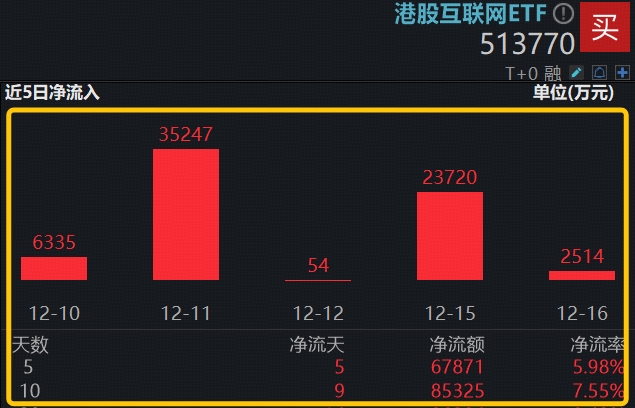
Group 1 - The Hong Kong stock market experienced a significant decline, with the Hang Seng Technology Index dropping nearly 3%, indicating a convergence of liquidity, fundamentals, and valuation pressures [1] - Recent inflows of southbound funds have slowed, potentially due to new fund management regulations that impose stricter performance benchmarks, leading to selling pressure on Hong Kong stocks [1] - The Hong Kong Internet sector, as a unique asset class, has attracted attention, with the Hong Kong Internet ETF (513770) seeing a net inflow of 853 million yuan over nine consecutive days [1] Group 2 - The valuation of the Hong Kong Internet sector is notably lower, with the CSI Hong Kong Internet Index's price-to-earnings ratio (TTM) at 24.92, significantly below that of the ChiNext Index and Nasdaq 100 [3][4] - Looking ahead to 2026, it is anticipated that policy improvements, such as enhanced connectivity mechanisms and relaxed QDII restrictions, will attract long-term capital to the Hong Kong market, with an expected increase of 1.54 trillion HKD in southbound long-term funds [4] - The Hong Kong Internet ETF and its associated funds are heavily invested in leading internet companies, with over 73% of the top ten holdings focused on AI cloud computing and applications, indicating a strong competitive advantage [5]
「AI新世代」直面OpenAI竞争!MiniMax通过港交所聆讯,海外收入占比超七成
Hua Xia Shi Bao· 2025-12-22 15:14
Core Insights - MiniMax, part of the "AI Six Tigers," has reported impressive revenue growth, achieving over $53 million in revenue in the first three quarters of 2025, which is approximately 376 million RMB, despite ongoing losses typical for AI companies [2][3] - The company has a significant global presence, with 73% of its revenue coming from international markets, operating in over 200 countries and regions [2][7] - MiniMax's user base has grown to over 212 million, with approximately 1.77 million paying users, indicating successful commercialization of its AI products [3] Revenue and Financial Performance - MiniMax's revenue for 2023, 2024, and the first three quarters of 2025 was $346 million, $30.52 million, and $53.44 million respectively [3] - The company's gross margins have improved, with figures of -24.7%, 12.2%, and 23.3% for the same periods, although they remain lower compared to competitors like Zhizhu [3][4] - The sales costs as a percentage of total revenue have decreased from 124.7% in 2023 to 76.7% in 2025, reflecting improved cost efficiency [5] Losses and Investment - MiniMax reported losses of $269 million, $465 million, and $512 million for 2023, 2024, and the first three quarters of 2025, attributed to significant investments in R&D and AI infrastructure [6] - The company has raised approximately $1.5 billion since its inception, maintaining a cash balance of over $1 billion as of September 2025, indicating a strong financial position relative to its expenditures [8] Market Position and Competition - MiniMax ranks as the tenth largest model technology company globally, with a market share of 0.3%, while OpenAI leads with a 30.1% share [8] - The company faces intense competition from industry giants like OpenAI and Google, which presents both challenges and opportunities for growth [7][8] - Analysts suggest that MiniMax's upcoming IPO could provide a valuation premium in a market eager for AI model companies, but long-term success will depend on technological advancements and product effectiveness [9]
MiniMax、智谱港股IPO获证监会备案,拟分别发行不超3357.7万、4303万股
Sou Hu Cai Jing· 2025-12-22 14:57
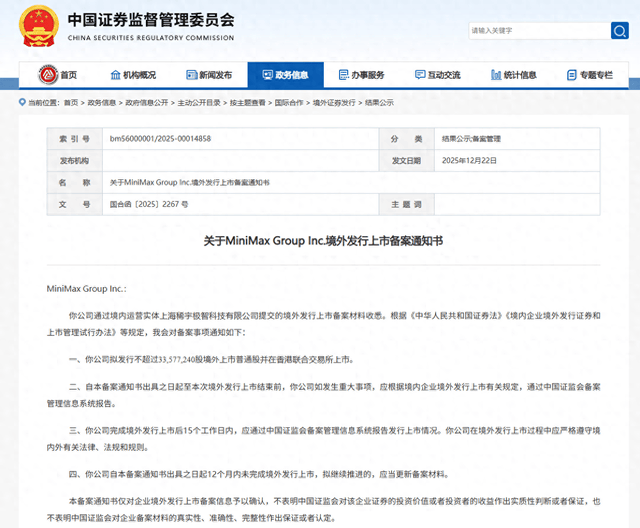
Core Viewpoint - MiniMax and Zhiyu have received approval from the China Securities Regulatory Commission (CSRC) for their overseas IPOs, marking significant steps for these companies in the AI sector [1][2][4]. Group 1: MiniMax - MiniMax plans to issue up to 33,577,240 shares for its overseas listing on the Hong Kong Stock Exchange, with its domestic operating entity being Shanghai Xiyu Jizhi Technology Co., Ltd [1]. - The company aims to comply with all relevant laws and regulations during the overseas listing process and must report any significant events to the CSRC [1]. - MiniMax was established in early 2022 and focuses on developing competitive general models, offering a range of AI-native products for both consumer and enterprise users [6]. Group 2: Zhiyu - Zhiyu intends to issue up to 43,032,400 shares for its overseas listing on the Hong Kong Stock Exchange, with 57 shareholders converting a total of 178,282,205 shares from domestic to overseas listings [2][4]. - The company must also adhere to CSRC regulations and report any significant events during the listing process [4]. - Zhiyu, founded in 2019, is recognized as a pioneer in large model research and has developed a comprehensive model matrix covering various applications [5]. Group 3: Financial Performance - Zhiyu reported a revenue of 190 million yuan for the first half of the year, with a net loss of 2.358 billion yuan, compared to a revenue of 44.9 million yuan and a net loss of 1.236 billion yuan in the same period last year [5]. - MiniMax's total revenue increased to 53.437 million USD as of September 30, compared to 19.455 million USD for the same period last year, with adjusted losses projected to reach 244 million USD by 2024 [6].
阿里巴巴员工数“锐减”后再次增长
首席商业评论· 2025-12-22 13:56
Core Viewpoint - Alibaba's employee count has significantly decreased, primarily due to the divestiture of its retail businesses, but this does not indicate mass layoffs as many employees transitioned to the acquiring companies [1][2]. Group 1: Employee Count and Financial Performance - As of March 31, 2025, Alibaba had 124,320 full-time employees, down from 204,891 the previous year, marking a reduction of 80,571 employees [1]. - By September 30, 2025, the employee count slightly increased to 126,661, indicating a net inflow of talent in the first half of the 2026 fiscal year [2]. - The data shows that revenue per employee has improved significantly, with the average revenue per employee rising from 3.35 million RMB in 2022 to 8.01 million RMB in 2025 [3]. Group 2: Strategic Shift and Market Position - Alibaba is transitioning from a traditional e-commerce platform to a technology-driven enterprise, aiming to enhance operational efficiency and profitability [4]. - The divestiture of traditional retail businesses is intended to lighten the financial burden and free up cash flow for investments in AI and cloud infrastructure, with a commitment of 380 billion RMB for AI and cloud initiatives [4]. - The competitive landscape is evolving, with Alibaba needing to establish new competitive advantages against rivals like Pinduoduo and Douyin, focusing on AI as a key area for growth and innovation [4]. Group 3: Stock Performance and Market Outlook - In 2025, Alibaba's stock experienced a recovery after a challenging period, characterized by a "W" shaped bottom formation [6]. - The outlook for 2026 suggests that Alibaba's restructured e-commerce group will maintain a significant market share, with expectations of robust growth in its cloud business [7]. - The stock price is anticipated to benefit from policy support for platform economies and successful AI applications, leading to improved overall profit structure [8]. Group 4: Comparative Analysis with Competitors - A comparison with JD.com and Pinduoduo reveals that while JD.com has a much larger employee base, Pinduoduo demonstrates exceptional efficiency with high revenue per employee [12][13]. - Pinduoduo's operational model, which leverages low pricing and efficient algorithms, has resulted in impressive profit margins despite a smaller workforce [13]. - The future of the e-commerce landscape remains uncertain, influenced by the rise of video commerce and the strategic use of AI [15].

冲刺第一股,中国最大独立模型厂商的成色、能力与野心
晚点LatePost· 2025-12-22 13:39
Core Insights - The article discusses the valuation of Zhipu, a leading Chinese AI model company, which is confirmed at 24.377 billion yuan, marking a significant moment in the AI market as it reveals the valuation of a major player in the industry [2] - The company is transitioning from a "novelty and gimmick" model to a more practical and adaptable large model, which is crucial for its acceptance in the capital market [2][3] - Despite being the first independent large model company to go public, Zhipu's financials show a significant loss that exceeds revenue growth, raising concerns about its sustainability [2] Business Model and Revenue - Zhipu's core revenue comes from localized deployment and cloud deployment, with the former focusing on private deployments for B-end clients and the latter providing API services through a MaaS platform [4] - By 2024, Zhipu is projected to be the largest independent large model vendor in China, surpassing Alibaba and SenseTime, with a market share of 6.6% in the enterprise LLM sector [4] - The company employs a "vertical and horizontal strategy" for revenue growth, where the MaaS platform's price reduction attracts more users, which in turn drives localized deployment revenue [5] Financial Performance - Zhipu's revenue is expected to grow significantly, with projections of 0.6 billion yuan in 2022, 1.2 billion yuan in 2023, and 3.1 billion yuan in 2024, reflecting a CAGR of 130% [5] - The company has a gross margin of 54.6% in 2022, which is expected to rise to 64.6% in 2023, but then decline to 50% in 2025 due to price competition in the MaaS platform [5] - As of 2025 Q3, Zhipu has empowered over 80 million end-user devices and has more than 12,000 institutional clients, indicating a substantial increase in customer base [5] Model and Product Development - The latest models, GLM 4.5 and 4.6, have achieved significant recognition, ranking third globally and first in China, showcasing Zhipu's competitive edge in model capabilities [18][20] - The company emphasizes that "model is product," indicating that the development of strong models is central to its growth strategy [9] - Zhipu's MaaS platform has over 2.9 million enterprise and application developers, making it one of the most active large model API platforms in China [10] Strategic Vision and Market Position - Zhipu's strategy involves significant investment in R&D, with adjusted net losses of 0.97 billion yuan in 2022 and projected losses of 24.66 billion yuan in 2024, highlighting the high cost of maintaining competitive model capabilities [11] - The company aims to balance its revenue streams between localized and cloud services, with a goal of achieving equal revenue distribution [6] - The competitive landscape in the AI model sector is intense, with Zhipu positioning itself as a key player in the ongoing race for market share and technological advancement [14][22]

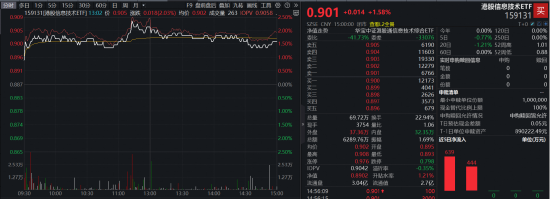
中国版OpenAI冲刺港交所!半导体芯片产业链大反攻,港股信息技术ETF(159131)收涨1.58%
Xin Lang Cai Jing· 2025-12-22 12:21
Core Viewpoint - The semiconductor chip industry is experiencing a strong rebound, highlighted by the performance of the first Hong Kong ETF focused on the chip sector, which saw a daily increase of 1.58% and a trading volume of 52.89 million yuan [1][8]. Group 1: ETF Performance - The Hong Kong Information Technology ETF (159131) opened high and closed with a gain of 1.58%, recovering its 5-day moving average [1][8]. - The ETF's underlying index has a price-to-earnings ratio of 33.23, which is at the 37.9% percentile over the past three years, indicating significant room for growth compared to its peak earlier in the year [3][10]. Group 2: Key Stocks Performance - Over 70% of the ETF's constituent stocks showed positive performance, with SenseTime-W leading with an increase of over 8%, followed by SMIC and Kinsus Interconnect Technology, both rising by 6% [4][11]. - The ETF is heavily weighted towards semiconductor and electronic companies, with SMIC holding a weight of 20.48% and Xiaomi Group-W at 9.53% [6][13]. Group 3: Technological Advancements - Researchers from Shanghai Jiao Tong University have made a breakthrough in optical computing chips, which could alleviate issues in the AI industry related to high costs, slow training, and energy consumption [2][9]. - The development of optical computing chips is expected to provide disruptive pathways for real-time AI, edge AI, and green AI applications, potentially transforming business and operational models in the AI sector [2][9]. Group 4: Market Trends and Future Outlook - The IPO of Zhizhu AI, regarded as the "Chinese version of OpenAI," signals a new phase in China's large model industry, focusing on technological strength and sustainable business models [3][10]. - The investment attractiveness of the Hong Kong chip sector is highlighted by its favorable valuation compared to other major tech indices, suggesting a strong potential for future growth [3][10].