新消费

Search documents
中金:中国消费市场更多呈现“消费分级”的特征,并非简单的“消费降级”
news flash· 2025-06-11 00:00
Core Viewpoint - The current Chinese consumer market is characterized by "consumption stratification" rather than a simple "consumption downgrade," with consumers willing to pay for "quality low prices" and "justifiable premiums" [1] Group 1: Market Trends - Overall consumption remains insufficient, but new consumption trends are emerging as hotspots [1] - The transition from mass consumption to personalized and rational consumption is underway in China [1] Group 2: Structural Highlights - Structural highlights in the consumption market must be built on a stable macroeconomic foundation [1] - The consumption willingness and ability of Generation Z, along with their focus on value-for-money and quality-price ratios, are driving the new consumption wave [1] Group 3: Regional Insights - The negative impact of real estate on lower-tier cities is gradually diminishing, which is helping to release consumption potential [1]
重估中国资产!外资新动向,看好这两个方向!
券商中国· 2025-06-10 23:28
Core Viewpoint - Foreign investors are reassessing Chinese assets, with a notable increase in their willingness to allocate to Chinese stocks due to concerns about missing out on technological advancements in China [2][6][12]. Group 1: Foreign Investment Trends - According to Morgan Stanley, international investors are seeking to diversify their portfolios and are increasingly interested in Chinese stocks, as their current exposure remains relatively low [2][6]. - As of June 10, the Hang Seng Index and the Hang Seng Tech Index have both seen year-to-date gains exceeding 20% [3][11]. - Recent inflows from long-term foreign capital, including global, U.S., and Pacific regional funds, have started to flow into the Hong Kong stock market [15]. Group 2: Market Outlook - Nomura Oriental International Securities predicts that Chinese equity assets will outperform overseas markets in the second half of the year, supported by strong policy backing for growth sectors [4][19]. - The report highlights that the gap between the weight of Chinese stocks in the MSCI Emerging Markets Index (29%) and the actual allocation by global investors (26.6%) indicates significant room for increased investment [13][14]. - Analysts expect that the performance of Hong Kong tech giants will remain robust, with anticipated earnings growth in 2025 [16]. Group 3: Investment Strategies - Nomura suggests a refined "barbell strategy" focusing on dividend and tech growth sectors, as the static valuation of the CSI 300 Index is still undervalued by 25.6% compared to its ten-year average [21]. - The report emphasizes the importance of stable dividend stocks and specific tech growth sectors, such as new energy and new consumption, for the upcoming market environment [21][20]. - Huatai Securities' chief macroeconomist anticipates an upward adjustment in China's economic growth expectations, indicating potential recovery for the RMB and RMB-denominated assets [22].



宠物行业发展动能强劲 板块投资机遇值得关注
Zhong Guo Zheng Quan Bao· 2025-06-10 20:52
Core Insights - The pet economy is experiencing rapid growth, with pets becoming important emotional companions and family members, leading to an expanding consumer market [1] - Analysts predict that new consumption habits and brand strength will continue to foster the emergence of new pet-related brands in the domestic market [1] Market Overview - The pet consumption market in China is projected to reach 300.2 billion yuan by 2024, with a year-on-year growth of 7.5%, and the number of urban pets (dogs and cats) expected to exceed 120 million [1] - The overall scale of the pet economy in China reached 592.8 billion yuan in 2023, marking a year-on-year increase of 20.1%, with expectations to grow to 1.15 trillion yuan by 2028 [1][2] Consumer Demographics - The post-2000 generation has become the core consumer group in the pet industry, with a pet ownership penetration rate of 24% among those over 20 years old, significantly higher than other age groups [2] - An estimated 15 million individuals will enter the 20+ age group annually over the next decade, which will further increase pet ownership rates [2] Company Strategies - Companies like Tianyuan Pet and Zhongchong Co. are actively expanding their product lines and enhancing their e-commerce capabilities to strengthen brand presence and sales channels [2][3] - Zhongchong Co. maintains a dual-channel sales strategy, utilizing both online and offline platforms, and collaborates with various retail chains to enhance market reach [3] - Yuanfei Pet is building a new domestic market team focused on e-commerce platforms, aiming to establish a dual-line strategy of "self-owned + agency" brands [3] Investment Opportunities - Pet food consumption is expected to account for approximately 52.8% of total urban pet spending in China by 2024, with pet medical services and products also showing significant growth potential [4] - The compound annual growth rates for pet food, pet supplies, pet medical services, and pet services from 2019 to 2024 are projected at 4.1%, 7.8%, 13.9%, and 4.2% respectively, indicating a robust growth trajectory for the pet medical sector [4] - The pet industry is anticipated to surpass 400 billion yuan by 2027, driven by evolving consumer trends such as emotional spending and rational pet ownership [4]

超六成主动权益基金收复“失地” 把握科技热点决胜后市
Zhong Guo Zheng Quan Bao· 2025-06-10 20:51
Group 1 - Over 60% of actively managed equity funds have recovered their net asset values to pre-April 7 levels as of June 9, driven by sectors such as innovative pharmaceuticals, new consumption, gold, and AI [1][2] - Funds heavily invested in innovative pharmaceuticals, such as Changcheng Pharmaceutical Industry Select A and Zhonghang Preferred Navigation A, have rebounded over 30% in the last two months, with some funds achieving returns exceeding 70% year-to-date [2][3] - AI-themed funds have also seen significant recovery, with several funds gaining over 10% from June 3 to June 9, indicating a strong performance in the AI sector [4][6] Group 2 - The market is experiencing a style shift, with recent adjustments in innovative pharmaceuticals and new consumption sectors, prompting discussions about potential short-term corrections [1][6] - The upcoming dividend distribution period for dividend assets may create selling pressure, potentially benefiting aggressive technology sectors if funds flow out of defensive assets [6][7] - There is a focus on technology stocks, particularly in AI and innovative pharmaceuticals, as they are expected to perform well due to favorable market conditions and industry catalysts [6][7]
潮玩宠物只是前菜,未炒透领域已被机构盯上
Sou Hu Cai Jing· 2025-06-10 20:25
Group 1 - The core viewpoint is that the new consumption concept stocks are not at their peak, and there is still significant potential in various traditional industries that can transform into new consumption sectors [1][4] - The current market trend is characterized by a wave-like progression rather than a straight line, indicating that new consumption is far from over [1][2] - Retail investors often lag behind institutional investors, who adjust their strategies based on market conditions, making it crucial for retail investors to understand market dynamics [2][4] Group 2 - Quantitative data serves as a crucial tool for retail investors to understand institutional trading behaviors and to navigate market complexities [5][10] - There are two types of good stocks: those with concentrated capital inflow and those that undergo repeated adjustments by institutions [6][8] - Institutional adjustments often lead to market fluctuations that can mislead retail investors into panic selling, while quantitative data can reveal the true market signals [10][12]
LABUBU爆火!公募人士分析:注意估值泡沫
Bei Jing Shang Bao· 2025-06-10 13:11
Core Insights - The core viewpoint of the articles highlights the explosive growth of Pop Mart, particularly its LABUBU plush toy line, which has gained significant popularity among consumers globally, leading to a substantial increase in the company's stock price and the personal wealth of its founder, Wang Ning [1][3][6]. Company Performance - Pop Mart's stock price has surged, with a year-to-date increase of 188.5%, closing at 258.8 HKD per share on June 10 [1][6]. - Wang Ning's net worth reached 21.5 billion USD, placing him at 99th on the global billionaire list and making him the new richest person in Henan [3]. Market Trends - The success of LABUBU has sparked enthusiasm in the new consumption sector, with 180 funds heavily investing in Pop Mart as of the end of Q1 2025, holding a total of 60.79 million shares valued at approximately 8.779 billion CNY [1][9]. - The popularity of LABUBU has led to significant price inflation in the secondary market, with some products being resold for several thousand CNY, creating a phenomenon likened to "plastic Moutai" [8]. Industry Dynamics - The growth of Pop Mart is attributed to its unique IP ecosystem, which includes original IP incubation, artist cultivation, and multi-channel retailing, allowing for product diversification beyond blind boxes to include plush toys and digital entertainment [6][7]. - The concept of "谷子经济" (Guzi Economy), which focuses on derivative products from popular culture IPs, is seen as a driving force for future growth in this sector [7]. Future Outlook - A report from Zhao Zheng International predicts that Pop Mart's net profit will reach 7 billion CNY by 2025, exceeding market expectations by about 15%, primarily due to underestimated overseas expansion [10]. - The company is expected to continue leveraging its strong IP capabilities and network effects to maintain high profitability and sustainability in the competitive landscape [7][10].

【e公司观察】超2000亿港元市值的蜜雪集团 高速扩张之路还能持续多久?
Zheng Quan Shi Bao Wang· 2025-06-10 12:56
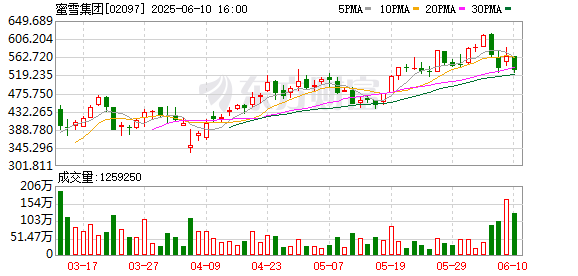
Core Viewpoint - The company, Mixue Group, has experienced rapid expansion and is positioned within the "new consumption" concept in the Hong Kong stock market, but its gross margin is significantly lower than its peers [1][4]. Expansion and Market Presence - As of the end of 2024, Mixue Group had a total of 41,584 stores in mainland China, covering all county-level cities, with a focus on the low-price market in third and fourth-tier cities [1]. - The distribution of stores by city tier is as follows: 1,983 in first-tier cities (4.8%), 8,143 in new first-tier cities (19.6%), 7,000 in second-tier cities (18.2%), and 23,858 in third-tier and below cities (57.4%) [1]. Financial Performance - The gross margin of Mixue Group is approximately 32%, which is lower than that of competitors like Pop Mart (64.79%) and Maogeping (84.37%) [1]. - The average single-store daily GMV (Gross Merchandise Volume) was about 4,184.4 yuan in the first three quarters of 2024, showing a year-on-year decline of 5.3% [2]. Store Growth and Challenges - The growth rate of store openings in third-tier and below cities has slowed down, with the number of stores increasing from 11,590 in 2021 to 23,858 in 2024, but with varying growth rates [2]. - The company has faced challenges with increasing store density leading to a decline in single-store GMV, indicating a potential saturation in the market [3]. Recent Developments - Mixue Group's stock price has faced significant fluctuations, with a drop of 6.19% on June 10, 2025, and three out of four trading days showing substantial declines [4]. - The company has also seen an increase in the number of closed stores, with 1,307 and 1,609 closures in 2023 and 2024, respectively [3]. Food Safety Concerns - Recent media reports have raised concerns about food safety issues in several Mixue stores, including allegations of altering ingredient expiration dates and using overnight tea [5]. - The company has acknowledged these issues and has taken steps to address them, including closing affected stores for rectification [5].
蜜雪冰城一门店或被检控!产品大肠杆菌超标70%
21世纪经济报道· 2025-06-10 12:55
Group 1 - The Hong Kong Food and Environmental Hygiene Department reported that a frozen dessert sample from "Mixue Ice City" exceeded legal limits for coliform bacteria and total bacterial count, with coliform levels at 170 per gram and total bacteria at 75,000 per gram, surpassing the legal limits by 70% [1] - The center has instructed the store to cease sales and dispose of the affected products, and has provided food safety education to the staff [1] - The maximum penalty for violating the Frozen Dessert Regulation is a fine of 10,000 HKD and up to three months of imprisonment [1] Group 2 - Two major investment banks, Bank of America and UBS, downgraded the rating of Mixue Ice City, citing overvaluation and unsatisfactory overseas expansion as reasons for limited long-term growth potential [5] - Despite the downgrade, UBS analysts noted that Mixue Ice City's domestic business shows strong growth momentum, projecting a 15% annual store growth rate over the next 3-4 years, aiming for a total of 70,000 stores by 2028 [5] - The stock price of Mixue Group fell by 6.19% as of June 9, with a total market capitalization of 201.4 billion HKD [3] Group 3 - The new consumption sector, which includes Mixue Ice City, has been experiencing significant market interest, with companies like Pop Mart and Old Puh Gold also being highlighted as key players [8] - The new consumption sector is characterized by crowded trading, with potential risks of market manipulation leading to sudden price drops [10] - Pop Mart recently reached a new stock price high of 262 HKD per share, with a market capitalization of 347.6 billion HKD, surpassing the combined market value of Hasbro and Mattel [8]

下半年港股投资机会在哪?多家券商机构最新观点
证券时报· 2025-06-10 12:34
2025年已行至年中,港股市场在经历上半年"脉冲式反弹"后,下半年走势成为投资者关注焦点。 近日,中金公司、中信证券、国泰海通等多家券商机构发布了港股下半年策略报告,多家机构认为,港股将延 续震荡向上趋势,高股息资产、科技互联网、新消费等方向有望受青睐。 多重因素推动港股市场走强 回顾今年上半年港股市场行情,在DeepSeek引领中国资产重估叙事的大背景下,港股表现全球领先。不过, 受美国所谓的"对等关税"扰动,市场在反弹与回调中循环往复。 截至目前,恒生指数年内涨幅为20.45%,恒生科技指数的年内涨幅为20.68%。个股方面,恒生指数成份股中 的石药集团、周大福、翰森制药、小米集团、比亚迪股份、药明生物、网易等多股年内涨幅超过50%。 今年上半年,DeepSeek引发AI热潮助推中国资产重估,推动港股市场一度领涨全球,随后,由于部分中国科 技龙头股的资本开支计划不及预期,科技重估叙事有所降温。中金公司认为,后续需要更多催化剂,尤其是跨 越式的模型迭代或突破性的应用落地。中短期来看,AI趋势主要通过拉动资本开支推动私人部门信用扩张, 2025年AI相关新增资本开支预计约1500亿元。 中金公司表示,当前中国 ...

【寻访金长江之十年十人】复胜资产陆航:聚焦1到10的成长机会,看好新消费和新科技
券商中国· 2025-06-10 12:31
Core Viewpoint - The article highlights the insights of Lu Hang, Chairman of Fusheng Asset, emphasizing the importance of performance-driven investment and the focus on growth stocks in the current market landscape, particularly in new technology and new consumption sectors [1][17]. Company Overview - Fusheng Asset was established in December 2015 and has 23 employees, with a research team of 12, including 3 fund managers and 8 researchers [7]. - The company employs a bottom-up approach to stock selection, focusing on underlying business barriers and identifying performance growth inflection points for investments in A-shares and Hong Kong stocks [7]. Investment Philosophy - The core investment philosophy is performance-driven, with a key criterion being whether a company's expected revenue compound growth rate can reach 20% over the next three years, distinguishing growth stocks from value stocks [9]. - Companies with revenue growth below 10% are classified as value stocks, while those with growth between 10% and 20% are approached with caution [9]. Market Insights - The current Chinese stock market is characterized by significant differentiation, presenting numerous investment opportunities, particularly in new technology and new consumption sectors [17][18]. - The shift from a real estate-driven economy to one focused on new consumption and technology is seen as a new investment era, requiring investors to understand consumer needs and product effectiveness [17]. Investment Strategy - The strategy involves identifying market themes each year, with a focus on leading companies whose performance is less likely to be manipulated [10][11]. - The company emphasizes the importance of high-quality research and monitoring financial reports to track revenue trends [10]. Performance and Risk Management - Fusheng Asset aims to capture the main investment themes each year, acknowledging that only about 30% of selected stocks typically drive significant profits [11]. - The company employs a diverse stock portfolio to manage volatility and uses a dynamic reduction strategy for stocks that do not meet performance expectations [16]. Future Outlook - The private equity industry is expected to undergo significant differentiation, with high-quality managers emerging, while investors should temper their return expectations [19].