
价值重估

Search documents
深刻理解能源格局 做非典型周期捕手
Zhong Guo Zheng Quan Bao· 2025-08-24 20:10
Group 1 - Zhang Teng, the fund manager of Yinhua Ruihe, adopts a unique energy perspective and macro framework for cyclical investment, distinguishing himself from traditional value and growth investors [1][2] - His investment philosophy emphasizes capturing structural opportunities through a deep understanding of energy dynamics and macroeconomic slow variables, particularly in the context of carbon neutrality and anti-involution [1][6] - Zhang's approach to cyclical stocks focuses on underlying variables rather than merely following commodity prices, aiming to identify undervalued elastic factors at the intersection of industry logic and macro changes [1][3] Group 2 - Zhang Teng's investment framework is influenced by Taleb's "anti-fragile" theory, which emphasizes the importance of macro awareness and diversified investments to achieve long-term stability [4][5] - His strategy includes maintaining a diversified portfolio across five main sectors to mitigate risks while focusing on core driving factors of different assets [5][6] - The "anti-fragile" framework has evolved to enable the identification of opportunities during extreme market fluctuations, allowing for dynamic optimization of investment portfolios [6][8] Group 3 - In the context of the "anti-involution" policy, Zhang Teng identifies significant investment opportunities in the changing supply-demand dynamics of the non-ferrous and chemical sectors, rather than in highly discussed areas like photovoltaics [7][8] - He emphasizes the importance of focusing on industries with steep supply curves and high cost differentials, particularly in strategic resources like rare earths, which are expected to experience value reassessment [7][8] - Zhang's macro perspective includes viewing the Federal Reserve's interest rate cut cycle as a key slow variable that will benefit the non-ferrous sector, with different metals responding at varying paces [8]
东风“腾笼换鸟”,岚图单飞港股|钛度车库
Tai Mei Ti A P P· 2025-08-24 06:02
Core Viewpoint - Dongfeng Motor Group's subsidiary, Lantu Automotive, is set to go public on the Hong Kong Stock Exchange through a reverse listing, while Dongfeng Group will simultaneously complete its privatization and delisting, marking a significant capital operation that reflects the transformation of traditional automakers in the era of new energy vehicles [1][2]. Group 1: Capital Market Dynamics - Dongfeng Group has faced a prolonged undervaluation in the Hong Kong market, with a total market value of HKD 39.12 billion and a price-to-book (PB) ratio of only 0.24 as of July 31, 2025, indicating a significant gap between market value and net assets [2]. - The introduction of Lantu Automotive as a high-end smart electric vehicle brand is expected to reshape the value of Dongfeng's brand matrix, with Lantu achieving a delivery of 85,697 vehicles in 2024, a year-on-year increase of approximately 70% [2]. Group 2: Financial Performance - Lantu Automotive has reached a critical point of turning from loss to profit, with a revenue of CNY 1.767 billion in 2021 and a net loss of CNY 706 million, but showing significant improvement in subsequent years, including a 185.8% increase in total deliveries in 2022 [3]. - In 2023, Lantu's sales grew to 50,600 units, a year-on-year increase of 160%, although it still reported a net loss of CNY 1.472 billion after tax, with expectations of narrowing losses in 2024 [3]. Group 3: Listing Strategy - The reverse listing approach allows Lantu to enhance liquidity and brand image without issuing new shares, which is suitable for companies that do not require immediate financing but seek to unlock value [5]. - The dual cash and equity compensation structure for minority shareholders is designed to provide certainty and activate value realization, while the listing is expected to break the historical undervaluation of Dongfeng Group's shares [5]. Group 4: Industry Transformation - Dongfeng Group's decision to privatize reflects the broader challenges faced by traditional automakers during industry transformation, with a reported 14.7% decline in vehicle sales in the first half of the year, despite a 6.6% increase in sales revenue [6]. - The shift from pursuing sales volume to focusing on quality and efficiency is crucial for traditional automakers, especially during the electrification transition [6]. Group 5: Future Challenges - Lantu faces significant challenges ahead, including the need to achieve profitability and reach a sales target of 200,000 units by 2025, with only 28% of the target achieved in the first half of the year [7]. - The reliance on a single product, the Lantu Dreamer, which accounts for nearly 60% of total sales, poses a risk to growth potential, prompting Lantu to accelerate product launches and collaborations to diversify its offerings [7]. Group 6: Independent Market Position - Lantu's independent listing on the Hong Kong market signifies a departure from reliance on its parent company, with future valuations dependent on its own product competitiveness and financial health [8]. - The success of this transformation will be measured not by short-term stock price fluctuations but by Lantu's ability to establish sustainable profitability and market position, serving as a reference for other traditional automakers undergoing similar transitions [9].


外资重估中国:再平衡下的新机遇
Zhong Guo Xin Wen Wang· 2025-08-23 05:09
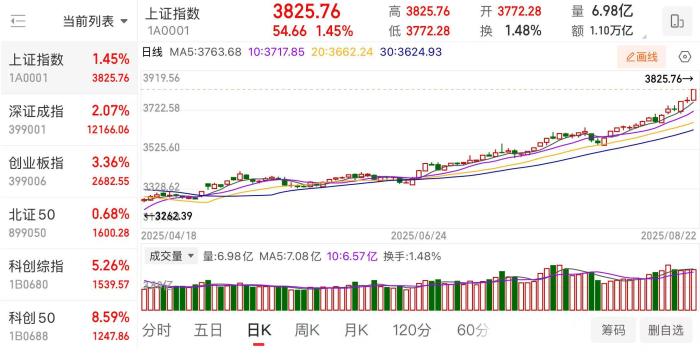
Core Viewpoint - The A-share market is experiencing a significant upward trend, with the Shanghai Composite Index surpassing 3,800 points, marking a 10-year high, driven by multiple favorable factors and a reassessment of asset values in China [1][3]. Group 1: Economic Resilience and Policy Support - In the first half of 2025, China's economy demonstrated unexpected resilience with a GDP growth rate of 5.3%, supported by proactive macro policies and liquidity measures from the central bank [3][6]. - External uncertainties have led to a shift in global capital allocation, with funds moving from the U.S. to undervalued markets like China, as indicated by a net inflow of over 80 billion yuan in foreign capital [4][5]. Group 2: Investment Strategies and Market Dynamics - Foreign investors are increasingly viewing Chinese assets as long-term investments rather than short-term trades, with a notable shift in attitude towards "investable" assets [3][10]. - The "barbell strategy" is gaining traction among foreign investors, focusing on growth leaders and high-dividend blue-chip stocks to balance growth and income opportunities [7][9]. Group 3: Sector Preferences and Growth Opportunities - Foreign capital is particularly attracted to sectors such as technology and consumer goods, with significant inflows into Hong Kong's market, reflecting a preference for structural opportunities in these areas [7][8]. - The rise of new consumption patterns, particularly among Generation Z, is creating growth opportunities in sectors like emotional consumption, which includes trendy products and cultural exports [8]. Group 4: Valuation and Market Positioning - Current valuation levels indicate that A-shares are relatively attractive compared to H-shares, with a low premium and strong support from state-owned capital [9]. - The high dividend yield of A-shares presents a potential advantage over government bond yields, making them appealing to foreign investors seeking income [9].
保险资金入市加速,这些险资中报重仓股已浮出水面
Xin Lang Cai Jing· 2025-08-20 06:31
Core Viewpoint - The establishment of private securities investment fund management companies by insurance firms marks a significant step in the long-term investment reform pilot, with a total of 7 insurance-related private equity firms now approved to operate in the market [1][4]. Group 1: Investment Scale and Participants - The total scale of the three batches of pilot projects has reached 222 billion yuan, with the first batch approved for 50 billion yuan, the second batch for 112 billion yuan, and the third batch for 60 billion yuan [1]. - Key participants in these pilot projects include major insurance companies such as China Life, New China Life, Taikang Life, and others [1][2]. Group 2: Investment Strategy and Market Impact - The influx of 222 billion yuan from these pilot projects is expected to improve the characteristics of the A-share market, shifting it away from short-term speculative trading towards a focus on low volatility and high dividend stocks [1]. - Insurance capital, characterized as "patient capital," is anticipated to smooth out short-term market fluctuations and direct investments towards technology innovation, green economy, and consumption recovery [1][4]. Group 3: Fund Management and Performance - The newly established private funds, such as Guofeng Xinghua and Taikang Stable, have begun operations with significant initial capital, indicating a robust start in the private equity sector [2][3]. - Guofeng Xinghua has already completed investments for its first fund with a good return rate, while Taikang Stable has successfully executed its first investment transaction [2][3]. Group 4: Industry Dynamics and Future Outlook - The emergence of insurance-related private equity firms is expected to reshape the competitive landscape of the private equity industry, introducing new investment logic and governance models [9]. - The management teams of these private equity firms are primarily composed of former executives from insurance asset management companies, ensuring continuity in investment philosophy and operational standards [4].



龙源电力(001289):业绩好于预期,拟派发中期股息
HTSC· 2025-08-20 02:15
Investment Rating - The investment rating for the company is "Buy" for both A-shares and H-shares, maintained from previous assessments [7]. Core Views - The company reported better-than-expected performance in its interim results, with a proposed interim dividend of 0.1 CNY per share, totaling 836 million CNY, representing a payout ratio of 24.77% [1]. - The company anticipates a revaluation of its value due to the compliance and confirmation of national subsidies [4]. - The company has adjusted its profit forecasts slightly downward for 2025-2027, with a projected compound annual growth rate (CAGR) of 10.1% for net profit [5]. Summary by Sections Financial Performance - In the first half of 2025, the company achieved revenue of 15.657 billion CNY, a year-on-year decrease of 18.6%, and a net profit attributable to shareholders of 3.375 billion CNY, down 13.8% year-on-year [1]. - The second quarter saw revenue of 7.517 billion CNY, a year-on-year decrease of 18.2% and a quarter-on-quarter decrease of 7.7% [1]. Installed Capacity and Generation - The company added 2,053.54 MW of installed capacity in the first half of 2025, bringing the total to 43.197 GW, with wind power contributing 986.95 MW and solar power 1,096.59 MW [2]. - The company's electricity generation increased by 12.7% year-on-year, with wind power generation up 6.1% to 33,502 GWh, primarily due to new installations [2]. Profitability Analysis - The operating profit from the wind power segment decreased by 11% year-on-year to 6.213 billion CNY, with a corresponding profit per MWh down 16% to 185 CNY/MWh [3]. - The photovoltaic segment saw a 51% increase in operating profit to 550 million CNY, with a profit per MWh of 89 CNY/MWh, down 12% year-on-year [3]. Cash Flow and Receivables - As of June 2025, the company's receivables financing increased by 5.96 billion CNY compared to the beginning of the year, accounting for 55.7% of net assets, indicating a rising trend since the end of 2022 [4]. - The operating cash flow for the first half of 2025 decreased by 8.5% year-on-year to 6.673 billion CNY, but the second quarter saw a year-on-year increase of 7.3% to 3.977 billion CNY [4]. Valuation Adjustments - The target price for A-shares is adjusted to 18.72 CNY, down from 18.96 CNY, based on a 24x PE for 2025, while the target price for H-shares is adjusted to 7.63 HKD from 7.73 HKD, based on a 9x PE for 2025 [5].

布米普特拉(北京)投资基金管理有限公司:A股突迎外围变局
Sou Hu Cai Jing· 2025-08-19 06:46
Group 1 - The Federal Reserve's emergency rate cut of 50 basis points has caused significant turbulence in global markets, with A-shares showing an independent trend amid the tug-of-war between "positive effects" and "recession concerns" [2] - Northbound capital saw a record net inflow in a single day, indicating strong investor interest [3] - Both gold stocks and technology stocks experienced rare simultaneous gains, reflecting a shift in market dynamics [3] - The Chinese yuan appreciated sharply by 800 points, showcasing currency market reactions to the Fed's decision [3] Group 2 - There is a contrast between the expectations of external demand recovery and the reality of weak domestic demand, highlighting a complex economic landscape [4] - The liquidity easing measures are juxtaposed with the risks of earnings downgrades, indicating potential challenges for companies [4] - The policy toolbox is being tested against the threshold of market confidence, suggesting that investor sentiment is crucial for future market movements [4] - Major funds are increasing their positions in consumer electronics, while speculative funds are targeting convertible bonds, indicating a shift in investment strategies [4] - Insurance funds are maintaining high dividend stocks, reflecting a preference for stable income amid market volatility [4] - This sudden change serves as both a stress test and an opportunity for value reassessment, necessitating a new cognitive framework for investors as the linkage between A-shares and global markets evolves [4]

8月11日主题复盘 | 沪指再创年内新高,锂电池爆发国产,国产芯片、机器人持续表现
Xuan Gu Bao· 2025-08-11 08:58
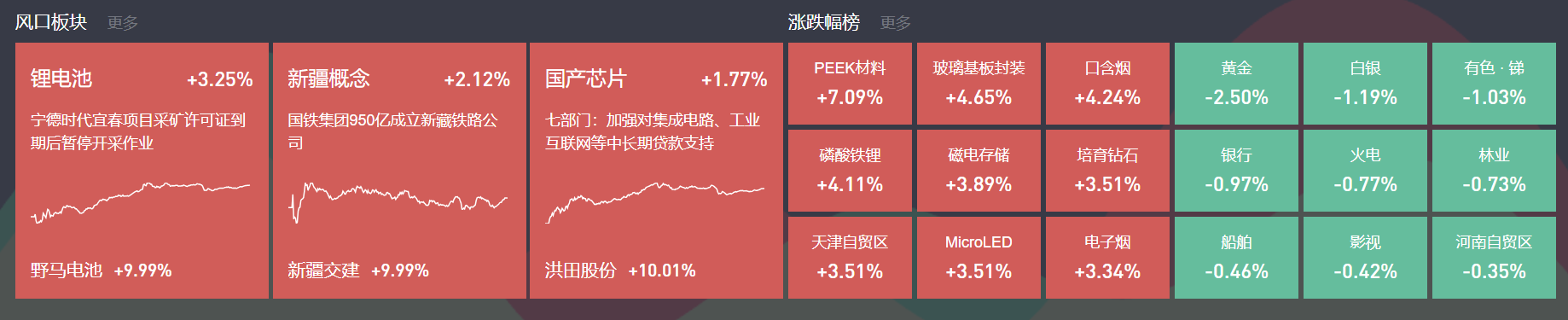
Market Overview - The market showed strong fluctuations throughout the day, with the ChiNext Index rising over 2% at one point. Lithium mining stocks experienced a collective surge, with companies like Tianqi Lithium and Ganfeng Lithium hitting the daily limit. The Xinjiang sector continued its strong performance, with Xinjiang Communications Construction and Xinjiang Torch also reaching the limit. The PEEK material concept saw significant gains, with companies like Zhongxin Fluorine Materials and Jinfat Technology hitting the limit. Computing hardware stocks also showed strength, with Shenghong Technology reaching a historical high. In contrast, gold stocks collectively adjusted, with Chifeng Jilong Gold falling over 5%. Overall, more than 4,200 stocks in the Shanghai and Shenzhen markets rose, with a total transaction volume of 1.85 trillion yuan [1]. Key Highlights Lithium Battery Sector - The lithium battery sector saw a significant rise, with stocks like Jiangte Motor and Tianqi Lithium hitting the daily limit. The catalyst for this surge was the announcement from CATL regarding the suspension of mining operations at its Yichun project due to the expiration of its mining license, which is currently under renewal. This follows previous announcements of production halts from various lithium mining companies due to regulatory issues. As a result, the price of battery-grade lithium carbonate increased by 8,000 yuan, averaging 78,000 yuan per ton, and lithium carbonate futures also saw an 8% increase [4][5][6]. Domestic Chip Sector - The domestic chip sector experienced a notable increase, with stocks like Hongtian Co., Haili Co., and Wantong Development hitting the daily limit. Dongxin Co. has seen over a 100% increase in its stock price over the past ten trading days. The delivery of the 500th stepper lithography machine by Shanghai Chip Micro Technology Co. was highlighted, which has a 35% global market share and a 90% domestic market share. This machine is crucial for advanced packaging technologies [6][7]. Robotics Sector - The robotics sector remained active, with companies like Beiwai Technology and Zhongxin Fluorine Materials hitting the daily limit. The 2025 World Robot Conference opened in Beijing, where industry leaders noted a significant growth trend in the robotics industry, with many companies reporting a 50%-100% increase in performance [8][9]. Other Active Sectors - Other sectors such as computing power, pharmaceuticals, and military industry continued to show activity, while gold and film sectors experienced declines [11].



机构最新研判!继续看好大盘上行趋势
Zhong Guo Zheng Quan Bao· 2025-08-10 15:36
Market Overview - The A-share market indices collectively rose this week, with the Shanghai Composite Index reaching a new high for the year, increasing over 2% [1] - The Shenzhen Component and ChiNext indices saw weekly gains of 1.25% and 0.49%, respectively [1] - The upward trend of the market is supported by liquidity and ongoing policy measures, which are expected to optimize supply and demand dynamics [1] Economic Indicators - In July, the Consumer Price Index (CPI) rose by 0.4% month-on-month, reversing a previous decline of 0.1% [2] - The core CPI, excluding food and energy, increased by 0.8% year-on-year, marking a continuous expansion for three months [2] - The Producer Price Index (PPI) decreased by 0.2% month-on-month, with a year-on-year decline of 3.6% [2] Investment Insights - Dongwu Securities indicates a solid upward trend in the market, with expectations for overall profitability and return on equity (ROE) to stabilize and improve [4] - The market is shifting from traditional cyclical sectors to technology sectors, with a focus on high-quality technology assets that may yield significant excess returns in Q3 [5][9] - Open-source Securities highlights a "dual-driven" market theme, with increasing margin financing balances and a clearer market direction driven by technology and PPI trading [6] Sector Focus - Investment opportunities are emerging in technology sectors such as AI, robotics, and high-end manufacturing, as well as in defensive high-dividend sectors [7][8] - Allianz Fund anticipates significant excess returns for quality technology assets in Q3, driven by a new cycle of value reassessment in the A-share market [9] - Citic Prudential Fund emphasizes the certainty of opportunities in manufacturing companies, particularly those with improving profitability and relatively low valuations [10]
"反内卷"提振大宗商品市场 政策驱动行业从"价格战"转向价值重估
Zhong Guo Jing Ji Wang· 2025-08-06 02:17
Group 1: Policy and Market Response - The Central Financial Committee's recent meeting emphasized the need to regulate low-price disorderly competition among enterprises and promote product quality improvement [1] - In response to the "anti-involution" policy, industries such as photovoltaic, cement, steel, and coke have begun to reduce production and increase prices [1][4] - The National Development and Reform Commission and the State Administration for Market Regulation have proposed amendments to the Price Law to standardize market pricing and address "involution-style" competition [1][4] Group 2: Commodity Market Trends - Major commodity futures, including coking coal, coke, polysilicon, industrial silicon, glass, and soda ash, have seen significant price increases, with polysilicon rising by 50% in July and reaching a record high of 53,000 yuan/ton [1][4] - The market is experiencing a shift from "anti-involution driven" to "stock replenishment driven," with expectations of further price increases as downstream demand rises [4][5] - Analysts predict that most commodity futures will experience a comprehensive rebound in the third quarter, driven by policy support and improved market conditions [5] Group 3: Industry Challenges and Opportunities - The chemical industry is facing a cycle of low-price competition, which undermines profitability and restricts R&D investment, leading to a lack of product value enhancement [2] - The Ministry of Industry and Information Technology is set to introduce plans to stabilize growth in key industries, focusing on structural adjustments and the elimination of outdated production capacity [2][3] - The "anti-involution" policy aims to enhance market order and promote industry upgrades, directing resources towards high-efficiency sectors and improving global competitiveness [6]
8月5日证券之星午间消息汇总:超6100亿!新增专项债发行规模创年内新高
Sou Hu Cai Jing· 2025-08-05 03:47
Macro News - The issuance of new local government special bonds has accelerated since April, with a record high of 616.936 billion yuan in July, an increase of 89.842 billion yuan from the previous month [1] - The cumulative issuance of new special bonds reached 2.16 trillion yuan in the first half of the year, a significant year-on-year increase of 45%, supporting major project construction and maintaining resilience in infrastructure investment growth [1] - The China Logistics and Purchasing Federation reported that the commodity price index rose for three consecutive months, reaching 111.4 points in July, a month-on-month increase of 0.5% [1] - Among 50 monitored commodities, 32 saw price increases, with lithium carbonate, industrial silicon, and coking coal rising by 10.2%, 9.8%, and 9.6% respectively [1] Industry News - The China Real Estate Industry Association announced measures to support the healthy development of small and medium-sized real estate companies, including reflecting policy demands, providing financial services, promoting sales, and improving supply chains [3] - The National Healthcare Security Administration is optimizing drug procurement measures, with 55 drugs proposed for inclusion in the national procurement range [3] - The paper industry is experiencing a price increase, with leading companies like Nine Dragons Paper and Lee & Man Paper announcing price hikes starting August 1, marking the fourth round of price increases since July [4] - Rising costs of raw materials, energy, and logistics are driving this price increase, which is seen as a response to the declining market conditions earlier this year [4] Sector Insights - CITIC Securities reports that the liquor industry is rapidly bottoming out, with leading companies likely to benefit from channel adjustments and market expansion as consumer demand gradually improves [5] - The beer industry is expected to maintain steady growth in sales, with an estimated revenue growth rate of 2%-5% [5] - China International Capital Corporation highlights the trend towards lightweight humanoid robots, which can enhance performance and safety through material and structural optimizations [5] - Huatai Securities expresses optimism about the commercial real estate sector, noting that top operators' shopping center assets exceed their book value, with C-REITs providing a clearer path for value realization [6]