
房地产市场调整

Search documents
李嘉诚王健林预言成真!家里有2套房以上家庭,今年起或迎来3个结局
Sou Hu Cai Jing· 2025-10-10 09:52
Core Insights - The real estate market is undergoing significant changes, leading to challenges for families with multiple properties, as evidenced by rising vacancy rates and declining rental yields [1][3][4] Group 1: Market Trends - As of Q2 2025, the national residential vacancy rate is projected to reach 16.8%, an increase of 3.5 percentage points since 2020 [1] - Average rental yields in first-tier cities are only 1.7%, while second-tier cities are even lower at 1.3%, making property investments less attractive compared to bank deposits [1] - A report indicates that 53 out of 70 major cities in China experienced a year-on-year decline in second-hand residential prices, with an average drop of 5.7% [3] Group 2: Financial Implications - The average property management fee is expected to rise by 8.7% in 2025, reaching 3.8 yuan per square meter per month, increasing the holding costs for property owners [3] - Approximately 36% of families with multiple properties report facing cash flow difficulties due to insufficient rental income to cover mortgage payments and maintenance costs [5] Group 3: Rental Market Challenges - Rental prices have decreased, with first-tier cities seeing a 5.2% drop and second-tier cities experiencing a 7.8% decline [4] - The average vacancy period for residential properties has extended to 2.7 months, an increase of 1.1 months since 2020, leading to longer periods without rental income [4] Group 4: Potential Outcomes for Property Owners - Many families are considering selling properties at discounted prices due to ongoing negative cash flow and asset depreciation [7] - The average transaction cycle for residential properties in major cities has increased to 98 days, with an average price difference of 8.7% between listing and selling prices [7] Group 5: Strategic Recommendations - Families should conduct a thorough assessment of their financial situation, including calculating the actual yield of each property and considering selling underperforming assets [8][10] - Adjusting rental strategies, such as lowering rents or making minor renovations, can improve rental competitiveness and potentially increase yields [8] - Diversifying asset allocation away from real estate into lower-risk financial products is advisable for families heavily invested in property [10][11]


经济压力大、人民不赚钱!为何越来越多的人,选择看好中国经济?
Sou Hu Cai Jing· 2025-10-08 13:19
Core Viewpoint - Despite economic pressures and challenges, there is optimism regarding China's economic resilience and potential for recovery in the second half of 2025 [1][3]. Economic Transition - China's economy has undergone significant transformations over the past decades, evolving from an agricultural base to an industrialized and now a high-tech and service-oriented economy [3]. - The current economic transition aims to reduce reliance on real estate and infrastructure, focusing instead on technological innovation and industrial upgrades [9][11]. Government Response - In response to a severe tariff shock in April 2023, the Chinese government acted swiftly to stabilize market confidence, contrasting with the slower response seen in the U.S. [5][7]. - The government's measures included supporting the Hong Kong stock market and implementing policies to stabilize the A-share market, demonstrating flexibility and effectiveness [5][7]. Supply Chain and Global Positioning - China's supply chain is evolving from being the "world's factory" to a "global cooperation link," emphasizing domestic and international market interactions [15]. - Initiatives like the Belt and Road Initiative are enhancing infrastructure, energy cooperation, and cultural exchanges, contributing to China's economic stability and global influence [15]. Financial Policy Adjustments - The Chinese government is shifting financial resources towards technology innovation and emerging industries, moving away from traditional reliance on real estate and infrastructure [22][24]. - Policies will focus on providing low-cost financing options for small and medium enterprises and tech startups, fostering a transition to high-value innovation [24]. Real Estate Market Focus - The government aims to ensure a healthy development of the real estate market by avoiding excessive stimulus and focusing on policies that support housing stability [19][21]. - Emphasis will be placed on affordable housing and policies that assist young and low-income groups in addressing housing challenges [21]. Employment and Skills Development - The economic transition presents both challenges and opportunities for the workforce, with traditional jobs declining while new industries emerge [26][28]. - Individuals are encouraged to adapt by enhancing their skills in emerging fields such as AI, digitalization, and green energy to seize new opportunities [28]. Market Volatility and Investment Strategy - The rebound of the A-share market after a significant drop illustrates the importance of maintaining a calm perspective during market fluctuations [30]. - Investors are advised to develop economic judgment and view market changes from a broader perspective rather than reacting impulsively to short-term volatility [30]. Conclusion on Economic Opportunities - China's current economic transition, while challenging, is also a period of significant opportunity, particularly for those who can adapt and respond to the evolving landscape [33].

卡尔加里周边两地房源暴增,买家机会来了!
Sou Hu Cai Jing· 2025-10-05 13:46
Core Insights - The Calgary real estate market remains stable overall, while surrounding areas Airdrie and Cochrane experience significant increases in housing inventory, providing buyers with more options and easing price pressures [1]. Group 1: Airdrie Market - Airdrie saw a 63.6% year-over-year increase in total inventory, reaching 571 listings with 295 new listings in September, marking a record high for the month [3]. - The sales-to-new-listings ratio dropped to 45%, with only 133 homes sold [3]. - The benchmark price in Airdrie is CAD 526,000, reflecting a 4.5% decrease compared to the previous year, but only a 1% decline since the beginning of the year, indicating a moderate market adjustment [3]. Group 2: Cochrane Market - Cochrane's inventory surged by 83.3% year-over-year, reaching 319 listings with 148 new listings in September [5]. - The sales increased by 6.9% year-over-year, with 62 homes sold, resulting in a sales-to-new-listings ratio of 42% [5]. - Despite the increase in supply, the benchmark price in Cochrane rose by 1% year-over-year to CAD 584,300 [6]. Group 3: Okotoks Market - Okotoks maintained a stable market with 69 new listings and a total inventory of 115 homes, achieving a sales-to-new-listings ratio of 74% [8]. - The benchmark price in Okotoks decreased by 2.6% year-over-year to CAD 613,900 [8]. - The overall increase in housing supply in Airdrie and Cochrane may provide more options for buyers and could further alleviate price pressures in the coming months [8].

低物价、稳就业、振楼市、治内卷的综合方略|宏观经济
清华金融评论· 2025-10-05 08:00
Economic Issues - The current economic hotspots include persistently low prices, employment and income issues, ongoing adjustments in the real estate market, and severe "involution" competition in certain industries [2][3]. Price Trends - The Consumer Price Index (CPI) has been below 1% for consecutive years, while the Producer Price Index (PPI) has experienced 34 months of negative growth. The GDP deflator has also been negative for nine consecutive months [6]. - Factors contributing to low prices include oversupply in certain industries, low capacity utilization, and declining prices in key CPI categories such as pork, fresh vegetables, and fruits. Additionally, the drop in international oil prices has increased downward pressure on PPI [6][7]. Employment and Income - The employment situation faces significant challenges due to structural employment pains from economic transformation and frictional unemployment from emerging technologies. However, stable economic growth and the development of new industries are expected to create new job opportunities [9]. - Wage income remains the primary source of residents' income, accounting for nearly 60% of per capita disposable income in the first half of the year. The government is implementing employment-first strategies to support job creation and income growth [9]. Real Estate Market - Following the Central Political Bureau's decision to stabilize the real estate market, various policies have been implemented, leading to a generally stable market. However, the market is still undergoing adjustments due to significant changes in supply-demand relationships and previous high inventory levels [11][12]. - In the first half of the year, new residential sales decreased by 3.5% in area and 5.5% in value year-on-year, but there are signs of improvement in core cities with high-priced projects [11]. Involution Competition - Industries such as new energy vehicles, photovoltaics, lithium batteries, and petrochemicals are experiencing severe "involution" competition characterized by homogeneous capacity expansion and price wars. For instance, the number of discounted passenger car models reached 227 in 2024, and the price of polysilicon has been below the industry average cost for over a year [14]. - This low-price competition has led to declining profit margins, with the automotive industry's profit rate dropping from 8% in 2017 to 3.9% in the first quarter of 2025, below the manufacturing average of 6% [14][15]. - The government is focusing on comprehensive measures to address "involution" competition, emphasizing the need for collaboration among government, enterprises, and industry associations to maintain fair competition and promote high-quality development [15].

假如房地产坚决不降价,买房者又坚决不购买,会出现什么结果?
Sou Hu Cai Jing· 2025-10-05 03:17
Core Viewpoint - The current real estate market is characterized by a standoff between buyers and developers, with significant declines in sales volume but relatively stable prices, indicating a delicate balance in the market dynamics [1][2]. Group 1: Market Dynamics - In the first half of 2025, the national sales area of commercial housing decreased by 18.7% year-on-year, marking the largest drop in five years [1]. - The new residential price index in first-tier cities only fell by 2.3%, significantly lower than the expected 5% [1]. - Developers are reluctant to lower prices significantly due to concerns over brand image and potential backlash from existing homeowners [2]. Group 2: Financial Pressures - The average debt-to-asset ratio in the real estate industry reached 78.3% in the first half of 2025, an increase of 3.5 percentage points from the end of 2023 [2]. - High land acquisition costs and financing rates from 2020-2022 create a hard constraint for developers, making significant price reductions potentially unprofitable [2]. Group 3: Diversification Strategies - Some strong developers are diversifying into commercial real estate, long-term rentals, and property management, with non-residential business income for the top 30 developers averaging 23.7% in the first half of 2025, up 7.8 percentage points from 2023 [3]. Group 4: Buyer Behavior - Housing demand is being postponed, with a significant drop in the home-buying willingness index for individuals under 35, which fell to 63.2, a decrease of 12.7 points from 2023 [5]. - Over 68% of respondents expect housing prices to decline in the next year, leading many potential buyers to adopt a wait-and-see approach [5]. - The average housing price-to-income ratio in first-tier cities is 20.3:1, significantly above the internationally recognized reasonable range of 3-6:1, making it difficult for many families to afford high mortgage payments [5]. Group 5: Market Segmentation - The market is expected to see increased differentiation, with high-quality areas maintaining stable prices while weaker projects may need to lower prices or offer incentives to sell [6]. - Over 200 real estate companies have applied for bankruptcy reorganization between 2024 and 2025, indicating a trend towards industry consolidation [6]. Group 6: Macro Economic Impact - The real estate sector's downturn is projected to weaken economic growth, with its contribution to GDP around 15% [10]. - Local government finances are under pressure due to a 23.6% year-on-year decline in land transfer revenue, totaling 1.65 trillion yuan in the first half of 2025 [10]. - The non-performing loan ratio for real estate loans was 2.7% as of June 2025, indicating manageable financial risks despite a slight increase [10]. Group 7: Long-term Outlook - The ongoing standoff may lead to a more rational real estate market, emphasizing housing's residential attributes rather than investment potential [11]. - The market is likely to shift towards urban renewal and stock renovation as new growth points, with investments in urban renewal expected to reach 3.5 trillion yuan by 2026 [11].

9月全国百城房价出炉!机构:新房价格上涨 二手房环比连跌41个月
Mei Ri Jing Ji Xin Wen· 2025-10-02 00:15
Core Insights - The real estate market in September showed a slight increase in new home prices, while second-hand home prices continued to decline, indicating a divergence in market performance between new and existing properties [1][3][7]. New Home Market - In September, the average price of new homes in 100 cities was 16,926 yuan per square meter, with a month-on-month increase of 0.09% and a year-on-year increase of 2.68% [1][3]. - The third quarter saw a cumulative increase of 0.47% in new home prices, although this was a slowdown compared to the previous quarter [3]. - First-tier cities experienced significant price increases, with Shanghai, Hangzhou, and Guangzhou leading the way in month-on-month growth [5][6]. - Core cities are expected to see a gradual increase in new home supply, which may support sales in these areas [1][6]. Second-Hand Home Market - The average price of second-hand homes in September was 13,381 yuan per square meter, reflecting a month-on-month decline of 0.74% and a year-on-year decline of 7.38% [7][10]. - Second-hand home prices have now fallen for 41 consecutive months, with a cumulative decline of 5.79% in the first three quarters of the year [7][10]. - The decline in second-hand home prices is particularly pronounced in second-tier cities, which recorded the largest month-on-month drops [10][12]. Market Dynamics - The disparity between new and second-hand home markets is evident, with new homes experiencing structural price increases while second-hand homes face ongoing adjustments [6][12]. - Policy measures are being implemented in various cities to alleviate pressure on the second-hand market, including adjustments to purchase restrictions and tax incentives [13]. - The overall sentiment in the real estate market remains cautious, with expectations of continued price adjustments in the second-hand segment [13].

9月全国百城房价出炉!机构:新房价格上涨,二手房环比连跌41个月
Mei Ri Jing Ji Xin Wen· 2025-10-01 16:05
Core Insights - The real estate market in September showed a slight increase in new home prices, while second-hand home prices continued to decline, indicating a divergence in market performance [1][2][6]. New Home Market - In September, the average price of new homes in 100 cities was 16,926 yuan per square meter, with a month-on-month increase of 0.09% and a year-on-year increase of 2.68% [1][2]. - The third quarter saw a cumulative increase of 0.47% in new home prices, although this was a slowdown compared to the previous quarter [2][4]. - First-tier cities experienced significant price increases, with Shanghai, Hangzhou, and Guangzhou leading the way in month-on-month growth [4][6]. - The new home market is characterized by a structural increase in prices, driven by active land acquisition by developers in core cities [6]. Second-Hand Home Market - The average price of second-hand homes in September was 13,381 yuan per square meter, reflecting a month-on-month decrease of 0.74% and a year-on-year decrease of 7.38% [1][7]. - Second-hand home prices have now declined for 41 consecutive months, with the cumulative drop in the third quarter reaching 2.26% [7][9]. - The decline in second-hand home prices is most pronounced in second-tier cities, which saw a month-on-month decrease of 0.87% [9][11]. Market Dynamics - The high inventory levels in the second-hand market are contributing to ongoing price pressures, with many projects adopting a "price reduction to increase sales" strategy [6][9]. - Policy measures are being implemented in various cities to alleviate pressure on the second-hand market, including adjustments to purchase restrictions and tax incentives [11][12]. - The overall sentiment in the real estate market remains cautious, with expectations of continued price adjustments in the short term [11].

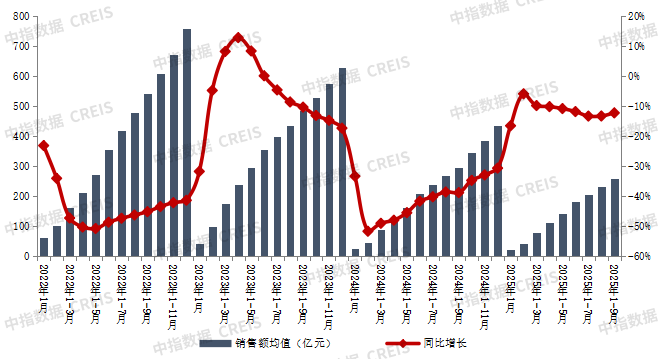
中指研究院:1-9月TOP100房企销售总额为26065.9亿元 同比下降12.2%
Zhi Tong Cai Jing· 2025-09-30 11:05
Core Insights - The total sales of the top 100 real estate companies in China for the first nine months of 2025 reached 26,065.9 billion yuan, a year-on-year decline of 12.2%, with the decline rate narrowing by 1.1 percentage points compared to January-August 2025 [1] - In September 2025, the monthly sales of the top 100 real estate companies increased by 11.9% month-on-month, with companies like Jianfa, Binjiang, Jinmao, and Poly Real Estate showing strong sales performance [1] Sales Performance by Company Tier - The average sales of the top 10 companies was 1280.9 billion yuan, down 11.2% year-on-year; the average sales for the 11-30 tier was 319.8 billion yuan, down 14.9%; for the 31-50 tier, it was 156.5 billion yuan, down 9.8%; and for the 51-100 tier, it was 74.6 billion yuan, down 12.9% [5][6] - The number of companies in various sales tiers changed, with 6 companies in the 1000 billion yuan tier (unchanged from last year), 7 in the 500-1000 billion yuan tier (down 1), 6 in the 300-500 billion yuan tier (down 1), and 40 in the 100-300 billion yuan tier (down 4) [10] Market Outlook - Core cities are continuing to optimize demand-side policies, leading to some market recovery, particularly in core cities like Shenzhen and Shanghai, which have implemented measures to ease purchasing qualifications and optimize property tax policies [11] - Despite the recovery in core cities, the overall market remains under pressure, with many cities experiencing relatively flat performance [11]




长假前后,消费、房市、股市会怎样?大数据告诉你答案
和讯· 2025-09-29 08:35
Core Viewpoint - The article discusses the anticipated trends in travel, consumption, real estate, and stock markets during the upcoming "super golden week" combining National Day and Mid-Autumn Festival, highlighting a significant rebound in travel and consumption patterns post-pandemic, with expectations for continued growth in various sectors [2]. Travel - National travel during the National Day holiday is expected to exceed 2.204 billion trips, with an average of 57.27 million daily trips, marking a 57.1% increase compared to the same period in 2022 [3][4]. - The travel structure shows a shift towards self-driving and personalized travel, while traditional public transport methods like long-distance buses are declining [4][5]. - By 2025, the travel volume is projected to surpass that of 2023, with railway passenger numbers expected to reach 150-180 million and civil aviation passenger numbers potentially exceeding 18-22 million [6]. Consumption Tourism - The tourism market is entering a stable growth phase, with 2023 seeing 826 million domestic trips and a revenue of 753.43 billion yuan, reflecting a 71.3% year-on-year increase [9][12]. - The trend of early travel planning and off-peak travel is becoming the norm, with expectations for 2025 to see 800-900 million trips and tourism revenue reaching 750-850 billion yuan [12]. Dining - Dining consumption is expected to continue its growth trajectory, with a significant rebound in 2023, particularly in tourist hotspots [14][16]. - The combination of National Day and Mid-Autumn Festival in 2025 is anticipated to further boost dining demand, with overall dining consumption projected to grow by 5%-10% compared to 2024 [16]. Film - The film market is recovering, with 2023 seeing a 37.16% increase in box office revenue compared to the previous year, although still below 2019 levels [17][20]. - The 2025 National Day film lineup includes diverse genres, with box office predictions ranging from 2.2 to 3 billion yuan [20]. Retail - Retail consumption is expected to grow by 6%-10% during the 2025 holiday, driven by strong demand for new energy vehicles, food and beverage, and liquor sectors [23][24]. - The retail market is characterized by diverse consumption scenarios and a focus on quality and brand upgrades [24]. Real Estate - The real estate market is showing signs of recovery, with some cities experiencing increased transaction volumes during the National Day holiday in 2023 [25][27]. - By 2025, the market is expected to stabilize, with localized peaks in transactions due to promotional activities [29]. Stock Market - Historical data indicates an average return of +2.1% during the National Day holiday window, with a higher probability of positive returns following the holiday compared to before [30][31].

智昇集团控股(08370)发布年度业绩,股东应占亏损1350.8万元 同比减少64.89%
Zhi Tong Cai Jing· 2025-09-26 10:49
Core Viewpoint - Zhisheng Group Holdings (08370) reported a significant reduction in losses, with a net loss of RMB 13.508 million, a decrease of 64.89% year-on-year, despite facing challenges in the furniture market due to a sluggish real estate sector [1] Financial Performance - The company achieved revenue of RMB 69.445 million for the year ending June 30, 2025, representing a year-on-year increase of 20.82% [1] - The loss attributable to shareholders was RMB 13.508 million, which is a notable improvement compared to the previous year [1] - Earnings per share were reported at a loss of 11.11 cents [1] Business Segment Analysis - Revenue from furniture sales amounted to approximately RMB 51.3 million, an increase of about RMB 14.2 million or 38.4% compared to the same period last year [1] - The domestic real estate market remains in a deep adjustment phase, leading to a slow recovery process that has adversely impacted the furniture sector [1] - Weak consumer demand and a reduction in the number of key financial clients have resulted in a significant decline in related orders, posing substantial challenges to operations [1]