
宏观政策调控

Search documents
权威解读GDP目标,如何实现
第一财经· 2026-03-05 06:54
Core Viewpoint - The government has set an economic growth target of 4.5%-5% for the year, aiming for better results in practice, reflecting a pragmatic approach to economic management [3][4]. Group 1: Economic Growth Target - The target is designed to balance domestic economic operations and external environmental changes, allowing for structural adjustments and risk prevention while aligning with the long-term vision for 2035 [4][5]. - The average annual growth rate of 5.4% achieved during the 14th Five-Year Plan period indicates that a future annual growth rate of over 4.17% is necessary to meet the 2035 GDP per capita goal of over $20,000 [5]. - The target is flexible, accommodating uncertainties and encouraging local governments to set their growth objectives, focusing on high-quality development [5][6]. Group 2: Macroeconomic Policies - The government plans to implement more proactive macroeconomic policies to achieve the growth target, addressing the current demand shortfall and external uncertainties [9][10]. - The fiscal deficit rate is maintained at around 4%, with an increase in the deficit scale by 230 billion yuan, and total new government debt reaching 11.89 trillion yuan, marking a historical high [9][10]. - Public budget expenditures are projected to exceed 30 trillion yuan for the first time, reflecting a more aggressive fiscal policy stance [10]. Group 3: Monetary Policy - The monetary policy will continue to be moderately accommodative, utilizing tools like interest rate cuts and reserve requirement ratio reductions to ensure ample liquidity and lower financing costs for businesses [10]. - New financial tools, such as a 100 billion yuan fund for fiscal-financial collaboration to boost domestic demand, will be introduced to support private investment and consumption [10].


建筑材料行业跟踪周报:继续关注涨价品种-20260302
Soochow Securities· 2026-03-02 07:29
Investment Rating - The report maintains an "Overweight" rating for the construction materials industry [1] Core Insights - The construction materials sector has shown a weekly increase of 4.42%, outperforming the CSI 300 and Wind All A indices by 3.34% and 1.67%, respectively [4] - The report highlights the potential for price increases in construction materials driven by rising costs of basic metals and crude oil, suggesting a focus on companies benefiting from overseas demand expansion and domestic consumption [4][5] - The report emphasizes the importance of monitoring the recovery of the real estate market, with signs of stabilization in second-hand housing transactions and potential improvements in profit margins for many companies [4] Summary by Sections 1. Bulk Construction Materials Fundamentals and High-Frequency Data - **Cement**: The national average price for high-standard cement is 338.5 CNY/ton, down 2.7 CNY/ton from last week and down 50.3 CNY/ton from the same period in 2025. The average cement inventory ratio is 64.1%, down 1.3 percentage points from last week but up 6.9 percentage points year-on-year [11][20] - **Glass**: The average price for float glass is 1164.6 CNY/ton, up 7.0 CNY/ton from last week but down 222.2 CNY/ton from the same period in 2025. Inventory levels have increased by 1565 million heavy boxes compared to last week [44][50] - **Fiberglass**: The market price for non-alkali fiberglass remains stable, with average prices around 3603.50 CNY/ton. The demand for fiberglass is expected to maintain steady growth, supported by wind power and new applications [6] 2. Industry Dynamics Tracking - The report notes that the cement industry is undergoing supply-side adjustments, with a focus on eliminating outdated capacity. The effective capacity for cement is projected to improve, leading to potential price elasticity during peak demand seasons [6] - The glass industry is experiencing a supply contraction, which may provide price elasticity for float glass in the first half of 2026. The report anticipates a rebound in prices as inventory levels decrease following seasonal demand increases [6] - The fiberglass sector is expected to see stable growth in demand, particularly in high-end applications, which may enhance profitability for leading companies [6] 3. Weekly Market Review and Sector Valuation - The report provides a detailed review of price changes and inventory levels across various regions for cement and glass, indicating regional disparities in market performance [20][21] - It highlights the importance of monitoring the competitive landscape and potential shifts in market dynamics due to policy changes and economic conditions [5][6]



经济日报金观平:推动物价合理回升
Jing Ji Ri Bao· 2026-01-29 22:12
Core Viewpoint - The recent positive changes in China's price levels, including a steady rise in the Consumer Price Index (CPI) and improvements in supply-demand dynamics, signal a recovery in economic vitality [1][4]. Group 1: Price Trends - The CPI has risen for four consecutive months, with a year-on-year increase of 0.8% in December 2025, marking a 34-month high [1]. - The core CPI has maintained a year-on-year growth rate of 1.2% for three months, reaching a nearly 50-month high [1]. - The Producer Price Index (PPI) decreased by 1.9% year-on-year in December 2025, but the decline has narrowed by 1.7 percentage points from the year's low, with a month-on-month increase for three consecutive months [1]. Group 2: Economic Policies and Strategies - The central economic work conference emphasized the importance of promoting stable economic growth and reasonable price recovery as key considerations for monetary policy in 2026 [3]. - A combination of policies is needed to promote reasonable price recovery, including maintaining macro policy continuity, implementing proactive fiscal policies, and moderately easing monetary policies [3]. - Structural policies should focus on "expanding demand and optimizing supply," with actions to boost consumption and enhance income for urban and rural residents [3]. Group 3: Market Mechanisms and Economic Environment - The establishment of a unified national market and the elimination of "involutionary" competition are essential for optimizing resource allocation and addressing structural contradictions in supply and demand [3]. - The goal is to ensure that price signals accurately reflect market supply and demand relationships, facilitating a positive interaction between economic growth and price recovery [3]. - The overall economic development trend in China is stabilizing, with a large market advantage being gradually released and the precision of policy regulation improving [4].
宏观和大类资产配置周报:本周沪深300指数下跌0.62%-20260124
Bank of China Securities· 2026-01-24 13:32
Macro Economic Overview - The report indicates that the Shanghai Composite Index fell by 0.62% this week, with the CSI 300 index futures down by 0.10% [1][12] - The report maintains the asset allocation order as stocks > commodities > bonds > currency [3][4] Economic Growth and Policy Recommendations - The economic growth target for 2025 was successfully achieved, with a GDP growth of 5%. For 2026, a coordinated effort between fiscal and monetary policies is deemed necessary to stabilize growth [2][22] - The report emphasizes the need for the optimization and continuation of existing growth policies, such as the "two new" policies, and suggests increasing institutional openness to solidify China's position in international trade [2][22] Asset Performance - The report notes that the ten-year government bond yield decreased by 1 basis point to 1.83%, while the active ten-year government bond futures rose by 0.12% [1][12] - The report highlights that the commodity futures index increased by 10.07% this week, with specific declines in coking coal and iron ore futures by 3.38% and 2.82%, respectively [1][12] Stock Market Insights - The report identifies that the leading index this week was the CSI 500, which rose by 4.34%, while the lagging index was the SSE 50, which fell by 1.54% [39][40] - It also notes that the construction materials sector led the industry gains with a rise of 9.18%, while the banking sector saw a decline of 2.69% [39][40] Bond Market Analysis - The report states that the ten-year government bond yield is expected to fluctuate around 2%, with a low allocation recommendation for bonds due to potential short-term impacts from stock-bond dynamics [4][44] - The credit spread decreased by 1 basis point to 0.40%, indicating a slight improvement in credit market conditions [44] Commodity Market Trends - The report indicates that the social inventory of construction materials remained stable at 5.84 million tons, while coal inventory at major ports was also stable at 69.39 million tons [28][29] - The report suggests that the implementation of fiscal policies will be crucial for the commodity market's performance in the coming weeks [4][39] Currency and Foreign Exchange - The report notes that the seven-day annualized yield of money market funds, such as Yu'ebao, remained stable at 1.00% [1][12] - The report highlights that the Chinese economy's fundamentals support a wide fluctuation in the exchange rate, maintaining a standard allocation for foreign exchange assets [4]
股指期货将偏弱震荡,黄金、白银期货价格再创新高
Guo Tai Jun An Qi Huo· 2026-01-21 10:52
1. Report Industry Investment Rating No information provided in the report. 2. Core Viewpoints of the Report - Through macro - fundamental and technical analysis, the report predicts the trends, resistance levels, and support levels of various futures contracts on January 21, 2026, and the trends of futures main continuous contracts in January 2026 [2]. - The report also provides macro - economic information and commodity - related information that may impact futures prices [5][9]. 3. Summary by Relevant Catalogs 3.1 Futures Market Outlook 3.1.1 January 21, 2026 Futures Main Contracts - Stock index futures (IF2603, IH2603, IC2603, IM2603) are expected to fluctuate weakly, with specific resistance and support levels provided [2]. - Gold futures (AU2604) are expected to fluctuate strongly, with resistance at 1080.0 and 1100.0 yuan/gram, and support at 1060.1 and 1054.3 yuan/gram, and may hit a new high [2]. - Silver futures (AG2604) are expected to have a strong and wide - range fluctuation, with resistance at 23800 and 24200 yuan/kilogram, support at 22763 and 22392 yuan/kilogram, and may hit a new high [2]. - Other metal futures such as copper (CU2603), aluminum (AL2603), nickel (NI2602), tin (SN2602), and non - metal futures like lithium carbonate (LC2605), steel products, and coal products also have their respective predicted trends, resistance, and support levels [2]. 3.1.2 January 2026 Futures Main Continuous Contracts - Stock index futures (IF, IH, IC, IM) are expected to fluctuate strongly, with the IM main continuous contract likely to hit a new high [2][4]. - Gold, silver, copper, aluminum, tin futures main continuous contracts are expected to fluctuate strongly and may hit new highs, with specific resistance and support levels provided [4]. - Lithium carbonate futures main continuous contract is expected to fluctuate strongly, and steel products (RB2605, I2605) and coking coal (JM2605) futures main contracts are expected to have wide - range fluctuations [4]. 3.2 Macro Information and Trading Tips - Chinese government officials attended international meetings and held economic and trade consultations, and introduced 2026 macro - policies, including expanding domestic demand, maintaining fiscal spending, and promoting domestic investment through financial policies [5][6]. - The 1 - month LPR remained unchanged, and there were international news such as the US president's remarks on tariffs, the EU's response to US trade threats, and global bond market sell - offs [7][8]. 3.3 Commodity Futures - Related Information - On January 20, domestic commodity futures markets closed with mixed results. Lithium carbonate hit the daily limit, precious metals were strong, base metals were divided, and coking coal futures led the decline [9]. - Shanghai introduced measures to enhance the influence of non - ferrous metals in the global market, and the Shanghai Futures Exchange adjusted margin ratios and price limits for some contracts [9]. - International precious metals, oil, and base metals futures markets had different price trends on January 20, affected by factors such as trade frictions and supply expectations [9][10]. 3.4 Futures Market Analysis and Outlook 3.4.1 Stock Index Futures - On January 20, major stock index futures contracts (IF2603, IH2603, IC2603, IM2603) opened slightly higher, then fell back after hitting resistance, with varying degrees of decline and changes in short - term trends [12][13]. - The A - share market adjusted on January 20, with a style shift from high - valuation growth sectors to value sectors. Hong Kong stocks and US and European stock markets also closed down [14][15]. 3.4.2 Gold Futures - On January 20, the gold futures main contract (AU2604) opened slightly lower, then rose after an initial decline, hitting a new high since its listing in 2008. The main continuous contract also showed a strong upward trend [34]. - It is expected to continue to fluctuate strongly in January 2026 and on January 21, 2026, and may hit new highs [34][35]. 3.4.3 Silver Futures - On January 20, the silver futures main contract (AG2604) opened slightly lower, then fell back after a rebound, with short - term upward momentum weakening. The main continuous contract showed a strong upward trend and hit a new high [38]. - It is expected to continue to fluctuate strongly in January 2026 and on January 21, 2026, and may hit new highs [39]. 3.4.4 Other Futures - Copper, aluminum, nickel, tin, lithium carbonate, steel products (including rebar, hot - rolled coil, iron ore), and coking coal futures all have their respective price trends on January 20 and predicted trends for January 2026 and January 21, 2026 [45][48][54][58][62][66][70][74][79].
中国经济年报丨国际机构积极评价中国外贸韧性 看好中国资产潜力
Sou Hu Cai Jing· 2026-01-19 15:30
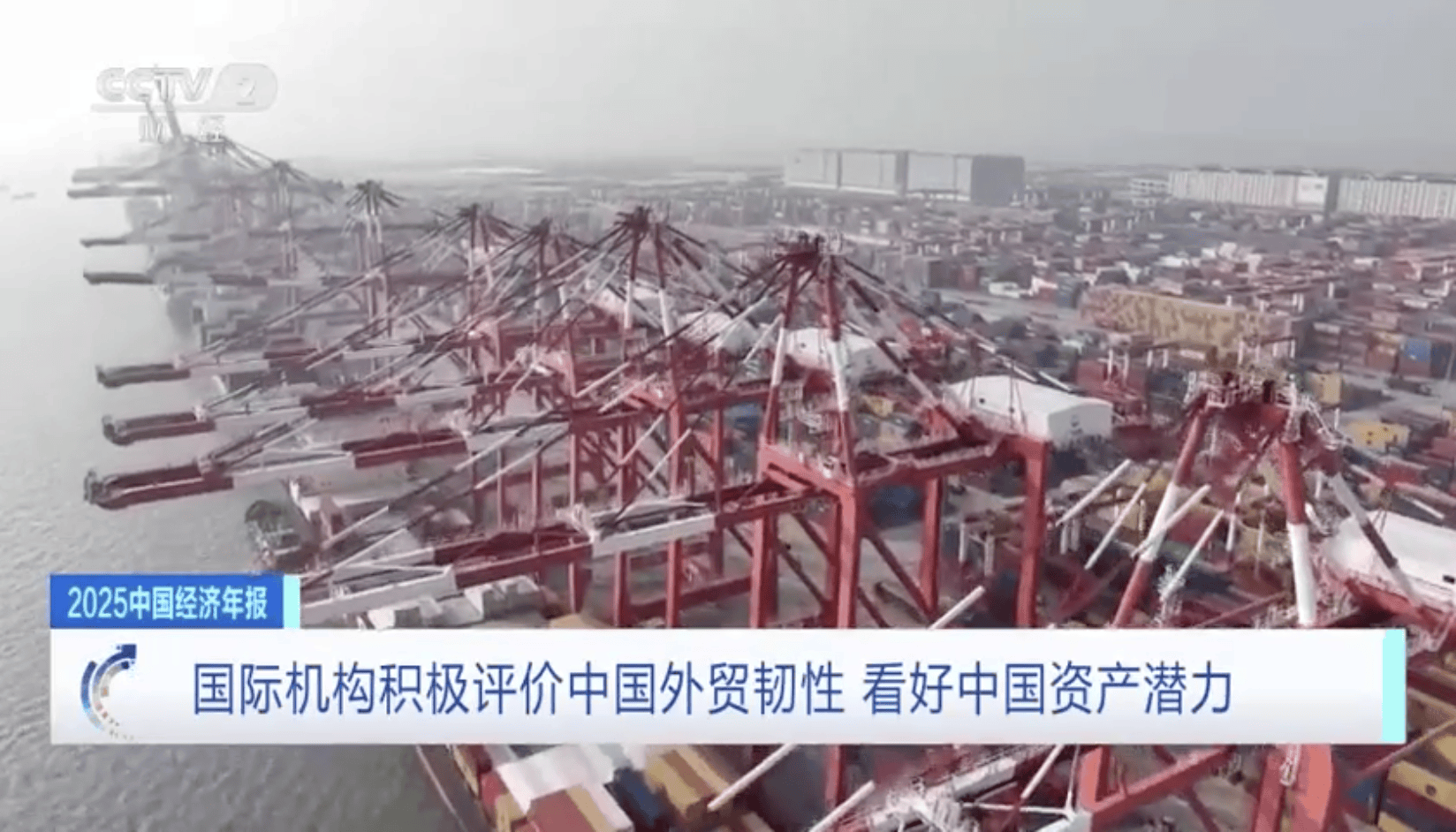
Group 1 - The core viewpoint is that by 2025, China's economy is expected to become a stable and reliable driver of global economic growth, with international institutions providing positive evaluations of China's competitiveness [1][3]. - Experts predict that China's foreign trade will demonstrate resilience and vitality in 2025, injecting certainty into global trade, supported by domestic macro policy adjustments that stimulate internal demand [3][7]. - Morgan Stanley's chief economist for Asia anticipates that China's global export share will increase from 15% to 16.5% by 2030, driven by strategic planning and foresight in identifying future global economic demands [5]. Group 2 - Fitch Ratings experts note that policies aimed at addressing "involution" competition are positively impacting price stabilization and improving corporate profitability in certain industries [7][9]. - It is expected that in 2026, China will adopt a reasonable expansion of fiscal deficits and flexible monetary policies to boost domestic demand and create favorable conditions for improving corporate profits and household income [7]. - A study by Invesco reveals that 59% of sovereign wealth funds prioritize China as a high or medium investment market, a significant increase from 44% in 2024, with digital technology, advanced manufacturing, and clean energy being the most attractive sectors [11].
中国经济进入内需攻坚之年
Jin Rong Shi Bao· 2026-01-05 03:32
Group 1 - In the first half of 2025, China's economy achieved a growth rate of 5.3% due to proactive fiscal measures, effective trade-in policies, and strong export resilience. However, growth momentum slowed in the second half of the year as the effects of stimulus policies diminished and high base effects emerged [1] - The 2026 economic work is under close scrutiny as it marks the beginning of the 14th Five-Year Plan, with a focus on maintaining economic growth as a priority. The Central Economic Work Conference in December 2025 emphasized the need for policies that are not only active but also effective [1] - The 2026 macroeconomic policy will continue to adopt a "more proactive" stance while focusing on enhancing effectiveness, integrating existing and new policies, and increasing counter-cyclical and cross-cyclical adjustments [1] Group 2 - China's export performance in 2026 is expected to exceed market expectations, supported by market diversification and product structure upgrades. From January to November 2025, China's export value increased by 5.4% year-on-year, surpassing the levels of the same period in 2024 [2] - Despite a nearly 20% decline in exports to the United States, exports to emerging markets such as Africa (26.3%), ASEAN (13.7%), and India (11.9%) showed significant growth. The share of exports to Latin America, Africa, and India combined reached 17.5%, matching that of ASEAN [2] - The strong resilience in exports is attributed to stable global economic growth, ongoing fiscal expansion in the US and Europe, and the stabilization of US-China trade relations. Additionally, technological advancements driven by artificial intelligence are expected to support exports [3] Group 3 - Infrastructure investment is projected to rebound in 2026, driven by the commencement of major projects and financial support. From January to October 2025, broad infrastructure investment grew by 1.5% year-on-year, with new policy financial tools and local government debt limits set to enhance project funding [3] - The 14th Five-Year Plan emphasizes the importance of technology innovation and industrial upgrading in driving manufacturing investment. Manufacturing investment grew by 2.7% year-on-year from January to October 2025, with a focus on advanced manufacturing and strategic emerging industries [4][5] Group 4 - The Chinese consumer market is showing strong resilience, with retail sales of consumer goods increasing by 5.0% year-on-year in the first half of 2025, supported by policies promoting trade-in programs. However, growth slowed in the second half due to diminishing effects of these policies [6] - The "14th Five-Year Plan" highlights the importance of enhancing the consumption rate and the role of domestic demand in driving economic growth. There is a focus on whether policies to stimulate consumption will be strengthened in 2026 [6] - The balance between short-term growth stabilization and long-term development tasks is crucial for policy formulation in 2026, with an emphasis on stabilizing the real estate market and improving social security systems [7]

预见2026|从外需韧性到内生动能 基本面于多重目标中获取平衡
Xin Hua Cai Jing· 2025-12-25 09:02
Core Insights - The Chinese economy is expected to achieve a growth target of around 5% for the year, supported by a significant contribution from domestic consumption and a resilient export sector [1][2]. Group 1: Economic Growth and Structure - In the first three quarters, consumption contributed 53.5% to GDP growth, a substantial increase of 9 percentage points compared to the previous year [2]. - Exports contributed 1.5 percentage points to GDP, accounting for approximately 30% of the growth, demonstrating strong resilience despite external uncertainties [2]. Group 2: Policy Measures and Economic Stability - The government has implemented timely macroeconomic policies to counteract pressures, particularly in real estate investment, showcasing a flexible approach to policy adjustments [3]. - A series of policies aimed at expanding domestic demand have shown tangible progress, with a 300 billion yuan subsidy for trade-ins leading to significant sales growth [4]. Group 3: Future Outlook and Challenges - The real estate sector remains a critical area of concern, as its stabilization is essential for financial security and consumer confidence [5]. - Looking ahead to 2026, the GDP growth target is likely to remain around 5%, with a focus on stabilizing employment and enhancing the environment for private and service sectors [7][8].
着眼全局 把握明年经济工作的总体要求和政策取向——论学习贯彻中央经济工作会议精神
Ren Min Ri Bao· 2025-12-14 22:46
Group 1 - The central economic work conference has outlined the overall requirements and policy orientation for economic work in the coming year, emphasizing the need to maintain stability while seeking progress and better coordinate domestic economic work with international trade struggles [1] - The conference highlighted the importance of implementing a more proactive macro policy, enhancing the forward-looking, targeted, and coordinated nature of policies, and continuously expanding domestic demand while optimizing supply [1][2] - The contribution rate of final consumption expenditure to economic growth reached 53.5% in the first three quarters, indicating a strong focus on expanding domestic demand [2] Group 2 - The current global situation is characterized by significant changes, with major power relations affecting international dynamics, which in turn impact domestic development [3] - The conference emphasized the need for strategic determination and confidence in overcoming external challenges, focusing on stabilizing employment, enterprises, markets, and expectations while enhancing the real economy and independent innovation capabilities [3] - The policy orientation for next year's economic work includes maintaining a stable yet progressive approach, improving quality and efficiency, and enhancing the effectiveness of both existing and new policies [3][4] Group 3 - The implementation of various macro policies, including the issuance of 1.3 trillion yuan in special long-term bonds, aims to support key sectors and stimulate consumption [4] - The focus on "quality and efficiency" in economic work is crucial, requiring a pragmatic approach to policy implementation and enhancing the consistency and effectiveness of macro policies [4] - Confidence in the economic outlook is emphasized, with a commitment to advancing China's economy through steady progress and achieving breakthroughs in both quantity and quality [4]
着眼全局,把握明年经济工作的总体要求和政策取向
Ren Min Ri Bao· 2025-12-14 22:30
Group 1 - The central economic work conference has outlined the overall requirements and policy orientation for economic work in the coming year, emphasizing the need to maintain stability while seeking progress and better coordinate domestic economic work with international trade struggles [1][3] - The conference highlighted the importance of implementing a more proactive macro policy, enhancing the forward-looking, targeted, and coordinated nature of policies, and continuously expanding domestic demand while optimizing supply [1][2] Group 2 - In the first three quarters of this year, the added value of high-tech manufacturing above designated size increased by 9.6% year-on-year, reflecting the successful transformation of traditional industries and the growth of emerging industries [2] - The final consumption expenditure contributed 53.5% to economic growth in the first three quarters, indicating a strong focus on expanding domestic demand [2] - The conference emphasized the need for a consistent and stable macro policy, continuing to implement a more active fiscal policy and moderately loose monetary policy, which aligns with this year's policy direction [3][4] Group 3 - The government plans to enhance the effectiveness of macro policies by focusing on quality and efficiency improvements, integrating existing and new policies, and increasing the precision and effectiveness of policy implementation [4] - The emphasis on "quality improvement and efficiency enhancement" aims to ensure that various policy measures work in concert to stabilize the economy and improve market expectations [4] - Confidence in the economic outlook is reinforced by the government's commitment to steadily advancing economic work and achieving breakthroughs in both quantity and quality [4]