
AI革命

Search documents
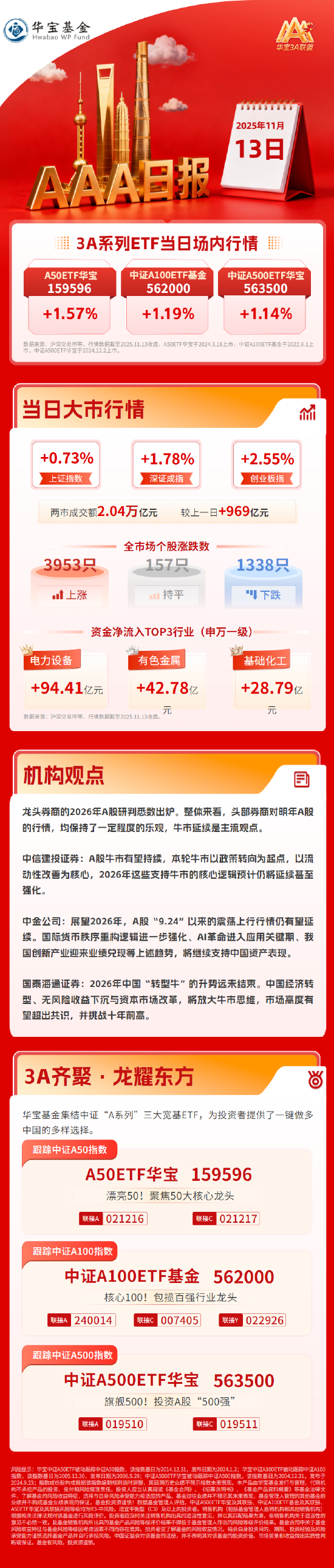
上证指数再创十年新高,龙头券商2026年研判出炉:A股牛市有望延续|华宝3A日报(2025.11.13)
Xin Lang Ji Jin· 2025-11-13 10:13
Group 1 - The overall sentiment among leading brokerages for the A-share market in 2026 is optimistic, with a prevailing view that the bull market will continue [3] - CITIC Securities believes that the bull market is expected to persist, driven by policy shifts and improved liquidity, with core logic supporting the bull market likely to continue or even strengthen [3] - China International Capital Corporation (CICC) anticipates that the upward trend since September 24, 2023, will continue, supported by the restructuring of international monetary order, the AI revolution entering a critical application phase, and the performance of innovative industries [3] Group 2 - Guotai Junan Securities asserts that the "transformation bull market" in China is far from over, with economic transformation, declining risk-free returns, and capital market reforms expected to amplify bullish sentiment [3] - The A50 ETF by Huabao focuses on 50 major leading companies, providing investors with a diversified option to invest in China [4] - The A100 ETF by Huabao tracks the CSI A100 Index, offering another avenue for investors to engage with the Chinese market [4]

获美国能源部关键批准 投行韦德布什重申Oklo(OKLO.US)“跑赢大盘“评级
智通财经网· 2025-11-13 06:58
Group 1 - The core viewpoint is that Oklo is laying the groundwork for the broader application of nuclear energy in the next decade, supported by a favorable regulatory environment and increasing demand for renewable energy driven by AI data centers [1][2] - Oklo's third-quarter performance shows no revenue generation, with an operating loss of $36.3 million, a net loss of $29.7 million, and a loss per share of $0.20, which is worse than the average analyst expectation of a loss of $0.13 per share [1] - The U.S. Department of Energy has authorized the construction and operation of Oklo's nuclear facilities, creating a modern pathway for the rapid construction of new nuclear power plants [1] Group 2 - The U.S. government is providing $300 to $400 million in funding to support the construction of new-generation nuclear power plants, with a significant portion allocated to help initial projects [2] - Oklo is recognized as a prominent nuclear power brand within the White House, with its Aurora reactor project aligning well with government plans [2] - Chris Wright, the U.S. Energy Secretary, has a history with Oklo, having served on its board, which enhances the company's visibility and credibility within government circles [2]
展望A股2026年行情 三大投资主线获券商青睐
Zhong Guo Zheng Quan Bao· 2025-11-12 20:08
Core Viewpoint - The A-share market is expected to continue its upward trend into 2026, driven by improving fundamentals and a more balanced market style between growth and value sectors [1][2][4]. Group 1: Market Performance and Outlook - The A-share market has experienced a significant upward trend since September 2024, supported by favorable policies and low valuations [2]. - Analysts predict that the overall profit growth for A-shares in 2026 could be around 4.7%, with non-financial profit growth expected to rise to approximately 8.2% [2][3]. - The market is currently in a high-level consolidation phase, with the Shanghai Composite Index fluctuating around the 4000-point mark [1]. Group 2: Sector and Style Analysis - The market is anticipated to see a rebalancing of styles in 2026, with both growth and value sectors presenting opportunities [4][5]. - High-growth sectors such as AI and semiconductors are expected to validate their performance, while advanced manufacturing sectors may begin to rebound [3][5]. - The current macroeconomic environment and innovation trends are still favorable for growth styles, but a more balanced approach is expected as cyclical industries approach supply-demand equilibrium [4][5]. Group 3: Investment Themes and Strategies - Key investment themes for 2026 include technology growth, overseas expansion, and cyclical recovery, with specific focus on AI applications, robotics, and renewable energy [6][7]. - Analysts suggest that investors should also pay attention to policy cycles, real estate cycles, and capital market reforms as potential investment clues [7]. - The sectors of interest include consumer electronics, automotive, innovative pharmaceuticals, and various cyclical industries like chemicals and aquaculture [6][7].


机构普遍看好2026年中国经济与A股市场
Zheng Quan Ri Bao· 2025-11-11 16:18
Economic Growth Outlook - Multiple institutions predict a stable economic growth trajectory for China in 2026, with targets around 5% [2][3] - China’s economic growth is expected to maintain resilience, with forecasts suggesting a GDP growth of approximately 4.9% in 2026 [2][3] Policy and Fiscal Measures - Fiscal spending is anticipated to continue moderate expansion, with local government finances improving due to steady progress in local debt management [2][3] - The government is expected to maintain a proactive fiscal stance, with an increase in special bonds and long-term treasury bonds [3][4] - Monetary policy is projected to include around two reserve requirement ratio cuts and one to two interest rate cuts in 2026 [3][4] A-Share Market Dynamics - The A-share market is transitioning from local to global exposure, with companies evolving into multinational entities [4] - A-share earnings are expected to gradually recover, with non-financial A-share growth projected to reach around 10% [4] - The market is likely to experience a shift towards balanced styles, driven by cyclical industries approaching supply-demand equilibrium [6] Industry Trends and Opportunities - Key industry trends include the upgrading of traditional manufacturing, the globalization of Chinese enterprises, and the expansion of AI applications [5][6] - The "new economy" sectors are expected to grow faster than other economic sectors, with their GDP contribution projected to increase by 3 percentage points by 2030 [3]
券商研判2026年A股走势:慢牛行情延续,基本面重要性进一步上升
Di Yi Cai Jing· 2025-11-11 12:00
"有资金、科技等力量的推动,中国股市在2026年仍是慢牛行情。" 沪指站上4000点之后怎么走?科技、消费等热门赛道还有哪些机会?行至年尾,对于以上种种市场关 切,多家券商在2026年市场展望中给出预判。 第一财经关注到,对于明年的A股市场整体走势,券商普遍认为,"9.24"以来的震荡上行行情有望延 续,A股仍将呈现慢牛行情。 "尽管在今年四季度,由于种种原因,A股有一定的波动,但我们认为有资金、科技等力量的推动,中 国股市在2026年仍然是一个慢牛(行情)。"中信建投首席经济学家黄文涛表示。 哪些因素将为行情提供支撑?整体来看,分析认为,市场经过一定的估值修复后,基本面的重要性进一 步上升;同时,盈利周期上行的预期能否逐步兑现,将是决定上涨行情持续性的关键。 从宏观角度,业内认为,经济基本面、资金动向等,都是2026年股市的重要影响因素。 中金公司研究部国内策略首席分析师李求索称,2026年,A股"9.24"以来的震荡上行行情仍有望延续, 但经历一定估值修复后,基本面重要性进一步上升。同时,全球资金和国内居民资金动向也是不可忽视 的因素。 他认为,两大因素将支持A股表现,一是中美关系步入新阶段,国际货币秩序 ...
我们很可能正走向一个“无工作社会”|腾研对话海外名家
腾讯研究院· 2025-11-11 09:33
Core Viewpoint - The article discusses the transformative impact of the AI revolution, comparing it to previous major revolutions like the Industrial Revolution, and suggests that AI may fundamentally reshape society, economy, and human relationships [6][9]. Group 1: Nature of the AI Revolution - The AI revolution is seen as a continuation of technology's role in enhancing human capabilities, shifting from physical to cognitive enhancements [7]. - AI is expected to accelerate the cycle of discovery and innovation, leading to exponential growth in technology and knowledge [8]. Group 2: Impact on Work and Society - The rise of AI may lead to the emergence of a "leisure class," where many professional jobs are replaced by AI, resulting in fewer people needing to work [11][12]. - Education will need to shift from preparing individuals for traditional jobs to teaching them how to live creatively and meaningfully in a world where work is not the primary focus [14]. Group 3: Challenges to Human Creativity - AI's capabilities in creative fields challenge the unique value of human creativity, as it can produce works indistinguishable from those created by humans [15]. Group 4: Economic and Social Structures - The traditional economic model based on work for income is being challenged, leading to discussions about basic income and wealth distribution in a potential "workless society" [17]. - The AI revolution could lead to a "post-scarcity" society, but there are concerns about wealth concentration and inequality [18]. Group 5: Knowledge and Intellectual Property - The concept of intellectual property may need to be redefined in an AI-driven world, where contributions to creative works are increasingly collaborative and difficult to attribute [19]. Group 6: Social Relationships and AI - AI is expected to decentralize social activities and relationships, potentially transforming how humans interact with each other and with AI [21][23]. Group 7: Global Implications - AI has the potential to foster global cooperation and reduce nationalism, but it may also reshape global power dynamics and economic structures [25][26]. Conclusion - The future of AI development depends on responsible practices that consider ethical, social, and ecological impacts, aiming for a better world with reduced conflict and poverty [28][29].

A股震荡不改上行趋势! 人形机器人将迎来“IPhone”时刻
天天基金网· 2025-11-11 09:26
Group 1 - The core viewpoint is that the A-share market is expected to continue its upward trend in 2026, despite short-term fluctuations, with a focus on sectors like technology recovery, dividend stocks, and low-positioned industries such as electric new energy [2][3][5] - The food and beverage sector is experiencing significant growth, with the liquor industry showing signs of bottoming out, presenting structural opportunities driven by policy benefits and consumption trends [9][11] - The Ministry of Industry and Information Technology is accelerating the cultivation of "robot+" application scenarios, with humanoid robots expected to enter mass production in 2026, marking a critical development period for the industry [14][16] Group 2 - According to various securities firms, the A-share market is currently in a policy and performance window, with a recommendation to maintain a "barbell" investment strategy focusing on low-positioned sectors that have growth logic [5][6][7] - The liquor industry is anticipated to enter a recovery phase, with a focus on companies that show early signs of turning points and growth elasticity [9] - The food and beverage industry is facing challenges such as insufficient domestic demand, but there are structural investment opportunities arising from policies aimed at boosting domestic consumption and evolving consumer trends [11]

哑铃策略成为四季度投资优选!港股科技扛鼎进攻端,攻守兼备应对震荡市
Mei Ri Jing Ji Xin Wen· 2025-11-11 02:57
Core Viewpoint - The Hong Kong stock market is showing a clear upward trend in the fourth quarter, with the "barbell strategy" being the optimal choice to respond to market changes, where the technology sector serves as the "offensive spear" of this strategy [1] Group 1: Market Strategy - The barbell strategy consists of two ends: the technology sector benefiting from the AI revolution and new productivity, focusing on high-growth opportunities, while high-dividend sectors provide stable cash flow to mitigate market risks [1] - This allocation aligns with the current market environment characterized by "policy support + technological breakthroughs" and matches the preferences of foreign institutions for leading growth stocks and high-dividend dual lines [1] Group 2: Investment Opportunities - For investors, positioning in the Hong Kong technology sector represents the most imaginative growth opportunity in a volatile market, achieving a balance between offensive and defensive strategies [2] - Relevant ETFs include the Hong Kong Stock Connect Technology ETF (159101), which covers the entire technology industry chain, and the Hang Seng Internet ETF (513330), which focuses on leading internet companies [2]
机构称国内创新产业迎来业绩兑换,500质量成长ETF(560500)盘中蓄势
Sou Hu Cai Jing· 2025-11-11 02:46
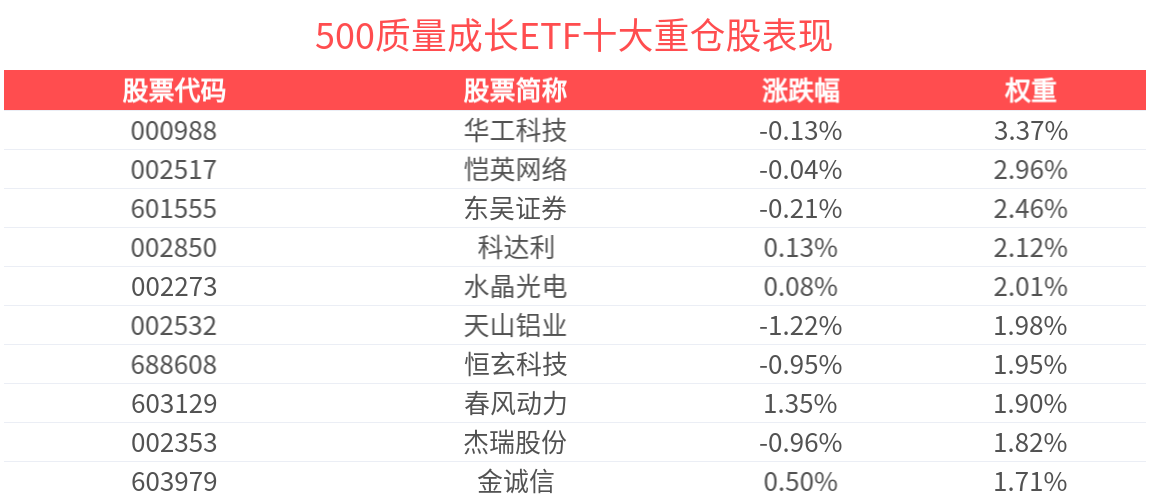
Core Insights - The China Securities 500 Quality Growth Index (930939) experienced a slight decline of 0.17% as of November 11, 2025, with mixed performance among constituent stocks [1] - The report from China International Capital Corporation (CICC) suggests that the restructuring of the international monetary order and the AI revolution will support the performance of Chinese assets in 2026 [1] - The CICC recommends focusing on three main investment themes: growth in prosperous sectors, breakthroughs in external demand, and cyclical reversals [1] Market Performance - The top-performing stock in the index was Weisheng Information (688100), which rose by 5.22%, while Sanmei Co. (603379) led the declines [1] - The 500 Quality Growth ETF (560500) saw a trading volume of 43.25 million yuan with a turnover rate of 0.09% [1] - Over the past three months, the 500 Quality Growth ETF's scale increased by 30.1 million yuan, indicating significant growth [1] Index Composition - The 500 Quality Growth Index comprises 100 stocks selected for high profitability, sustainable earnings, and strong cash flow [2] - As of October 31, 2025, the top ten weighted stocks in the index accounted for 21.64% of the total index weight, with Huagong Technology (000988) being the largest at 3.37% [2][4]
贵金属周报:金银维持震荡,调整尚未结束-20251110
Tong Guan Jin Yuan Qi Huo· 2025-11-10 02:39
Report Information - Report Title: Precious Metals Weekly Report [1][13][23][44] - Report Date: November 10, 2025 [2] Investment Rating - No investment rating for the industry is provided in the report. Core Views - Last week, precious metal prices were in a volatile consolidation. Although the US private employment data in October exceeded expectations, gold and silver were supported. Market sentiment was affected by two uncertainties: the ongoing US government shutdown and the US Supreme Court's questioning of the legality of Trump's comprehensive tariff collection [3][6]. - The AI revolution has accelerated the wave of layoffs. The number of Challenger job cuts in the US in October increased by 175.3% year-on-year, reaching the highest level in the same period in twenty years. The private data provider Revelio Labs reported that non-farm payrolls turned negative in October, with a decrease of 9,100 jobs [3][7]. - Fed officials' statements showed a divergence on monetary policy. This year's Fed voters were cautious due to the government shutdown, and the direction of a December rate cut was unclear. Next year's voters were more concerned about inflation risks, and monetary policy may remain in a tightening stance for a longer time [3][7]. - Currently, gold and silver prices are in a volatile state, waiting for more information for further guidance. In the short term, prices may rebound due to data fluctuations, but the rebound space is expected to be limited. The view that gold and silver prices are in a phased adjustment is maintained [3][7]. Summary by Directory 1. Last Week's Trading Data | Contract | Closing Price | Change | Change Rate (%) | Total Volume (Lots) | Total Open Interest (Lots) | Price Unit | | --- | --- | --- | --- | --- | --- | --- | | SHFE Gold | 921.26 | -0.66 | -0.07 | 136,660 | 178,255 | Yuan/gram | | Shanghai Gold T+D | 917.64 | -2.56 | -0.28 | 37,088 | 254,462 | Yuan/gram | | COMEX Gold | 4007.80 | -5.60 | -0.14 | - | - | US dollars/ounce | | SHFE Silver | 11484 | 43 | 0.38 | 522,479 | 634,627 | Yuan/kilogram | | Shanghai Silver T+D | 11480 | 38 | 0.33 | 619,304 | 4,294,018 | Yuan/kilogram | | COMEX Silver | 48.23 | -0.02 | -0.05 | - | - | US dollars/ounce | [4] 2. Market Analysis and Outlook - The US government shutdown has broken the previous record and become the longest in history. Some Senate Democrats are ready to advance a package to end the shutdown, showing the most significant breakthrough in bipartisan negotiations in over a month [6]. - On November 5, the Supreme Court debated the legality of Trump's large - scale tariff collection. Most justices initially thought Trump overstepped his authority. The specific judgment time is undetermined [6]. - The Fed's officials have different views on monetary policy. Governor Milan called for more aggressive rate cuts, while Governor Cook said that each Fed meeting is real - time for monetary policy, and the risk on both sides of the Fed's dual mandate has increased [7]. - This week, attention should be paid to the US October CPI and PPI data, Fed speeches, the progress of the US government shutdown, and the Supreme Court's "tariff ruling" on Trump [8] 3. Important Data Information - The US ADP employment in October increased by 42,000, significantly exceeding the expected 30,000, but overall labor demand is still slowing, and wage growth is stagnant [9]. - As of September this year, the number of job cuts announced by US companies has approached 950,000, the highest level in the same period since 2020, with the government sector being the hardest - hit area [9]. - The US ISM manufacturing PMI in October was 48.7, contracting for the eighth consecutive month and lower than the expected 49.5 [9]. - The US ISM services PMI in October rose 2.4 points to 52.4, reaching an eight - month high, far exceeding the expected 50.8 [9]. - The eurozone's October manufacturing PMI was 50, with new orders stagnant and exports declining for four consecutive months. German and French manufacturing PMIs remained in the contraction zone [10]. - The eurozone's October services PMI was 53%, better than the initial value, pushing the composite PMI to the highest level since May 2023. Germany's service industry recovered strongly, while France's contracted for 14 consecutive months [10]. - The China Securities Regulatory Commission approved the registration of platinum, palladium futures, and options on the Guangzhou Futures Exchange [10]. - Indian gold ETFs have seen record capital inflows this year, with purchases approaching $3 billion, equivalent to about 26 tons of gold [10]. - China's foreign exchange reserves at the end of October were $3.343 trillion, and the gold reserves were 74.09 million ounces, increasing by 30,000 ounces month - on - month, the 12th consecutive month of increase [11] 4. Related Data Charts - The report provides multiple charts showing the price trends of SHFE and COMEX gold and silver, inventory changes, non - commercial net long positions, ETF holdings, price spreads, and the relationships between gold prices and other factors such as the US dollar, copper prices, inflation expectations, and interest rates [16][18][22][25][29][30][36][40][42]