
商业航天

Search documents
公用事业行业深度报告:火箭发射深度1:可回收路径中稀缺耗材:推进剂特气份额、价值量提升
Soochow Securities· 2026-01-22 03:15
Investment Rating - The report maintains a "Buy" rating for Jiufeng Energy, highlighting its potential in the commercial aerospace sector [1]. Core Insights - The commercial aerospace industry is transitioning into a phase of scaled launches, with supply capabilities being continuously released. This shift is characterized by an increase in launch frequency and demand for launch services [9]. - The cost structure of launch services is evolving, with a clear path towards cost reduction through high payload capacity and reusable technology. The unit cost of launching is expected to decrease significantly by 2029 [29]. - The demand for propellants and special gases is becoming increasingly rigid, with their value and share in the overall cost structure expected to rise over time [38]. Summary by Sections 1. Industry Trends - The commercial aerospace sector is moving from a capability-building phase to a scaled launch phase, driven by the acceleration of low Earth orbit satellite constellation construction [9]. - China's launch infrastructure has developed a comprehensive system, including multiple launch sites that enhance operational efficiency and specialization [10][11]. 2. Cost Constraints and Reduction Pathways - The cost structure of launch services is divided into fixed, semi-fixed, and variable costs, with propellants and special gases representing the most rigid costs [19][22]. - The unit cost of launching is currently high, but it is projected to decrease from approximately 115,000 RMB per kilogram in 2020 to around 45,000 RMB per kilogram by 2029 [29][24]. - High payload capacity and reusable technology are recognized as key methods for reducing costs in the industry [29]. 3. Propellant and Special Gas Demand - The choice of rocket fuel is evolving, with liquid oxygen and methane emerging as a prominent option due to their cleaner combustion and lower carbon buildup, which is advantageous for high-frequency reuse [39][40]. - The report outlines the comparative advantages of different rocket fuel technologies, emphasizing the long-term coexistence of liquid oxygen and kerosene alongside liquid oxygen and methane [41][42]. 4. Investment Recommendations - Jiufeng Energy is recommended for its strategic positioning in the supply of special fuels and gases for commercial aerospace, with expected net profits of 1.56 billion, 1.8 billion, and 2.13 billion RMB from 2025 to 2027 [1].

商业航天板块,大面积涨停
第一财经· 2026-01-22 03:13
Core Viewpoint - The commercial aerospace sector is experiencing significant stock price increases, driven by news of SpaceX's potential IPO and the government's focus on building a strong aerospace nation as part of the 14th Five-Year Plan [1][3][4]. Group 1: Stock Performance - On January 22, several stocks in the commercial aerospace sector saw substantial gains, with over ten stocks hitting the daily limit, including Tengda Technology and Jieli Rigging [1]. - Notable stock performances include: - Triangle Defense: +15.80% - Tianli Composite: +15.36% - Zhongtai Shares: +14.49% - Jianghang Equipment: +10.81% [2]. Group 2: SpaceX IPO News - Reports indicate that Elon Musk is actively pushing for SpaceX's IPO, aiming to complete it by July this year, which marks a shift from his previous resistance to going public [3]. - The IPO is seen as crucial for funding Musk's ambition to establish data centers in space and to support his AI company, xAI, in competing with rivals [3]. Group 3: Government Initiatives - The current year marks the beginning of the 14th Five-Year Plan, with a focus on accelerating the construction of a strong aerospace nation, which is now a key task in the national agenda [4]. - The construction of China's first offshore liquid rocket launch recovery test platform is underway, highlighting the government's commitment to advancing aerospace capabilities [4].





张坤2025四季报出炉:三只产品跑输基准 亚洲精选飘红 坚定看好中国核心资产长期价值
Xin Lang Cai Jing· 2026-01-22 03:12
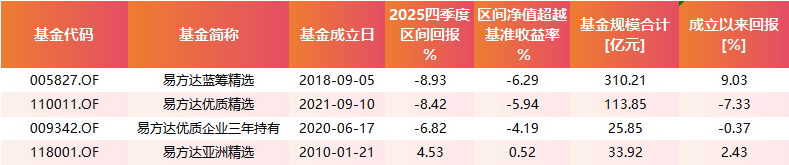
Core Viewpoint - The report highlights the investment strategies of Zhang Kun, a prominent fund manager at E Fund, focusing on the performance of his funds and his optimistic outlook on China's economic growth and consumer market potential over the next decade [1][2][3]. Fund Performance Summary - As of the end of Q4 2025, Zhang Kun managed a total fund size of 48.383 billion yuan, with three A-share focused funds underperforming their benchmarks, while the E Fund Asia Select fund achieved a positive return of 4.53%, significantly exceeding its benchmark [1][2][3]. - The E Fund Blue Chip Select (005827.OF) reported a net value growth rate of -8.93%, underperforming its benchmark by over 6 percentage points, with a total size of 31.021 billion yuan and a cumulative return of 9.03% since inception [2][3][4]. - The E Fund Quality Select (110011.OF) and E Fund Quality Enterprise Three-Year Holding (009342.OF) also reported negative returns of -8.42% and -6.82%, respectively, since their inception returns are -7.33% and -0.37% [3][4]. Market Outlook and Investment Strategy - Zhang Kun maintains a long-term optimistic view on the macroeconomic environment, asserting that the living standards and social security levels in China will significantly improve over the next decade, narrowing the gap with developed countries [2][3][4]. - He emphasizes that the current pessimistic market pricing has made high-quality companies' valuations very attractive, presenting good opportunities for long-term investors [3][4][5]. - The report indicates a structural adjustment in fund allocations, focusing on sectors such as healthcare, consumer goods, and technology, while maintaining stable stock positions [10][11][12]. Consumer Market Insights - Zhang Kun argues that the current weakness in domestic consumption is a temporary phenomenon, with significant growth potential in China's domestic market, which is expected to be a key driver for future investments [11][12][13]. - He cites the goal of achieving a per capita GDP comparable to developed countries by 2035, suggesting that China has ample room for growth in consumer spending and quality of life improvements [12][13][14]. - The report also highlights the potential for recovery in consumer sentiment as housing price declines stabilize, which could enhance consumer willingness to spend [12][13][14]. Technology and Innovation - The report discusses the unique advantages of the Chinese market in the context of the global AI wave, noting that a strong domestic demand market is crucial for technological innovation [13][14][15]. - Zhang Kun expresses optimism about domestic AI application companies, anticipating that a stronger consumer environment will facilitate better interactions between subscription revenues and model capabilities, aiding in closing the gap with global leaders [13][14][15]. Conclusion - The report reflects Zhang Kun's commitment to long-term investment strategies amid market volatility, with a focus on optimizing fund structures and capitalizing on undervalued assets, positioning for potential excess returns in the next economic cycle [15][16][17].





通用航空ETF南方 )涨3.30%,航天电子涨7.84%。
Cai Jing Wang· 2026-01-22 02:58
Group 1 - The stock market in Shanghai and Shenzhen showed an upward trend on January 22, with the low-altitude economy and commercial aerospace sectors performing well, as evidenced by the General Aviation ETF Southern (159283.SZ) rising by 3.30% and Aerospace Electronics increasing by 7.84% [1] Group 2 - The third Beijing Commercial Aerospace Industry High-Quality Development Promotion Conference will be held from January 23 to 24, focusing on the theme "Gathering Strength for New Quality in Aerospace" with various activities including results release, keynote speeches, and thematic discussions [2] - The conference will involve representatives from government departments, aerospace institutions, leading enterprises, and financial institutions to explore new trends in technological transformation and outline new development plans for the industry [2] - Dongfang Securities highlights the potential of military enterprises in the civil aviation sector and commercial aerospace, as well as the expansion of the military trade market due to the acceleration of high-end equipment exports [2] - Tianfeng Securities emphasizes the supportive policies for the low-altitude economy, including Shenzhen's "14th Five-Year Plan" for low-altitude operation facilities and the National Energy Administration's deployment of high-quality charging infrastructure [2] - The general aviation sector is identified as a significant subfield of high-end manufacturing, benefiting from low-altitude economic policies and trends in consumer upgrades, indicating substantial growth potential for the industry [2] - The General Aviation ETF Southern (159283.SZ) tracks the CSI General Aviation Theme Index, which selects quality enterprises in subfields such as aviation materials and aircraft manufacturing, providing comprehensive coverage of related companies in the industry [2]


航天航空板块早盘直线拉升,卫星制造+发射市场空间五年复合增速48%,卫星ETF广发(512630)、军工ETF广发(512680)双双涨超3%
Xin Lang Cai Jing· 2026-01-22 02:57
Core Viewpoint - The commercial aerospace sector in China is experiencing rapid growth due to breakthroughs in reusable rocket technology and accelerated large constellation networking, which are expected to yield significant industry benefits [1][2]. Group 1: Industry Developments - The launch frequency of China's commercial aerospace has increased, with the Long March 12 rocket's launch cycle shortened by 4 days, showcasing enhanced efficiency and commitment to meeting launch schedules [1]. - The upcoming launches of new rockets such as the Lijian-2, Zhuque-3, and Long March 12A are anticipated to mark a period of rapid development in China's commercial aerospace sector during the 14th Five-Year Plan [1]. - The global competition for low Earth orbit resources is intensifying, with an estimated capacity limit of approximately 60,000 satellites in near-Earth orbit, and around 57,000 low Earth orbit satellites expected to be deployed by 2029 [2]. Group 2: Market Growth Projections - The satellite manufacturing and launch market in China is projected to grow from 26.8 billion yuan in 2026 to 127.9 billion yuan by 2030, reflecting a compound annual growth rate (CAGR) of 48.1% [1]. - The military and aerospace sectors are becoming core investment directions, driven by strategic initiatives in manned lunar missions and deep space exploration [2]. Group 3: ETF Performance - The military ETF Guangfa (512680) saw a rise of over 3%, with significant gains in constituent stocks such as Triangle Defense and Steel Research, indicating strong market interest [2]. - The satellite ETF Guangfa (512630) also experienced a peak increase of over 3%, with notable performances from stocks like Electronic Science and Technology and Aerospace Universe [2]. - The satellite ETF Guangfa reached a latest scale of 1.472 billion yuan, with a net inflow of 394 million yuan over the past 10 trading days [3].
ETF盘中资讯|军工领跑全市场,120亿主力资金猛攻!军工ETF华宝(512810)盘中劲升逾3%,大飞机概念领涨
Sou Hu Cai Jing· 2026-01-22 02:54
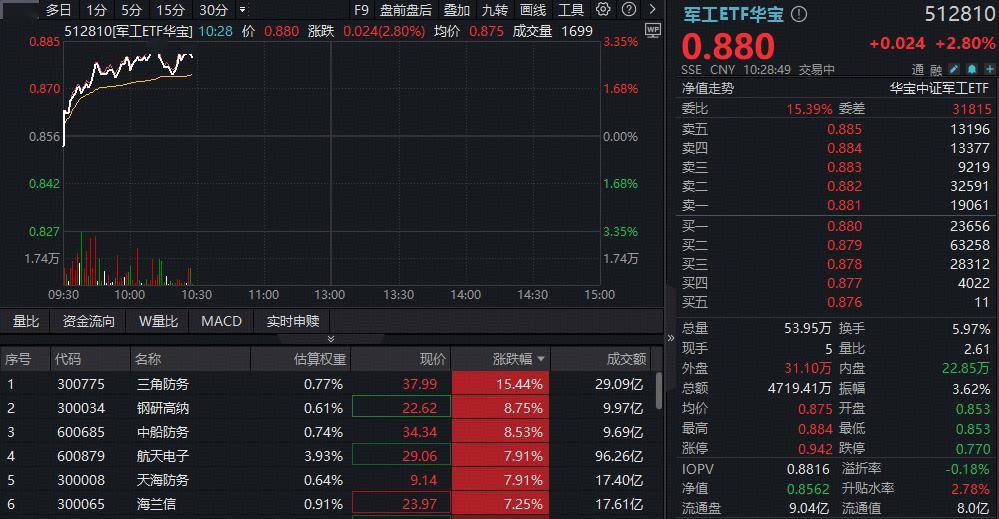
Core Viewpoint - The military industry sector is experiencing a significant rally, with the military ETF Huabao (512810) leading the market, driven by strong performance in the large aircraft concept and notable gains in specific stocks like Triangle Defense and Steel Research High-tech [1][3]. Group 1: Market Performance - The military ETF Huabao (512810) saw a peak increase of 3.35% during trading, with Triangle Defense hitting a 20% limit up and Steel Research High-tech rising over 8% [1]. - In less than an hour after the market opened, net purchases in the defense and military industry reached nearly 12 billion yuan, ranking first among 31 primary industries [3]. Group 2: Company Developments - The European Union Aviation Safety Agency (EASA) has begun test flights of China's independently developed C919 passenger aircraft in Shanghai, indicating progress in international certification [3]. - Dongfang Securities noted that the C919 has successfully completed domestic transportation for hundreds of thousands of passengers, suggesting that accelerated international certification could enhance China's large aircraft global positioning [3]. Group 3: Policy and Industry Outlook - The Suzhou "14th Five-Year" plan emphasizes deep integration into the Yangtze River Delta large aircraft industry cluster, which is expected to boost the production pace of domestic commercial aircraft and self-sufficient aviation engines [4]. - Longjiang Securities reports that the military aviation sector is likely to see significant growth driven by the production of commercial aircraft and self-sufficient engines during the 14th Five-Year period [4]. Group 4: Investment Opportunities - The military ETF Huabao (512810) covers various hot themes including commercial aerospace, low-altitude economy, large aircraft, satellite navigation, military information technology, and controllable nuclear fusion, making it an efficient tool for investing in core military assets [4].
国防ETF(512670)上涨3%,商业航天资本化进程加速
Xin Lang Cai Jing· 2026-01-22 02:52
Group 1 - The commercial aerospace sector is experiencing a revival, with companies like Star River Dynamics, Interstellar Glory, and Tianbing Technology updating their listing guidance, while Blue Arrow Aerospace's IPO application has been accepted and China Aerospace has completed its guidance filing, marking a significant push towards becoming the "first commercial aerospace stock" [1] - The core energy technology for satellites, solar wings, is evolving from rigid to flexible designs, significantly reducing size and weight, which aids in satellite lightweight integration, supports multi-satellite stacking launches, and lowers launch costs, facilitating rapid deployment of satellite internet [1] - Space photovoltaic technology utilizes high-intensity space sunlight to efficiently meet the energy needs of satellites and space stations, with potential for wireless energy transmission to provide clean power to the ground, becoming a focal point in global technological competition [1] Group 2 - As of January 22, 2026, the CSI Defense Index (399973) has risen by 3.14%, with notable increases in component stocks such as Triangle Defense (up 13.95%), Western Materials (up 10.00%), and Steel Research High-Tech (up 9.66%) [1] - The Defense ETF (512670) closely tracks the CSI Defense Index and has increased by 3.00%, with the latest price reported at 1.03 yuan [1] - The top ten weighted stocks in the CSI Defense Index as of December 31, 2025, include Aerospace Electronics, Aero Engine Corporation, AVIC Shenyang Aircraft, and others, collectively accounting for 42.34% of the index [2]
军工领跑全市场,120亿主力资金猛攻!军工ETF华宝(512810)盘中劲升逾3%,大飞机概念领涨
Xin Lang Ji Jin· 2026-01-22 02:43
Group 1 - The military industry sector experienced a significant rally, leading the entire market with a notable increase in the military ETF, Huabao (512810), which rose by 3.35% at one point [1] - Major stocks in the military sector saw substantial gains, with Triangle Defense hitting a 20% limit up and Gangyan Gaona increasing over 8% [1] - The net buying in the defense and military industry reached nearly 12 billion yuan within the first hour of trading, ranking first among 31 primary industries [2] Group 2 - The C919 aircraft, developed independently in China, has completed hundreds of thousands of passenger transports domestically, indicating sufficient market validation, and international certification is expected to accelerate China's global aviation layout [3] - The "14th Five-Year Plan" for Suzhou emphasizes deep integration into the Yangtze River Delta's large aircraft industry cluster, which is expected to boost the production rhythm of domestic commercial aircraft and self-controlled aviation engines [3] - The military ETF Huabao (512810) covers various popular themes such as commercial aerospace, low-altitude economy, large aircraft, satellite navigation, military informationization, and controllable nuclear fusion, serving as an efficient tool for investing in core military assets [3]
通信对话化工-哪个环节价值量高
2026-01-22 02:43
Summary of Conference Call on Chemical Materials in Commercial Aerospace Industry Overview - The commercial aerospace sector has a significant demand for specialty chemical materials, including carbon fiber, epoxy resin, ceramic shells, thermal insulation materials (PI, PET), and high-temperature alloys (containing chromium salts, tantalum, and niobium) due to their superior performance and adaptability to space environments [1][3]. Key Insights and Arguments - **Ceramic Shells**: The highest value chemical material in satellite manufacturing, with a single satellite requiring approximately 1 million yuan worth of ceramic shells. If 4,000 satellites are launched over three years, the market size could reach 4 billion yuan, presenting substantial opportunities for suppliers [1][4][6]. - **Carbon Fiber**: Used extensively in satellites, with each satellite utilizing tens to hundreds of kilograms. The price ranges from hundreds of thousands to millions per ton, indicating a broad market potential as a significant growth point in commercial aerospace chemical materials [1][4][6]. - **Tantalum and Niobium Alloys**: Although their overall usage is relatively low, they are crucial components in rockets. The sales volume may decrease due to advancements in rocket reusability technology [2][5]. Notable Companies and Market Opportunities - **Guocera Materials**: A core supplier of ceramic shells, holding a significant market share in domestic satellite launches. The company is expected to significantly enhance its performance in the commercial aerospace sector [1][6]. - **Zhenhua Co., Ltd.**: Produces specialized products benefiting from environmental regulations and military demand growth, showing continuous economic improvement and reasonable valuation, making it a company to watch in commercial aerospace applications [1][6]. - **Dongcai Technology**: Leading in the field of bismaleimide resin, indicating a strong position in the market [1][6]. - **Longbai Group**: Produces titanium materials and other additives for aerospace products, demonstrating significant advantages in its niche market [1][6]. Additional Important Points - The materials used in satellites must withstand extreme temperature variations and strong electronic radiation while maintaining high precision. Common materials include carbon fiber reinforced resin composites, epoxy resin, and bismaleimide resin [3]. - Thermal insulation materials such as PI, PET, and polyester short fibers are also essential for satellite applications [3][4].


3D打印与商业航天
2026-01-22 02:43
Summary of 3D Printing and Commercial Aerospace Conference Call Industry Overview - **Industry**: 3D Printing in Commercial Aerospace - **Key Companies**: Platinum and Huazhu are leading domestic metal 3D printing service providers in China, with significant market presence compared to foreign competitors like Germany's EOS and Nikon [2][15] Core Insights and Arguments - **Application of 3D Printing**: Widely used in manufacturing metal parts for rocket engines and satellites, addressing issues of long processing cycles, low precision, and complex structures [1][3] - **Material Costs**: Prices for commonly used materials have significantly decreased, with steel powder at 50-60 RMB/kg, aluminum alloy at 30-40 RMB/kg, and titanium alloy reduced to 200-300 RMB/kg, promoting wider application [1][5] - **Market Demand**: The commercial aerospace sector is projected to require 6,000 to 8,000 metal 3D printers annually, potentially exceeding 10,000 units when considering satellite manufacturing needs [8][11] - **Current Equipment**: The most mature 3D printing equipment is the 350 model, priced between 2.6 million to 3 million RMB, with future demand focusing on 350 and 450 models [9][10] Additional Important Content - **Production Efficiency**: 3D printing can optimize internal structures, reduce manual labor, and significantly improve yield rates, with about 80-90% of core rocket components now manufacturable via this technology [4][5] - **Emerging Markets**: The fastest-growing applications for 3D printing are in the electric vehicle and consumer electronics sectors, with major companies like Apple, Huawei, and Xiaomi adopting the technology for core components [13][14] - **Competitive Landscape**: Domestic companies are gaining ground against international firms due to more efficient and market-responsive development models, with a notable gap widening between local and foreign manufacturers [2][15] - **Future Trends**: The 3D printing industry is expected to see continued advancements in large-scale and support-free printing technologies, with Chinese companies rapidly catching up to international leaders [17][18] - **Material Market Dynamics**: Metal materials are anticipated to see the most significant growth in demand, outpacing plastics, resins, and nylon, which are primarily used for smaller applications [19] This summary encapsulates the key points discussed in the conference call regarding the advancements and market dynamics of 3D printing technology in the commercial aerospace sector.
