哑铃策略

Search documents
港股震荡重视哑铃策略!“科技+红利”一把抓,香港大盘30ETF(520560)连日吸金盘中持续溢价
Mei Ri Jing Ji Xin Wen· 2025-10-17 06:42
Core Viewpoint - The Hong Kong stock market continues to experience fluctuations, with the Hong Kong Large Cap 30 ETF (520560) showing strong investor interest despite a price drop of over 2% as of the report date [1] Group 1: Market Performance - The Hong Kong Large Cap 30 ETF (520560) has been trading at a premium, with a peak premium rate of 0.46%, indicating strong capital inflow intentions [1] - Since its listing on October 13, the ETF has seen a cumulative net purchase exceeding 18 million, with a net flow rate of 2.7% over nearly four trading days [1] Group 2: Sector Analysis - The Hang Seng China 30 Index has shown a divergence in performance recently, with a slight valuation correction [1] - Essential consumer sectors such as food and beverage, as well as agriculture, forestry, and animal husbandry, are presenting attractive valuation opportunities [1] - The technology sector has experienced a price-to-earnings (PE) ratio decline of over 1x, indicating significant potential for valuation recovery [1] Group 3: ETF Characteristics - The Hong Kong Large Cap 30 ETF (520560) closely tracks the Hang Seng China (Hong Kong listed) 30 Index, which consists of 30 constituent stocks [1] - The ETF employs a "dumbbell strategy," combining high-volatility technology stocks with high-dividend yield assets, focusing on leading companies in the internet, finance, electronics, and consumer sectors [1] - The top ten holdings of the ETF account for over 74% of its total weight, indicating a high concentration and strong capacity to absorb large trades with low impact costs [1]
行情震荡还看哑铃策略?一手抓科技+红利“520560”上市4日获资金坚定加仓!
Xin Lang Ji Jin· 2025-10-17 05:34
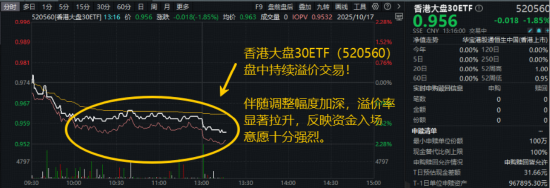
香港大盘30ETF(520560)紧密跟踪恒生中国(香港上市)30指数,该指数持仓30只成份股,自带哑铃 策略,融合高弹性科技+高股息红利标的!集中互联网、金融、电子、消费等行业龙头,均为港股通高 流通性大盘股,前十大重仓股合计权重超74%,集中度高,资金容纳能力较强,大额交易冲击成本较 低。 值得注意的是,自10月13日上市以来,近4个交易日,香港大盘30ETF(520560)资金面呈现出坚定的 连续加仓态势,累计净买入超1800万元,净流率达2.7%! 10月17日,港股大市维持震荡表现,自带"哑铃策略"的香港大盘30ETF(520560)随市调整,截至发稿 场内价格跌1.85%,但盘中持续呈现溢价交易状态!分时图可见伴随调整幅度加深,溢价率显著拉升, 一度突破0.4%,反映资金入场意愿十分强烈。 成份股方面,农业银行、建设银行等高股息红利标的呈涨势,中芯国际、阿里巴巴-W和小米集团-W则 表现相对较弱。 国信证券指出,恒生中国30指数近期表现分化,估值小幅回调。必选消费行业如食品饮料和农林牧渔估 值性价比凸显,科技板块PE下挫超过1x,估值修复空间较大。 MACD金叉信号形成,这些股涨势不错! 责任编辑 ...

资金逢跌加速入场!自带哑铃策略“520560”上市三日吸金1500万!机构:科技龙头与高股息资产或迎估值修复
Xin Lang Ji Jin· 2025-10-16 05:33
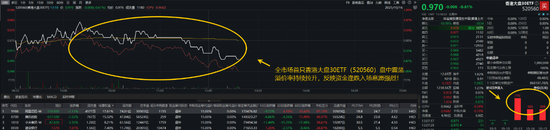
Core Viewpoint - The Hong Kong stock market showed a lackluster performance, with the Hong Kong Large Cap 30 ETF (520560) experiencing a slight decline after an initial rise, indicating a clear intention from investors to buy on dips [1][2]. Group 1: ETF Performance - The Hong Kong Large Cap 30 ETF (520560) has seen a net inflow of over 15 million yuan in the past three trading days since its listing on October 13 [2]. - The ETF recorded a slight drop of 0.6% with a trading volume exceeding 10 million and a premium rate of 0.39% [1][2]. Group 2: Sector Analysis - The top ten holdings in the ETF showed mixed performance, with stable results from high-dividend financial stocks like China Construction Bank and Industrial and Commercial Bank of China, while tech giants like Alibaba and Tencent underperformed [2]. - The technology sector in Hong Kong is benefiting from the AI technology cycle, with hardware demand high and software applications in the early stages of empowerment [2]. - E-commerce, local living services, and advertising are performing well due to policy support, while the gaming industry is seeing strong new product performance [2]. Group 3: Index Composition - The Hong Kong Large Cap 30 ETF closely tracks the Hang Seng China (Hong Kong-listed) 30 Index, which consists of 30 constituent stocks and employs a barbell strategy combining high-growth tech and high-dividend stocks [2]. - The top ten holdings account for over 74% of the index, indicating a high concentration and strong capacity to absorb large trades with low transaction costs [2][3]. - The total market capitalization of the index is approximately 320,825 million yuan [3].
美股的第三轮AI叙事挑战
SINOLINK SECURITIES· 2025-10-15 15:36
Group 1 - The core viewpoint of the report highlights that the third round of AI narrative in the US stock market is facing challenges due to excessive speculation and a shift in focus from companies to debt, raising market sensitivity to negative news [1][5][3] - The report indicates that despite concerns, the US stock market still has strong fundamental support, with economic resilience and a shift in fiscal policy from contraction to expansion, which is expected to boost private sector demand [2][8][23] - The report emphasizes that the current core risk is the emergence of a third round of AI bubble, characterized by a new model of "AI + debt," which could lead to broader market impacts beyond just stock market bubbles [3][55][57] Group 2 - The report notes that the AI narrative has gone through two previous adjustments, with the latest risk being the reliance on external financing rather than operating cash flow, which could amplify debt risks across multiple markets [3][55][57] - It is mentioned that the technology sector's earnings per share (EPS) is expected to grow significantly, but the true impact of AI on productivity remains difficult to measure, complicating the identification of genuine growth drivers [79][3][90] - The report discusses the wealth effect from high-income individuals supporting retail earnings, with a notable increase in retail sector profits and revenues, indicating a positive outlook for consumer spending [33][41][14] Group 3 - The report highlights that the US stock market's valuation indicators are at historical highs, yet the high productivity expectations and ample cash flow from major companies provide some support against traditional valuation metrics [42][49][57] - It points out that the current trading crowding in the US stock market is high in the short term but low in the long term, suggesting that any market pullback could attract new investments [49][51] - The report suggests that the "dumbbell strategy" of balancing investments between AI and gold has become a mainstream choice to hedge against uncertainties in a stagflation environment [90][3][5]


沪指强势重回3900点,下阶段市场怎么走?| 华宝3A日报(2025.10.15)
Xin Lang Ji Jin· 2025-10-15 09:28
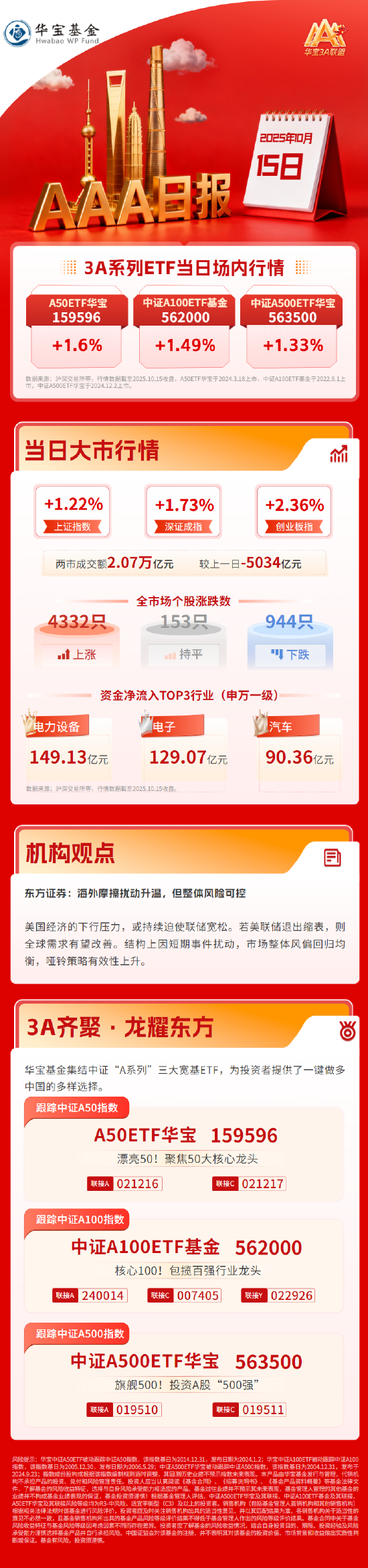
Group 1 - The overall market performance showed a positive trend with major indices like the ChiNext Index, Shanghai Composite Index, and Shenzhen Component Index increasing by 2.36%, 1.73%, and 1.22% respectively [1] - The total trading volume in the two markets reached 2.07 trillion yuan, which is a decrease of 503.4 billion yuan compared to the previous day [1] - The number of stocks that rose in the market was 4,332, while 944 stocks declined, indicating a strong bullish sentiment [1] Group 2 - The top three sectors with net capital inflow were in the electric power equipment industry, with inflows of 149.13 billion yuan, 129.07 billion yuan, and 90.36 billion yuan respectively [2] - The report from Dongfang Securities highlighted that while external friction is increasing, the overall risk remains controllable, suggesting a potential for improved global demand if the Federal Reserve continues its accommodative policies [2] - The "A Series" ETFs from Huabao Fund provide investors with diversified options to invest in China's market, tracking major indices such as the A50, A100, and A500 [2]
就市论市丨高位资产调整红利股活跃 市场“换挡”信号显现?
Sou Hu Cai Jing· 2025-10-15 04:14
来源:第一财经 东方证券投顾汪啸骅认为,海外摩擦扰动升温,但整体风险可控。美国经济下行压力,或持续迫使联储 宽松。若美联储退出缩表,则全球需求有望改善。结构上因短期事件扰动,市场整体风偏回归均衡,哑 铃策略有效性上升。进攻端关注相对低位的医药、软件、新能源、互联网等板块,寻求轮动补涨。防守 端侧重红利、大金融、基建、电力等低位板块的长线分红潜力。 (本文来自第一财经) ...
关税扰动再起,历史有何借鉴?:——可转债周报20251014-20251014
Huachuang Securities· 2025-10-14 12:49
1. Report Industry Investment Rating No relevant content provided. 2. Core Viewpoints of the Report - Since October, Sino - US trade friction has intensified. The market performance in April can be used as a reference. The equity market has strong support from market - stabilizing funds, and the convertible bond market has different performances in terms of valuation, rating, and industry [1][5]. - In the future, although there are significant macro - fluctuations, the expectation of market - stabilizing forces remains strong. A rapid adjustment may provide trading opportunities. A dumbbell strategy can be adopted for medium - rated convertible bonds, and sectors with "counter - cyclical" adjustment functions and the semiconductor self - controllable direction are worthy of attention [5]. 3. Summary According to the Table of Contents 3.1 Tariff Disturbance Resurfaces: What Can We Learn from History? - In October, Sino - US trade friction has intensified. On October 13, the equity market showed a slight decline, and the convertible bond market had a more obvious decline in valuation. The net redemption of convertible bond ETFs continued. Structurally, medium - and low - rated convertible bonds and export - oriented industries had more significant callbacks, while sectors such as banks and non - ferrous metals rose against the market [9]. - The market performance from April to June can be used as a reference. During the period of market - stabilizing funds, the valuation of convertible bonds was relatively stable, and medium - rated and export - oriented sectors had relatively large callbacks. After the panic, leveraged funds still had high expectations for the future, but the convertible bond market faced pressure from institutional position - reducing [17][25][30]. 3.2 Market Review: Convertible Bonds Slightly Declined Weekly, and Valuation Slightly Compressed 3.2.1 Weekly Market Quotes - Last week, major stock indices had different performances. The Shanghai Composite Index rose 0.37%, while the Shenzhen Component Index, ChiNext Index, Shanghai 50 Index, and CSI 1000 Index declined. The CSI Convertible Bond Index rose 0.03%. The convertible bond market was also differentiated, with some sectors rising and others falling [31]. - There are 423 issued and non - expired convertible bonds, with a balance of 5909.41 billion yuan. Fueneng Convertible Bonds will be issued on October 13, with a scale of 38.02 billion yuan [31]. 3.2.2 Valuation Performance - The weighted average closing price of convertible bonds rose 0.04%. The closing prices of different types of convertible bonds all increased. The proportion of convertible bonds in the 120 - 130 yuan range increased significantly. The median price rose 0.12%. The convertible bond market's 100 - yuan par - value fitted conversion premium rate decreased by 0.05 pct. High - rated and large - scale convertible bonds had more significant premium rate compression [39]. 3.3 Terms and Supply: Luokai and Enjie Convertible Bonds Announced Early Redemption, with a Total Pending Issuance Scale of Approximately 8 Billion 3.3.1 Terms - As of October 10, Luokai and Enjie Convertible Bonds announced early redemption; Mengsheng and Hengbang Convertible Bonds are expected to meet the early redemption conditions. No convertible bonds announced not to redeem early [2][60]. - Last week, no convertible bonds proposed downward revisions in the board of directors. Huitong Convertible Bonds announced the downward revision result; 2 convertible bonds announced not to revise downward; 6 convertible bonds are expected to trigger downward revisions [2]. 3.3.2 Primary Market - No convertible bonds were issued last week. Fueneng Convertible Bonds will be issued this week, with a scale of 38.02 billion yuan [3]. - No new board of directors' proposals were added last week. Five new companies passed the general meeting of shareholders. As of October 10, 2 companies obtained the issuance approval, with a proposed issuance scale of 26.77 billion yuan, and 8 companies passed the issuance review committee, with a total scale of 53.05 billion yuan. The total pending issuance scale is approximately 8 billion yuan [3][66][76].
ETF总规模再创历史新高
Shen Zhen Shang Bao· 2025-10-11 05:31
Core Insights - The popularity of index-based investment continues to rise, with significant growth in ETF shares and scale in 2023, reaching a historical high of nearly 5.63 trillion yuan [1][2] Group 1: ETF Market Overview - As of the end of Q3 2023, the number of ETFs in China reached 1,325, with total shares exceeding 28.5 billion, marking a quarter-on-quarter increase of nearly 11% and a year-on-year increase of nearly 28% [1] - The total scale of ETFs approached 5.63 trillion yuan, reflecting a quarter-on-quarter increase of 30.7% and a year-on-year increase of 60.5% [1] - The ETF market has expanded rapidly, with the total scale surpassing 1 trillion yuan for the first time in October 2020, and reaching 5 trillion yuan in August 2023 [1] Group 2: ETF Types and Performance - By the end of Q3 2023, the number of stock-type ETFs exceeded 1,000, reaching 1,040, with total shares surpassing 20.7 billion, a quarter-on-quarter increase of 3.57% and a year-on-year increase of 19.41% [2] - The number of bond-type ETFs grew to 53, with a scale nearing 700 billion yuan, reflecting a quarter-on-quarter growth of nearly 81% and a year-on-year increase of nearly 4.1 times [2] - Cross-border ETFs reached 177 in number, with a scale exceeding 890 billion yuan, showing a quarter-on-quarter growth of 57% and a year-on-year increase of 124% [2] Group 3: Leading ETF Products - ETFs tracking the CSI 300 index saw a scale increase of 211.02 billion yuan in the first three quarters of 2023, with total scale exceeding 1 trillion yuan, approaching 1.2 trillion yuan [3] - There are currently 7 ETFs with scales exceeding 100 billion yuan, with the top four linked to the CSI 300 index, including Huatai-PB CSI 300 ETF and E Fund CSI 300 ETF [3] - The leading ETF managers include Huaxia Fund, E Fund, and Huatai-PB Fund, with respective ETF scales of 903.56 billion yuan, 862.66 billion yuan, and 597.87 billion yuan [2] Group 4: Investment Strategies - The diverse nature of ETFs allows for investments in various asset classes, including commodities, bonds, and overseas markets, suggesting a multi-asset allocation strategy for investors [4] - The "barbell strategy" is recommended for risk balancing, allowing investors to position themselves on both aggressive and defensive ends to ensure profitability in varying market conditions [4]
A股四季度展望|流动性拐点预期之下的资产荒
野村东方国际证券· 2025-10-10 09:15
Core Viewpoint - The article discusses the impact of liquidity improvements on market performance, highlighting a significant rise in the CSI 300 index in the third quarter, driven by enhanced liquidity conditions [2][3]. Group 1: Market Performance - The CSI 300 index recorded a cumulative increase of 18.7% in the third quarter, outperforming emerging markets which rose by 10.9% [2]. - Despite a lackluster performance in the first half of the year, the market has shown resilience due to rapid liquidity improvements [2]. Group 2: Liquidity Outlook - The expectation of continued liquidity support is anticipated to drive stock market performance in the fourth quarter, with potential benefits from a loosening monetary policy by the Federal Reserve [3]. - There is a consensus in the market regarding the weakness of the fundamentals, but optimism regarding potential policy support may offset these concerns [3]. Group 3: Earnings Forecast - The company maintains its earnings growth forecast for the CSI 300 index at 2.8% and 6.7% for 2025 and 2026, respectively, amid increasing pressure on bank profitability [4]. - Revenue growth is projected at 4.5% and 5.3% for the same periods, reflecting a cautious outlook on macroeconomic growth [5]. Group 4: Investment Strategy - The article suggests an investment strategy focusing on sectors with confirmed growth potential, advocating for a shift from dividend stocks to technology growth sectors [6]. - Key themes for investment include "aesthetic overseas" through new consumption trends and high-end intelligent manufacturing, with a focus on industries such as electronics, appliances, automotive, and military [6].

红利资产跌出机会?
老徐抓AI趋势· 2025-10-09 06:11
Core Viewpoint - The recent market rotation has raised concerns about the effectiveness of dividend strategies, but it may also present a new opportunity for investment in high-dividend assets [1]. Group 1: Institutional Preference for Dividend Assets - Dividend assets are being re-evaluated for their strategic value due to global liquidity easing and structural transformation [1]. - Insurance funds are increasingly investing in high-dividend assets to counteract the pressure of declining market interest rates and to address maturity mismatch risks [1]. - The maximum guaranteed interest rate for ordinary insurance products has dropped to 2%, making a 4% dividend return from long-term equity investments essential for meeting expected returns [1]. Group 2: Evolution of Public Fund Dividend Strategies - Public funds are evolving from simple high-dividend selection to a multi-factor comprehensive strategy, emphasizing both willingness and capability while considering corporate governance and operational quality [2]. Group 3: Hong Kong Dividend Assets as Institutional Favorites - Hong Kong dividend assets have become a priority for institutions, with the Hang Seng High Dividend Yield Index rising 21% year-to-date, outperforming the CSI Dividend Total Return Index by 18% [3]. - The Hang Seng High Dividend Index offers a dividend yield of 6.27%, significantly higher than the 4.66% yield of the CSI Dividend Index, even after accounting for a 20% dividend tax [4]. - There is a notable valuation gap, with leading companies in Hong Kong's financial and energy sectors trading at 20%-30% lower valuations compared to their A-share counterparts, providing a safety margin [7]. - Hong Kong's offshore characteristics and high foreign capital ratio make it a key beneficiary of foreign capital inflows during the Federal Reserve's rate-cutting cycle [9]. Group 4: Recent Decline in Dividend Assets - The recent decline in dividend assets can be attributed to market style rotation, with funds shifting towards growth sectors like semiconductors and AI since July [10]. - Fundamental disruptions, such as coal price fluctuations and concerns over bank net interest margins, have also impacted short-term performance [10]. - Changes in the overseas macro environment, including rising U.S. Treasury yields, have reduced the relative attractiveness of dividend yields [10]. - Structural changes in the funding landscape have increased volatility, with some funds choosing to take profits during the concentrated dividend payout period [10]. - Emotional and currency factors have amplified the volatility of dividend assets, with uncertainties around the National Day holiday prompting cautious behavior among investors [11]. Group 5: Long-term Value of Dividend Assets - Despite short-term pressures, the core logic supporting the long-term value of dividend assets remains intact, with stable cash flow assets offering 4%-6% returns being scarce [12]. - The current adjustment period presents a more favorable entry point for high-quality dividend assets [12]. Group 6: Investment Strategies - Investors are encouraged to focus on the high cost-performance advantage of Hong Kong dividend assets compared to A-shares, with several public funds offering yields above 6% and lower volatility [13]. - The "barbell strategy" is recommended to balance portfolios, combining dividend assets for stable income with high-growth sectors for potential higher returns [14]. - Specific public funds, such as the Wan Jia CSI Dividend ETF and Tianhong CSI Low Volatility 100 Fund, are highlighted for their focus on dividend strategies [14]. Group 7: Conclusion - The recent decline in dividend assets is primarily a result of market sentiment and fund rotation, rather than a fundamental breakdown of their defensive value [15]. - The current market environment offers a rare opportunity for long-term investors to accumulate dividend assets at lower prices, emphasizing the importance of maintaining a balanced investment approach [15].