
扩内需政策

Search documents
7月份居民消费价格指数环比上涨0.4%
Xin Hua She· 2025-08-10 00:27
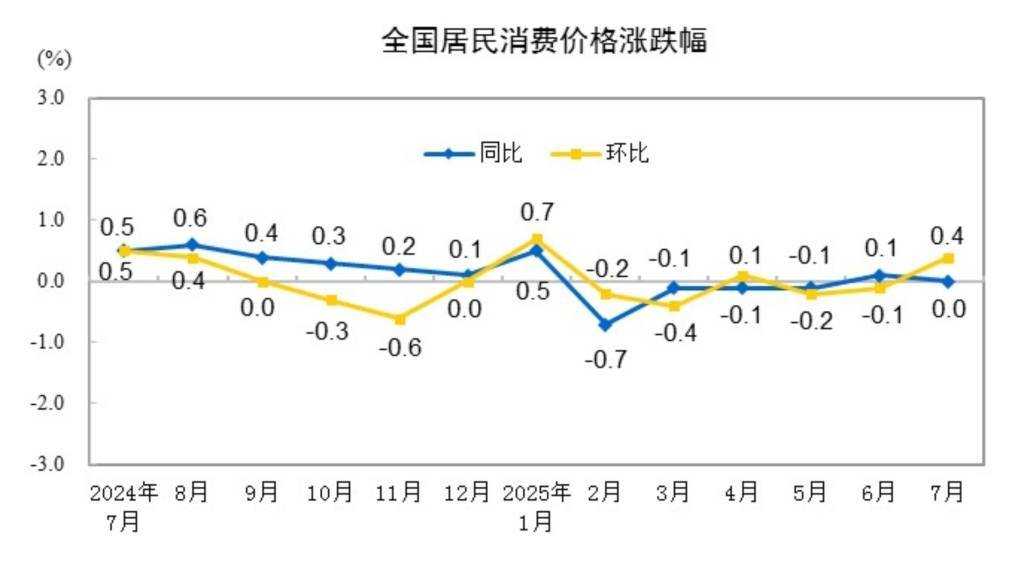
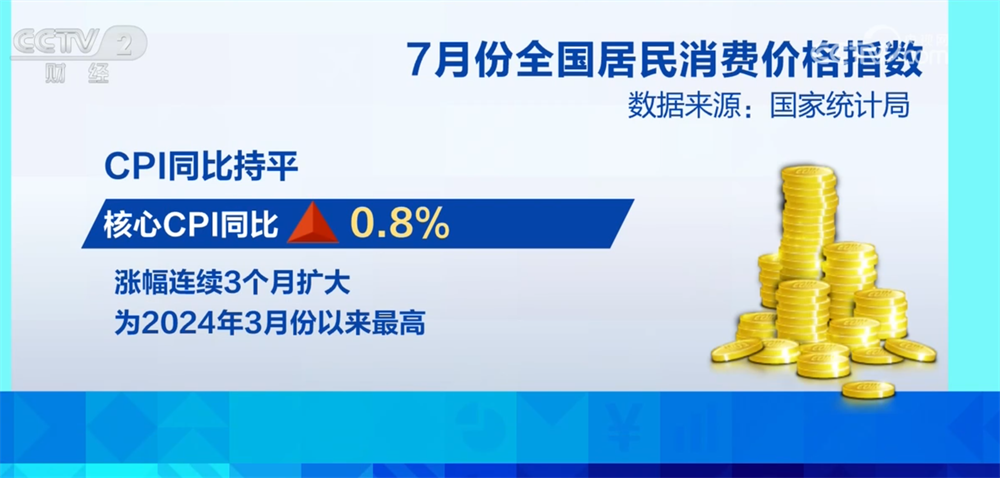
Group 1 - The core viewpoint of the article highlights that in July, the effects of policies to expand domestic demand are becoming evident, with the Consumer Price Index (CPI) remaining flat year-on-year and increasing by 0.4% month-on-month after a previous decline of 0.1% [1] - The core CPI, excluding food and energy prices, rose by 0.8% year-on-year, marking an expansion in growth for three consecutive months [1] - Food prices decreased by 1.6% year-on-year, while non-food prices increased by 0.3% [1] Group 2 - The average CPI from January to July showed a decline of 0.1% compared to the same period last year [1] - The analysis indicates that the flat year-on-year CPI is primarily influenced by lower food prices, particularly fresh vegetable prices, which fell by 7.6% year-on-year, with a significant increase in the rate of decline [1] - Service prices increased by 0.6% month-on-month, contributing approximately 0.26 percentage points to the CPI increase, accounting for over 60% of the total rise [1]
7月份全国CPI同比持平 环比上涨0.4%
Shan Xi Ri Bao· 2025-08-09 23:50
Core Insights - The consumer price index (CPI) in China remained flat year-on-year in July, with a month-on-month increase of 0.4%, reversing a previous decline of 0.1% [1] - The core CPI, excluding food and energy prices, rose by 0.8% year-on-year, marking an expansion in growth for three consecutive months [1] Price Trends - Food prices decreased by 1.6% year-on-year, while non-food prices increased by 0.3% [1] - Consumer goods prices fell by 0.4% year-on-year, whereas service prices rose by 0.5% [1] - The average CPI from January to July showed a decline of 0.1% compared to the same period last year [1] Influencing Factors - The flat year-on-year CPI was primarily influenced by lower food prices, particularly fresh vegetables, which saw a 7.6% decrease, expanding the decline by 7.2 percentage points compared to the previous month [1] - Fresh fruit prices increased by 2.8% year-on-year, but the growth rate fell by 3.3 percentage points from the previous month [1] - The month-on-month increase in CPI was driven mainly by rising service prices, which increased by 0.6%, contributing approximately 0.26 percentage points to the CPI increase [1] - Industrial consumer goods prices rose by 0.5% month-on-month, with an increase of 0.4 percentage points compared to the previous month, contributing about 0.17 percentage points to the CPI rise [1]
7月CPI与PPI:环比有变化,“反内卷”成政策重点
Sou Hu Cai Jing· 2025-08-09 23:46
Group 1 - The core viewpoint of the article highlights the multidimensional changes in consumer and industrial prices in July, indicating the effects of policies aimed at expanding domestic demand [1] - The Consumer Price Index (CPI) showed a month-on-month increase of 0.4% in July, reversing a previous decline of 0.1%, while the year-on-year change remained flat [1] - The core CPI rose by 0.8% year-on-year, marking the highest increase since March 2024, with significant contributions from service and industrial consumer goods prices [1] Group 2 - The Producer Price Index (PPI) decreased by 0.2% month-on-month, but the decline was narrowed by 0.2 percentage points, the first contraction since March, with a year-on-year decrease of 3.6% [1] - Seasonal factors and uncertainties in international trade have led to price declines in certain industries, particularly in non-metallic mineral products and computer communication sectors [1] - The article suggests that the narrowing of the PPI decline reflects positive changes due to effective policies and industry structure optimization, with a focus on reshaping supply and demand in the short term [1]
7月CPI:环比涨0.4%同比持平,促消费支撑物价
Sou Hu Cai Jing· 2025-08-09 22:25
Core Insights - The July Consumer Price Index (CPI) shows a month-on-month increase of 0.4%, reversing a previous decline of 0.1%, while year-on-year CPI remains flat [1] - The core CPI, excluding food and energy, rose by 0.8% year-on-year, marking the highest increase since March 2024 [1] - The increase in CPI is attributed to the effects of domestic demand expansion policies, with notable price rises in services and industrial consumer goods [1] Group 1: CPI Trends - The month-on-month CPI increase of 0.4% is 0.1 percentage points higher than seasonal levels, driven by rising prices in the consumption sector [1] - Service prices increased by 0.6% month-on-month, contributing approximately 0.26 percentage points to the overall CPI increase [1] - Industrial consumer goods prices, excluding energy, rose by 0.2%, while energy prices increased by 1.6% month-on-month [1] Group 2: Consumer Behavior and Policy Impact - The demand recovery is supported by consumption promotion policies, particularly in the automotive and home appliance sectors [1] - The prices of fuel and new energy vehicles stabilized, while household appliance prices saw month-on-month increases ranging from 0.5% to 2.2% [1] - The "trade-in for new" policy is expected to further support consumer goods prices and mitigate price wars in the automotive sector [1] Group 3: Gold and Jewelry Market - The prices of gold and platinum jewelry increased significantly, with year-on-year rises of 37.1% and 27.3%, respectively, contributing approximately 0.22 percentage points to the year-on-year CPI [1] - The automotive price decline is at its smallest in nearly 34 and 28 months, indicating a stabilization in the market [1] Group 4: Future Outlook - Continued implementation of consumption promotion measures is anticipated to bolster demand and support price stability [1] - The proactive macroeconomic policies are expected to accelerate domestic demand recovery, countering deflationary pressures and leading to a slight rebound in prices [1]
7月CPI环比上涨0.4% PPI环比降幅收窄
Ren Min Ri Bao· 2025-08-09 21:44
Group 1 - The core viewpoint of the articles indicates that the effects of domestic demand expansion policies are becoming evident, with the Consumer Price Index (CPI) showing a month-on-month increase of 0.4% in July, reversing a previous decline of 0.1% [1] - The core CPI, excluding food and energy prices, has increased by 0.8% year-on-year, marking the highest growth since March 2024, and the growth rate has expanded for three consecutive months [1] - The Producer Price Index (PPI) has decreased by 0.2% month-on-month in July, with a year-on-year decline of 3.6%, indicating a narrowing of the month-on-month decline by 0.2 percentage points [1] Group 2 - The CPI year-on-year remained flat, primarily due to lower food prices, which decreased by 1.6% year-on-year, influenced by a high price base from the previous year [2] - Non-food prices have increased by 0.3% year-on-year, with the growth rate expanding by 0.2 percentage points compared to the previous month [2]
通胀数据点评:大宗涨价推不动7月PPI?
Tianfeng Securities· 2025-08-09 14:24
1. Report Industry Investment Rating No information provided in the given content. 2. Core Views of the Report - The inflation data in July showed that CPI was weakly recovering, while PPI was oscillating at the bottom. The positive changes in price operation were mainly due to the continuous manifestation of the effects of policies to expand domestic demand. In the future, prices may continue to rise moderately at a low level [1][2][3]. - In the short - term, the bond market may maintain a pattern of "oscillation + recovery". The overall stable macro - policy, fundamental logic, loose orientation of monetary policy, and reasonable and sufficient liquidity still support the bond market, but attention should be paid to the possible disturbances of changes in the stock and commodity markets to the bond market sentiment [3]. 3. Summary by Relevant Catalogs 3.1 7 - month Inflation Data: CPI Weakly Recovering, PPI Oscillating at the Bottom - In July, CPI was flat year - on - year (previous value was 0.1%), with a month - on - month increase of 0.4% (previous value was - 0.1%); PPI was - 3.6% year - on - year (unchanged from the previous value), and - 0.2% month - on - month (with the decline narrowing by 0.2 percentage points compared to the previous value) [1]. - The data in July confirmed "inflation at the bottom and structural differentiation". On one hand, policies to expand domestic demand promoted the recovery of service consumption and industrial consumer goods prices, and the increase in core CPI confirmed the marginal repair of internal driving force. On the other hand, seasonal factors and uncertainties in the international trade environment affected the price decline of some industries, and PPI was still oscillating at the bottom year - on - year [2]. - The rise in bulk prices in July deviated from the weak PPI. The reasons were that the price increase in the upstream could not be effectively transmitted to the downstream, and the insufficient terminal demand weakened the price transmission power. If there was no obvious repair of demand, the pulling effect of upstream price increases on PPI would be limited [3]. 3.2 CPI: Month - on - Month Change from Decline to Increase, Core CPI Reached a New High in the Year - In July, CPI was flat year - on - year, and the month - on - month change turned from decline to an increase of 0.4%, stronger than the seasonal level, mainly supported by service and industrial consumer goods prices. Core CPI increased by 0.8% year - on - year, with the increase expanding for three consecutive months, reaching a new high since March 2024 [9]. - Service prices increased by 0.6% month - on - month, contributing about 0.26 percentage points to the month - on - month increase of CPI. Affected by the peak summer travel season, prices of air tickets, tourism, hotel accommodation, and vehicle rental increased by 17.9%, 9.1%, 6.9%, and 4.4% respectively month - on - month [10]. - Industrial consumer goods prices increased by 0.5% month - on - month, with the increase expanding by 0.4 percentage points compared to the previous month, contributing about 0.17 percentage points to the month - on - month increase of CPI. Energy prices increased by 1.6% month - on - month, and industrial consumer goods prices excluding energy increased by 0.2% [11]. - Core CPI increased by 0.8% year - on - year, reaching a high point since March 2024, mainly due to the increase in the prices of gold and platinum jewelry. The year - on - year decline in automobile prices converged. Food prices decreased year - on - year, becoming the main drag on CPI [11]. 3.3 PPI: Month - on - Month Decline Narrowed, Year - on - Year Continued to Bottom - In July, PPI was - 3.6% year - on - year, remaining the same as the previous month, showing signs of bottoming out, indicating weak demand in the industrial sector. The month - on - month decline was 0.2%, with the decline narrowing by 0.2 percentage points compared to the previous month, the first narrowing of the month - on - month decline since March [18]. - The drag on the month - on - month PPI was mainly affected by seasonal disturbances and trade uncertainties. Eight industries in total affected the month - on - month decline of PPI by about 0.24 percentage points. Seasonal factors affected the PPI of some industries, and uncertainties in the international trade environment put pressure on the prices of export - related industries [19][20]. - Positive factors were that the effects of capacity governance and "anti - involution" policies were gradually emerging, and the month - on - month decline in the prices of coal, steel, photovoltaic, and lithium batteries narrowed, weakening the downward pull on PPI [20].
分析|扩内需政策效应持续显现,7月核心CPI同比涨幅回升至0.8%
Sou Hu Cai Jing· 2025-08-09 09:57
Group 1: Consumer Price Index (CPI) Insights - In July, the national Consumer Price Index (CPI) remained flat year-on-year and increased by 0.4% month-on-month, with an average decline of 0.1% from January to July compared to the previous year [1] - The decline in food prices significantly impacted the CPI, with food prices dropping by 1.6% year-on-year, contributing approximately 0.29 percentage points to the CPI's year-on-year decline [5][6] - The core CPI, excluding food and energy prices, rose by 0.8% year-on-year, marking the highest level since March 2024, indicating a gradual improvement in market supply and demand relationships [6][10] Group 2: Producer Price Index (PPI) Insights - In July, the Producer Price Index (PPI) decreased by 0.2% month-on-month, with the decline narrowing for the first time since March, while the year-on-year decline remained at 3.6% [8][9] - The PPI's year-on-year decline has ended a four-month trend of increasing declines, with some industries showing price recovery due to improved supply-demand relationships [9][12] - The "anti-involution" policy is expected to support a rebound in industrial product prices, particularly in August, although overall PPI month-on-month growth is anticipated to be around 0.0% [12][13] Group 3: Economic Policies and Market Trends - The ongoing effects of demand expansion policies are leading to positive changes in consumer prices, with service prices rising by 0.6% month-on-month, contributing significantly to the CPI increase [6][10] - The "anti-involution" policy is projected to reshape industry supply-demand structures, particularly in overcapacity sectors, potentially leading to a more reasonable price recovery [13] - The overall economic environment remains uncertain, with external trade conditions and domestic demand pressures influencing price trends [11][12]

从7月份CPI和PPI看全国消费市场亮点 扩内需政策效应持续显现
Yang Shi Wang· 2025-08-09 06:33
Group 1: Consumer Price Index (CPI) Insights - In July, the Consumer Price Index (CPI) increased by 0.4% month-on-month, reversing a previous decline, while year-on-year it remained flat [2][6] - The core CPI, excluding food and energy prices, rose by 0.8% year-on-year, marking the highest increase since March 2024 and continuing a trend of expansion for three consecutive months [2][6] - The rise in CPI was primarily driven by increases in service and industrial consumer goods prices, with notable price hikes in airfares, tourism, hotel accommodations, and vehicle rentals [2][4] Group 2: Producer Price Index (PPI) Insights - The Producer Price Index (PPI) decreased by 0.2% month-on-month, with the decline narrowing by 0.2 percentage points compared to the previous month, while year-on-year it fell by 3.6% [6][8] - The construction of a unified national market is improving market competition in industries such as coal, steel, photovoltaic, cement, and lithium batteries, leading to positive price changes in these sectors [6][8] Group 3: Agricultural Products Price Trends - In July, the wholesale price of pork increased by 1.3% month-on-month, influenced by tight supply due to low market release from farmers, although prices later stabilized as supply improved [8][10] - The average wholesale price of pork in Beijing was reported at 18.16 yuan per kilogram, reflecting a month-on-month increase of 4.37% but a year-on-year decrease of 20.18% [12] - The wholesale price of eggs decreased by 1.8% month-on-month and 25% year-on-year, attributed to increased supply and weak demand, although prices are expected to rise due to seasonal demand factors [15][17]
7月份CPI环比上涨0.4%同比持平 消费领域价格继续呈现积极变化
Yang Shi Wang· 2025-08-09 05:08
7月份,CPI同比持平,主要受食品价格较低影响,其中鲜菜价格同比降幅比上月有所扩大,鲜果价格同比涨幅比上月回落,是带 动CPI同比由涨转平的主要原因。扣除食品和能源价格的核心CPI同比上涨0.8%,涨幅继续比上月扩大0.1个百分点,为2024年3月以来 最高。 从服务价格看,7月份,服务价格环比由上月持平转为上涨0.6%,占CPI总涨幅六成多。受暑期出游旺季影响,飞机票、旅游和宾 馆住宿价格环比分别上涨17.9%、9.1%和6.9%,涨幅均高于季节性水平。 央视网消息:国家统计局8月9日发布数据显示,7月份,随着扩内需政策效应持续显现,我国消费领域价格继续呈现积极变化。 居民消费价格指数CPI环比由上月下降转为上涨,同比持平。 7月份,居民消费价格指数(CPI)环比由上月下降转为上涨0.4%,涨幅高于季节性水平0.1个百分点,消费领域价格继续呈现积 极变化。 从消费品价格看,7月份,工业消费品价格环比上涨0.5%,涨幅比上月扩大0.4个百分点。提振消费政策带动需求持续回暖,燃油 小汽车和新能源小汽车环比价格由连续5个月以上的下降转为持平。 专家表示,以旧换新等促消费政策效应持续显现,新能源汽车、家电等重点商品 ...

重要数据发布!环比上涨0.4%
Zhong Guo Zheng Quan Bao· 2025-08-09 04:53
Group 1 - The core viewpoint is that the effects of domestic demand expansion policies are becoming increasingly evident, with the Consumer Price Index (CPI) showing a month-on-month increase of 0.4% in July, reversing a previous decline of 0.1% [1][2] - The core CPI, excluding food and energy prices, rose by 0.8% year-on-year in July, marking the highest increase since March 2024, and the growth rate has expanded for three consecutive months [5][6] - The increase in CPI is primarily driven by rising prices in the service sector and industrial consumer goods, with service prices up 0.6% month-on-month, contributing approximately 0.26 percentage points to the CPI increase [4][5] Group 2 - The Producer Price Index (PPI) decreased by 0.2% month-on-month in July, but the decline has narrowed by 0.2 percentage points compared to the previous month, marking the first contraction in the rate of decline since March [6][8] - Seasonal factors and uncertainties in the international trade environment have led to price declines in certain industries, while domestic market competition continues to improve, resulting in a reduced downward impact on PPI [8][9] - Year-on-year, the PPI fell by 3.6% in July, with the decline remaining consistent with the previous month, indicating some improvement in supply-demand relationships in certain sectors due to ongoing macroeconomic policies [8][9]
