
新能源消纳

Search documents
新能源ETF领涨,机构建议把握行业拐点性机会丨ETF基金日报
2 1 Shi Ji Jing Ji Bao Dao· 2025-11-12 02:53
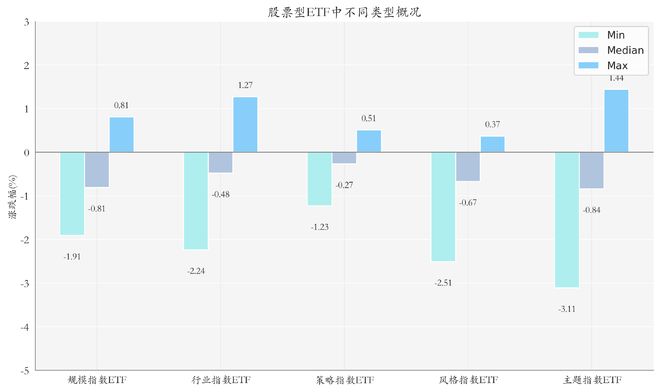
Market Overview - The Shanghai Composite Index fell by 0.39% to 4002.76 points, with a high of 4024.94 points during the day [1] - The Shenzhen Component Index decreased by 1.03% to 13289.0 points, reaching a peak of 13493.17 points [1] - The ChiNext Index dropped by 1.4% to 3134.32 points, with a maximum of 3209.89 points [1] ETF Market Performance - The median return of stock ETFs was -0.75% [2] - The highest performing scale index ETF was the Yinhua CSI 2000 Enhanced Strategy ETF with a return of 0.81% [2] - The top industry index ETF was the Penghua National Grain Industry ETF, yielding 1.27% [2] - The highest return among thematic index ETFs was the Penghua SSE Sci-Tech Innovation Board New Energy ETF at 1.44% [2] ETF Performance Rankings - The top three ETFs by return were: - Penghua SSE Sci-Tech Innovation Board New Energy ETF: 1.44% [4] - Huatai-PB SSE Sci-Tech Innovation Board New Materials ETF: 1.44% [4] - Penghua National Grain Industry ETF: 1.27% [4] - The largest declines were seen in: - Guotai CSI All Share Communication Equipment ETF: -3.11% [5] - Guotai ChiNext Artificial Intelligence ETF: -2.93% [5] - Fortune ChiNext Artificial Intelligence ETF: -2.88% [5] ETF Fund Flows - The top three ETFs by fund inflow were: - Guotai CSI All Share Securities Company ETF: 564 million yuan [6] - E Fund CSI 300 Non-Bank Financial ETF: 439 million yuan [6] - Guotai CSI All Share Communication Equipment ETF: 399 million yuan [6] - The largest outflows were from: - Huaxia SSE 50 ETF: 278 million yuan [7] - Fortune CSI Tourism Theme ETF: 221 million yuan [7] - Penghua CSI National Defense ETF: 214 million yuan [7] ETF Margin Trading Overview - The highest margin buy amounts were: - Huaxia SSE Sci-Tech Innovation Board 50 Component ETF: 508 million yuan [8] - E Fund ChiNext ETF: 427 million yuan [8] - Guotai CSI All Share Securities Company ETF: 424 million yuan [8] - The largest margin sell amounts were: - Huaxia CSI 1000 ETF: 33.26 million yuan [9] - Southbound CSI 500 ETF: 18.57 million yuan [9] - Huatai-PB CSI 300 ETF: 17.97 million yuan [9] Institutional Insights - Wanlian Securities suggests focusing on investment opportunities driven by the growth of new energy storage downstream demand and project profitability [10] - The firm highlights the importance of grid upgrades and the core role of new energy storage in the consumption of renewable energy [10] - Galaxy Securities notes that the gradual completion of new energy policies presents pivotal opportunities, recommending attention to the reliability and flexibility of power systems [11]

万联晨会-20251112
Wanlian Securities· 2025-11-12 01:03
Core Insights - The A-share market experienced a decline on Tuesday, with the Shanghai Composite Index falling by 0.39% to 4002.76 points, the Shenzhen Component Index down by 1.03%, and the ChiNext Index down by 1.40% [2][8] - The total trading volume in the A-share market reached 2.01 trillion RMB, with over 2700 stocks rising [2][8] - In the Shenwan industry classification, the retail and real estate sectors led the gains, while the communication and electronics sectors lagged [2][8] - The U.S. stock market showed mixed results, with the Dow Jones up by 1.18% and the Nasdaq down by 0.25% [2][8] Important News - The People's Bank of China reported a reasonable growth in financial totals, with the social financing scale stock and M2 money supply growing by 8.7% and 8.4% year-on-year, respectively [3][9] - The U.S. announced a suspension of export control rules from November 10, 2025, to November 9, 2026, affecting companies on the U.S. export control "entity list" [3][9] A-Share Market Performance - The overall net profit of A-share companies in Q3 2025 showed a year-on-year growth of 6%, an increase of 5.0 percentage points compared to the same period in 2024 [10][12] - The revenue of all A-share companies in Q3 2025 increased by 1% year-on-year, marking a shift from negative to positive growth [10][12] - The small-cap stocks demonstrated strong performance, with the ChiNext Index and Northbound A-shares showing revenue growth exceeding 10% [11][12] Sector Analysis - In the automotive sector, the fund's heavy positions decreased, transitioning from overweight to underweight, with total market value dropping by 15.41% quarter-on-quarter [14][15] - The mechanical equipment sector maintained a low allocation level, with total market value increasing by 38.94% quarter-on-quarter [22][23] - The electric power equipment sector saw a significant increase in fund holdings, with total market value rising by 58.76% quarter-on-quarter [25][26] Investment Recommendations - The report suggests focusing on the technology growth sector, particularly in AI and related industries, as they continue to show high growth potential [13][29] - In the automotive sector, it is recommended to pay attention to companies with strong brand and market advantages, especially those expanding into overseas markets [17][29] - For the electric power equipment sector, the report highlights the importance of grid upgrades and new energy storage solutions as key investment opportunities [32][29]
银河证券:建议关注可靠性、灵活性价值逐步兑现的火电,以及拥有风光抽蓄成长性加持的水电
Zheng Quan Shi Bao Wang· 2025-11-12 00:44
Core Viewpoint - The National Development and Reform Commission and the National Energy Administration released guidelines to promote the consumption and regulation of renewable energy, aiming to meet the annual demand for the reasonable consumption of over 200 million kilowatts of new energy, supporting the carbon peak target [1] Group 1: Policy Developments - The guidelines are part of a series of policies that have been gradually implemented since the issuance of Document No. 136, which stabilized electricity price expectations for renewable energy [1] - The acceleration of national subsidies and the recent issuance of consumption guidelines indicate a comprehensive policy framework for the renewable energy sector [1] Group 2: Industry Implications - With ongoing policy support, the current issues related to electricity prices, subsidies, and consumption in the renewable energy sector are expected to ease [1] - The large-scale and high-proportion development of renewable energy will necessitate improvements in the overall adjustment capacity of the power system [1] - There is a recommendation to focus on thermal power, which is expected to realize value in reliability and flexibility, as well as hydropower that benefits from wind and solar energy storage growth [1]

财信证券晨会纪要-20251112
Caixin Securities· 2025-11-11 23:31
Market Strategy - The market is experiencing a volume contraction and continued weakness in the technology sector [5][7] - The overall A-share index fell by 0.51%, with the Shanghai Composite Index down 0.39% and the ChiNext Index down 1.40% [7][8] - Small-cap stocks outperformed, while mid-cap stocks lagged behind [8] Industry Dynamics - The Jiangsu Provincial Development and Reform Commission announced a bidding notice for mechanism electricity prices for new energy projects from June 1, 2025, to December 31, 2026, with a total scale of 13 billion kWh [24][25] - The Chinese foldable smartphone market saw a significant recovery in Q3 2025, with shipments reaching 2.63 million units, a year-on-year increase of 17.8% [26][27] - Huawei leads the foldable smartphone market with nearly 70% market share, followed by Honor and vivo [28] Company Updates - Zoomlion (000157.SZ) has led the publication of two national standards in the concrete machinery industry, filling a gap in technical parameter testing [29][30] - Chengde Lululemon (000848.SZ) completed a share buyback of 2.98% of its shares, which will be canceled, enhancing investor confidence [32][33] - Fangsheng Pharmaceutical (603998.SH) received a drug registration certificate for Indobufen tablets, expanding its cardiovascular drug portfolio [34]
A股市场大势研判:大盘震荡调整,三大指数高开低走
Dongguan Securities· 2025-11-11 23:31
Market Overview - The market experienced fluctuations with the three major indices opening high but closing lower, indicating a bearish trend [1][4][6] - The Shanghai Composite Index closed at 4002.76, down 0.39%, while the Shenzhen Component Index fell by 1.03% to 13289.01 [2] Sector Performance - The top-performing sectors included retail trade (1.43%), real estate (0.81%), and steel (0.62%), while the weakest sectors were telecommunications (-2.20%) and electronics (-1.74%) [3][4] - Concept sectors such as cultivated diamonds (6.08%) and perovskite batteries (2.98%) showed strong performance, whereas the China AI 50 index (-1.76%) lagged [3][4] Future Outlook - The market is expected to maintain a volatile adjustment phase, with a shift in focus from technology growth to cyclical value stocks [6] - The government is promoting private investment in low-altitude economy infrastructure and supporting the issuance of real estate investment trusts in the infrastructure sector [5] - The new energy vehicle market saw retail sales of 1.282 million units in October, reflecting a year-on-year growth of 7.3% [5]
新能源消纳调控迎指导意见 产业加速从“建得好”迈向“用得巧”
Zheng Quan Ri Bao· 2025-11-11 16:08
Core Insights - The "Guiding Opinions" issued by the National Development and Reform Commission and the National Energy Administration aim to establish a multi-level, efficient renewable energy consumption and regulation system by 2030, ensuring smooth grid connection and diverse utilization of renewable energy [1][2] - The policy framework emphasizes energy transition as the main line, supported by measures such as energy storage, new power systems, and ultra-high voltage construction, addressing the current challenges in renewable energy consumption [1][2] - The new policy is expected to shift the renewable energy industry from rapid growth to more refined development, particularly impacting the wind and solar sectors [2][3] Industry and Company Impacts - The establishment of a multi-layered renewable energy consumption system will provide clearer pathways for technological innovation and market expansion within the renewable energy industry [2] - Companies like Longi Green Energy and JA Solar are already adapting to the new policy by exploring integrated solutions such as electric-hydrogen collaboration and energy storage to enhance renewable energy consumption [3] - The policy encourages the development of distributed solar power stations, particularly in industrial parks and export-oriented enterprises, which will be key markets for project profitability [2][3] Future Goals and Market Opportunities - By 2035, the goal is to have a new power system that can accommodate a high proportion of renewable energy, with a unified national electricity market playing a foundational role in resource allocation [4] - The policy highlights the need to enhance cross-provincial and cross-regional transmission capabilities, which will create growth opportunities in ultra-high voltage equipment, smart substations, and flexible direct current transmission [4] - The downstream electricity sales market is expected to drive service upgrades and promote the development of the entire electricity sales industry chain, improving overall industry efficiency [4]


新能源消纳明确底线:每年新增至少2亿千瓦,算力、储能成破局点
2 1 Shi Ji Jing Ji Bao Dao· 2025-11-11 13:01
Core Viewpoint - The "Guiding Opinions" issued by the National Development and Reform Commission and the National Energy Administration aim to promote the high-quality development of renewable energy in China, establishing a clear implementation path for achieving at least 200 million kilowatts of new renewable energy consumption capacity annually [1][2]. Group 1: Renewable Energy Development - The document emphasizes the need for a multi-layered renewable energy consumption regulation system to meet the annual demand for at least 200 million kilowatts of new renewable energy by 2030 [2][3]. - The current installed capacity of wind and solar energy in China exceeds 1.7 billion kilowatts, indicating that an average of 180 to 200 million kilowatts of new capacity will need to be added annually from 2026 to 2035 to meet future targets [2][3]. Group 2: Energy Consumption and Regulation - The "Guiding Opinions" categorize renewable energy development and consumption into five types, focusing on optimizing the integration of various energy sources and enhancing local consumption capabilities [2][3]. - The document highlights the importance of establishing a pricing mechanism for coal power, pumped storage, and new energy storage to support the flexible adjustment of energy resources [3][4]. Group 3: Storage Technology and Innovation - The installed capacity of new energy storage in China has surpassed 100 million kilowatts, with a significant increase in the share of renewable energy generation [4][5]. - The "Guiding Opinions" encourage the innovation of various storage technologies, including liquid flow batteries and compressed air storage, to meet the demand for large-capacity and long-duration energy storage [6][7]. Group 4: Market Opportunities and Collaboration - The document outlines new market opportunities by promoting the synergy between renewable energy and computing power facilities, which are expected to have a direct impact on the computing industry [5][6]. - Companies are advised to consider regional renewable energy layouts when planning computing projects, prioritizing areas with stable green electricity availability [5][6].
两部门联合发文再分配新能源消纳责任,利好这些板块
Di Yi Cai Jing· 2025-11-11 11:16
Core Viewpoint - The recent issuance of the "Guiding Opinions on Promoting New Energy Consumption and Regulation" by the National Development and Reform Commission and the National Energy Administration is expected to benefit sectors such as energy storage, electrical equipment, photovoltaics, and offshore wind power, leading to a strong market response in related stocks. Group 1: Policy Implications - The "Opinions" propose differentiated strategies for the development and consumption of new energy resources based on their geographical distribution, aiming to align energy development with regional needs [1] - The document emphasizes the importance of local consumption of renewable energy, particularly in regions with high energy demand, such as the eastern coastal areas, while also promoting the conversion of green energy into hydrogen and ammonia [1] - The new pricing mechanisms aim to enhance the transmission of market price signals to end users, optimizing resource allocation and encouraging self-regulation among users [2] Group 2: Industry Trends - The new energy storage capacity in China has seen significant growth, with cumulative installed capacity exceeding 100 GW by the third quarter of this year, representing a more than 30-fold increase compared to the end of the 13th Five-Year Plan [2] - Future trends in distributed energy storage include diversification of application scenarios, support for high-energy-consuming industries in carbon reduction, and acceleration of participation in electricity market models [3] - The integration of various energy sources, including conventional hydropower, pumped storage, and new energy storage, is highlighted as a key pathway for enhancing the adaptability of the new power system to renewable energy [2]


科技赛道延续承压调整
Tebon Securities· 2025-11-11 11:12
Market Analysis - The A-share market is experiencing a mild adjustment with a decrease in trading volume, indicating a continuation of pressure on the technology sector [2][6] - The Shanghai Composite Index closed at 4002.76 points, down 0.39%, while the ChiNext Index fell 1.40% to 3134.32 points, reflecting a divergence in market preferences for "policy certainty" and "high growth elasticity" [6][5] - The photovoltaic equipment sector showed strong performance, driven by favorable policies and technological breakthroughs, while major technology stocks faced declines [6][5] Sector Performance - The photovoltaic equipment sector saw significant gains, with companies like Zhonglai Co. and Xiexin Integration hitting the daily limit, supported by new energy consumption policies [6][5] - The technology sector, including server and consumer electronics indices, experienced declines of 2.45% and 2.11% respectively, attributed to profit-taking after previous gains [6][5] - The report suggests that if there are new catalysts in semiconductor domestic substitution or AI applications, there may be opportunities for rebounds in the technology sector [7] Bond Market Insights - The bond market is characterized by narrow fluctuations with a continued loose funding environment, as evidenced by the central bank's reverse repo operations [11][8] - The 30-year main contract closed at 116.30, while the 10-year contract slightly decreased to 108.475, indicating stable but cautious market conditions [11][8] - The report maintains a cautiously optimistic view on the bond market, emphasizing the need to monitor changes in U.S. Treasury yields [11][8] Commodity Market Overview - The commodity market displayed a mixed performance, with the South China commodity index slightly down by 0.06%, while precious metals continued to show strength [10][8] - Precious metals like gold and silver saw price increases of 3.20% and 2.67% respectively, driven by expectations of U.S. Federal Reserve easing and safe-haven demand [10][8] - The report notes a significant drop in coking coal prices, attributed to weak demand, as steel production has declined to levels comparable to the previous year [10][8] Investment Strategy Recommendations - The report suggests a balanced allocation strategy focusing on dividend stocks, micro-cap stocks, and technology sectors, with a long-term positive outlook on technology [12][7] - In the bond market, a continued loose funding environment is expected, with attention to domestic policies and the potential impact of further U.S. rate cuts [12][7] - For commodities, the report recommends accumulating positions in precious metals, particularly as the Fed's easing policies become more pronounced [12][10]
瑞达期货锰硅硅铁产业日报-20251111
Rui Da Qi Huo· 2025-11-11 10:53
1. Report Industry Investment Rating - Not provided in the content 2. Core Viewpoints of the Report - On November 11, the manganese - silicon 2601 contract was reported at 5764, down 0.41%, and the Inner Mongolia silicon - manganese spot was reported at 5600. With a surge in low - price "bank direct - supply houses", some properties were sold at a price 25% lower than the market price. Fundamentally, inventory rebounded rapidly, production continued to decline slightly from a high level, and inventory rose for 6 consecutive weeks. On the cost side, the port inventory of imported manganese ore increased by 83,000 tons, and on the demand side, hot metal declined seasonally. The Inner Mongolia spot profit was - 190 yuan/ton, and the Ningxia spot profit was - 280 yuan/ton. The mainstream steel tender price in October was 5820 yuan/ton, a month - on - month decrease of 180 yuan/ton. Technically, the daily K - line was below the 20 - day and 60 - day moving averages, and the market was expected to move in a volatile manner [2]. - On November 11, the ferrosilicon 2601 contract was reported at 5488, down 1.05%, and the Ningxia ferrosilicon spot was reported at 5270. Trump stated that if the Supreme Court ruled against the imposition of comprehensive tariffs, the US would face an "economic disaster". In terms of supply and demand, demand declined, and inventory rebounded significantly this period. The Inner Mongolia spot profit was - 390 yuan/ton, and the Ningxia spot profit was - 580 yuan/ton. Technically, the daily K - line was below the 20 - day and 60 - day moving averages, and the market was expected to move in a volatile manner [2]. 3. Summary by Relevant Catalogs 3.1 Futures Market - SM (manganese - silicon) main contract closing price was 5764 yuan/ton, down 56 yuan; SF (ferrosilicon) main contract closing price was 5488 yuan/ton, down 100 yuan [2]. - SM futures contract holdings were 580,581 hands, up 11,630 hands; SF futures contract holdings were 358,909 hands, up 8355 hands [2]. - Manganese - silicon's top 20 net positions were - 49,221 hands, up 7970 hands; ferrosilicon's top 20 net positions were - 30,065 hands, up 6367 hands [2]. - SM 5 - 1 month contract spread was 58 yuan/ton, unchanged; SF 5 - 1 month contract spread was 38 yuan/ton, down 28 yuan [2]. - SM warehouse receipts were 18,113, up 1756; SF warehouse receipts were 7302, up 105 [2]. 3.2 Spot Market - Inner Mongolia, Guizhou, and Yunnan manganese - silicon FeMn68Si18 prices were 5600 yuan/ton, 5600 yuan/ton, and 5580 yuan/ton respectively, all unchanged [2]. - Inner Mongolia, Qinghai, and Ningxia ferrosilicon FeSi75 - B prices were 5300 yuan/ton, 5200 yuan/ton, and 5270 yuan/ton respectively, all unchanged [2]. - Manganese - silicon index average was 5595 yuan/ton, down 51 yuan; SF main contract basis was - 218 yuan/ton, up 100 yuan; SM main contract basis was - 164 yuan/ton, up 56 yuan [2]. 3.3 Upstream Situation - South African ore: Mn38 block at Tianjin Port was 32 yuan/ton - degree, unchanged; silica (98% in the northwest) was 210 yuan/ton, unchanged [2]. - Inner Mongolia Wuhai secondary metallurgical coke was 1250 yuan/ton, unchanged; semi - coke (medium material in Shenmu) was 880 yuan/ton, unchanged [2]. - Manganese ore port inventory was 4.397 million tons, up 83,000 tons [2]. 3.4 Industry Situation - Manganese - silicon enterprise operating rate was 40.24%, down 2.75 percentage points; ferrosilicon enterprise operating rate was 36.26%, up 0.18 percentage points [2]. - Manganese - silicon supply was 201,880 tons, down 5845 tons; ferrosilicon supply was 114,100 tons, up 900 tons [2]. - Manganese - silicon manufacturers' inventory was 319,500 tons, up 5000 tons; ferrosilicon manufacturers' inventory was 78,690 tons, up 6700 tons [2]. - Manganese - silicon national steel mill inventory was 15.7 days, down 0.23 days; ferrosilicon national steel mill inventory was 15.67 days, up 0.15 days [2]. 3.5 Downstream Situation - Five major steel types' manganese - silicon demand was 121,113 tons, down 3379 tons; five major steel types' ferrosilicon demand was 19,813.7 tons, down 461.6 tons [2]. - 247 steel mills' blast furnace operating rate was 83.15%, up 1.42 percentage points; 247 steel mills' blast furnace capacity utilization rate was 87.79%, down 0.80 percentage points [2]. - Crude steel output was 73.4901 million tons, down 3.8784 million tons [2]. 3.6 Industry News - Deputy Premier Liu Guozhong will visit Guinea and Sierra Leone from November 10 - 16 and attend the commissioning ceremony of the Simandou Iron Ore Project on November 11 [2]. - There is a surge in low - price "bank direct - supply houses", with some properties sold 25% below the market price. Banks are accelerating property disposal to improve debt recovery rates [2]. - The National Development and Reform Commission and the National Energy Administration issued a guidance on promoting new energy consumption and regulation. By 2030, new electricity demand will be mainly met by new new - energy power generation [2]. - The National Development and Reform Commission held a video conference on energy supply during the 2025 - 2026 heating season, requiring stable energy production and supply [2].