
贸易战

Search documents
欧元上涨空间可能有限 欧洲央行降息押注下降
Jin Tou Wang· 2025-05-14 07:51
周三(5月14日)欧洲时段,欧元/美元小幅上涨至接近1.1200,在美国4月通胀数据低于预期后,美元 保持防御姿态。欧元兑美元上涨,荷兰国际集团分析师Francesco Pesole在一份研报中称,这是因为周二 美国公布了低于预期的通胀数据,不过,欧元兑美元进一步上涨的空间可能有限。 美国4月通胀数据低于预期,导致美元(USD)兑欧元(EUR)走弱。交易员等待德国4月harmonized Index of Consumer Prices(HICP)数据以获得新的动力,该数据定于周三晚些时候公布。 根据美国劳工统计局周二发布的数据,衡量美国通货膨胀的消费者价格指数(CPI)在4月同比下降 2.3%,低于市场预期的2.4%和3月份的2.4%,创下自2021年2月以来的最低水平。核心CPI(排除波动较 大的食品和能源价格)4月同比上涨2.8%,与前值和预期持平。美国CPI报告出炉后,美元立即走软。 经过两天在瑞士日内瓦的谈判,美国和中国同意相互降低关税。美国将对中国进口商品的关税从145% 降至30%,中国将美国进口商品的关税从125%降至10%。市场对世界上两个最大经济体之间可能达成关 税协议以缓和贸易战的乐观情 ...
“不要被特朗普唬住,中国打了个样”
Guan Cha Zhe Wang· 2025-05-14 03:25
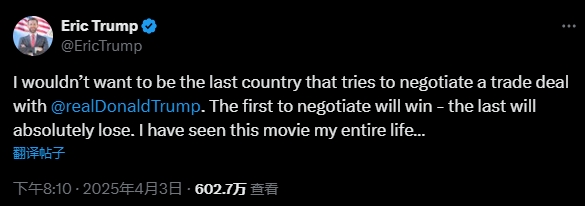
推文截图 文章称,世界上大多数国家接受了这一建议,但此后却发现,与一名似乎不懂贸易运作方式的总统达成 全球贸易协议非常困难。各国外交官们沮丧万分,因为他们根本无法确定特朗普到底想从他们那里得到 什么,更不用说他准备提供什么回报了。迄今为止,只有英国通过让步与美国达成协议。 相反的是,中国采取了对美反制措施,对美国进口产品征收高额关税,并实施对美稀土出口限制。 观察者网消息,"不要被特朗普的虚张声势唬住,中国给全世界打了个样。" 5月12日,美国《大西洋月刊》以此为题刊文称,美国总统特朗普向全球高举关税大棒,同时发出严厉 警告:"不得报复,必有回报"。然而中国无视了这一警告,最终却得到了回报。同日早些时候,中美在 经贸高层会谈后同意在90天内降低关税,将税率下调115%。 "今天上午,特朗普基本暂停了贸易战,得到的只是中方持续谈判的承诺,"《大西洋月刊》专刊作者乔 纳森·柴特写道,"受到特朗普威胁的每个人,无论是国家、企业还是大学,都可以从中国那里学到一 课。" 4月2日,特朗普宣布所谓"解放日"关税政策,对全世界征收高额"对等关税"。 文章称,特朗普公布关税政策的同时,还上演了一场独特的"霸权主义戏剧"。特朗 ...

安粮期货商品期货投资早参-20250514
An Liang Qi Huo· 2025-05-14 03:11
1、现货市场:日照嘉吉一级豆油 8130 元/吨,较上一交易日涨 50 元/吨。 2、国际大豆:当前时间窗口下,正处美豆播种、省长与南美豆收割、出口季,目前巴西豆 收割基本完成。总体来看,南美新作丰产格局或将大概率成为事实。美国农业部 5 月 US DA 报告显示,2025/26 年度大豆单产预估为 52.5 蒲式耳/英亩,2024/25 年度预估为 50.7 蒲式 耳/英亩。 3、国内产业层面:综合供需端,豆油中期去库周期或逐渐进入尾声阶段,关注后市南美进 口大豆到港、海关检验放行后,豆油库存或低位反弹。 4、参考观点:豆油 2509 合约,短线或区间震荡整理。 现货信息:43 豆粕各地区现货报价:张家港 2990 元/吨(-20)、天津 3080 元/吨(0)、 日照 3010 元/吨(-20)、东莞 3050 元/吨(-10)。 市场分析:(1)宏观面: 中美经贸会谈将在瑞士进行,关注会谈内容。 (2)国际大豆:USDA5 月报告发布,美豆产量下调,全球库存增加。市场交易重心转移至 北美播种季,巴西大豆进入出口高峰期。 (3)国内豆粕供需面:大豆供给逐渐恢复,油厂开机率提升,豆粕供给预期由紧转为宽松。 ...
PTA市场遭遇三方合围
Zhong Guo Hua Gong Bao· 2025-05-14 02:12
Core Viewpoint - The PTA industry is facing significant challenges due to ongoing trade wars and policy uncertainties, leading to a drop in prices to near four-year lows. The high cost of raw material PX is expected to erode profits, and the overcapacity in the industry, combined with weak downstream demand, suggests that PTA prices may remain low for the foreseeable future [1]. Group 1: Market Supply and Capacity - China's PTA industry has seen significant capacity expansion, becoming the world's largest PTA producer with a total capacity of 86.2 million tons as of March [2]. - The rapid rise of private enterprises in the PTA sector has intensified industry transformation, leading to a more integrated competitive landscape where major suppliers have established a "PX-PTA-Polyester" supply chain [2]. - Despite the gradual increase in domestic PTA demand due to downstream polyester projects, the growth rate of PTA capacity is outpacing that of polyester, resulting in a buyer-dominated market [2]. Group 2: Raw Material Prices - The PX market has experienced a slowdown in capacity expansion after a rapid release phase, with domestic PX capacity expected to remain at 43.48 million tons in 2024, with no new projects planned for that year [3]. - The supply of PX is expected to remain tight, making it difficult for prices to decrease, which will further squeeze the profit margins of downstream products like PTA [4]. Group 3: Demand Challenges - The polyester industry, a key downstream consumer of PTA, holds 70% of the global market share, but the growth rate of new polyester capacity is slowing, leading to an oversupply crisis [5]. - The uncertainty in the international trade environment has negatively impacted overseas orders, particularly affecting exports to the U.S. and Europe, which is significant for the home textile industry [5]. - Many weaving enterprises are currently facing a dilemma of "high costs and low demand," leading some small and medium-sized companies to implement production cuts to maintain prices [5][6].
中美经贸高层会谈在日内瓦举行—— 积极成果为世界经济注入正能量
Jing Ji Ri Bao· 2025-05-13 21:49
贝森特在5月12日的媒体发布会上表示,此次会谈的一项重要共识就是美国与中国的经贸合作空间巨 大,且美国不想与中国"脱钩",未来希望通过对华经贸合作,更好地解决自身贸易逆差高企、精密制造 业空心化等迫切问题。贝森特的有关表态显示,在中美经贸关系问题上,美此前寄希望通过畸高关税施 压讹诈,迫使中方让步的单边主义、霸权主义阴谋已破产,若美方希望更好参与中国市场,只能通过平 等对话争取互利共赢。此次会谈中,美方展现了从对中方极限施压到谋求合作的积极态度转变,有利于 推动中美经贸合作重回正轨。 当今世界,各国经济相互依赖性强,各国的生产者和消费者通过供应链紧密相连。中美之间的贸易战, 无论是以畸高关税还是友岸外包的形式发生,都会对全球供应链布局产生巨大冲击。4月中旬,联合国 贸发会议在其报告《2025年贸易和发展展望——压力之下:不确定性重塑全球经济前景》中称,近期有 关国家采取的关税举措,正在扰乱全球供应链,并破坏其可预测性,贸易政策的不确定性处于历史高 位,导致了投资的推迟以及就业的减少。 此次中美经贸高层会谈再次明确了美国不寻求对中国"脱钩"的立场,使其他国家尤其是广大发展中国 家,得以更好遵从市场规律,加强自身 ...
Why Shopify Stock Is Up Today
The Motley Fool· 2025-05-13 18:01
Core Viewpoint - The reduction of the "de minimis" tariff on low-value imports from China is seen as a positive development for small online businesses and companies like Shopify that support them [1][4]. Group 1: Tariff Changes - The "de minimis" tariff on goods valued at $800 or less has been eliminated, which previously exempted these goods from tariffs [3]. - President Trump announced a reduction of the tariff on "de minimis" goods from 120% to 54%, with exemptions in place for 90 days as negotiations continue [4]. Group 2: Impact on Shopify - Although Shopify itself is not directly affected by the tariff changes, many of its small business customers could face increased costs due to the new tariff rates [3][5]. - The potential for higher costs for Shopify's customers could have a near-term impact on the company's earnings if the tariffs remain in place [5]. Group 3: Long-term Outlook - For long-term investors, the current tariff situation is not a reason to avoid investing in Shopify, as the company is well-positioned to navigate the challenges posed by trade tensions [6].


加拿大想发“美难财”,使劲向中国说好话,中方直接把话挑明
Sou Hu Cai Jing· 2025-05-13 14:52
Group 1 - China has not imported US LNG for nearly two and a half months since imposing a 15% retaliatory tariff in February, with imports dropping from 65,700 tons in February to zero in March compared to 412,500 tons last year [1][3] - The Chinese government is diversifying its natural gas supply channels and is not solely reliant on the US, focusing on increasing domestic production and utilizing cheaper alternatives such as coal and renewable energy [3][5] - The trade tensions have led to Canada imposing high tariffs on Chinese electric vehicles and steel products, prompting China to retaliate with tariffs on Canadian agricultural products [5][6] Group 2 - There is a call from various sectors in Canada for a pragmatic cooperation with China, suggesting a need to reassess past policies towards China to improve bilateral relations [7] - The Chinese ambassador to Canada emphasized the strong complementary nature of economic relations between China and Canada, particularly in the energy sector [6][7]
大越期货原油早报-20250513
Da Yue Qi Huo· 2025-05-13 14:47
Report Industry Investment Rating No relevant information provided. Core Viewpoints - The agreement between the US and China to significantly reduce high tariffs for at least 90 days has temporarily eased the trade war, but the fundamental differences remain, and it will take years to reshape the trade relationship. The short - term market has been strongly boosted, but the oil price has fallen from its high due to supply - side pressure and long - term tariff negotiation issues. In the short term, it is difficult for crude oil to break through without more news stimuli. The short - term range of crude oil is 478 - 486, and long - term investors should partially take profit on long positions [3][5]. Summary by Directory 1. Daily Tips - **Crude Oil 2506**: The fundamentals are neutral as the US - China trade agreement eases the situation, but Iraq plans to cut exports. The basis is bullish with spot premiums over futures. Inventory data is bullish as API, EIA, and Cushing inventories all decreased, and Shanghai crude oil futures inventory also declined. The 20 - day moving average is flat with the price below it, showing a neutral signal. WTI and Brent's main positions are long, but with different trends (WTI long positions increasing, Brent long positions decreasing), also neutral. The short - term range is 478 - 486, and long - term investors should partially take profit on long positions [3]. - **Futures and Spot Market**: In the futures market, the settlement prices of Brent, WTI, SC, and Oman crude oil all increased, with increases of 1.05 (1.64%), 0.93 (1.52%), 5.90 (1.26%), and 1.15 (1.78%) respectively. In the spot market, the prices of various crude oils also rose, with the UK Brent Dtd increasing by 1.54 (2.41%), WTI by 0.93 (1.52%), Oman crude by 1.82 (2.92%), etc. [7][9] 2. Recent News - **Trade Agreement**: The US and China reached an agreement to significantly reduce high tariffs for at least 90 days, temporarily easing the trade war. However, the fundamental differences remain, and it will take years to reshape the trade relationship. The Fed officials believe that the agreement can reduce the impact of the trade war, but the remaining tariffs are still high and will have a stagflation effect on the economy [5]. - **Mexico's Oil Export**: Pemex plans to reduce its crude oil exports this year as more crude will be sent to local refineries, especially the new Olmeca refinery. Once fully operational, it can process 340,000 barrels of crude per day and will receive about 100,000 barrels per day, increasing local processing to 1.2 million barrels per day and leaving about 400,000 barrels per day for export [5]. 3. Long - Short Concerns - **Bullish Factors**: Not clearly stated in the text. - **Bearish Factors**: The optimism on the demand side remains to be verified, and OPEC+ may increase production ahead of schedule. The market is driven by the resonance of damaged demand due to US policies and potential rapid supply - side production increases. There are also risks such as the breakdown of OPEC+ internal unity and the escalation of war risks. Additionally, the US threatens to sanction Iran, and Venezuelan crude is also at risk of sanctions, while there are signs of some easing in the trade war [6]. 4. Fundamental Data - **API Inventory**: As of May 2, the API crude oil inventory decreased by 4.494 million barrels, more than the expected decrease of 2.48 million barrels [3][10]. - **EIA Inventory**: As of May 2, the EIA inventory decreased by 2.032 million barrels, more than the expected decrease of 833,000 barrels, and the Cushing area inventory decreased by 740,000 barrels [3][14]. - **Supply - Demand Balance Sheet**: The text presents a supply - demand balance sheet showing the supply - demand gap, OPEC+ crude oil production, and Call on OPEC+ from 2023 to 2026 - Q4 [20]. 5. Position Data - **WTI Crude Oil**: As of April 29, the net long position of WTI crude oil funds was 177,209, an increase of 6,254. As of May 6, it decreased by 1,781 to 175,428 [16]. - **Brent Crude Oil**: As of April 29, the net long position of Brent crude oil funds was 109,941, a decrease of 18,442. As of May 6, it decreased by 12,383 to 97,558 [19].
美国银行调查:贸易冲突最有可能引发信贷危机
news flash· 2025-05-13 13:41
Core Insights - A recent Bank of America survey indicates that 43% of investors believe trade conflicts are the most likely trigger for a systemic credit crisis [1] - The second most cited source of potential credit crisis is the shadow banking sector, with 25% of investors identifying it as a concern [1] - The survey was conducted prior to the announcement of tariff reductions, and the bank noted that the outcomes of US-China trade talks have "prevented economic recession or credit events" [1]

美国通胀保持稳定,市场预期后续将因关税上涨
news flash· 2025-05-13 12:45
Core Insights - US inflation remained stable in April, with economists warning that this may be the last calm period before consumer prices surge due to tariffs from the trade war initiated by Trump [1] Inflation Data - The Consumer Price Index (CPI) in February increased by 2.3% year-on-year, slightly lower than the previous month's annual increase [1] - Core CPI rose by 2.8% year-on-year, consistent with the increase observed in March [1]