消费升级

Search documents
“白领”和“蓝领”,年轻人该如何择业
Ren Min Ri Bao· 2025-08-07 23:35
Group 1 - The number of college graduates in China is expected to reach 12.22 million in 2025, marking a historical high, while the growth of "white-collar" job opportunities is slowing down or even shrinking, prompting some young people to shift towards skilled "blue-collar" jobs as a pragmatic response to reality [1] - In the first half of the year, 6.95 million new urban jobs were created, achieving 58% of the annual target, supported by various employment stabilization policies from the central to local governments [1] Group 2 - The perception of "blue-collar" jobs has evolved, showcasing new appeal as China transitions from a manufacturing giant to a manufacturing powerhouse, with a significant increase in demand for high-skilled talent in emerging industries like information communication and artificial intelligence [3] - High-skilled talent in China has surpassed 60 million, yet challenges such as insufficient total numbers and structural imbalances remain, prompting the government to enhance support for skill development through various initiatives [5] - The integration of personal development with national and societal needs is emphasized, highlighting that every job holds significance and can contribute meaningfully to society [4][5]
咖啡氤氲展现消费升级图景
Sou Hu Cai Jing· 2025-08-07 22:54
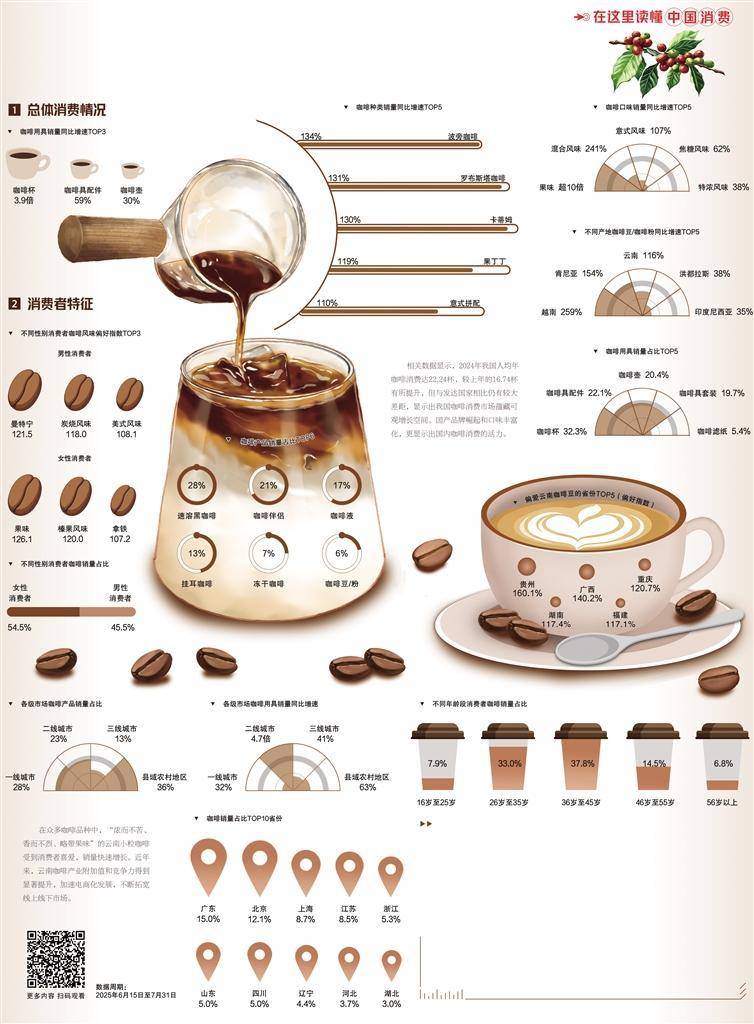
从消费选择层面看,速溶黑咖啡凭借便捷性和性价比,稳居销量榜首,成为大众首选;而以波旁咖啡为代 表的高品质咖啡,销量大幅增长,彰显精品化浪潮的强劲势头;在口味偏好方面,消费者的选择更趋多 元,果味、混合风味咖啡等口感层次丰富的品类高速增长,标志着消费者已从单一功能需求向个性化体验 满足转变,体现了消费观念的升级与进化。 值得关注的是,县域农村地区咖啡销量占比已超过一线城市,这不仅意味着咖啡消费已突破地域与层级限 制,在广袤县域市场开辟出新天地,更揭示出下沉市场蕴藏的巨大消费潜力,展现出我国消费市场的深度 与广度,为咖啡产业乃至整个消费品行业提供了广阔发展空间。 消费的纵深发展,正推动我国成为全球咖啡文化的融合交汇点。一方面,国产咖啡凭借地缘优势和不断提 升的品质强势崛起,日益赢得更多消费者的认可和喜爱;另一方面,国际资源加速涌入:海关数据显示, 2020年至2024年,我国咖啡净进口量增长13.08万吨,年均复合增长率达65.7%。本土品牌与国际品牌交融 共生,既丰富了市场供给,满足了消费者多样化需求,也为国内咖啡产业链的全方位升级与完善注入了强 大动力,推动产业向更高层次、更精细化方向发展。 从速溶咖啡的普及 ...

我国高技能人才总量突破6000万人,但仍面临总量不足、结构失衡问题 “白领”和“蓝领”,年轻人该如何择业(民生一线)
Ren Min Ri Bao· 2025-08-07 22:43
Core Viewpoint - The article highlights the increasing number of college graduates in China, reaching a record high of 12.22 million in 2025, while the demand for "white-collar" jobs is slowing down, prompting some young people to shift towards skilled "blue-collar" jobs as a pragmatic response to the current job market [1]. Group 1: Employment Trends - The number of new urban jobs created in the first half of the year reached 6.95 million, achieving 58% of the annual target [1]. - The shift towards skilled "blue-collar" jobs is seen as a practical response to the challenges faced in the job market, with a growing recognition of the value of these roles [3]. Group 2: Skills and Education - The total number of skilled workers in China has surpassed 60 million, yet there are still issues related to insufficient numbers and structural imbalances [5]. - The government is intensifying efforts to support the growth of skilled talent through various initiatives, including the promotion of vocational education and training programs [5]. Group 3: Industry Evolution - The new wave of industrialization is calling for a blend of intelligence and skills, leading to an increased demand for high-skilled talent in sectors like information communication and artificial intelligence [3]. - Emerging fields such as high-end housekeeping and customized tourism are driving innovation and upgrading in the service industry, creating new opportunities for skilled professionals [3]. Group 4: Value of Work - The distinction between "white-collar" and "blue-collar" jobs is seen as superficial; both contribute significantly to societal needs and development [4]. - The article emphasizes that the value of a job lies not in its label but in its contribution to personal growth and societal needs, advocating for a holistic view of career fulfillment [4].
“白领”和“蓝领”,年轻人该如何择业(民生一线)
Ren Min Ri Bao· 2025-08-07 22:40
2025年全国普通高校毕业生规模达1222万人,创历史新高;同时,部分行业经营承压,"白领"岗位数量 增长趋缓甚至萎缩。调整职业路径,投身技能型"蓝领"工作,成为一部分年轻人应对现实的务实之举。 未来,让"蓝领"更有吸引力,还需各方协同发力:相关部门做好前瞻规划,强化人力资源分析预测,加 大对职教和技能培训投入;院校教育要深化产教融合、校企合作;个人规划与兴趣、能力和市场需求结 合,不盲目跟风;企业完善内部培养体系,建立科学的技能人才评价与晋升机制。当国家培养与个人投 入,都能精准转化为社会所需、个人所长时,人才浪费的担忧方能消解。无论是"白领"还是"蓝领",都 能在合适的位置上发光发热。 职业价值不在"领子的颜色",而在于将"小我"融入"大我",将个人发展融入国家和时代需要。每一个岗 位、每一份工作都是有意义的,也都会熠熠生辉。 新型工业化浪潮呼唤"智""技"融合的顶尖工匠。我国正从制造大国加速迈向制造强国,信息通信、人工 智能等领域的新技术产业化应用加快,企业对高技能人才的需求显著增加。高学历人才不断加入,为传 统产业转型升级注入强劲动力。大学生詹兆君入职联想合肥生产基地,从一线操作员干起,逐渐成长为 技 ...
经济大省新亮点|零售“焕新升级”激发新需求——河南提振消费一线观察
Sou Hu Cai Jing· 2025-08-07 20:51
Group 1 - The core viewpoint of the articles highlights the emergence of "first stores" and "first launches" in Henan as a strategy to boost consumption, with a focus on creating unique shopping experiences [1][2][8] - In the first half of the year, Henan's total retail sales of consumer goods reached 1.42 trillion yuan, a year-on-year increase of 7.2%, surpassing the national average by 2.2 percentage points [1] - The government of Henan has prioritized "boosting consumption" as a key focus for 2025, emphasizing the development of first-store economies and supporting cities like Zhengzhou and Luoyang to become international consumption centers [2][8] Group 2 - The "first store" concept has attracted significant foot traffic, with a notable example being the "Red Star Forward Bakery" in Zhengzhou, which sees daily customer traffic of 1,500 [2] - Large commercial complexes like Zhengdong Vientiane City have become popular destinations, housing over 540 brands, including more than 100 first stores and nearly 50 flagship stores [2][3] - The retail landscape in Henan is shifting from price competition to quality competition, with a focus on creating comprehensive shopping experiences that integrate art, culture, and commerce [8][12] Group 3 - The development of first-store economies in Henan has effectively tapped into consumer potential, as seen in the performance of Dennis David City, which recorded a foot traffic of 13.9 million and sales exceeding 5.5 billion yuan in the first half of the year [7] - The introduction of new retail formats, such as the "IP image flagship store" by Huayu Baijia Supermarket, has successfully combined shopping with social experiences, achieving a customer flow of 17,100 and sales of 1.98 million yuan on its opening day [15] - Henan's retail sector is experiencing a transformation, with a focus on safety and quality, supported by a robust supply chain and logistics network, which is crucial for high-quality development [12][15]
经济大省新亮点丨零售“焕新升级”激发新需求——河南提振消费一线观察
Xin Hua Wang· 2025-08-07 13:46
Group 1 - The core viewpoint of the article highlights the revitalization of consumption in Henan through the promotion of "first store" economies and tailored consumption scenarios, leading to a significant increase in retail sales [1][2][4] - In the first half of the year, Henan's total retail sales reached 1.42 trillion yuan, a year-on-year increase of 7.2%, surpassing the national average by 2.2 percentage points [1] - The government of Henan has prioritized "boosting consumption" as a key focus for 2025, emphasizing the development of first-store economies and supporting cities like Zhengzhou and Luoyang to become international consumption centers [2][4] Group 2 - The emergence of first stores has attracted significant consumer traffic, with some stores reporting daily foot traffic of up to 1,500 visitors [2] - Large commercial complexes in Henan, such as Zhengdong Vientiane City, have become popular destinations for young consumers, featuring over 540 brands, including more than 100 city-first stores [2][3] - The retail landscape in Henan has shifted from price competition to quality competition, with a focus on creating comprehensive shopping experiences that integrate art, culture, and commerce [4] Group 3 - Henan is implementing a three-year action plan to optimize the consumer environment, aiming to create a safe and reliable shopping atmosphere [5] - The success of brands in Henan is attributed to their focus on safety and quality, supported by efficient logistics and digital supply chain networks [6] - The opening of flagship stores, such as the Hua Yu Bai Jia supermarket, has demonstrated strong initial performance, with first-day foot traffic reaching 17,100 and sales exceeding 1.98 million yuan [6]
零售“焕新升级”激发新需求——河南提振消费一线观察
Xin Hua She· 2025-08-07 13:13
Group 1 - The core viewpoint of the articles highlights the emergence of "first stores" and "first launches" in Henan as a strategy to boost consumption, with a reported retail sales total of 1.42 trillion yuan in the first half of the year, reflecting a year-on-year growth of 7.2%, surpassing the national average by 2.2 percentage points [1] - The government of Henan has prioritized "boosting consumption" as a key focus for 2025, actively promoting the development of first-store economies and supporting cities like Zhengzhou and Luoyang to become international consumption centers [2] - The opening of new flagship stores and brands, such as the Honey Snow Ice City headquarters and the Dong Mingzhu Health Home in Zhengzhou, indicates a strong push towards attracting younger consumers, with first stores playing a significant role in driving consumption [2] Group 2 - The retail landscape in Henan is evolving from price competition to quality competition, with a focus on creating integrated spaces that combine art, culture, and commerce, reflecting a shift in consumer demand towards service-oriented consumption [4] - The establishment of a safe and reliable consumption environment is crucial for boosting consumer confidence, with initiatives to create trustworthy stores and markets, supported by a robust supply chain network [5] - The opening of the Huayu Baijia supermarket's flagship store, which combines shopping and social interaction, achieved impressive initial results with a customer flow of 17,100 and sales exceeding 1.98 million yuan on its opening day [6]
10万娶越南新娘的“驸马爷”,靠炸鸡掘金越南
Hu Xiu· 2025-08-07 08:33
Group 1 - The article discusses the entrepreneurial journey of Mei Chuming, who transitioned from the restaurant industry in China to establishing a fried chicken brand in Vietnam, capitalizing on the local market's potential [1][3][12] - Mei's business model focuses on leveraging the low chain rate in Vietnam's restaurant industry, which stands at only 4%, compared to over 20% in China, indicating significant growth potential [9][10][11] - The Vietnamese market is experiencing a consumption upgrade, with a population exceeding 100 million and a projected GDP per capita of $4,700 in 2024, suggesting a burgeoning middle class [7][10] Group 2 - The article highlights the importance of understanding local consumer behavior and preferences, emphasizing that successful brands must align with consumer perceptions rather than solely relying on their established reputation [12][13] - Mei's strategy involves selecting proven market segments, such as fried chicken, which already has established demand in Vietnam, as evidenced by the presence of international brands like KFC and McDonald's [15] - The article outlines the dual strategies in the Vietnamese restaurant market: "mass market" targeting budget-conscious consumers and "premium" offerings for higher-income groups [18][17] Group 3 - The article notes that the current state of Vietnam's offline dining industry is comparable to China's around 2012, with online food delivery still in its early stages, similar to China's 2019 market [32][34] - Three main food delivery platforms in Vietnam are identified: Grab, ShopeeFood, and Be, each catering to different consumer segments and price points [35][36] - Marketing strategies in Vietnam heavily rely on social media platforms like Facebook, which serves as a primary channel for brand exposure and consumer engagement [39][40] Group 4 - The article discusses the challenges of hiring full-time staff in Vietnam, leading to a flexible employment model where one full-time employee is supported by six part-time workers [45] - It emphasizes the need for companies to adapt to local labor laws and cultural expectations, including maintaining good relationships with local authorities to mitigate hidden costs associated with business operations [51][52] - The article concludes with a reminder that successful entrepreneurship in Vietnam requires a deep understanding of local customs and consumer behavior, urging businesses to adapt rather than impose their practices [50]

专访路威凯腾陈悦:中国消费市场在效率、创新和模式上全球领先
2 1 Shi Ji Jing Ji Bao Dao· 2025-08-07 05:44
Core Insights - The Chinese consumer market is experiencing significant growth, driven by changing consumption patterns and the emergence of new consumption models such as trendy toys, jewelry, and pet-related products [1][3][10] - L Catterton, the largest private equity firm in the global consumer goods sector, has invested over $37 billion and completed more than 300 investments in the consumer industry, focusing on notable Chinese brands [1][10] - The investment environment in China is considered favorable, with a large middle class and increasing consumer spending potential, despite the current low percentage of consumption in GDP [10][11] Investment Trends - The younger generations, particularly those born in the 1990s and 2000s, exhibit strong consumption willingness, prioritizing emotional value over functional benefits [3][4] - Traditional consumption categories like liquor and tea are experiencing a decline, while sectors like dining and trendy products are thriving, indicating a shift in consumer preferences [4][10] - The investment strategy of L Catterton focuses on three main areas: consumer brands, consumer services, and consumer concepts, with a strong emphasis on high-quality domestic brands [8][10] Market Dynamics - Cities like Guangzhou and Chengdu are emerging as international consumption centers due to their industrial strengths and vibrant cultural scenes, respectively [6][10] - The collaboration between L Catterton and LVMH enhances the investment firm's ability to identify and support promising consumer brands through strategic resources and expertise [7][8] - The Chinese market is characterized by rapid innovation in business models, including the use of digitalization and AI in manufacturing and the growth of e-commerce and live-streaming platforms [11][12] Challenges and Opportunities - Foreign investment firms are encouraged to adopt a focused investment approach rather than a broad one, emphasizing the importance of industry expertise and value creation [12] - The potential for exit strategies is diversified, with over 50% of projects historically exiting through mergers and acquisitions, highlighting the importance of industry alignment [12]
一杯冰淇淋卖38元,曾有多名消费者投诉吃出异物,野人先生要冲刺港股?
凤凰网财经· 2025-08-07 03:31
Core Viewpoint - The article discusses the rapid expansion of the ice cream brand "野人先生" (Mr. Wildman), highlighting its growth strategy, market challenges, and consumer perceptions in the context of the Chinese ice cream market [2][11][26]. Group 1: Company Overview - 野人先生 was founded in 2011 by 崔渐为, initially starting as a small stall in Beijing, and has evolved into a significant player in the ice cream market, particularly focusing on Gelato [6][9]. - The brand transitioned from a direct sales model to a franchise model in 2023, resulting in a significant increase in the number of stores from 400 to 900 within five months [9][11]. Group 2: Market Dynamics - The Chinese ice cream market is projected to reach a size of 183.5 billion yuan by 2024, with Gelato experiencing a notable growth rate of 10%, surpassing a market size of 12 billion yuan [11]. - The gross profit margin for Gelato products is reported to be over 60%, with some products reaching up to 70% [11]. Group 3: Expansion Strategy - 野人先生's marketing strategy has shifted from a low-profile approach to aggressive online and offline promotions, significantly increasing brand visibility [9][11]. - The brand's unique selling proposition is its "freshly made" ice cream, although this claim has faced scrutiny regarding its actual production methods [13][24]. Group 4: Consumer Perception and Challenges - Consumer feedback on 野人先生's products is polarized, with some praising the quality while others criticize the pricing, labeling it as "ice cream assassin" due to its high prices [21][24]. - The brand has faced multiple complaints regarding food safety issues, raising concerns about the risks associated with its open production model [24][26]. Group 5: Competitive Landscape - The ice cream market is becoming increasingly competitive, with various brands entering the space, including established players like 光明集团 and popular tea brands expanding into ice cream [26]. - Seasonal fluctuations in ice cream consumption present a significant challenge, particularly in maintaining revenue during winter months [26].