
产品创新

Search documents
中金:首次覆盖裕元集团给予“跑赢行业”评级 目标价19.46港元
Zhi Tong Cai Jing· 2025-12-31 08:33
Core Viewpoint - CICC reports that Yue Yuen Industrial Holdings Limited (00551) is a global leader in athletic shoe manufacturing and is expanding its retail business in Greater China, with a diversified global production base. The initial coverage gives an "outperform" rating with a target price of HKD 19.46, corresponding to a P/E of 10.5x for 2026 [1]. Industry Overview - The athletic shoe industry has significant growth potential and is becoming increasingly concentrated. According to Euromonitor, the global athletic shoe market is projected to reach USD 167.7 billion in 2024, with a mid-single-digit growth rate expected over the next five years. The top 10 brands are anticipated to hold a market share of 57% by 2025, indicating a concentrated market structure [2]. - Yue Yuen is the largest athletic shoe manufacturer globally, with an estimated shipment share exceeding 10%. Its subsidiary, Pou Chen Corporation, is a leading athletic apparel retailer in Greater China. For 2024, Yue Yuen's revenue and net profit attributable to shareholders are projected to be USD 818 million and USD 39 million, respectively, with the manufacturing segment accounting for 69% of revenue and 89% of net profit [2]. Competitive Advantages - The company has strong development capabilities for mid-to-high-end footwear, allowing it to establish deep ties with major international brands such as Nike and Adidas, as well as long-term collaborations with other renowned brands like Asics and New Balance. The top five customers are estimated to account for 80-90% of the manufacturing segment's revenue [3]. - Yue Yuen is at the forefront of global capacity expansion, with a diversified layout of production bases [3]. Business Outlook - With overseas brand inventories at manageable levels and accelerated product innovation, the manufacturing segment's performance is expected to stabilize and grow. By 2026, tariff disruptions may lessen, and major brand clients, exemplified by Nike, are focusing on product innovation. This, combined with the growth of several premium brands, is expected to lead to stable revenue growth in the manufacturing segment [4]. - The company is anticipated to improve its performance due to the resolution of previous capacity ramp-up issues and uneven capacity utilization [4]. Market Differentiation - The company is expected to restart growth by actively optimizing its customer base and structure, leveraging its development capabilities and global capacity layout to ensure performance certainty. The forecasted dividend yield for 2026 is 8.2%, providing a margin of safety. Potential catalysts include the recovery of clients and orders exceeding expectations, as well as improvements in production efficiency [5]. Earnings Forecast and Valuation - The company is projected to have EPS of USD 0.23 and USD 0.24 for 2025 and 2026, respectively, with a CAGR of -0.4% from 2024 to 2026. The current stock price corresponds to a P/E of 8.6x for 2026. Based on a P/E of 10.5x for 2026, the target price is set at HKD 19.46, indicating a 23% upside from the current price, with an initial coverage rating of "outperform" [6].
爱施德:目前饮料业务处于持续产品创新和渠道扩展阶段
Zheng Quan Ri Bao Wang· 2025-12-31 07:49
Core Viewpoint - Aishide (002416) is focusing on the health beverage sector with its own brands "Chaxiaokai," "Yuexiaokai," and "Qingqipai," which have collectively reached over 300,000 offline outlets [1] Group 1: Product and Market Strategy - The company has developed four product series: sugar-free tea, traditional health water, fruit and vegetable tea, and sparkling beverages, targeting health-conscious and younger consumers [1] - The beverage business is currently in a phase of continuous product innovation and channel expansion, achieving good market performance in the ready-to-drink tea category [1] Group 2: Future Development Plans - The company plans to leverage its own channels, supply chain, and digital capabilities to continuously enhance product competitiveness and brand strength [1] - A steady advancement of business development is anticipated as the company focuses on its strategic initiatives [1]

“保障+科技”双轮驱动,富德生命人寿获评年度产品创新企业
Cai Jing Wang· 2025-12-31 07:24
Core Insights - Innovation is the core driving force for sustainable development in the life insurance industry, as highlighted by Fude Life Insurance's recognition for product innovation in the 2025 Financial Industry Annual Awards [1] Group 1: Product Innovation and Development - Fude Life Insurance has continuously enriched its product offerings in four key areas: education, wealth, health, and retirement, emphasizing comprehensive protection and innovative features [1] - The company launched 58 new products in 2025, bringing the total number of products available to 99, including annuity insurance, life insurance, health insurance, and accident insurance [2] Group 2: Risk Management and Financial Strategy - In response to the low interest rate environment, Fude Life Insurance is shifting towards a model that emphasizes asset-liability management and business structure balance, moving away from reliance on high-cost liability products [2] - The company is enhancing its ability to hedge against interest rate risks by dynamically adjusting the predetermined interest rates of its products and extending asset durations while controlling liability durations [2] Group 3: Technology Integration - Fude Life Insurance is integrating AI and big data into its actuarial processes, transitioning from traditional pricing methods to personalized pricing strategies based on customer profiles [3] - The application of AI and big data has improved operational efficiency, risk management, and service optimization across various functions, including risk pricing and claims management [3] Group 4: Market Adaptation and Customer Focus - The company is actively exploring paths for developing floating income products in response to market trends, with various channels for dividend products already launched [4] - Fude Life Insurance aims to enhance its product system in health insurance, annuity insurance, and floating income products, focusing on a comprehensive service model that meets diverse customer needs [4] Group 5: Awards and Recognition - Fude Life Insurance received multiple awards for its innovative products, including the "2025 Today's Insurance - Annual Preferred Pension Insurance Product" for its "Fude Life Changying Life Annuity Insurance (Smart Version)" [5] - The company is committed to ongoing product innovation and service upgrades to meet the diverse needs of customers in a complex market environment [5]
三重动力助推ETF规模突破6万亿元
Zheng Quan Ri Bao· 2025-12-30 16:12
Group 1 - The total number of ETFs in the market reached 1,391, with a total scale exceeding 6 trillion yuan, marking historical highs in both quantity and scale [1] - Among all ETFs, stock ETFs account for 77.71% of the total number and 63.78% of the total scale, with 1,081 stock ETFs totaling 3.85 trillion yuan [1] - Passive index ETFs have become the market mainstream, with 1,208 such ETFs representing 86.84% of the total number and 5.06 trillion yuan, which is 83.91% of the total scale [1] Group 2 - Bond and commodity ETFs showed remarkable growth, with bond ETFs increasing from 173.91 billion yuan at the end of 2024 to 804.56 billion yuan, a growth rate of 362.62% [2] - Technology-themed ETFs are highly favored, with 134 ETFs containing "technology" or "innovation" in their names, totaling 1.05 trillion yuan, which is 17.41% of the total ETF scale [2] - The rapid growth of bond ETFs and innovative products like technology bond ETFs are key drivers of market expansion, alongside the popularity of commodity and cross-border ETFs [2] Group 3 - The "Matthew Effect" is increasingly evident among fund managers, with 16 leading institutions managing ETFs exceeding 100 billion yuan, collectively accounting for 89.55% of the total ETF scale [3] - The growth of the ETF market is supported by policy guidance, product innovation, and the influx of long-term capital, with new policies creating favorable conditions for rapid development [3] - The variety of ETFs covering multiple asset classes, including broad-based, thematic, bond, cross-border, and commodity ETFs, effectively meets investors' needs for capturing structural opportunities [3]
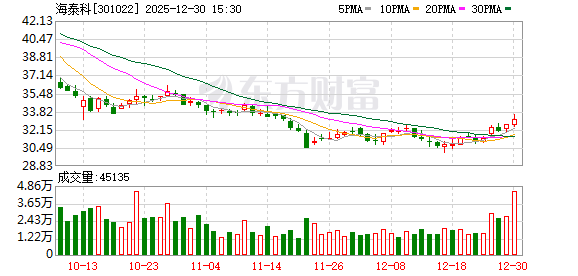
海泰科:通过在PEEK材料中创新性添加50%碳纤维等实现产品轻量化等性能
Zheng Quan Ri Bao· 2025-12-30 09:41
(文章来源:证券日报) 证券日报网讯 12月30日,海泰科在互动平台回答投资者提问时表示,公司通过在PEEK材料中创新性添 加50%碳纤维、PEEK+石墨和陶瓷纤维+碳纤维等实现产品轻量化、自润滑、耐高温等性能,可应用于 轻量化仿生骨架、自润滑关节轴承和耐高温电机外壳等关键部件。 ...

孚日股份2025年12月30日涨停分析:股东增持+业务拓展+产品创新
Xin Lang Cai Jing· 2025-12-30 03:16
Group 1 - The core point of the article is that Fuzhi Co., Ltd. (SZ002083) reached its daily limit of 12.45 yuan, with an increase of 8.75%, resulting in a total market capitalization of 11.653 billion yuan and a circulating market capitalization of 11.649 billion yuan, with a total transaction amount of 1.623 billion yuan [1] Group 2 - The reasons for the stock price surge include shareholder increases, business expansion, and product innovation. Major shareholders and their concerted actions have cumulatively increased their holdings by 0.32%-0.17%, indicating recognition of the company's long-term value. Some shareholders have committed to a 12-month lock-up period, reducing short-term selling pressure and enhancing shareholder stability, which boosts market confidence in the company [1] - The company is actively expanding its business and innovating products. The project for producing 6,127 tons of towels annually in Egypt has been approved, which will enhance its international competitiveness. The launch of new home textile products and progress in developing functional products have also been noted. Additionally, the 20,000-ton silicon-carbon anode project is in the pilot testing stage, which, while currently having a minor impact on revenue and profit, demonstrates the company's layout in the new energy materials sector [1] - In terms of industry performance, data from Tonghuashun indicates that some stocks in the textile and home textile sector performed actively on the same day, creating a certain sectoral linkage effect. Technically, the stock broke through short-term moving average resistance, and the MACD indicator showed a reduction in green bars, indicating an increase in short-term bullish momentum [1] - According to data from Dongfang Caifu, there was a significant net inflow of main funds on that day, which contributed to the stock price hitting the daily limit [1]

天有为:2026年公司将继续重视股东利益
Zheng Quan Ri Bao Wang· 2025-12-29 13:42
Group 1 - The company will continue to prioritize shareholder interests, especially those of minority shareholders, in 2026 [1] - The company plans to deepen its core business, enhance market value management, and continuously promote product innovation and overseas market expansion [1] - The goal is to improve the company's profitability [1]
2025年海外成熟ETF市场的发展历程和经验启示
Sou Hu Cai Jing· 2025-12-29 04:00
近年来,全球交易所交易基金(ETF)市场蓬勃发展,其中美国市场以其规模庞大、产品丰富、创新活跃等特点,成为全球ETF 发展的标杆。根据最新研究报告,美国ETF市场资产管理规模已突破10万亿美元,占据全球约七成份额,其发展路径和成功经 验对正处快速成长期的中国市场具有重要借鉴意义。 美国ETF市场自1993年诞生以来,历经多个阶段演进,从最初跟踪宽基指数的简单产品,逐步扩展到行业、主题、固收、商品 及另类资产等多类别,并衍生出主动管理、因子策略、杠杆反向等复杂形态。推动其持续增长的关键因素主要包括四个方面: 一是独特的实物申购赎回机制带来税收优势,有效减少资本利得分配,提升长期持有吸引力;二是低费率策略显著降低投资者 成本,指数股票基金平均综合费率已降至0.05%,远低于主动管理产品;三是养老金体系成为重要资金来源,401(k)和个人退休 账户等长期资金持续配置ETF,形成稳定且规模庞大的需求基础;四是投顾模式转型与投资者教育深化,推动ETF在资产配置中 被广泛运用,家庭持有ETF的渗透率在二十年间从1%提升至12%。 今天分享的是:2025年海外成熟ETF市场的发展历程和经验启示 报告共计:35页 然而,美国 ...
从东莞工厂到美国客厅:一棵折叠圣诞树的意外走红
创业邦· 2025-12-29 03:10
Core Viewpoint - The article highlights the success of Dongguan Lihui Trading Co., Ltd. in leveraging TikTok Shop to sell innovative products, specifically a foldable Christmas tree, which has significantly outperformed expectations in sales and market engagement [5][22]. Group 1: Company Background and Transformation - The founder of the company, Mr. Luo, transitioned from a factory worker to a business owner, starting his own factory in Dongguan in 2009 after a decade in the industry [7]. - The company faced a major challenge in 2021 when its largest client decided to self-manufacture, leading to a loss of orders and prompting a shift towards direct-to-consumer sales [7][8]. - In late 2022, the company established an international trade team and began its transformation to online sales, eventually launching the "Bringstar Store" on TikTok Shop in May 2025 [8][22]. Group 2: Product Innovation and Market Response - The foldable Christmas tree, which simplifies the traditional setup process, became the star product of the store, allowing for quick assembly and appealing visual effects [11][22]. - Initial expectations for the product were cautious, with only 5,000 units prepared for sale, but the product quickly sold out due to viral marketing by influencers [13][14]. - The product's success is attributed to its innovative design and the effective use of TikTok's platform for visual storytelling, which resonated with consumers [14][20]. Group 3: Sales Dynamics and Market Trends - The typical sales peak for seasonal products like Christmas trees occurs in November, but TikTok Shop enabled early sales, with 40% of inventory sold by September [16][20]. - The platform's content-driven approach allowed for the creation of demand ahead of the traditional sales season, effectively shifting the sales timeline [20][21]. - The company observed that TikTok Shop's model not only increased sales but also provided valuable consumer feedback, allowing for rapid product improvements [22][23]. Group 4: Future Plans and Industry Implications - The company plans to continue focusing on innovative products and utilize TikTok Shop's logistics services to enhance operational stability and customer experience [23][24]. - The success of the foldable Christmas tree serves as a model for other manufacturers in China, illustrating the potential for direct engagement with global markets through innovative platforms [24].

国家发改委:对轻工、纺织等量大面广的产业,关键在于降本扩量、提质增效
Di Yi Cai Jing· 2025-12-29 00:40
Core Viewpoint - The article emphasizes the importance of optimizing and upgrading traditional industries, particularly in the light industry and textile sectors, to enhance cost efficiency, expand production, and improve quality [1] Group 1: Industry Significance - The light industry and textile sectors are crucial for ensuring livelihoods, stimulating market prosperity, expanding exports, and creating employment opportunities due to their large scale and diverse product offerings [1] Group 2: Strategic Initiatives - During the "14th Five-Year Plan" period, there is a focus on accelerating product innovation, enriching product categories, and enhancing supply characteristics to achieve diversification, quality improvement, and brand creation [1] - Support for enterprises in equipment upgrades and technological transformation is essential, alongside the application of advanced and suitable technologies to promote digital transformation and green upgrades [1] Group 3: Quality and Standards - The implementation of key consumer goods quality enhancement actions aims to elevate mandatory product energy efficiency and safety standards, ensuring the enforcement of national standards [1] - Strengthening quality support and standard leadership is a priority to enhance the overall quality of products in the industry [1] Group 4: Brand Development - Promoting brand construction and effectively organizing events like China Brand Day is vital for increasing the recognition and influence of Chinese brands [1] Group 5: Regional Development - There is a need to improve the collaborative mechanism for the orderly transfer of industries within the country, guiding the light industry and textile sectors to shift towards the central and northeastern regions [1]