成长风格

Search documents
中欧基金蓝小康:价值投资坚守者,确定性收益中寻求投资效率最大化:基金经理研究系列报告之八十四
Shenwan Hongyuan Securities· 2025-10-28 12:21
Report Industry Investment Rating No relevant content provided. Core Views of the Report - Value style outperforms growth style and the overall market in the long - run, with better risk - return ratios [2][6]. - Value - style funds are scarce in the market, and fund managers need strong conviction and support to adhere to this style [14][16]. - Lan Xiaokang of China Europe Fund is a value - investment adherent. His China Europe Dividend Optimal has achieved excellent performance [2][17]. Summary by Directory 1. Value Style Fund Product Investment Value Overview 1.1 Value Style Performance: Better Risk - Return Ratio in the Long Run - Since 2012 (as of 2025/10/24), the Guozheng Value R has significantly outperformed the Guozheng Growth R and the Wind All - A, indicating the long - term superiority of the value style [6]. - The investment return of the value style is more stable, with a higher win - rate. From 2017 to 2025/10/24, the one - year rolling return win - rate of Guozheng Value R is 70.77%, compared to 56.50% for Guozheng Growth R [8]. - In terms of risk indicators such as yield, volatility, and maximum drawdown, the Guozheng Value R outperforms the Guozheng Growth R in different time periods, showing a better risk - return ratio [11]. 1.2 Scarcity of Value - Style Fund Products in the Market - Only 11 out of over 1700 active equity fund managers manage value - style funds that meet the defined criteria, and 4 of them are financial real - estate funds [14]. - Reasons for the scarcity include fund managers' subjective wavering, scale pressure, and inappropriate fund company assessment systems [15][16]. 2. Lan Xiaokang of China Europe Fund - A Value - Investment Adherent Seeking Maximum Investment Efficiency in Certain Returns 2.1 Background: Years of Research and Management Experience, Historical Performance Outperforming the CSI 300 - Lan Xiaokang has about 8.5 years of investment management experience, currently manages 4 funds with a total scale of 24.809 billion yuan [17]. - His fund manager index has outperformed the CSI 300, especially since 2021 [17]. 2.2 Investment Framework: Seeking Maximum Investment Efficiency under the Premise of Safety - Lan Xiaokang builds a systematic investment framework through top - down and bottom - up research, focusing on macro trends and individual stock fundamentals [19]. - He uses multiple investment strategies, including long - term, dividend, stable - return, hedging, and trend - reversal strategies, to seek differentiated excess returns [19]. 2.3 Representative Product: China Europe Dividend Optimal - Lan Xiaokang's China Europe Dividend Optimal has achieved a return of 169.82% since he took over in 2018/4/20, significantly outperforming its benchmark [20][22]. 3. Analysis of the Characteristics of China Europe Dividend Optimal 3.1 Performance: Leading in Return and Risk - Return Ratio - Since Lan Xiaokang took over, as of 2025/10/24, the cumulative return of China Europe Dividend Optimal is 169.82%, significantly outperforming the benchmark [24]. - From 2019 to 2025/10/24, the quarterly win - rate of positive returns is 74.1%. The quarterly win - rate of relative returns compared to the benchmark and Guozheng Value R is 77.8% and 74.1% respectively, with average quarterly excess returns of 3.82% and 2.58% [25]. - Since 2019, the annualized return of China Europe Dividend Optimal is 19.88%, ranking in the top 12% among similar products. The annualized volatility is 19.98%, ranking in the bottom 25%. The annualized Sharpe ratio and Calmar ratio are in the top 5% and 1.5% respectively [30]. 3.2 Industry Distribution: Timely Rotation with Good Results - The fund mainly invests in value - style sectors such as household appliances, non - bank finance, and real estate, and rotates among these sectors in a timely manner [34]. - Industry rotation operations have brought significant excess returns. For example, in 2024, the increase in bank holdings and the reduction in coal holdings contributed positive excess returns [38][42]. 3.3 Holding Characteristics: Moderate Concentration of Individual Stocks and Timely Allocation of Hong Kong Stocks - The top ten holdings of the fund account for 40% - 60%, and the top thirty holdings account for over 90%, with a moderate concentration of individual stocks [43]. - The fund has a low turnover rate, with a short - term increase in 2020 - 2021, presumably due to adjustments in response to market changes [43]. - The fund mainly focuses on large - and medium - cap stocks, and has gradually increased its allocation to Hong Kong stocks since 2023, with nearly 50% of stock positions in Hong Kong stocks as of the 2025 semi - annual report [45]. 3.4 Return Breakdown: Significant Contribution from Stock Selection - Stock selection is the main source of excess returns for the fund, and trading also contributes a small amount of excess returns [48]. - The absolute return of the fund comes from multiple sectors, with significant contributions from the cyclical sector. In terms of relative returns, the cyclical and financial real - estate sectors have made significant contributions [53]. 3.5 Product Feature Summary - The fund focuses on value - style sectors and achieves good results through timely industry rotation [58]. - It has an outstanding risk - return ratio, with leading returns and low volatility [58]. - Stock selection is the main source of excess returns, mainly from cyclical and financial real - estate innovation sectors [58]. 4. Fund Manager's Ability Circle: Outstanding Hidden Trading and Industry Rotation Abilities - Lan Xiaokang has a moderately diversified industry allocation and a moderately concentrated individual - stock allocation [59]. - His stock - selection ability is strong, ranking in the top 20% among similar products since 2020 [59]. - His hidden trading ability is excellent, ranking in the top 10% among similar products [59]. - His industry rotation ability is stable, ranking in the top 15% among similar products [60]. - His ability to invest in both upward and downward markets is good, being able to seize opportunities in upward markets and defend well in downward markets [60].
押注失误,巨亏爆表,广发百亿基金6只倒数产品
Sou Hu Cai Jing· 2025-10-28 04:16
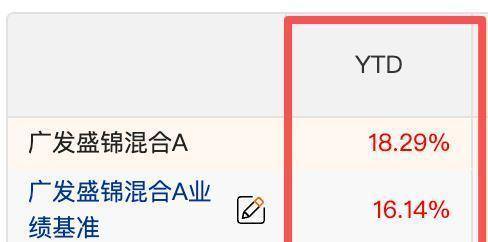
Core Insights - The performance of Wang Mingxu's funds has significantly declined, with a year-to-date return of -12.69%, ranking last among 1522 fund managers [1][10] - A systemic issue is evident as six out of seven equity products managed by Wang have consistently underperformed, with declines mostly in double digits [2][4] - The concentrated investment strategy, heavily weighted in traditional value stocks, has led to increased risk and poor performance, especially as market styles shift [3][6] Performance Analysis - Wang's funds were primarily established during market peaks in 2020-2021, leading to a disadvantage as market preferences shifted towards growth and technology sectors [3] - The contrasting performance of the Guangfa Shengjin Mixed Fund, which achieved an 18.29% positive return, highlights the importance of a diversified investment approach [3] - The management scale of Wang has decreased from over 300 billion to around 100 billion, indicating a loss of market confidence [6] Market Sentiment - Investor dissatisfaction is growing due to the significant gap between expectations and actual performance, exacerbated by long-term underperformance [4][8] - The second quarter saw Wang reduce holdings in real estate and brokerage sectors while increasing positions in banks and consumer electronics, which did not align with market trends [4] - The upcoming quarterly report will be crucial in determining whether there will be substantial adjustments in fund positions and risk management strategies [8] Fund Performance Metrics - Specific funds managed by Wang have shown substantial losses, with the Guangfa Value Advantage Mixed Fund down 17.40% and the Guangfa Value Preferred Mixed Fund down 15.36% year-to-date [9] - The performance of these funds is significantly lagging behind the benchmark index, the CSI 300, which has gained 17.06% [9][10] Strategic Recommendations - The need for timely adjustments and clear communication from the fund management is critical to restore investor trust and improve performance [8][10] - Enhancing portfolio diversity and risk management execution will be essential for future recovery, as the market may not remain forgiving [10]

中邮因子周报:成长风格显著,小盘风格占优-20251027
China Post Securities· 2025-10-27 06:59
- **Barra style factors**: The report tracks several style factors including Beta, Market Cap, Momentum, Volatility, Non-linear Market Cap, Valuation, Liquidity, Profitability, Growth, and Leverage. These factors are constructed using historical data and financial metrics such as turnover rates, earnings growth rates, and market leverage ratios. For example, the Beta factor represents historical beta, while the Valuation factor is calculated as the inverse of the price-to-book ratio. The formulas for constructing these factors include weighted combinations of metrics like turnover rates and earnings ratios [14][15][16] - **Factor performance tracking**: The report evaluates the recent performance of style factors across the market. Beta, Liquidity, and Momentum factors showed strong long positions, while Market Cap, Non-linear Market Cap, and Valuation factors performed better in short positions. The tracking methodology involves selecting stocks from the Wind All A pool, excluding ST stocks, suspended stocks, and newly listed stocks under 120 days. Long positions are taken in the top 10% of stocks with the highest factor values, and short positions in the bottom 10%, with equal weight allocation [16][19][20] - **Factor backtesting results**: The report provides detailed backtesting results for style factors. For example, Beta achieved a weekly return of 4.58%, while Market Cap showed a negative weekly return of -3.55%. Other factors like Momentum and Liquidity also demonstrated varied performance across different time horizons, such as one week, one month, and year-to-date. The report highlights the annualized returns for three-year and five-year periods for each factor [17][18][19] - **GRU factor performance**: GRU factors showed weaker performance overall, with only the barra1d model achieving positive returns. Other GRU models experienced drawdowns in their long-short portfolios. This indicates potential challenges in the effectiveness of GRU factors under current market conditions [20][25][29] - **Technical factors**: Technical factors such as 20-day Momentum, 60-day Momentum, and various volatility measures (e.g., 120-day Volatility) were tracked. These factors generally showed positive returns in long positions, particularly in high-volatility and high-momentum stocks. For example, 120-day Volatility achieved a weekly return of 5.92% in the CSI 300 stock pool [24][27][31] - **Fundamental factors**: Fundamental factors like ROA growth, ROC growth, and Net Profit growth were analyzed. In the CSI 300 stock pool, Net Profit growth achieved a weekly return of 2.51%, while ROA growth showed a return of 1.19%. These factors generally favored stocks with stable and strong growth metrics [23][25][30] - **Multi-factor portfolio performance**: The report evaluates the performance of multi-factor portfolios. The barra5d model outperformed the CSI 1000 index by 0.27% this week and achieved a year-to-date excess return of 5.91%. Other models showed mixed results, with some experiencing slight drawdowns. The multi-factor portfolio achieved a weekly excess return of 0.04% relative to the CSI 1000 index [8][33][34]
成长风格延续涨势,成长ETF(159259)标的指数盘中涨超2%
Mei Ri Jing Ji Xin Wen· 2025-10-27 06:40
Core Viewpoint - The growth style continues to rise, with the Guozheng Growth 100 Index increasing by 2.6% as of 14:15, attracting significant capital attention to related products [1] Group 1: Index Performance - The Guozheng Growth 100 Index focuses on A-share stocks with prominent growth characteristics, selecting 100 securities based on criteria such as quarterly net profit year-on-year changes and expected net profit growth rates [1] - The latest expected net profit growth rate for the index's constituent stocks in 2025 exceeds 100%, significantly outperforming other similar indices [1] - Since the base date at the end of 2012, the index has achieved an annualized return of over 20%, with a return of approximately 105% since the beginning of 2024 and nearly 50% year-to-date, outperforming similar style indices [1] Group 2: Investment Products - The Growth ETF (159259) is the only ETF product tracking the Guozheng Growth 100 Index, providing a convenient option for investors favoring growth stocks to invest in high-quality growth companies [1]
风格轮动策略周报:当下价值、成长的赔率和胜率几何?-20251026
CMS· 2025-10-26 13:40
Group 1 - The report introduces a quantitative model solution for addressing the value-growth style switching issue, combining investment expectations based on odds and win rates [1][8] - The overall market growth style portfolio achieved a return of 4.58%, while the value style portfolio returned 2.24% in the last week [1][8] Group 2 - The estimated odds for the growth style is 1.08, while for the value style it is 1.12, indicating a negative correlation between relative valuation levels and expected odds [2][14] - The current win rate for the growth style is 63.24%, compared to 36.76% for the value style, based on seven win rate indicators [3][19] Group 3 - The latest investment expectation for the growth style is calculated to be 0.32, while the value style has an investment expectation of -0.22, leading to a recommendation for the growth style [4][21] - Since 2013, the annualized return of the style rotation model based on investment expectations is 27.99%, with a Sharpe ratio of 1.04 [4][22]
港股市场策略周报:调整后重回成长风格,关注互联网与保险-20251025
CMS· 2025-10-25 12:22
Market Outlook and Strategy - The report indicates that the recent decline in the Hong Kong stock market is an overreaction to external shocks, particularly influenced by the US-China trade tensions. It suggests that the easing of trade conflicts and the release of incremental policies will support a rebound in the market [2][4][5] - The overall outlook for the fourth quarter is characterized by a "first dip, then rise" trend, with a gradual or wave-like process of style switching rather than a simple flip. Growth style is expected to remain the main focus in the near term as market risk appetite improves [2][5] Industry Recommendations - The report recommends focusing on the internet and insurance sectors. The internet sector is highlighted for its strong fundamentals, with cloud revenue showing high growth rates, and the insurance sector is expected to benefit from increased equity positions and expanding interest spreads [6][2] Market Performance - The Hong Kong stock market experienced a broad decline last week, with the Hang Seng Index dropping by 3.97% and the Hang Seng Tech Index falling by 7.98%. The AH premium significantly widened to 120 [8][11] - The report notes that the major industries saw more declines than gains, with utilities, telecommunications, and energy sectors showing slight increases, while information technology and healthcare sectors led the declines [11][8] Micro Liquidity Analysis - The average daily trading volume in the Hong Kong market was HKD 359 billion, reflecting a slight decrease but remaining high compared to historical levels [15] - The report highlights a net outflow of local and foreign capital, with a net inflow of HKD 451 billion from southbound funds, primarily directed towards financial and non-essential consumer sectors [26][21] Valuation Levels - The current price-to-earnings ratio for the Hang Seng Index is 12.2 times, compared to a three-year median of 9 times and an eight-year average of 10.3 times. The MSCI China Index has a current P/E ratio of 13.6 times, with similar historical comparisons [29][30] Financing Needs - As of October 19, the financing demand for Hong Kong-listed companies is estimated at HKD 27 billion, with IPO and placement needs accounting for HKD 8.5 billion and HKD 17.2 billion, respectively [31]
招商证券:港股调整后重回成长风格 关注互联网与保险
智通财经网· 2025-10-25 07:22
Core Viewpoint - The recent adjustment in the Hong Kong stock market is seen as an overreaction to external shocks, with expectations of a rebound supported by easing trade tensions and incremental policy benefits [1][2] Market Performance - The Hong Kong stock market experienced a broad decline last week, with the Hang Seng Index dropping by 3.97% and the Hang Seng Tech Index falling by 7.98% [2] - The AH premium significantly widened to 120, indicating a disparity between Hong Kong and mainland stock valuations [2] Industry Recommendations - The report recommends focusing on the internet and insurance sectors as key areas for investment [1] - The overall market style shift is expected to be gradual or wave-like rather than a sudden switch, with growth style remaining the main focus in the near term [1] Micro Fund Flow - There was a net inflow of capital from various sources, including a net inflow of 451 million HKD from southbound funds, primarily directed towards financial and non-essential consumer sectors [2] - Foreign capital saw a net sell-off of 3.8 million USD through ETFs, while local ETFs experienced a net outflow of 17 million HKD [2] Liquidity Changes - After a rapid rise, Hong Kong market interest rates have stabilized, with the overnight Hibor at 3.04% and the 3-month Hibor at 3.61% [2] - The USD to HKD exchange rate is approaching the strong-side Convertibility Undertaking at 7.77 [2]

创业板成长ETF大涨5.31%,5个交易日跑赢创业板指数超4个百分点
Mei Ri Jing Ji Xin Wen· 2025-10-24 09:49
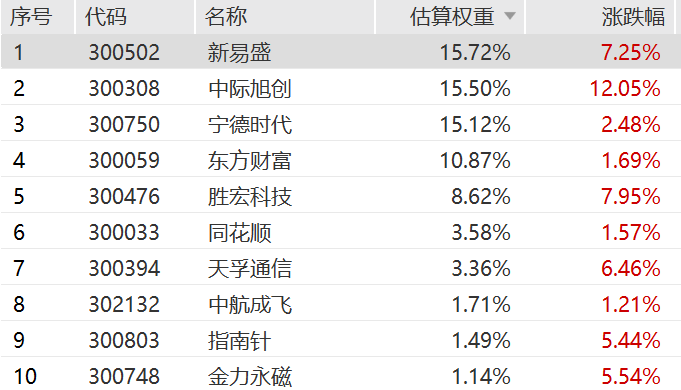
Core Points - The market opened high and continued to rise, with growth style stocks outperforming. The Shanghai Composite Index increased by 0.71%, surpassing 3950 points, while the ChiNext Index rose by 3.57% and the Sci-Tech 50 Index increased by 4.21% [1] - The Growth Index surged by 5.35%, with all top 10 heavyweights experiencing gains. Notably, Zhongji Xuchuang saw a significant increase of 12.05%, while Xinyi Sheng, Tianfu Communication, Zhinanzhen, and Jinli Yongci all rose by over 5% [1] Summary by Category Market Performance - The Shanghai Composite Index rose by 0.71% to above 3950 points [1] - The ChiNext Index increased by 3.57% and the Sci-Tech 50 Index by 4.21% [1] Growth Index and Heavyweights - The Growth Index increased by 5.35%, with all top 10 stocks in the index rising [1] - Zhongji Xuchuang had the highest gain at 12.05%, followed by Xinyi Sheng, Tianfu Communication, Zhinanzhen, and Jinli Yongci, each with gains exceeding 5% [1] ETF Performance - The ChiNext Growth ETF (159967) has shown strong performance, rising by 12.23% over the last five trading days, outperforming the ChiNext Index, which rose by 8.05% during the same period, resulting in an excess return of 4.1 percentage points [2] - The annualized return for the ChiNext Growth ETF is 10.58%, with a maximum drawdown of -4.18% [3]

成长风格今日再度爆发,成长ETF(159259)标的指数涨超3%
Mei Ri Jing Ji Xin Wen· 2025-10-24 07:50
Core Viewpoint - The growth style in the market has seen a resurgence, with the Guozheng Growth 100 Index rising by 3.8% at the close, indicating strong investor interest in growth-oriented stocks [1] Group 1: Index Performance - The Guozheng Growth 100 Index focuses on A-share stocks with prominent growth characteristics, featuring leading companies in new productivity sectors such as AI and high-end manufacturing [1] - The index's constituent stocks are expected to achieve a more than 100% growth in net profit attributable to shareholders by 2025, according to consensus forecasts [1] - Year-to-date, the index has delivered a return of over 48%, and approximately 105% since the beginning of 2024, outperforming similar style indices [1] Group 2: Investment Products - The Growth ETF (159259) is the only ETF product tracking the Guozheng Growth 100 Index, providing a convenient option for investors favoring growth stocks to gain exposure to high-quality growth companies [1]
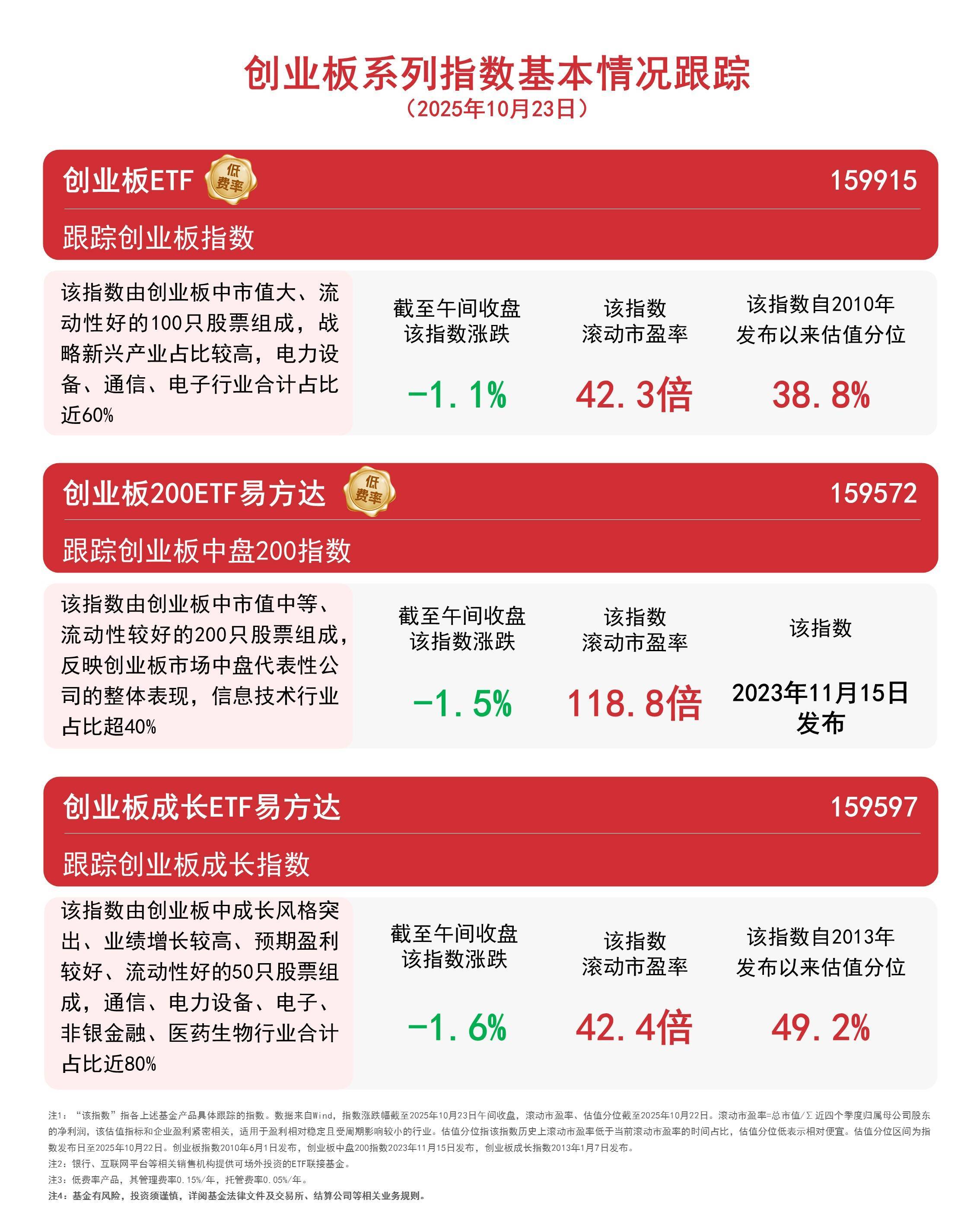
创业板指半日跌超1%,关注创业板ETF等产品投资机会
Sou Hu Cai Jing· 2025-10-23 05:21
Core Viewpoint - The current growth style is transitioning from the first phase to the second phase of the industrial prosperity cycle, indicating a healthy adjustment period with expectations for a potential end by the end of this month or early next month, suggesting opportunities for gradual investment in growth industries [1]. Group 1: Market Performance - As of the midday close, the ChiNext Index fell by 1.1%, the ChiNext Mid 200 Index decreased by 1.5%, and the ChiNext Growth Index dropped by 1.6% [1]. Group 2: Industry Composition - The information technology sector accounts for over 40% of the overall performance of representative companies in the ChiNext market, with the communication, power equipment, electronics, non-bank financials, and pharmaceutical industries collectively making up nearly 80% [3]. Group 3: Investment Products - The E Fund ChiNext Growth ETF tracks the ChiNext Growth Index, which consists of 50 stocks characterized by prominent growth styles, high earnings growth, favorable profit expectations, and good liquidity [3]. - The fund has a low management fee rate of 0.15% per year and a custody fee rate of 0.05% per year [3].