资产配置

Search documents
关税风暴下,如何让你的资产配置稳如磐石?
伍治坚证据主义· 2025-08-15 03:58
Core Viewpoint - The article discusses the volatility of the U.S. government's tariff policies and their impact on market conditions, emphasizing the need for investors to adjust asset allocation amidst uncertainty [2][3]. Macroeconomic Analysis - The S&P 500 index reached a new high in July, with the top ten companies accounting for over 38% of the index, and a price-to-earnings ratio of 22, significantly above the 30-year average of 17 [2]. - Despite strong market performance, the labor market shows signs of weakness, with an average non-farm employment growth of only 135,000 over the past three months, and job openings and voluntary resignations below pre-pandemic levels [2]. Asset Allocation Strategies - Adjusting asset allocation is crucial due to the uncertainty in the stock market, driven by tariff policies affecting corporate cost structures and capital expenditures [3]. - Gold has risen by 26% this year, surpassing $3,300 per ounce in July, driven by inflation expectations and geopolitical risks, indicating that physical assets can provide a buffer in uncertain environments [3][4]. Importance of Bonds - Fixed income investments are becoming increasingly important, with Swiss Re's portfolio consisting of 85% fixed income assets, primarily government bonds, to match long-term liabilities [4]. - The ten-year U.S. Treasury yield is around 4.5%, but real returns are limited after accounting for a 2.5% inflation rate, making government bonds a stabilizing force during economic uncertainty [4]. Technology and AI Sector Trends - The Nasdaq index rebounded by 21.95% in Q2, largely due to the rise of AI-related stocks, which account for 45% of the U.S. stock market's total market capitalization [5]. - Some AI companies have valuations as high as 25 times sales, despite revenues below $2 billion, raising concerns about potential market bubbles and the inherent risks in the AI sector [5]. Global Diversification - The concentration of the U.S. stock market, with the top ten companies exceeding 38% of total market capitalization, makes it vulnerable to performance fluctuations of a few firms [6]. - The depreciation of the dollar by 11% in the first half of the year has led to better performance in international markets, highlighting the importance of global diversification [6]. Investment Approach for Individuals - Investors should categorize their portfolios into core and satellite assets, prioritizing stable investments like low-cost index funds, bonds, and REITs for core assets, while using satellite assets for potential excess returns [6]. - Controlling investment costs and maintaining a long-term perspective are essential strategies to navigate short-term market volatility [7].


高瓴HHLR二季度美股持仓:31亿美元九成押注中概股,拼多多稳居第一
Jin Rong Jie· 2025-08-14 22:39
Core Insights - HHLR Advisors, a fund management platform under Hillhouse Capital, reported a total market value of $3.105 billion in its U.S. stock holdings as of the end of Q2 2025, with over 90% allocated to Chinese concept stocks, indicating a long-term bullish outlook on quality Chinese assets [1] Group 1: Holdings Overview - Eight out of the top ten holdings of HHLR are Chinese concept stocks, with Pinduoduo being the largest position, having increased by 20% year-to-date [1] - Futu Holdings has seen a remarkable year-to-date increase of 106%, reflecting strong performance among HHLR's key investments [1] - Other notable holdings include BeiGene, NetEase, Alibaba, and Legend Biotech, all of which have shown significant performance [1] Group 2: Recent Changes in Holdings - In Q2, HHLR increased its positions in Futu Holdings and Pinduoduo while partially reducing its stakes in Alibaba, Beike, and NetEase, which have experienced substantial price increases of 52% and 54% respectively year-to-date [1] - This adjustment in holdings suggests a strategy focused on locking in profits and optimizing asset allocation in a high market environment [1] Group 3: New Entrants - For the first time, Moomoo Securities entered HHLR's top ten holdings, with Hillhouse having participated in multiple financing rounds since 2021; Moomoo went public on NASDAQ in April this year, currently valued at approximately $7.5 billion [1]


探寻“本土化解法”、极致风控打造低波FOF!基金经理最新研判来了
券商中国· 2025-08-14 15:05
Core Viewpoint - The article discusses the transformation and challenges faced by the capital market, emphasizing the need for professional investment research to optimize asset allocation. It highlights the shift in China's public fund industry from scale expansion to high-quality development, driven by the evolution of fund managers and research systems [1]. Group 1: Foreign Fund Management in China - Since the approval of the first wholly foreign-owned public fund company in June 2021, foreign public funds have begun their localization journey in China, facing deeper challenges such as avoiding a "copy-paste" approach and developing differentiated strategies [4]. - Fidelity's General Manager, Sun Chen, emphasizes the importance of finding a "long-term solution" to establish a core advantage in a highly localized market, which includes a dual-market strategy focusing on both local and international markets [5][6]. - The "two systems" strategy involves integrating local and global research frameworks to create investment strategies that meet the specific needs of the Chinese market, ensuring a beneficial cycle between local client demands and global product offerings [6][8]. Group 2: Investment Strategies and Market Dynamics - Sun Chen believes that the Chinese asset management industry is still evolving, presenting sustainable growth opportunities due to its relatively weak efficiency and high volatility in investor behavior [7]. - Fidelity's approach to multi-asset strategies leverages its global experience, particularly in the pension investment sector, to introduce these strategies into the Chinese market [7][8]. - The firm focuses on long-term investment principles, avoiding short-term trends and emphasizing a stable investment framework to navigate market fluctuations [9][10]. Group 3: Low-Volatility Investment Products - In response to increasing demand for low-volatility products, the article highlights the growth of fixed-income plus funds and low-risk FOFs, which aim to provide stable wealth growth regardless of market conditions [13][14]. - Jiang Hong from Invesco Great Wall emphasizes the importance of strict drawdown control, aiming for a maximum drawdown of 2% while achieving an annualized return of over 3%, which is a challenging standard in the current market [14][17]. - Jiang's management of a conservative FOF product focuses on risk control and volatility management, utilizing a diversified asset allocation strategy to ensure steady growth and minimize drawdowns [15][19].

牛市中,亏钱的才是大多数!能抓住牛市的三种人,其中有你吗?
雪球· 2025-08-14 13:00
Core Viewpoint - The article discusses the different strategies and mindsets that successful investors adopt during a bull market, emphasizing the importance of early belief and disciplined execution of investment strategies to achieve profitability. Group 1: Bull Market Phases - A bull market typically has five phases, starting from a prevailing bear market mindset to a stage where most people are unaware of the market's end [5][6][7][9]. - Investors who profit during a bull market often do so by believing in the market early and making strategic investments in the initial phases [10]. Group 2: Successful Investor Types - The first type of successful investor is one who believes early, invests early, and remains steadfast despite market fluctuations [10]. - The second type relies on a disciplined strategy without attempting to predict market movements, focusing on value investing, grid strategies, or trend investing [12][13][14][16]. - The third type utilizes asset allocation as a passive strategy, which is easier for most ordinary investors to understand and implement [18]. Group 3: Asset Allocation Strategy - Asset allocation does not require investors to predict market trends, as it diversifies investments across various asset classes, including global stocks and bonds [19]. - The article provides historical performance data of different asset classes over the years, indicating that asset allocation can yield returns regardless of market conditions [20]. - The dynamic rebalancing strategy in asset allocation allows investors to maintain their desired asset ratios, thus mitigating anxiety over market timing [21][22]. Group 4: Limitations and Benefits of Asset Allocation - While asset allocation may not lead to rapid wealth accumulation, it offers a stable growth trajectory, allowing investors to benefit from various market phases [23]. - The article mentions a specific asset allocation strategy with a 6:3:1 ratio of stocks to bonds to commodities, which has yielded a 10%+ return as of August 11 [23].

权益基金投资者占比持续提高 京东财富锚定高质量发展
Zhong Jin Zai Xian· 2025-08-14 12:33
Core Viewpoint - The China Securities Regulatory Commission (CSRC) has introduced a plan to promote high-quality development of public funds, emphasizing a shift from scale to investor returns, which is being actively implemented by JD Wealth [1][2] Group 1: Regulatory Response and Market Impact - JD Wealth has responded to regulatory guidance by enhancing services and investor protection, achieving significant growth in user engagement, with new fund users increasing by 58% year-on-year and trading users by 47% as of July 2025 [1] - The investor demographic is becoming younger, with 40% of investors aged 25-35 and 20% aged 18-25, collectively representing over half of the fund investment growth [1] - The investment preference is shifting towards a diversified allocation, with 68% in equity active and index funds, and 20% in stable bond funds and "fixed income+" products, indicating a trend of "aggressive as primary, stable as support" [1] Group 2: Strategic Development Directions - JD Wealth is transitioning from a "fund sales platform" to an "asset allocation service provider," focusing on high-quality development, enhancing equity fund layouts, and establishing core business indicators related to investor returns and investment duration [2] - The company is building a refined fund classification system and evaluation matrix covering nearly a thousand niche sectors, integrating investor returns and performance benchmarks into core evaluation metrics [2] - JD Wealth aims to accelerate its "investment advisory" transformation, guiding investors to shift from focusing on individual products to improving portfolios and emphasizing long-term holdings [2]
A股一路走高,怕踏空又怕追涨,怎么办?
天天基金网· 2025-08-14 10:57
Core Viewpoint - The article emphasizes the importance of understanding the source of funds when investing, suggesting that aligning investment strategies with the nature of the funds can reduce anxiety and improve decision-making [5][6][8]. Group 1: Investment Strategies - The article outlines a shift in focus from "what products to buy" to "what money to allocate to which products," highlighting the common pitfalls of following media trends and making impulsive decisions [5][10]. - It suggests categorizing funds based on their source, such as "spare money," "idle funds," and "earned income," to determine appropriate investment strategies and products [9][7]. Group 2: Emotional Management - The article discusses the need to manage emotions in investing, advocating for a focus on emotional stability rather than solely on profit strategies [10][11]. - It highlights the benefits of systematic investment plans (SIPs) to alleviate emotional stress during market downturns, allowing investors to maintain a long-term perspective [12][11]. Group 3: Asset Allocation - The article stresses the importance of asset allocation, particularly the role of pure bond funds as stabilizers in a portfolio, which can help manage volatility and emotional responses to market fluctuations [14][15][19]. - It recommends diversifying investments to mitigate risks, emphasizing that proper asset allocation can lead to smoother investment experiences, especially during bear markets [23][24].

股市走强,黄金失宠
和讯· 2025-08-14 09:30
Core Viewpoint - The article discusses the declining interest in gold investments amid a strong stock market performance, highlighting a significant reduction in gold ETF sizes and prices due to easing global trade tensions and shifting investor sentiment towards riskier assets [5][6][11]. Summary by Sections Gold ETF Performance - As of August 12, seven gold ETFs in China have seen a reduction of approximately 6.9 billion yuan in size over the past month, with notable declines in major ETFs such as Huaan and E Fund [4][5][11]. Market Sentiment and Price Trends - The COMEX gold futures contract fell below $3,400 per ounce, marking a significant drop of nearly 2.5% on August 11, the largest decline since May [5][12]. - The London spot gold price also decreased, closing at $3,348.02 per ounce on August 12, down 1.4% from its August high [5][12]. Investor Behavior - Investors are reallocating funds from gold to equities, driven by rising stock markets in China and the U.S., with the Shanghai Composite Index up approximately 4.8% in July [6][12][14]. - Despite the recent downturn, some financial institutions are increasing their allocations to "gold+" products, which include a minimum of 5% gold in their asset mix [7][15]. Long-term Outlook for Gold - Analysts from UBS and Goldman Sachs maintain a bullish long-term outlook for gold prices, projecting targets of $3,500 to $4,000 per ounce by 2026, supported by ongoing central bank demand and potential geopolitical tensions [7][18][20]. - The World Gold Council reports that a significant majority of central banks plan to increase or maintain their gold reserves, indicating a stable demand outlook [19]. Challenges for Retail Investors - Ordinary investors face challenges in gold investment, including decision-making, timing, and holding strategies, which could be mitigated by professional management through "gold+" products [8][16].

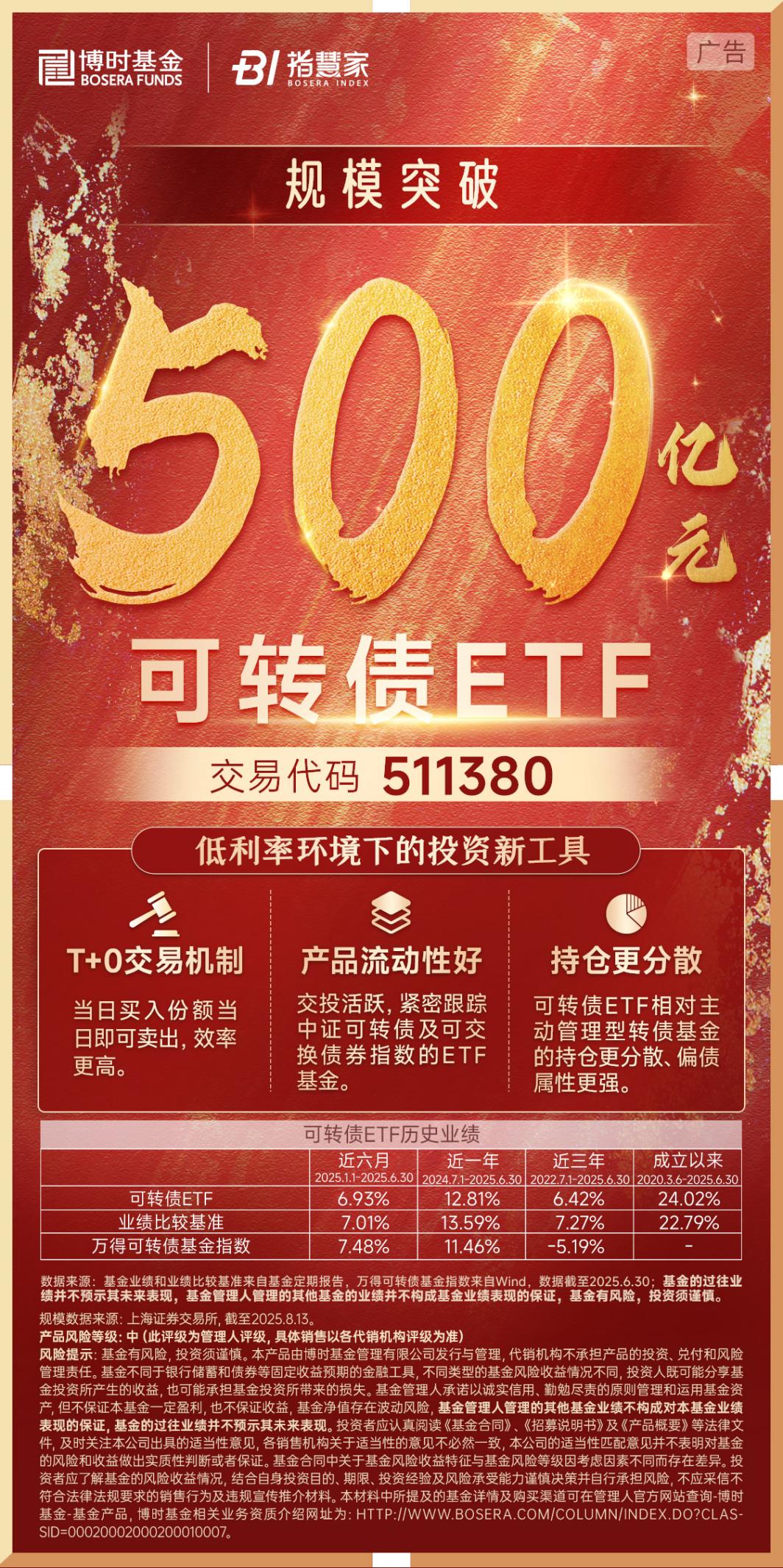
可转债ETF(511380)突破500亿,解码低利率时代的“攻守道”
Zhong Guo Jing Ji Wang· 2025-08-14 06:43
Core Insights - The BoShi Convertible Bond ETF (511380) has surpassed 50 billion yuan in scale as of August 13, 2024, reflecting its growth from a niche product to a favored investment tool in a low-interest-rate environment [1][5][11] Group 1: Performance and Growth - Since its inception on March 6, 2020, the BoShi Convertible Bond ETF has achieved a cumulative return of 24.02%, outperforming its benchmark return of 22.79% and the CSI Convertible Bond Index's return of 21.29% [6][12] - The ETF's performance over the past six months, one year, and since inception shows returns of 6.93%, 12.81%, and 24.02% respectively, indicating strong performance relative to its benchmarks [3][6] Group 2: Market Position and Strategy - The BoShi Convertible Bond ETF fills a gap in the passive investment market for convertible bonds, with only two such ETFs available in mainland China [5][11] - The ETF closely tracks the CSI Convertible Bond and Exchangeable Bond Index, with a market capitalization-weighted methodology that adjusts monthly [5][6] Group 3: Advantages of Convertible Bond ETFs - Convertible Bond ETFs offer a superior risk-return profile, combining equity-like growth potential with bond-like protection, making them attractive in both bull and bear markets [7][8] - They simplify asset allocation for investors by integrating both stock and bond characteristics into a single product, reducing the complexity of managing separate stock and bond ETFs [8][10] - The liquidity of Convertible Bond ETFs is generally higher than that of individual convertible bonds and some stock ETFs, making them suitable for both institutional and retail investors [9][10] Group 4: Broader ETF Landscape - In addition to the Convertible Bond ETF, BoShi has successfully launched other bond ETFs, with total bond ETF assets exceeding 90 billion yuan, showcasing its strong management capabilities [11][12] - The current market dynamics, influenced by stock-bond interactions and external uncertainties, highlight the importance of stable bond assets in investment portfolios [11]
买方投顾转型中的财富规划实践:匡正、李斌、杨辉共探破局之道
Morningstar晨星· 2025-08-14 01:05
Core Viewpoints - The wealth management industry is undergoing a significant transformation from a product-driven model to a service-driven model, necessitating a balance between global standards and local client needs through talent development and technological investment [1][8][9] Group 1: Wealth Management Transformation - The Chinese wealth management industry is shifting from a focus on individual products to a broader emphasis on asset allocation, with investors increasingly sensitive to short-term gains and losses [8] - Institutions are encouraged to invest in technology and talent to enhance their capabilities in global asset allocation, family office services, and retirement planning, thereby establishing long-term competitiveness in the Chinese market [8] - Different financial institutions are exploring unique strategies to navigate the opportunities and challenges presented by the transition from "sell-side sales" to "buy-side advisory" [2][8] Group 2: Unique Advantages of Brokerage Firms - Brokerage firms possess distinct advantages in wealth management, including a client base with a higher tolerance for risk and volatility, allowing for more comprehensive wealth planning strategies [8] - The experience of advisory teams in managing risk and volatility is noted, although there is a need to enhance capabilities in asset allocation [8] - The symbiotic relationships between brokerages and asset managers (public and private) facilitate a deeper understanding of management strategies, enabling better client service [8] Group 3: Internet Platforms and Data Utilization - Internet platforms are leveraging their vast user base and data advantages to provide personalized wealth management services, addressing the challenge of delivering tailored services to a large audience [9] - The implementation of KYC (Know Your Customer) and KYP (Know Your Portfolio) processes is crucial for creating accurate user profiles and reducing decision-making difficulties for investors [9] - The transition from a product-centric sales model to an account-centered asset allocation advisory model is emphasized, with a focus on enhancing the user experience through simplicity, safety, and enjoyment [9] Group 4: System and Team Development - The establishment of a TAMP (Turnkey Asset Management Platform) model is highlighted as a means to integrate research, data analysis, and advisory tools, enhancing the support for financial advisors [11] - The importance of a feedback mechanism between research teams and client needs is stressed to ensure alignment in service delivery and product offerings [11] - The goal for financial advisors is to evolve into long-term financial partners for clients, supported by effective AI tools to enhance service quality [13] Group 5: Focus Areas for Brokerages - Brokerages are advised to focus on three key areas: developing ETF-based intelligent trading and allocation tools, embracing AI technology to improve service efficiency, and evolving account systems to support comprehensive wealth management [13] - The relationship between sales and advisory roles is viewed as a gradual transition, with a structured growth path for professionals to develop from sales to specialized advisory capabilities [13]

从1到N,东方红万里行的十年温度
Mei Ri Jing Ji Xin Wen· 2025-08-13 23:53
Core Insights - The article emphasizes the evolution of investor services in China's asset management industry over the past decade, highlighting the "Dongfanghong Wanli Xing" initiative as a cornerstone for healthy industry development [1][4][14] - The initiative has successfully conducted over 14,400 events, reaching more than 2.09 million investors across over 100 cities, establishing a comprehensive support system for investors [1][4] Group 1: Historical Context and Development - The "Dongfanghong" brand was established in 2005, focusing on value investment and investor education, which has been a fundamental aspect of its operations [5][6] - The initiative was launched in 2015 during a turbulent market period, aiming to help investors understand the relationship between long-term value and short-term volatility [6][9] - The team recognized that excellent performance alone is insufficient; systematic services and support are essential to protect investor returns [6][9] Group 2: Service Evolution and Upgrades - In recent years, the company has upgraded its investor service system, expanding its course offerings from four core modules to eighteen detailed courses, addressing various investor needs [9][10] - A dedicated lecturer team has been established to provide customized services based on client demands, enhancing the educational experience for different investor profiles [10][11] - The initiative has expanded its outreach to include diverse groups such as corporate employees, students, and the elderly, ensuring a broad dissemination of financial knowledge [11][12] Group 3: Future Directions and Goals - The company plans to launch a nationwide tour in 2025, themed "Picking Up Light and Walking Together," to further engage with investors and enhance their understanding of investment and asset management [14][15] - The tour will cover ten key cities, focusing on providing targeted services based on local economic conditions and investor needs [14][15] - The overarching goal is to improve financial literacy and support the high-quality development of China's capital markets, reinforcing the company's commitment to long-term investor relationships [15][16]