
成长风格

Search documents
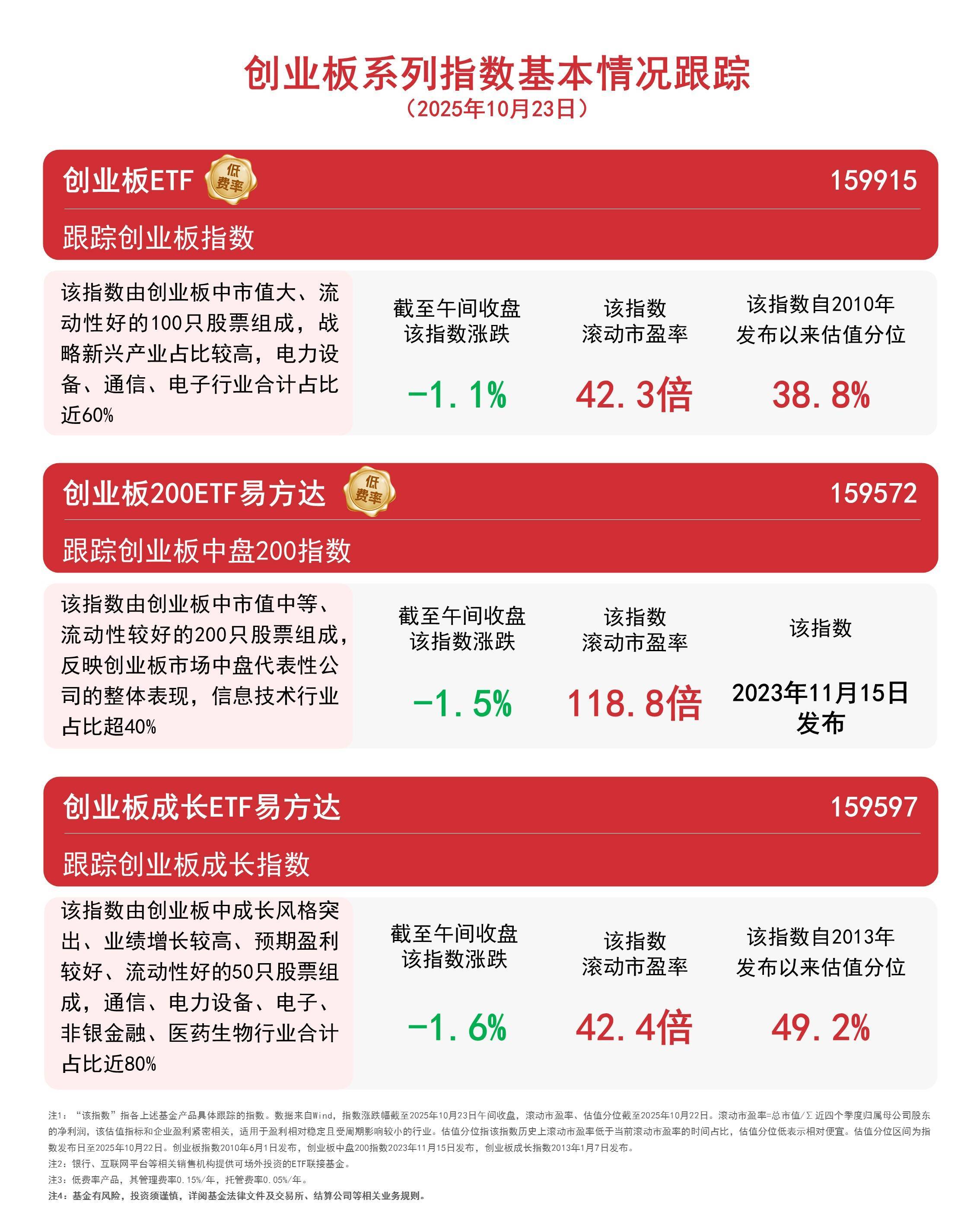
创业板指半日跌超1%,关注创业板ETF等产品投资机会
Sou Hu Cai Jing· 2025-10-23 05:21
Core Viewpoint - The current growth style is transitioning from the first phase to the second phase of the industrial prosperity cycle, indicating a healthy adjustment period with expectations for a potential end by the end of this month or early next month, suggesting opportunities for gradual investment in growth industries [1]. Group 1: Market Performance - As of the midday close, the ChiNext Index fell by 1.1%, the ChiNext Mid 200 Index decreased by 1.5%, and the ChiNext Growth Index dropped by 1.6% [1]. Group 2: Industry Composition - The information technology sector accounts for over 40% of the overall performance of representative companies in the ChiNext market, with the communication, power equipment, electronics, non-bank financials, and pharmaceutical industries collectively making up nearly 80% [3]. Group 3: Investment Products - The E Fund ChiNext Growth ETF tracks the ChiNext Growth Index, which consists of 50 stocks characterized by prominent growth styles, high earnings growth, favorable profit expectations, and good liquidity [3]. - The fund has a low management fee rate of 0.15% per year and a custody fee rate of 0.05% per year [3].


事关A股!高盛、摩根大通、瑞银等多家外资巨头集体发声
天天基金网· 2025-10-23 01:10
Core Viewpoint - The article discusses the optimistic outlook for the Chinese stock market, highlighting a transition to a "slow bull" market with significant potential for growth in the coming years, driven by various economic and policy factors [4][6][9]. Group 1: Market Outlook - Goldman Sachs predicts that the Chinese stock market is entering a slow bull phase, expecting major indices to rise by approximately 30% by the end of 2027, supported by a 12% growth in earnings and a 5%-10% upward adjustment in valuations [4][6]. - Morgan Stanley maintains a positive view on the CSI 300 index, citing a shift in household asset allocation towards equities, which is expected to sustain the market's rebound [9][10]. - UBS analysts believe the market outlook is favorable in the medium term, with growth style investments likely remaining the main focus [11][12]. Group 2: Supporting Factors - The article identifies four key supports for the anticipated bull market: 1. Policy benefits, including measures to reduce risks and stimulate demand [6]. 2. Accelerated economic growth driven by AI and increased competitiveness [7]. 3. Low current valuations of the Chinese stock market compared to historical levels and global markets [7]. 4. Strong capital inflows into the stock market, with potential for trillions in new investments as household assets shift [7][8]. Group 3: Investment Strategies - Investors are advised to shift their mindset from "selling high" to "buying low" as the bull market develops, focusing on growth stocks, particularly in sectors benefiting from the "anti-involution" trend and companies with strong cash flow [8][9]. - Morgan Stanley emphasizes the importance of the "anti-involution" theme, which could drive significant investment opportunities over the next 18-24 months [9][10]. - UBS suggests that despite recent market fluctuations, the growth style is likely to outperform value style investments in the medium term, with a favorable risk-return profile for investing in the ChiNext index [11][12].

[10月22日]指数估值数据(价值风格强势;季报更新,哪些品种盈利增长好;ETF估值表已上线)
银行螺丝钉· 2025-10-22 13:59
Core Viewpoint - The article discusses the current market trends, focusing on the performance of various stock styles and the recovery of corporate earnings in A-shares and Hong Kong stocks, indicating potential investment opportunities. Group 1: Market Performance - The market experienced slight declines, with the index closing at 4.2 stars [1] - Both large, medium, and small-cap stocks showed minor declines [2] - Value styles remained relatively resilient during market fluctuations [3] - The Shanghai Dividend and CSI 300 Value indices have returned from undervaluation to normal valuation levels [4] - Other indices like the Hong Kong-Shenzhen Dividend and Free Cash Flow are also approaching normal valuation [5] Group 2: Earnings Recovery - The recent quarterly reports indicate a recovery in corporate earnings after a low-performing year [16][17] - Three tiers of earnings recovery are identified: 1. Technology and pharmaceutical stocks in Hong Kong showed significant year-on-year earnings growth, exceeding 100% for some [18][19] 2. Stable earnings growth was observed in consumer sectors and value styles, with A-share pharmaceuticals also recovering [22][24] 3. Some sectors, like A-share consumer and real estate, remain in a low-performing phase with no signs of recovery yet [26][28][29] - The overall economic low point is expected to occur in 2024, followed by a gradual recovery [30] Group 3: Investment Tools and Features - A new feature in the "Today Stars" app allows users to view core data and real-time valuations of mainstream ETFs [31] - The app supports tracking ETF premium/discount rates and historical valuation data [33] - Users are encouraged to provide feedback on additional data or features they would like to see [32]

行情步入慢牛!外资巨头,集体发声!
证券时报· 2025-10-22 13:50
高盛:投资者思维应从"逢高减仓"转向"逢低买入" 10月22日,高盛研究部股票策略分析团队发布最新研报,认为中国股票市场正步入慢牛行情。 高盛研究部股票策略分析团队分析称,MSCI中国指数相对于2022年末的周期底部已反弹了80%,但其间 经历了四次大幅回撤。"我们目前认为中国股市将步入更具持续性的上行趋势,预计主要股指到2027年底 将上涨约30%,受到盈利增长12%的趋势和估值进一步上修5%~10%推动。" 十月以来,A股市场维持高位震荡。近期,高盛、摩根大通、瑞银等多家外资巨头相继发声,积极看 好后市。 高盛在10月22日最新研报指出,中国股市正步入慢牛行情,预计主要股指到2027年底将上涨约30%。该 机构还表示,随着牛市行情的展开,投资者的思维模式应从"逢高减仓"转向"逢低买入"。 摩根大通也在近日发布研报称,随着居民资产配置逐步向股市转移,看好沪深300指数截至2026年底的表 现。 瑞银证券中国股票策略分析师孟磊也在本周发声,认为市场中期向好,成长风格或仍是投资主线。 该团队指出,中国股市迎来持久牛市行情,具备四大有力支撑: 首先,政策利好窗口开启。一是托底政策在一年前已经出台,旨在降低左侧尾部 ...

行情步入慢牛!外资巨头,集体发声!
券商中国· 2025-10-22 12:46
Core Viewpoint - The A-share market is experiencing a high-level fluctuation, with several foreign financial giants expressing optimism about the future market performance [1][2]. Group 1: Goldman Sachs Insights - Goldman Sachs predicts that the Chinese stock market is entering a slow bull market, expecting major indices to rise by approximately 30% by the end of 2027, driven by a 12% growth in earnings and a 5%-10% upward adjustment in valuations [2][4]. - The firm identifies four key supports for this sustained bull market: favorable policies, accelerated economic growth, low current valuations, and strong capital inflows [4][5]. - Investors are advised to shift their mindset from "selling high" to "buying low" as the bull market unfolds, focusing on growth stocks, particularly in sectors like AI and emerging private enterprises [6]. Group 2: JPMorgan Insights - JPMorgan maintains a positive outlook on the CSI 300 index, anticipating that the shift of household assets towards the stock market will sustain the rebound trend until the end of 2026 [7]. - The firm emphasizes the potential of the "anti-involution" theme and service consumption opportunities, which could lead to an investment boom over the next 18-24 months [7][8]. - JPMorgan also highlights that compared to developed markets, China's service consumption has significant room for growth, particularly in healthcare, financial services, and entertainment sectors [8]. Group 3: UBS Insights - UBS analysts believe the market outlook is positive in the medium term, with growth style likely remaining the main investment theme despite a recent shift towards value stocks [9]. - The firm attributes the recent market style changes to factors such as escalating US-China trade tensions and profit-taking in the tech sector, but expects these factors to have limited impact on medium-term trends [9][10]. - UBS suggests that the current risk-reward profile for investing in growth stocks, particularly in the ChiNext index, remains favorable [10].



复盘系列(三):四季度是否存在风格切换
Changjiang Securities· 2025-10-22 11:27
- The report discusses the seasonal characteristics of the A-share market in Q4, highlighting a tendency for slight upward movement driven by year-end policy signals and marginal improvements in the funding environment[65][66][55] - Large-cap stocks, represented by the CSI 300 index, typically outperform small-cap stocks in Q4 due to their defensive attributes and institutional fund reallocation preferences. Historical data shows a CSI 300 win rate of 61% and median return of 1.63%, compared to the CSI 1000's win rate of 39% and median return of -1.60%[19][20][27] - Micro-cap stocks exhibit strong resilience in Q4, with a win rate of 78% and median return of 7.35%. This performance is attributed to factors such as liquidity preferences post-holiday and supportive policies for small and micro enterprises[29][30][33] - Growth and dividend styles show distinct characteristics in Q4. Growth stocks often face volatility due to profit-taking and valuation rebalancing, while dividend stocks demonstrate stability with a win rate of 56% and median return of 0.87%[35][38][40] - Industry rankings experience significant shifts in Q4, with most leading industries from the first three quarters dropping in rank, while new leaders emerge due to policy catalysts or valuation adjustments. Stable industries typically benefit from consistent policy support, solid fundamentals, and uninterrupted fund allocation[44][48][50]

四点半观市 | 机构:中国股市将进入更为持久的上涨阶段 成长风格有望继续跑赢价值风格
Shang Hai Zheng Quan Bao· 2025-10-22 10:37
Group 1 - The core viewpoint of the news indicates that the A-share market is expected to enter a more sustainable upward trend, with major indices projected to rise by approximately 30% by the end of 2027, driven by corporate earnings growth and valuation recovery [1] - Goldman Sachs' research team suggests that the current market leverage levels are generally controllable, with no signs of overheating, and despite recent market pullbacks, the medium-term outlook remains positive [1] - UBS Securities highlights a shift in market style since October, with a consensus likely to form around the technology growth sector, supported by easing risk sentiment and the verification of third-quarter earnings [1] Group 2 - The micro-cap stock index has shown impressive performance, with a year-to-date increase of nearly 64% as of October 21, 2023, reaching a historical high, which may be attributed to its "reverse stock selection" characteristic [2]
资本热话 | 国际大行继续“超配中国”,这些A股行业龙头最受青睐
Sou Hu Cai Jing· 2025-10-22 10:29
Group 1 - UBS maintains an overweight rating on China within emerging markets, citing faster revenue and earnings growth compared to India, and improving capital return rates in the MSCI China index [1] - A-shares have experienced a style shift from "growth" to "value dividend" since October, influenced by US-China trade tensions and profit-taking in the tech sector, but the medium-term outlook for A-shares remains positive [1][3] - Foreign investors are closely monitoring China's 14th Five-Year Plan, particularly aspects related to "anti-involution," consumption promotion, high-quality growth, and the development of new productive forces [1][11] Group 2 - A-shares are showing structural differentiation, with major indices fluctuating, but foreign investors believe there is still high allocation value in the market despite recent tariff impacts [3][4] - The market's sensitivity to US-China trade tensions has decreased, and there is an expectation of policy measures to stabilize the market if significant volatility occurs [4] - Foreign investors favor industry leaders, with significant holdings in companies like Kweichow Moutai, Ping An, and Wuliangye, indicating a preference for stable, high-quality stocks [6][7] Group 3 - Foreign investors are increasing their positions in leading stocks, with notable increases in holdings for companies like Siyi Electric and Hai Da Group during the third quarter [8][6] - UBS expresses a preference for A-shares over H-shares due to their defensive nature against geopolitical tensions, maintaining a focus on growth styles as the main investment theme [10] - The upcoming policies in the 14th Five-Year Plan are expected to create potential opportunities in "anti-involution" and service consumption, which could drive cyclical improvements in various industries [12]




[10月21日]指数估值数据(螺丝钉定投实盘第386期发车;养老指数估值表更新)
银行螺丝钉· 2025-10-21 14:00
Core Viewpoint - The overall market has shown an upward trend, with significant gains in both the A-share and Hong Kong markets, indicating a positive sentiment towards technology and value stocks [1][12][7]. Group 1: Market Performance - The overall market index has risen to 4.2 stars, reflecting a positive market sentiment [1]. - Both large, mid, and small-cap stocks have experienced similar upward movements [2]. - The ChiNext index has also seen a substantial increase, currently at a normal to slightly high valuation level [4]. - The technology sector has been a primary driver of profit growth in both A-shares and Hong Kong stocks this year [7]. Group 2: Earnings and Valuation - Leading companies in the ChiNext have reported good earnings growth, which is essential for the long-term rise of the index [3][5]. - Different sectors are recovering at varying paces, with value stocks showing less volatility compared to growth stocks [6][9]. - Recently, previously undervalued dividend stocks are approaching their normal valuation levels [10]. - The estimated valuation metrics suggest that as the market approaches around 3 stars, the green rate in the valuation table will be low [11]. Group 3: Investment Strategies - The investment strategy includes pausing regular investments in the index-enhanced portfolio as it returns to normal valuation, while continuing to hold existing positions [14]. - The active selection portfolio is also close to normal valuation, indicating a cautious approach to new investments [14]. - The "monthly salary treasure" investment strategy, which consists of 40% stocks and 60% bonds, is recommended for stable market participation [14]. - The introduction of an "automatic stop-loss" feature for investment portfolios aims to enhance risk management by automatically executing profit-taking strategies when market conditions are favorable [43].

国际大行继续“超配中国” A股行业龙头最受青睐
Di Yi Cai Jing· 2025-10-21 13:32
Core Viewpoint - The A-share market is experiencing a collective rise, with foreign investors expressing optimism about China's market, particularly highlighting the potential for growth in the A-share index compared to other emerging markets like India [1][3]. Group 1: Market Performance and Investor Sentiment - The A-share indices collectively rose on the 21st, with the Shanghai Composite Index reclaiming the 3900-point mark [1]. - UBS has maintained an "overweight" rating on China within emerging markets, citing faster revenue and earnings growth compared to India, and improvements in capital return rates for the MSCI China Index [1][3]. - Since October, A-shares have shifted from a "technology growth" style to a "value dividend" style, influenced by factors such as renewed US-China trade tensions and profit-taking by investors [1][3]. Group 2: Foreign Investment Trends - Foreign investors have been actively targeting leading A-share stocks, with significant holdings in companies like Siyuan Electric, Huaming Equipment, and Hongfa Technology, each having over 24% foreign ownership [2][6]. - As of the end of September, major foreign-favored stocks included Kweichow Moutai, Ping An Insurance, and Wuliangye, with foreign institutional holdings reaching 85, 83, and 81 respectively [6]. - The banking sector remains a strong focus for foreign investors, with seven of the top ten A-share companies by foreign holdings being banks [6][7]. Group 3: Market Outlook and Strategic Focus - UBS believes that the A-share market will continue to perform well in the medium term, with growth styles likely to outperform value styles [9]. - Investors are encouraged to focus on companies with strong fundamentals and pricing power to navigate uncertainties in the trade environment [10]. - The upcoming "14th Five-Year Plan" is expected to provide investment opportunities, particularly in areas like "anti-involution" and service consumption, which may drive cyclical improvements in various industries [10][11].

