
耐心资本

Search documents
双向奔赴!险资“南下北上”找“增长溢价”
2 1 Shi Ji Jing Ji Bao Dao· 2025-12-22 12:51
Core Viewpoint - The recent surge in local governments' initiatives to attract insurance capital reflects a pressing need for long-term, stable funding to support economic transformation and major projects amid economic pressures and limited traditional financing options [5][6][9]. Group 1: Government Initiatives - Multiple local governments, including those in Henan, Shaanxi, Tibet, Shandong, and Liaoning, are actively promoting "insurance capital into X" initiatives to channel large-scale insurance funds into local economies and significant projects [1][7]. - The "insurance capital into Henan" initiative has successfully attracted over 1 trillion yuan in insurance funds since its launch in July 2022, with a notable increase in investment scale and diversification of investment methods [3][4]. - The introduction of insurance capital is seen as a strategic move by local governments to address capital shortages and enhance financing structures during economic transitions [5][6]. Group 2: Investment Trends - Insurance funds are increasingly being directed towards emerging industries and projects, moving away from traditional sectors like chemicals and infrastructure, with plans to invest over 5 billion yuan in health-related initiatives [3][4]. - The total investment scale of China Life in Henan has exceeded 140 billion yuan, showcasing the significant role of major insurance companies in local economic development [4]. - The competition for attracting insurance capital is not limited to inland provinces but is also evident in coastal and northeastern regions, indicating a nationwide trend [7][8]. Group 3: Economic Context - The push for insurance capital is driven by the need for stable, long-term investments to support infrastructure, technological innovation, and green projects, particularly in the context of economic downturns and rising financing costs [6][9]. - The insurance sector is facing pressure due to declining long-term interest rates, prompting a search for stable returns through investments in significant local projects [9][10]. Group 4: Challenges and Solutions - The successful integration of insurance capital into local projects requires a robust framework that includes project quality, credit enhancement measures, policy support, and exit mechanisms [12][13]. - Local governments must establish a credible, long-term policy environment to attract insurance capital, balancing short-term funding needs with the long-term stability that insurance funds require [12][13].

保险资负管理新规征求意见:严控资负错配、引导培育耐心资本
2 1 Shi Ji Jing Ji Bao Dao· 2025-12-22 09:49
南方财经全媒体记者 孙诗卉 林汉垚 在当前利率中枢持续下行的背景下,如何平滑穿越周期、防范利差损风险,已成为行业共同面临的严峻考题。 2024年发布的《国务院关于加强监管防范风险推动保险业高质量发展的若干意见》明确提出"强化资产负债联动监管"。 近日,国家金融监管总局发布《保险公司资产负债管理办法(征求意见稿)》(以下简称《办法》),进一步推动保险公司不断强化改进资产 负债管理架构、政策和程序。 国家金融监管总局有关司局负责人在答记者问中表示,《办法》是国家金融监管总局落实国务院重要文件精神、提升行业经营韧性、健全审慎 监管制度体系的重要措施之一。 应对行业新挑战 有效的资产负债管理是金融机构可持续经营的基础。2018年以来,监管部门陆续发布了《保险资产负债管理监管暂行办法》(以下简称《暂行 办法》)和五项监管规则,初步构建了符合国内保险行业特征的资产负债管理和监管体系。 但近年来,我国保险业面临的内外部环境发生了显著变化,这对保险公司的资产负债管理能力提出了严峻考验。 北京大学应用经济学博士后朱俊生教授在接受21世纪经济报道采访时表示,《办法》的出台,源自我国保险行业近年来面临的内外部环境变 化,尤其是日益 ...

重点改革稳步推进 2025年保险业向“质”而行
Jin Rong Shi Bao· 2025-12-22 09:43
Core Insights - The insurance industry in China is entering a critical year in 2025, focusing on high-quality development and internal reforms despite a complex external environment [1] Group 1: Life Insurance Sector - The life insurance industry is transitioning from reliance on interest rate spreads to a new cycle of value growth, emphasizing risk management and marketing reforms [2] - A dynamic adjustment mechanism for the predetermined interest rate was implemented, with the minimum guaranteed rates set at 2.0% for ordinary products, 1.75% for participating products, and 1.0% for universal insurance [2] - The insurance agent workforce is being upgraded, with a shift towards professional roles such as "health wealth planners" and "insurance wellness consultants" [3] Group 2: Property Insurance Sector - The property insurance sector is addressing challenges such as the difficulty in insuring new energy vehicles and enhancing management of non-auto insurance [4] - The "Good Insurance for Cars" platform was launched, involving 37 property insurance companies and providing coverage for over 1.1 million vehicles, with a total insured amount of 1.1 trillion yuan [5] - Non-auto insurance is undergoing stricter regulation, with a focus on improving compliance and quality, as outlined in the new regulatory framework [5] Group 3: Insurance Capital - Insurance capital is increasingly being utilized as patient capital, with total investment exceeding 37 trillion yuan, a 16.5% year-on-year increase [6] - Policies supporting insurance capital investment have been strengthened, including adjustments to asset allocation ratios and long-term investment assessments [7] - The scale of long-term investment pilot programs has expanded, with a total of 222 billion yuan approved for participation from various insurance companies [8]
最高允许100%亏损,这个省优化国资创投考核机制
母基金研究中心· 2025-12-22 09:22
Core Viewpoint - The article discusses the recent policy initiatives by the Sichuan Provincial Government aimed at increasing financial support for technological innovation, particularly through a more lenient loss tolerance mechanism for investment funds [2][3]. Group 1: Policy Initiatives - Sichuan's new plan allows for a maximum investment loss tolerance of 60% for government-guided and state-owned funds, which can be increased to 80% for funds investing in seed-stage companies or future industries, and up to 100% for individual projects [2]. - The policy encourages equity investment institutions to increase their investments in technology-driven enterprises and projects that focus on results transformation [2][3]. Group 2: Loss Tolerance Mechanism - The article highlights a growing trend among local state-owned assets to adopt a 100% loss tolerance for individual projects, indicating a significant shift in investment risk acceptance [3]. - This trend is seen as a positive signal for the venture capital landscape, suggesting that local state-owned assets are becoming more open to the idea of total loss in investments [3]. Group 3: Government and State-Owned Fund Management - Recent policies emphasize the need for optimizing the management and accountability mechanisms of government investment funds, including the establishment of a fault tolerance mechanism [4][5]. - The government aims to create a supportive environment for innovation by allowing for a more flexible evaluation system that does not solely rely on the performance of individual projects or annual profits [5]. Group 4: Long-term Investment Strategies - Sichuan's initiatives reflect a commitment to "patient capital," which is characterized by long-term support and a high tolerance for risk and failure, particularly in the context of technological innovation [6][7]. - The province aims to establish a significant number of private equity and venture capital management institutions by 2030, with a target fund management scale of 4 trillion yuan [8]. Group 5: Fund Duration and Investment Conditions - The article notes that many newly established funds have extended durations of 15 to 20 years, with a significant portion of new funds allowing for a longer investment horizon [9]. - Sichuan's policies also propose that the duration for sub-funds can be extended up to 15 years, demonstrating a commitment to long-term capital [10]. Group 6: Investment Return Requirements - There is a noticeable trend towards lowering the return requirements for government investment funds, with average return multiples decreasing significantly over the past six years [11][13]. - The article mentions that many local governments are increasingly flexible regarding return requirements, allowing for lower ratios and broader definitions of what constitutes a return [12]. Group 7: Future Expectations - The article anticipates that more regions will adopt similar policies to enhance the incentive and fault tolerance mechanisms for government and state-owned funds, promoting the development of long-term, patient capital [13].

从“融合生态”到职业规范,农业专家为乡村CEO发展精准支招
Xin Lang Cai Jing· 2025-12-22 09:04
在"农村集体经济经理人"被正式纳入国家职业序列的背景下,"乡村职业经理人大会2025"日前在北京门 头沟召开。 他特别肯定了北京门头沟区的探索:党政"一把手"亲自推动,出台20条真金白银政策,甚至将"北京户 口"作为人才引进配套,展现出极高的政治站位与战略眼光。同时,他也高度赞扬头部企业的深度参 与,认为具有社会责任感的企业投身乡村振兴,是"融合生态"得以成型的重要支撑。此外,他点名称赞 中国农业大学李小云教授团队"最接地气",长期扎根云南昭通等地,将学术研究与基层实践紧密结合, 为乡村CEO制度提供了扎实的理论与行动基础。 顾益康进一步提出,未来乡村最大的产业不是"养猪养鸡",而是"养人"——即通过发展康养、研学、农 文旅等新质生产力业态,吸引城市人群下乡消费、旅居、创业。而实现这一目标,关键在于依靠年轻化 的乡村CEO群体,打造有吸引力的乡村生活场景和产业生态。 此外,顾益康还强调制度保障的重要性,呼吁通过农广校系统将乡村CEO纳入国家政策框架,争取写入 中央一号文件,甚至推动立法保障。 乡村CEO的双重挑战 刘振伟从实践角度出发,指出乡村CEO虽"强势崛起",但其发展之路充满挑战。他强调,乡村CEO不是 ...
从资本占用到长期持有:调整风险因子或为红利低波打开显著增量空间?
Sou Hu Cai Jing· 2025-12-22 03:27
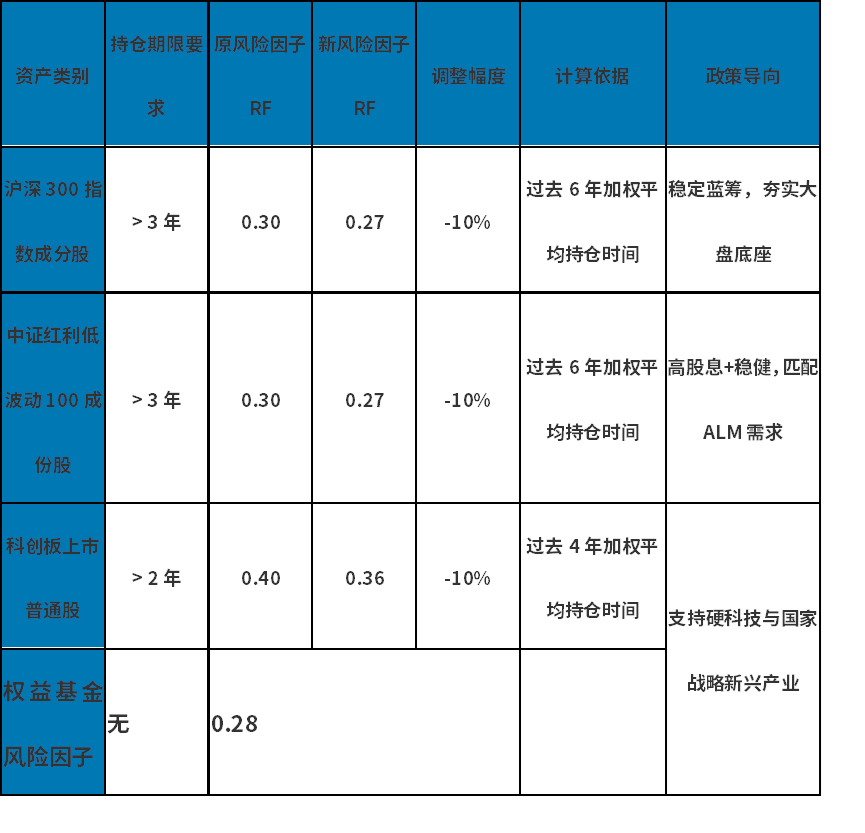
Core Viewpoint - The recent regulatory change to lower the risk factor for insurance companies investing in the stock market is expected to increase the available capital for investments, particularly benefiting dividend-paying and low-volatility assets [1][4]. Group 1: Understanding the Risk Factor Adjustment - The risk factor is a key constraint for insurance companies, determining the minimum capital they must hold against their investments. A lower risk factor means less capital is required for the same investment, thus improving capital efficiency [2][3]. - The new regulation reduces the risk factor from 0.30 to 0.27, a 10% decrease, which directly lowers the capital cost for equity investments [4]. Group 2: Implications for Dividend and Low-Volatility Assets - The inclusion of the CSI Dividend Low Volatility 100 index in the favorable risk factor category indicates a clear policy direction to encourage investment in stable, high-dividend assets [5]. - Insurance companies, facing challenges in traditional fixed-income returns, are likely to seek out high-quality assets with stable cash flows, making dividend-paying stocks more attractive [5]. Group 3: Comparison with Previous Adjustments - The current macroeconomic environment is more favorable compared to the previous risk factor adjustment in 2023, which occurred during a period of aggressive interest rate hikes by the Federal Reserve. This time, the anticipated easing of rates and clearer policy direction may enhance the effectiveness of the new regulation [6]. Group 4: Summary of Potential Market Impact - The adjustment in the risk factor is expected to release significant incremental capital, directing investments towards high-quality, long-term assets like dividend-paying stocks. Monitoring insurance capital allocation may provide valuable insights for investors in a volatile market [8].
2025年保险业向“质”而行
Jin Rong Shi Bao· 2025-12-22 03:02
Group 1: Core Insights - The year 2025 is pivotal for China's insurance industry, marking the end of the "14th Five-Year Plan" and a critical year for high-quality development amidst a complex external environment [1] - The insurance industry is undergoing significant internal reforms, focusing on enhancing service to the real economy and improving public welfare through supply-side structural reforms [1] Group 2: Life Insurance Sector - The life insurance industry is transitioning from reliance on interest spread to a new cycle of value growth, emphasizing risk prevention and marketing system reform as dual engines for transformation [2] - A dynamic adjustment mechanism for the predetermined interest rate in life insurance has been implemented, with the minimum guaranteed rates set at 2.0% for ordinary products, 1.75% for participating products, and 1.0% for universal insurance [2] - The insurance agent workforce is being upgraded, with a shift towards professional and vocational roles, enhancing the industry's talent base for high-quality development [3] Group 3: Property Insurance Sector - The property insurance sector is addressing challenges such as the difficulty in insuring new energy vehicles and is enhancing management of non-auto insurance businesses [4] - The "Good Insurance for Cars" platform has been launched, involving 37 property insurance companies and providing coverage for over 1.1 million vehicles, with a total insured amount of 1.1 trillion yuan [5] - Non-auto insurance is entering a new regulatory phase, with measures to improve compliance and quality, aiming to resolve longstanding issues of high costs and low rates [5] Group 4: Insurance Capital - Insurance capital is increasingly being transformed into patient capital, with the total investment balance exceeding 37 trillion yuan, a year-on-year increase of 16.5% [7] - Policies supporting insurance capital market entry have been strengthened, including adjustments to the regulatory ratios for equity assets, enhancing the role of insurance funds as long-term capital [8] - The scale of long-term investment reform pilot programs has expanded, with a total of 222 billion yuan approved for participation, involving major insurance companies [9]

中邮保险39亿增持四川路桥年内四次举牌 投资收益超95亿股票配置两年半增12倍
Chang Jiang Shang Bao· 2025-12-21 23:21
长江商报消息 ●长江商报记者 徐佳 险资再次出手加仓A股。 日前,沪市主板上市公司四川路桥(600039.SH)公告,中邮人寿保险股份有限公司(以下简称"中邮保 险")买入四川路桥股票,持股升至5%,达成举牌。 长江商报记者注意到,近十个月内,中邮保险累计耗资38.91亿元买入四川路桥。截至12月19日收盘, 中邮保险所持四川路桥股份市值约为42.98亿元,账面浮盈约4.07亿元。 至此,2025年中邮保险已举牌四家上市公司,其中包括两家A股上市公司和两家H股上市公司。而2025 年以来,险资共计39次出手举牌上市公司,数量创近十年最高。 作为中国邮政下属全国性寿险企业,中邮保险在政策引导下,坚定长期投资理念,落实耐心资本实践, 充分发挥保险资金优势,服务实体经济和产业发展。 截至2025年6月末,中邮保险的股票配置规模已达到494.62亿元,较2022年末的37.39亿元增长超过12 倍,占投资资产的比例也由0.85%大幅提升至7.24%。 2025年前九月,中邮保险实现营业总收入283.05亿元,净利润90.97亿元。其中,投资收益95.78亿元, 公允价值变动收益1.15亿元。 举牌四川路桥已浮盈超4亿 ...

“十五五”首席观察|专访锁凌燕:老龄化加速,及早推动商业保险供给侧改革
Bei Jing Shang Bao· 2025-12-21 05:36
Core Viewpoint - The insurance industry is positioned to play a crucial role in enhancing pension finance and addressing the challenges posed by an aging population during the "14th Five-Year Plan" period, with a focus on collaborative efforts across the "three pillars" of pension finance [1][5]. Group 1: Pension Finance and Insurance Industry - In 2026, the insurance industry will focus on pension finance as a core area, with policies and market forces driving the collaboration of the "three pillars" from design to implementation [1]. - The insurance sector is expected to fill gaps in basic social security through inclusive products and services, while addressing longevity risks and capital preservation pressures with annuity schemes and cross-cycle risk management [1][5]. - The development of pension finance is seen as a strategic pillar for enhancing the long-term stability of the pension system and improving residents' welfare [5]. Group 2: Investment Strategies and Challenges - The value of insurance funds as "patient capital" will become more prominent, requiring a shift from being "simple investors" to "professional experts" through enhanced long-term assessment mechanisms and deep industry research [2][8]. - The insurance industry must address challenges such as low interest rates and the balance of risks and returns in technology investments while ensuring long-term investment stability and solvency [8][10]. - A focus on professional depth and risk management is essential for the insurance sector to transition from passive "value guardians" to active "value creators" [10]. Group 3: Product Innovation and Consumer Needs - The insurance industry faces a mismatch between personalized consumer demands and standardized products, necessitating fundamental reforms in product design and service ecosystems [12]. - Advanced technologies like big data and AI can help the insurance sector provide more personalized services and products by analyzing customer needs and optimizing risk management [13][14]. - The integration of insurance products with health management and long-term care services is crucial for reducing overall pension costs and enhancing the resilience of the pension finance system [6][14]. Group 4: Regulatory and Ethical Considerations - The insurance industry must balance technological innovation with compliance and ethical standards, particularly as AI applications evolve from single-point solutions to comprehensive empowerment across the value chain [14][15]. - There is a need for regulatory frameworks that not only correct errors but also allow for experimentation and innovation within the insurance sector [15].

中国生物医药十年突围
Cai Jing Wang· 2025-12-20 23:36
Core Insights - The Chinese biopharmaceutical industry has significantly improved in both the quantity and quality of innovative drugs, with 43 innovative drugs approved in the first half of 2025, a 59% year-on-year increase, and domestic innovative drugs accounting for 93% of this total [1][7] - The industry has evolved from a focus on generic drugs to a strong emphasis on original innovation, supported by policy reforms and increased R&D investment [5][7] - The geopolitical landscape poses challenges for the industry, necessitating a strategic global positioning and market diversification to mitigate risks associated with supply chain security and international cooperation barriers [2][3] Industry Development - The transformation of the Chinese biopharmaceutical industry began with the 2015 reform of the drug approval system, which shifted the focus to clinical value and significantly shortened approval times [5] - The industry has seen a shift from a model of "combination of imitation and innovation" to "source innovation," with substantial increases in R&D investment over the past decade [5][6] - The successful case of the drug Senglitin, which bypassed phase II clinical trials due to its strong performance in phase I trials, exemplifies the supportive environment for innovation in China [6] Global Positioning - The Chinese biopharmaceutical industry is increasingly targeting emerging markets in Southeast Asia and the Middle East, facilitated by regulatory cooperation under the Belt and Road Initiative [2][3] - The industry is forming a diversified international cooperation model, addressing local healthcare needs while enhancing resilience against geopolitical risks [3] Capital Market Dynamics - The capital market for biopharmaceuticals has experienced volatility, with a significant contraction in financing since 2022, but signs of recovery are emerging as of mid-2025 [8][9] - The need for "patient capital" is emphasized, with suggestions to relax investment restrictions for long-term capital sources to strengthen the ecosystem [9][10] - A proposed mechanism linking IPO approvals to the outcomes of major national drug projects aims to enhance funding opportunities for innovative companies [10] Technological Advancements - The application of artificial intelligence (AI) in drug development is becoming a key driver for innovation, improving efficiency in clinical trials and enhancing drug accessibility [11][12] - AI's role in integrating data across various stakeholders is crucial for establishing reasonable pricing and ensuring the sustainability of innovative drugs [12] Future Outlook - The transition from a "China New" to a "Global New" paradigm requires ongoing collaboration among policymakers, industry leaders, researchers, and capital markets, focusing on clinical value and global perspectives [13]
