
通货膨胀

Search documents
How many rate cuts in 2026? These mounting pressures will put the Fed at a crossroads this year
Yahoo Finance· 2026-01-26 17:04
By design, the group of officials voting on interest rates is going to look a lot different this year.Fed policymakers have a direct line to your wallet . Their decisions help shape everything from mortgage rates and home equity lines of credit (HELOCs), to personal loans, credit card rates and car loans. They’re also the reason savers have enjoyed historic returns on savings accounts and certificates of deposit (CDs) for four years. Here’s an inside look at all of the shifting forces that could alter how m ...
瑞银展望2026美国经济:一旦AI泡沫破裂衰退概率将达50%,市场低估了6月前降息的可能性
Sou Hu Cai Jing· 2026-01-26 07:48
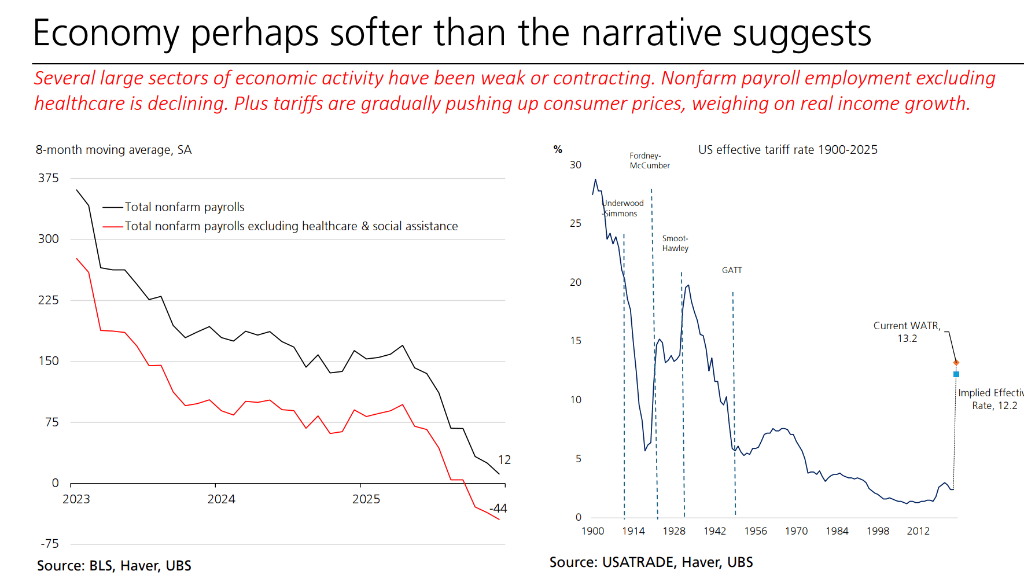
Group 1 - UBS reports that despite strong overall economic data, growth sources are extremely narrow, with most of the real economy in a state of weakness or contraction, except for the AI and technology sectors [1][5] - The labor market expansion has significantly slowed, with actual employment shrinking when excluding the healthcare sector [1][6] - The current asset prices are based on the dual pillars of sustained AI investment and strong consumption from the wealthy, leading to a warning that any downturn in AI investment could trigger a recession with a 50% probability [3][15] Group 2 - UBS forecasts that the Federal Reserve will face a dilemma between maintaining independence and rescuing the labor market, predicting two rate cuts of 25 basis points each in 2026, bringing the target federal funds rate to 3.00% to 3.25% [4] - The market currently underestimates the likelihood of a rate cut in March, with only about 16% probability priced in, while UBS believes the chances are higher due to potential labor report weaknesses [4] - Political pressures are mounting on the Federal Reserve, which may lead to delays in necessary rate cuts to avoid perceptions of yielding to political influence [4] Group 3 - The growth of the U.S. economy is heavily reliant on AI-related investments, with a 17% increase in AI-related equipment investment over the past four quarters, while other equipment investments have declined by 1% [5] - Non-residential structure investment has contracted for six consecutive quarters, and residential investment has declined in four of the last five quarters [5] - The wealth distribution is increasingly polarized, with stock market wealth reaching a record 37% of total household wealth, benefiting high-income groups while others face inflation and stagnant real incomes [5] Group 4 - The labor market has deteriorated significantly, with an average monthly decrease of 41,000 jobs in the private sector when excluding healthcare and social assistance [6] - Broader labor utilization indicators are rising, indicating a more severe weakness in the labor market than headline data suggests [6] - Current employment growth is below the breakeven point needed to maintain stable unemployment rates, highlighting the extent of labor market weakness [6] Group 5 - Tariff policies are creating significant macroeconomic headwinds, with the weighted average tariff rate (WATR) rising to 13.2%, effectively imposing a 1.1% tax on GDP [10] - This has led to a rebound in inflation from 2.61% in April 2025 to 2.91% in August 2025, with expectations of inflation peaking in summer 2026 before gradually declining [10] - Tariffs are expected to significantly hinder real GDP growth in 2025 and 2026, limiting the Federal Reserve's policy options [10] Group 6 - Fiscal policy is expected to provide short-term support amid weak private sector demand, with a projected surge in personal tax refunds of approximately $50 to $60 billion due to the implementation of the "One Big Beautiful Bill" [11] - This fiscal stimulus is anticipated to shift from negative to positive in 2026, providing a bottom support for economic expansion despite underlying weaknesses [11] - UBS believes that as long as fiscal support continues, the economy is unlikely to collapse immediately [11]


史诗级暴涨!黄金、白银彻底失控,一场更大风暴将来袭
Sou Hu Cai Jing· 2026-01-26 03:11
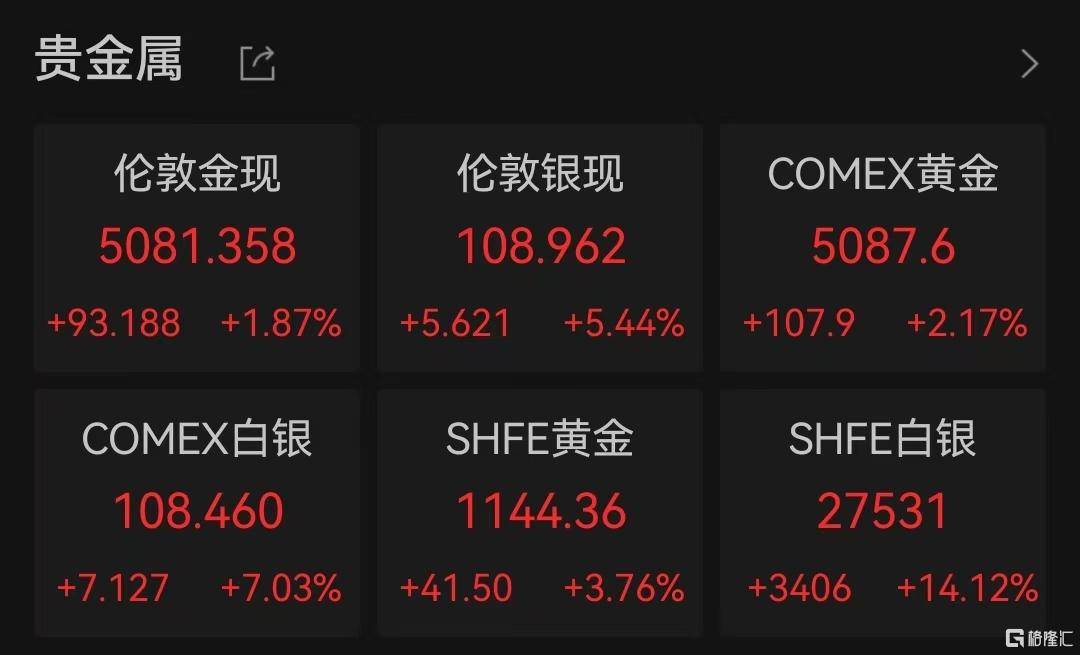
港、A股贵金属股集体走强。A股中,湖南黄金、恒邦股份涨停,晓程科技涨超9%,中金黄金、招金黄金涨超8%;港股中,中国白银集团涨超10%,中国 黄金国际、赤峰黄金涨超6%。 | 贵金属 了 | | | | --- | --- | --- | | 伦敦金现 | 伦敦银现 | COMEX黄金 | | 5081.358 | 108.962 | 5087.6 | | +93.188 +1.87% +5.621 +5.44% +107.9 +2.17% | | | | COMEX白银 | SHFE黄金 | SHFE自银 | | 108.460 | 1144.36 | 27531 | | +7.127 +7.03% | | +41.50 +3.76% +3406 +14.12% 三格隆汇 | 今日,现货黄金历史首次突破5000美元/盎司整数大关,白银涨破108美元续刷新高。 截止发稿,现货黄金涨幅扩大至1.87%,刷新历史新高至5081美元/盎司,本月累涨超730美元。现货白银涨超5%,刷新历史高点至每盎司108.962美元,月 内暴涨超50%。现货铂金首次站上2890美元/盎司,今年首月累涨约40%。 受国际金价影响,国 ...


美联储或暂停降息,比特币年内涨幅接近归零,特朗普威胁对加拿大征收100%关税
2 1 Shi Ji Jing Ji Bao Dao· 2026-01-25 14:56
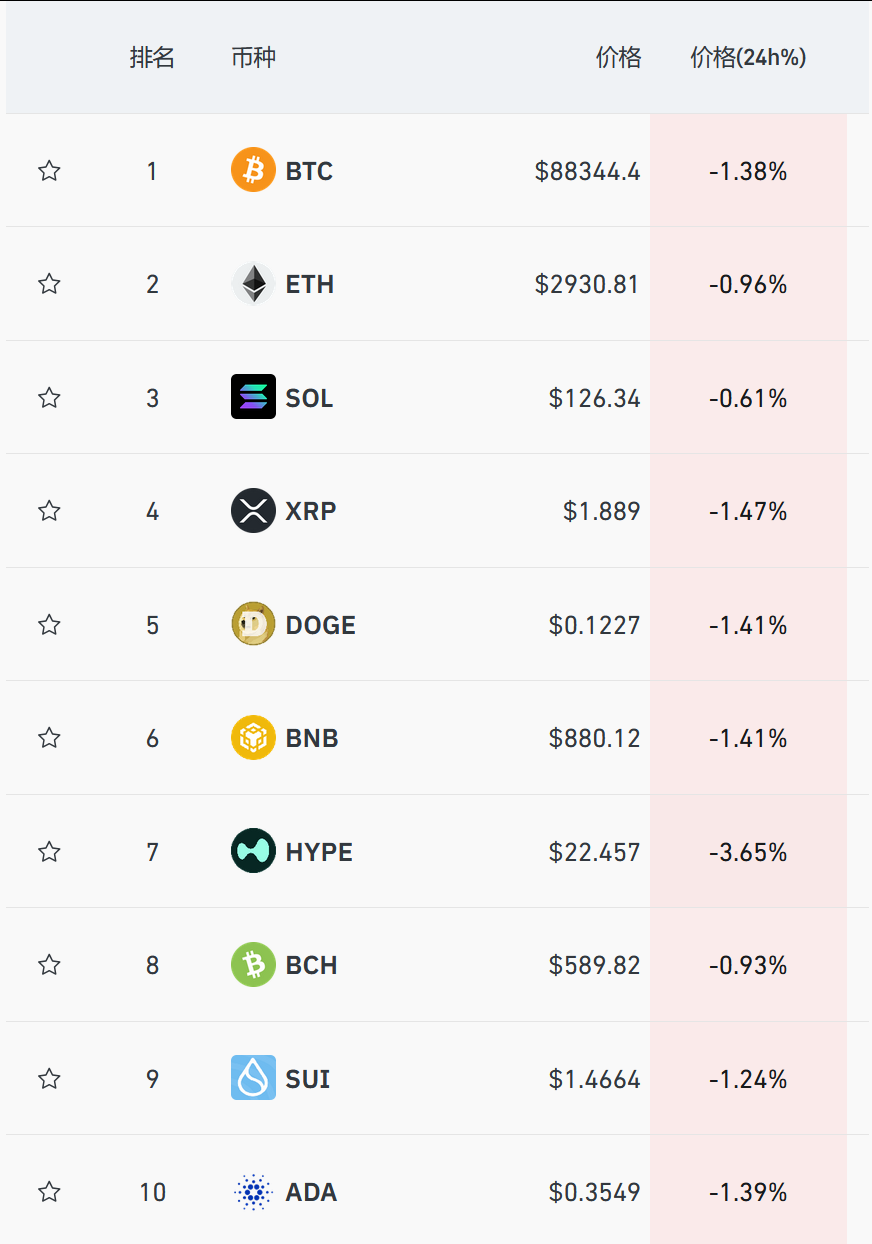
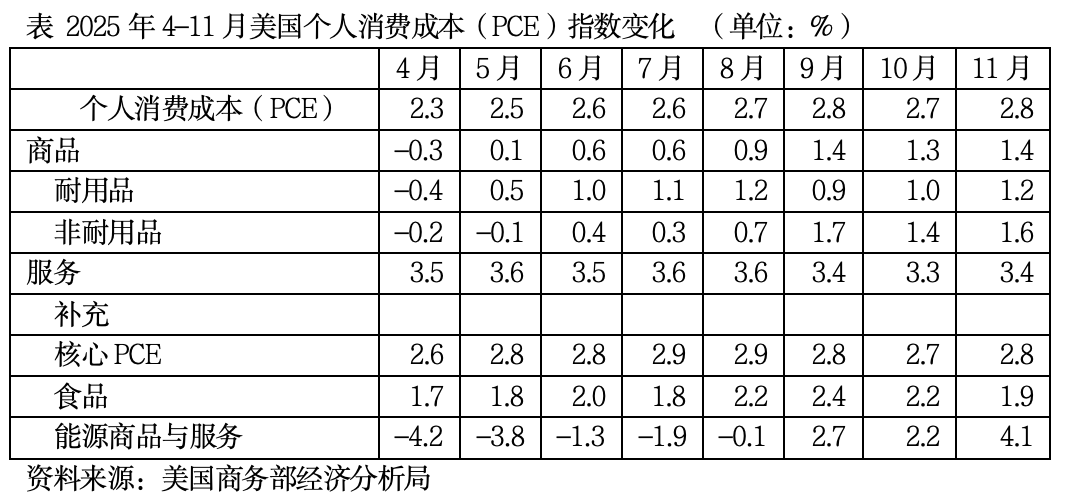
Group 1: Federal Reserve and Interest Rates - The Federal Reserve is expected to pause interest rate cuts during the upcoming meeting on January 27-28, with a 95.6% probability of maintaining current rates and only a 4.4% chance of a 25 basis point cut [1] - The market's anticipation of the Fed's decision is influenced by recent employment and inflation data, which show mixed signals regarding the economic outlook [4][9] Group 2: Cryptocurrency Market - The cryptocurrency market continues to decline, with Bitcoin experiencing a 7.3% drop this week, bringing its year-to-date gains close to zero [1] - Ethereum has fallen below $3,000, and other cryptocurrencies like BNB and Dogecoin have also seen declines of around 1% [1][2] - Nearly 100,000 traders faced liquidation in the last 24 hours, with total liquidation amounts reaching $121 million [1] Group 3: Economic Indicators - The latest PCE data indicates that the U.S. inflation rate remains elevated, with the November PCE index rising 2.8% year-over-year, aligning with expectations [4][5] - Core PCE, excluding food and energy, also rose by 2.8%, indicating persistent inflationary pressures that are far from the Fed's long-term target of 2% [4][5] Group 4: Government Debt and Fiscal Policy - The U.S. government debt has reached $38.65 trillion, with plans to increase military spending by over 50% compared to the previous fiscal year [8] - The government's fiscal policies, including cuts to food and green energy subsidies, are raising concerns about long-term sustainability and could lead to a shift in investment preferences away from U.S. assets [8] Group 5: Technology Sector Performance - The technology sector is facing a downturn, with major companies like META and Microsoft experiencing significant stock price declines following earnings reports [7][9] - The performance of AI stocks has been mixed, with some leading companies seeing substantial losses, while others like Google have gained [7] - The upcoming earnings reports from tech giants will be crucial in determining market adjustments and investor sentiment [9]
比房子、金子更重要?若发生严重通胀,这样的东西才是无价之宝
Sou Hu Cai Jing· 2026-01-25 13:43
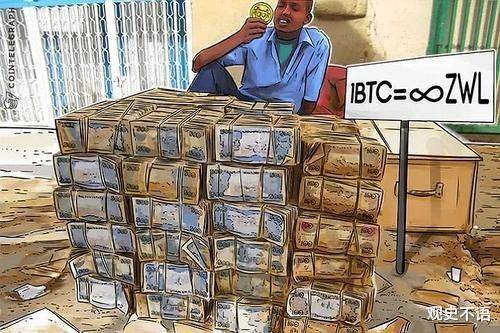
首先,通货膨胀时期没人会愿意用如此高昂的代价去买房。其次,现在的房地产市场早已不像几年前那般火爆,而且在政府的宏观调控下,房价的涨幅已被 大大遏制,想要出现大幅波动几乎不可能。在一线和二线城市,房价或许还会有一定的变动,但对于三四线城市而言,房产根本无法与严重的通货膨胀抗 衡。 通货膨胀,作为一个时常出现在人们日常对话中的话题,总能在某些特定时刻引发广泛关注。每当某些国家或地区遭遇严峻的通货膨胀危机,经济形势便会 迅速变得复杂。无论是上世纪九十年代的美国,战时的中国,还是最近发生的津巴布韦经济危机,历史上曾有过多次不同程度的通货膨胀事件。事实上,通 货膨胀就像一个隐形的影子,时刻伴随着我们的生活,虽大多数时候只是表现为平常的通胀,而不会导致灾难性的后果。 然而,当下我们正处于一个全球性通货膨胀的周期之中,粮食、石油、天然气等商品的价格几乎都在不断攀升。与此同时,不仅是新兴经济体,欧美发达国 家也在经历着严重的通货膨胀,其影响已经蔓延到全球的经济格局。在这样的大环境下,我国的通货膨胀也开始显现出一些苗头。很多人不禁会问:如果严 重的通货膨胀再度袭来,我们究竟该如何准备? 不可否认,严重的通货膨胀无疑会对我们的日 ...
美国通涨压力依旧,美股市场仍在寻找方向
Sou Hu Cai Jing· 2026-01-25 08:39
Market Overview - The U.S. stock market experienced volatility, with the S&P 500 index down 0.35%, the Dow Jones down 0.53%, and the Nasdaq down 0.06% over the week [1] - The U.S. 10-year Treasury yield rose to 4.239%, reflecting a 0.19% increase, while gold and silver futures saw significant gains of 8.36% and 14.45%, respectively [1] Economic Indicators - The U.S. Commerce Department reported a better-than-expected Q3 GDP, with personal consumption contributing 2.34%, the highest since Q1 2022 [4] - The core Personal Consumption Expenditures (PCE) price index rose to 2.8%, the highest level since November 2023, indicating persistent inflationary pressures [2][4] Sector Performance - The technology sector, particularly AI stocks, has seen a decline, with major companies like META and Microsoft experiencing significant drops of 12.4% and 14%, respectively [5] - In contrast, industrial, materials, and energy sectors showed positive performance, with increases of 14.7%, 14.5%, and 12.1% [5] Government Fiscal Policy - The U.S. government debt has reached $38.65 trillion, with plans to increase military spending by over 50% to $1.5 trillion, raising concerns about fiscal sustainability [6] - The Treasury Department's proposal to tax foreign official institutions on Treasury yields may lead to a shift away from dollar-denominated assets [6] Future Outlook - The upcoming earnings reports from tech giants will significantly influence market adjustments, with the Federal Reserve's policy statement on January 29 being a key focus for investors [7] - Geopolitical issues, including the Greenland acquisition and ongoing tensions in Ukraine, are expected to impact market sentiment and financial stability [7][8]
土耳其里拉暴跌,国内通货膨胀高达30%,遭遇股汇债三杀
Sou Hu Cai Jing· 2026-01-24 08:11
Group 1 - The core viewpoint of the articles discusses the implications of the appreciation of the Chinese yuan against the US dollar, highlighting both short-term and long-term effects on the export and foreign trade sectors [1] - The current exchange rate is approximately 6.3 yuan per dollar, with predictions that it may drop below 6 yuan by the end of the year, which could impact the price competitiveness of Chinese exports [1] - Despite the yuan's appreciation, the ongoing reliance on Chinese goods due to overseas factory shutdowns from the pandemic has mitigated the negative impact on the export sector [1] Group 2 - The strength of the yuan is attributed to China's relatively stable economic fundamentals compared to the US, where excessive money printing has raised concerns about the dollar's future [1] - The article contrasts the situation in Turkey, where the lira has depreciated over 50% against the dollar in six months, leading to severe economic consequences, including a significant drop in GDP per capita [1] - The rapid depreciation of the lira has resulted in inflation exceeding 30%, with the Turkish government struggling to address the crisis through wage increases that may exacerbate inflation [1][3] Group 3 - The Federal Reserve is expected to raise interest rates at least three times in the coming year to combat 7% inflation in the US, which could have adverse effects on other economies, particularly Turkey [3] - The global economic cycle is influenced by US monetary policy, with Turkey's currency and debt crisis being highlighted as a potential victim of this global monetary storm [3]
日本央行为何维持利率不变?
2 1 Shi Ji Jing Ji Bao Dao· 2026-01-23 23:20
Core Viewpoint - The Bank of Japan (BOJ) decided to maintain its policy interest rate at 0.75%, reflecting a careful balancing act amid concerns over fiscal deterioration and market pressures following the government's announcement of tax cuts and increased spending ahead of the upcoming elections [1][4]. Monetary Policy - The BOJ's decision to keep the interest rate unchanged is seen as a demonstration of the central bank's independence, which is crucial for price stability [5]. - The BOJ's economic outlook report revised core CPI forecasts, increasing the 2025 core CPI from 2.8% to 3% and adjusting GDP growth forecasts for 2025 and 2026 upwards, while slightly lowering the 2027 growth forecast [2]. Economic Context - The Japanese government announced plans for tax cuts and increased fiscal spending, leading to concerns about further fiscal deterioration and a subsequent drop in bond prices [1][3]. - The Japanese yen has been depreciating against the dollar and euro, with the exchange rate reaching historical lows, although the overall dollar depreciation against other currencies may mitigate further yen declines [3]. Market Reactions - The market had anticipated the BOJ's decision to maintain the interest rate, resulting in a muted reaction; however, this does not alleviate the downward pressure on Japanese government bond prices and the yen [4]. - The BOJ's previous interest rate hike in December was insufficient to halt the yen's depreciation trend, as the increase was modest and did not meet market expectations for a neutral rate adjustment [4]. Political Environment - The dissolution of the Japanese House of Representatives marks a significant political event, with elections scheduled for February 8, raising uncertainties about potential government interventions in the market during this transitional period [3][5].
Worried Inflation Will Wreck Your Retirement? Here Are 2 Things to Do.
Yahoo Finance· 2026-01-23 20:08
Core Insights - Inflation is a persistent concern affecting both workers and retirees, with a recent Consumer Price Index indicating a 2.7% annual increase in December, which, while not extreme, contributes to cumulative cost pressures [2][8] Investment Strategies - It is crucial for retirees to invest in a diversified portfolio that includes bonds, dividend stocks, and real estate investment trusts to generate consistent income and mitigate the impact of rising costs [5][9] - Delaying Social Security benefits can significantly increase monthly checks, with an 8% increase for each year benefits are postponed past full retirement age, leading to larger cost-of-living adjustments [6][7]
12月份通货膨胀加剧,食品价格上涨推高生活成本
Shang Wu Bu Wang Zhan· 2026-01-23 16:36
Core Insights - Inflation in Sri Lanka increased slightly in December 2025, with the Consumer Price Index (CPI) rising to 210.5, up 1.57% from November [1] - The rise in CPI was primarily driven by food prices, which increased by 1.55%, while non-food prices saw a minimal increase of 0.02% [1] Food Prices - Key food items contributing to the CPI increase included vegetables, green peppers, fresh fish, and onions, while prices for eggs, chicken, potatoes, dried chili, coconut oil, dried fish, chili powder, coconut, and rice flour saw smaller increases [1] - Some food items, such as lime, fresh fruits, sugar, ginger, and mung beans, experienced slight price declines [2] Non-Food Prices - Non-food price increases were modest, with dining, hotel, and medical services rising by 0.01% [2] - Other non-food categories, including housing, communication, education, and entertainment, remained stable, while furniture and alcohol prices saw slight decreases [2] Year-on-Year Inflation - Year-on-year inflation accelerated to 2.9% in December, up from 2.4% in November, with food inflation rising from 3.6% to 4.4%, indicating upward pressure on essential goods [2] - Non-food inflation increased slightly to 1.6% from 1.5% [2] Contribution to Inflation - Food prices contributed 2.0 percentage points to annual inflation, while non-food prices contributed 0.88 percentage points [3] - Within non-food categories, housing, water, electricity, and other fuels contributed 0.17%, education 0.21%, healthcare 0.11%, and dining and hotels 0.15%, while transportation and cultural entertainment saw price declines of -0.08% and -0.04%, respectively [3] Overall Economic Outlook - Despite relatively moderate inflation, the persistent rise in food prices indicates vulnerabilities in the market for essential goods [3] - December data suggests overall consumer prices remain stable, providing room for monetary and fiscal policy adjustments [3]