
出口退税政策调整

Search documents
光伏价格走势分化
中国能源报· 2026-02-03 08:06
Core Viewpoint - The photovoltaic industry chain is experiencing a phase of price differentiation, with upstream prices under pressure while component and battery prices are on the rise due to various factors including export tax policy adjustments and raw material cost fluctuations [2][4]. Upstream Pressure - The upstream segments, particularly polysilicon and silicon wafers, are in a significant destocking cycle, leading to a downward price trend. Current polysilicon inventory has exceeded 510,000 tons, and despite production cuts by leading companies, the oversupply pressure remains substantial [4]. - Silicon wafer prices are also facing downward pressure, with inventory levels above 22 GW. The high operating rates in the crystal pulling segment have exacerbated supply-side contradictions, and prices have returned to pre-increase levels [5][6]. - The market sentiment is pessimistic, with expectations of further price declines for polysilicon and silicon wafers, as demand from downstream sectors remains weak [5][6]. Midstream Dynamics - In contrast to the upstream, battery prices are rising due to increasing silver prices, with mainstream N-type battery prices reaching around 0.45 yuan per watt. However, actual transaction volumes remain low, indicating limited market acceptance of higher prices [7][8]. - The rising costs driven by silver prices have not effectively translated to demand, as the cancellation of export tax incentives has not significantly boosted battery sales. Many companies are opting to halt purchases to mitigate cost risks [8]. Downstream Recovery - The adjustment of export tax policies and concentrated overseas demand have accelerated the shipment pace of components. The price of TOPCon components has increased for three consecutive weeks, with a current benchmark price of 0.115 USD per watt [10]. - Despite the price increases, the sustainability of this upward trend is uncertain due to potential fluctuations in overseas demand and the impact of rising silver costs on profit margins for component manufacturers [11].


组件价格跟着金属期货价格走 义乌中小光伏企业: 不敢报价接单
Mei Ri Jing Ji Xin Wen· 2026-02-02 03:15
Core Viewpoint - The adjustment of the new energy export tax rebate policy has led to a significant decrease in inquiries from overseas customers, particularly price-sensitive clients from the Middle East, causing challenges for small and medium-sized photovoltaic companies in pricing and order acquisition [1][4]. Group 1: Impact of Policy Changes - The adjustment of the export tax rebate policy has resulted in reduced inquiries from overseas clients, particularly those sensitive to price increases [1]. - The price of photovoltaic components has surged due to rising metal prices, with component prices increasing from approximately 0.6 yuan/watt to 0.9 yuan/watt within a month, marking a nearly 50% increase [4]. - The dual impact of policy changes and market conditions is forcing small and medium-sized photovoltaic companies to reassess their survival strategies [4][10]. Group 2: Cost Structure Changes - The cost structure of photovoltaic components has shifted, with silver prices rising over 200% since 2025, leading to silver paste costs becoming the largest cost component, increasing from 17% to 30% of total costs [7][8]. - The average price of silver reached 30,900 yuan/kg by January 29, 2026, reflecting a significant increase from approximately 7,600 yuan/kg at the beginning of 2025 [8]. - Copper and aluminum prices have also risen, with copper prices increasing by 22.1% and aluminum prices rising by 10% in January 2026 compared to the previous year [8][9]. Group 3: Market Dynamics and Strategies - The current market dynamics have led to a breakdown in pricing mechanisms, resulting in transaction failures and credit losses among companies [4][10]. - Companies are shifting their inventory strategies, opting to clear stock rather than stockpiling, due to fears of price declines that could lead to significant losses [10]. - Some companies are exploring new materials to reduce costs, such as using fiberglass instead of aluminum for component frames, although acceptance in the market remains low [11]. Group 4: Profitability and Business Diversification - With the main business of photovoltaic components nearing zero profit margins, companies are increasingly relying on inverter and energy storage businesses as key profit drivers [11]. - The profitability of energy storage batteries is relatively high, and companies are leveraging foreign trade operations to mitigate the impact of domestic export tax policy changes [11]. - Long-term sustainability for small and medium-sized photovoltaic companies will require developing their own brands and core technologies rather than relying solely on profit from processing and trading [11].
组件价格跟着金属期货走 义乌中小光伏企业:不敢报价接单
Mei Ri Jing Ji Xin Wen· 2026-02-01 12:52
Core Viewpoint - The adjustment of the export tax rebate policy for new energy products has led to a significant decrease in inquiries from overseas customers, particularly those from the Middle East, who are price-sensitive and reluctant to purchase amid rising prices [1][2]. Group 1: Impact of Policy Changes - The adjustment in export tax rebates has created a challenging environment for small and medium-sized photovoltaic (PV) companies, forcing them to reassess their survival strategies due to the dual impact of policy changes and rising metal prices [1][2]. - The price of PV components has surged, with some companies reporting increases from approximately 0.6 yuan/watt to 0.9 yuan/watt, a rise of about 50% within a month, driven by insufficient domestic supply and stockpiling by distributors [2][5]. Group 2: Cost Structure Changes - The cost structure of PV components has shifted dramatically, with silver prices soaring over 200% since 2025, causing silver paste costs to rise from 17% to 30% of total costs, now becoming the largest cost component in PV modules [4][5]. - The average price of silver in January 2026 reached a peak of 30,900 yuan/kg, while copper and aluminum prices also saw significant increases of 22.1% and 10% respectively [4][5]. Group 3: Market Dynamics and Strategies - The current market dynamics have led to a breakdown in pricing mechanisms, resulting in increased instances of contract breaches in the PV industry, particularly as companies struggle to keep up with rapidly changing prices [2][3]. - In response to the pressures of rising costs and policy changes, companies are adopting new inventory strategies, moving away from traditional stockpiling practices to avoid potential losses from price corrections [6][7]. Group 4: Alternative Revenue Streams - With the main business of PV modules nearing zero profit margins, companies are increasingly turning to inverters and energy storage systems as important profit centers, with some reporting significant sales in these areas [6][7]. - Companies are exploring new materials to reduce costs, such as using fiberglass instead of aluminum for module frames, although there are concerns about meeting quality standards [7].
华泰期货:看涨情绪高涨,碳酸锂价格突破18万大关
Xin Lang Cai Jing· 2026-01-26 01:17
Price Movement - The lithium carbonate 2605 contract experienced a "first suppression then rise, strong rally at the end" trend, with prices soaring from 147,600 RMB/ton to 181,520 RMB/ton, an increase of approximately 24.16% [2][8] - The average price of battery-grade lithium carbonate rose from 151,000 RMB/ton at the beginning of the week (January 19) to 164,500 RMB/ton by Thursday (January 22), a total increase of 13,500 RMB/ton [2][8] - The average price of industrial-grade lithium carbonate increased from 147,500 RMB/ton to 161,000 RMB/ton, also a total increase of 13,500 RMB/ton [2][8] Supply Side - According to SMM statistics, some lithium salt manufacturers have begun to schedule maintenance, which is expected to lead to a reduction in output [3][9] - The total weekly output of lithium carbonate was 22,217 tons, down from 22,605 tons the previous week [3][9] - Specific outputs included spodumene-derived lithium carbonate at 13,914 tons (down from 14,124 tons), mica-derived at 2,882 tons (down from 2,936 tons), salt lake-derived at 3,115 tons (down from 3,145 tons), and recycled lithium carbonate at 3,115 tons (down from 3,145 tons) [3][9] Consumption Side - Data from Baichuan indicates that the production of lithium iron phosphate decreased by 20.00% month-on-month, while ternary materials fell by 1.37% [3][9] - The demand for downstream production has increased compared to early month forecasts, but remains down month-on-month [3][9] - The energy storage sector maintains optimistic demand expectations, while the seasonal downturn in power batteries and maintenance schedules at some positive electrode material factories have constrained current procurement demand [3][9] Inventory and Profitability - Current spot inventory stands at 108,896 tons, a decrease of 783 tons month-on-month [4][10] - Smelter inventory is at 19,834 tons (up 107 tons), while downstream inventory is at 37,592 tons (up 1,940 tons), and other inventory is at 51,470 tons (down 2,830 tons) [4][10] - Despite a generally sufficient total import of lithium ore, miners' willingness to maintain prices is strong, leading to rising costs for companies relying on external raw materials, which supports lithium carbonate prices [4][10] Market Strategy - The current price increase relies on supply disruptions and demand front-loading; if supply recovers or demand is overstretched, prices may easily adjust [5][11] - A range-bound trading strategy is recommended, focusing on consumption and inventory turning points, with considerations for selling high to hedge [5][11]

光伏、电池出口退税将取消 对相关新能源金属品种影响几何
Qi Huo Ri Bao· 2026-01-26 00:39
Core Viewpoint - The Ministry of Finance and the State Taxation Administration announced the cancellation of VAT export rebates for certain products, including photovoltaic (PV) products, starting April 1, 2026, marking a significant policy shift that has raised concerns across the industry chain [1][7]. Group 1: Policy Changes - The export VAT rebate for PV products will be completely canceled from April 1, 2026, and the rebate rate for battery products will be reduced from 9% to 6% until December 31, 2026, after which it will also be eliminated [7]. - The export rebate policy for PV products began in October 2013, with rates gradually decreasing over the past two years, indicating a transition towards the complete removal of such subsidies [7]. Group 2: Industry Impact - The cancellation of export rebates is expected to fundamentally change the cost structure for PV products, increasing export prices by approximately 8% to 10%, which may weaken China's competitive edge in markets like Europe, the U.S., and Southeast Asia [9][10]. - Despite the anticipated increase in costs, the expected export volume of PV components for 2024 and 2025 remains relatively stable, suggesting that the immediate impact on export quantities may be limited [10]. Group 3: Market Dynamics - The cancellation of export rebates is likely to lead to a surge in domestic procurement of polysilicon, with estimates suggesting a 20% increase in monthly procurement in Q1 2026 compared to Q4 2025, driven by companies rushing to secure orders before the policy takes effect [10][12]. - The overall market for industrial silicon, a key upstream material for polysilicon production, is expected to face dual pressures from expanding capacity and slowing demand growth, leading to a potential decline in utilization rates and prices [13]. Group 4: Lithium Battery Sector - The export rebate for lithium battery products will also be gradually reduced, with a decrease from 13% to 9% effective December 1, 2024, and a further reduction to 6% in 2026, which may lead to increased costs for battery manufacturers [14][15]. - Despite the cost pressures, the demand for lithium batteries is expected to remain strong due to robust overseas demand, potentially leading to a short-term boost in export volumes [14][15].
产品单价、出口退税率双双下滑,野马电池2025年净利最高预降70%
Shen Zhen Shang Bao· 2026-01-23 15:19
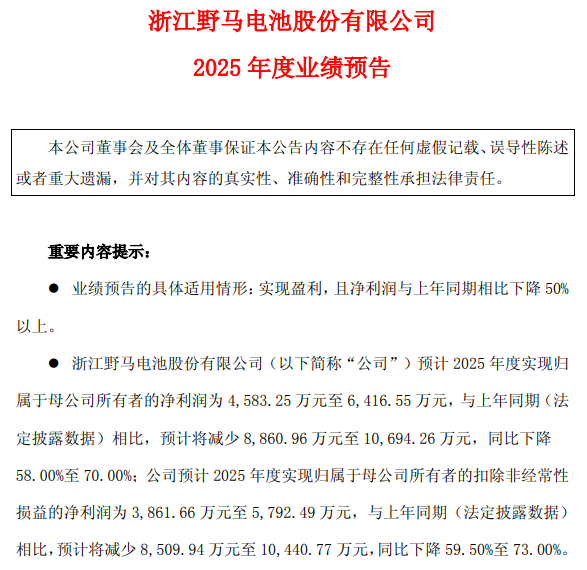
Core Viewpoint - Yema Battery (605378) forecasts a significant decline in net profit for the year 2025, estimating a drop of 58% to 70% compared to the previous year [1][4]. Financial Performance Summary - The company expects its net profit attributable to shareholders to be between 45.83 million and 64.17 million yuan for 2025, a decrease of 88.61 million to 106.94 million yuan from the previous year, representing a year-on-year decline of 58% to 70% [4]. - The forecasted net profit after excluding non-recurring gains and losses is projected to be between 38.62 million and 57.92 million yuan, down by 85.10 million to 104.41 million yuan from the previous year, indicating a decline of 59.50% to 73% [4]. - In the previous year, the company reported a total profit of 175.65 million yuan, with a net profit attributable to shareholders of 152.78 million yuan, and a net profit after excluding non-recurring gains and losses of 143.02 million yuan [4]. Reasons for Performance Changes - The decline in performance is attributed to increased market competition and industry trends, leading to a decrease in sales prices for some products [5]. - Rising commodity prices in the second half of 2025 are expected to exert pressure on the company's cost structure [5]. - Changes in export tax rebate policies, with the rebate rate dropping from 13% to 9%, have increased cost pressures in the export segment, contributing to a decrease in product gross margins [5]. - Fluctuations in the RMB exchange rate have also impacted performance, as the company's export products are priced in USD, and the appreciation of the RMB since April 2025 has led to reduced revenue when converted to RMB [5]. Recent Financial Results - For the first three quarters of 2025, the company reported revenue of 1.028 billion yuan, an increase of 8.15% year-on-year, while net profit attributable to shareholders was 54.66 million yuan, a decrease of 53.24% [6][7]. - In the third quarter alone, revenue was 443.44 million yuan, up 4.37% year-on-year, but net profit fell to 24.03 million yuan, down 50.58% [6][7]. - The operating cash flow for the first three quarters was 26.45 million yuan, reflecting a decline of 54.99% [9].

交易所出手:调整涨跌停板
Zhong Guo Ji Jin Bao· 2026-01-23 14:35
Core Viewpoint - The Shanghai Futures Exchange (SHFE) announced adjustments to the trading rules for nickel, lead, and zinc futures, effective January 27, 2026, which includes changes to price limits and margin requirements [1][4]. Group 1: Adjustments to Futures Contracts - Nickel futures will have a price limit adjustment to 10%, with the margin for hedging positions set at 11% and for general positions at 12% [4][5]. - Aluminum, lead, and zinc futures will see their price limit adjusted to 8%, with hedging margin at 9% and general margin at 10% [4][5]. - Stainless steel futures will have a price limit of 6%, with hedging margin at 7% and general margin at 8% [4][5]. Group 2: Market Reactions and Implications - Following the announcement, nickel prices surged nearly 4% in the afternoon session, influenced by Indonesia's potential approval of a significant nickel ore production quota of approximately 260 million tons by 2026 [5][7]. - Nickel has been notably absent from the recent bull market in non-ferrous metals, with only a 3% increase since the beginning of 2024, contrasting sharply with gains in precious metals and other industrial metals [7]. - The cancellation of export tax rebates for certain lithium battery materials starting April 1, 2026, is prompting companies in the ternary materials sector to adjust production schedules, anticipating a surge in exports in the first quarter [7]. Group 3: Strategic Developments in Trading Rules - The adjustments to trading rules are part of a broader initiative to enhance the linkage between spot and futures markets, aiming to align SHFE's regulations more closely with international exchanges like LME and CME [8]. - The increase in price limits is intended to provide more room for market sentiment while the higher margin requirements are expected to raise speculative costs, potentially leading to a shift of short-term funds towards industrial clients and professional institutions [8].
中泰化学:2026年公司抢抓一季度出口窗口期,预计短期出口量增加
Zheng Quan Ri Bao Zhi Sheng· 2026-01-23 14:13
Core Viewpoint - The Ministry of Finance and the State Administration of Taxation announced the cancellation of export tax rebates for polyvinyl chloride (PVC) products starting April 1, 2026, which will not significantly impact the company's normal operations [1] Company Summary - In 2025, the company's PVC export revenue accounted for 3.6% of total operating revenue [1] - The cancellation of the export tax rebate is expected to lead to an increase in export costs for PVC, prompting the company to optimize its production capacity and enhance competitiveness in the long term [1] Industry Summary - The cancellation of export tax rebates is anticipated to accelerate adjustments within the industry, leading to structural changes [1] - The company plans to seize the export window in the first quarter of 2026, expecting a short-term increase in export volume [1]

供应预期偏紧 碳酸锂高位震荡
Qi Huo Ri Bao· 2026-01-23 00:43
Group 1 - The core viewpoint of the article highlights the increasing volatility in the lithium carbonate market, with the main contract experiencing a significant rise of over 30% year-to-date as of January 22, 2026, and total market funds exceeding 30 billion yuan [1] Group 2 - Supply-side uncertainties are driving the pricing logic in the lithium carbonate market, particularly due to tightening environmental regulations affecting lithium mica mining in Jiangxi province. The recent solid waste management action plan from the State Council restricts the approval of mining projects without self-built mines and tailings disposal facilities, raising concerns about future supply stability [2] - The price of lithium spodumene concentrate (CIF China) has reached 2,130 USD/ton as of January 22, 2026, reflecting an increase of 582 USD/ton since the beginning of the year, indicating strong cost support for lithium carbonate futures amid tight supply expectations [2] Group 3 - Demand for lithium carbonate remains robust despite the traditional off-season, driven by preemptive consumption expectations due to policy changes. The announcement regarding the adjustment of export tax rebate policies for photovoltaic and battery products has led to increased orders from battery companies and overseas clients in the first quarter to secure existing tax benefits [3] - Positive signals from overseas electric vehicle markets, such as Canada's quota and tariff reductions on Chinese electric vehicles and Germany's plans to reinstate electric vehicle subsidies, are expected to bolster demand in the lithium battery supply chain [3] Group 4 - The rapid increase in lithium prices has disrupted price transmission within the supply chain, intensifying operational pressures on upstream and downstream companies. New regulatory measures implemented by the exchange aim to curb market overheating and speculation, including increased transaction fees and limits on daily opening positions for certain contracts [4] - The inability to pass on high costs to the battery cell segment has led to a general reluctance among downstream cathode material manufacturers to accept current high lithium carbonate prices, resulting in a cautious market with low actual transaction volumes [4]
银河期货航运日报-20260122
Yin He Qi Huo· 2026-01-22 10:15
Report Summary 1. Investment Rating No investment rating for the industry is provided in the report. 2. Core View The spot freight rate is in a downward channel, with the near - month futures market remaining volatile. However, due to geopolitical factors, the expectation of full - scale resumption of the European route in the first half of the year is weak, and the far - month contracts are slightly stronger. The export tax rebate may slow down the decline of spot freight rates but is unlikely to reverse the trend. The market is divided on the intensity of the potential pre - policy rush of shipments, and the subsequent spot booking situation needs to be monitored [6][7]. 3. Summary by Section Container Shipping - Freight Index (European Route) - **Futures Market Data**: On January 22, 2026, for different EC contracts, the closing prices, price changes, price change rates, trading volumes, trading volume change rates, open interests, and open interest change rates are presented. For example, EC2602 closed at 1,707.6, up 0.4 (0.02%), with a trading volume of 748.0 (down 3.86%) and an open interest of 4,681.0 (down 8.32%) [4]. - **Spread Structure**: The spreads between different contracts and their changes are given. For instance, the spread between EC02 - EC04 was 570, down 7.6 [4]. - **Container Freight Rates**: Weekly container freight rates, including SCFIS and SCFI for various routes, show different trends. SCFIS European route was at 1954.19 points, down 0.11% week - on - week and 29.89% year - on - year. SCFI: Shanghai - Europe was at 1676 USD/TEU, down 2.50% week - on - week and 41.21% year - on - year [4]. - **Fuel Costs**: WTI crude oil near - month was at 60.45 dollars/barrel, up 1.68% week - on - week and down 19.52% year - on - year. Brent crude oil near - month was at 64.62 dollars/barrel, up 1.86% week - on - week and down 17.6% year - on - year [4]. Market Analysis and Strategy Recommendation - **Market Analysis**: Spot freight rates are in a downward trend during the off - season. The 04 contract has a discount. The high spot settlement price is due to ship delays in January, and the index is expected to decline. The spot freight rate inflection point has emerged, and the market is divided on the intensity of the potential pre - policy rush of shipments. Geopolitical uncertainties make it difficult for large - scale resumption of the European route in the first half of the year [6][7]. - **Trading Strategies**: For unilateral trading, it is recommended to wait and see due to many short - term disturbances in the 04 contract and market divergence on the rush of shipments. For arbitrage, it is recommended to hold the 6 - 10 long - short spread [8][9]. Industry News - Trump stated at the Davos World Economic Forum that the US has no intention of using excessive force to acquire Greenland and will not implement the planned European tariff measures on February 1. - The European Parliament's International Trade Committee Chairman announced an indefinite freeze on the review of the EU - US trade agreement, and Denmark rejected Trump's negotiation request regarding Greenland [10][12]. Related Attachments The report includes multiple figures showing various shipping indices and container freight rates, such as SCFIS European and US West lines, SCFI comprehensive index, and container freight rates for different routes [13][16][19].