国家自主贡献

Search documents
新一轮国家自主贡献意味着什么?看专家解读
Ren Min Ri Bao· 2025-10-10 23:08
Core Points - China's new round of Nationally Determined Contributions (NDCs) aims for a 7%-10% reduction in greenhouse gas emissions from peak levels by 2035, with a focus on achieving even better results [1][2] - Non-fossil energy consumption is targeted to exceed 30% of total energy consumption, with wind and solar power capacity expected to reach over 360 million kilowatts, six times the 2020 level [1][2] - The new NDCs include qualitative goals such as making new energy vehicles the mainstream of new vehicle sales and establishing a nationwide carbon trading market covering major high-emission industries [2][3] Summary by Categories Emission Reduction Goals - The NDCs represent a significant shift from intensity control to total emission control, marking the first time China has set absolute reduction targets for all greenhouse gases across the entire economy [2][3] - The new targets reflect China's commitment to addressing climate change and provide a clear direction for the country's green and low-carbon transformation [2][3] Energy and Renewable Resources - China aims to increase the share of non-fossil energy in primary energy consumption to over 30% and achieve a total installed capacity of wind and solar power that is six times that of 2020 [2][5] - The country has built the world's largest and fastest-growing renewable energy system, supplying over 80% of global photovoltaic components and 70% of wind power equipment [5] Carbon Trading and Market Development - China has established the largest carbon trading market globally, covering over 60% of national carbon emissions, with recent expansions to include industries such as steel, cement, and aluminum [5] - The carbon market's development is seen as a crucial step in enhancing the effectiveness of carbon emission management [5] International Cooperation and Climate Governance - The new NDCs are expected to boost international confidence in global climate governance and highlight China's leadership role in international climate action [4][7] - Achieving these goals will require a fair international environment, stable cooperation, and mutual trade relations, emphasizing the need for global collaboration in addressing climate change [7]
为全球气候治理合作注入更多正能量
Ren Min Ri Bao· 2025-10-10 00:51
Core Points - China aims to reduce its total greenhouse gas emissions by 7%-10% from peak levels by 2035, marking a significant shift from intensity control to total control of carbon emissions [1][2] - The new targets include increasing the share of non-fossil energy consumption to over 30%, expanding wind and solar power capacity to six times that of 2020, and achieving a forest stock of over 24 billion cubic meters [1][2] - The announcement reflects China's commitment to global climate governance and its role as a responsible major country [2][4] Group 1: National Contribution Goals - The "1+3+3" framework combines qualitative and quantitative targets, with the first goal being the reduction of total greenhouse gas emissions [2] - The three quantitative indicators represent an enhancement of previous 2030 targets, showcasing China's intensified efforts to combat climate change [2][3] - New qualitative indicators include making new energy vehicles the mainstream of new vehicle sales and establishing a nationwide carbon trading market covering major high-emission industries [2][3] Group 2: Global Climate Governance - The new national contribution is expected to boost international confidence in climate governance and enhance global cooperation [4] - China's renewable energy system is the largest and fastest-growing globally, providing over 80% of the world's photovoltaic components and 70% of wind power equipment [4] - The country has made significant progress in implementing its 2030 national contributions, with a continuous decline in carbon emissions per unit of GDP [4][5] Group 3: Challenges and Future Directions - Achieving the 2035 targets will require substantial efforts from China and a favorable international environment [6][7] - Experts emphasize the need for technological innovation and policy guidance to facilitate the transition to low-carbon energy sources [7] - The realization of national contribution goals depends on fair international conditions, stable cooperation, and secure supply chains [7]
为全球气候治理合作注入更多正能量(美丽中国)
Ren Min Ri Bao· 2025-10-09 22:22
Core Points - China has announced a new round of Nationally Determined Contributions (NDCs) aiming for a 7%-10% reduction in greenhouse gas emissions from peak levels by 2035, with a focus on achieving more ambitious targets [1][2][3] - The NDCs include a qualitative and quantitative framework termed "1+3+3," which encompasses absolute reduction targets and specific indicators for non-fossil energy consumption, renewable energy capacity, and forest carbon stocks [2][3] - The new targets signify a shift from intensity control to absolute control of carbon emissions, marking a significant step in China's climate strategy [2][4] Group 1: NDC Goals and Framework - The new NDCs cover all economic sectors, including energy, industry, transportation, and agriculture, and include non-CO2 greenhouse gases like methane and nitrous oxide [4] - The qualitative indicators include making new energy vehicles the mainstream in sales and establishing a nationwide carbon trading market covering major high-emission industries [2][4] - The targets are designed to align with China's long-term development strategy while addressing complex domestic and international factors [3][4] Group 2: Progress and Achievements - China has made significant progress in implementing its 2030 NDCs, establishing the world's largest renewable energy system and reducing the cost of wind and solar power generation [6] - The country has achieved a 19.8% share of non-fossil energy in primary energy consumption ahead of the 2030 target, and has built the largest carbon trading market covering over 60% of national emissions [6][5] - Experts emphasize the importance of technological innovation and international cooperation in achieving the new NDC goals [8][6] Group 3: Challenges and Future Directions - Achieving the 2035 NDCs will require substantial efforts from China, alongside a favorable international environment [7][8] - There is a need for further research on climate adaptation strategies, as well as coordination of policies and funding to address climate risks [7][8] - Experts advocate for a collaborative global approach to climate change, emphasizing the need for fair trade and stable international relations to support low-carbon transitions [8]
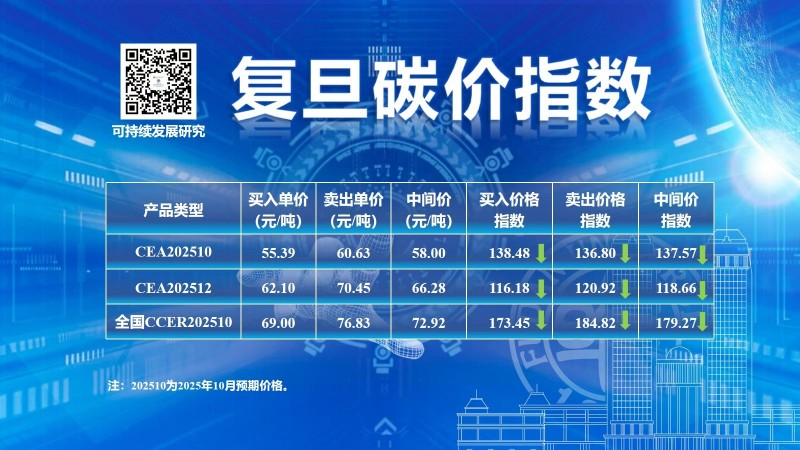
复旦大学可持续发展研究中心:9月全国碳市场放量下跌
Cai Fu Zai Xian· 2025-09-29 07:36
Core Insights - The Fudan University Sustainable Development Research Center released the carbon price index for October 2025, including national carbon emission allowance (CEA) prices, voluntary carbon market (CCER) prices, and green electricity certificate (GEC) prices [1][2]. CEA and CCER Price Indices - The expected buying price for CEA in October 2025 is 55.39 CNY/ton, with a selling price of 60.63 CNY/ton, resulting in a midpoint price of 58.00 CNY/ton. The buying price index decreased by 19.09%, and the selling price index decreased by 16.23% [2][3]. - For December 2025, the expected buying price for CEA is 62.10 CNY/ton, with a selling price of 70.45 CNY/ton, leading to a midpoint price of 66.28 CNY/ton [2][3]. - The expected buying price for CCER in October 2025 is 69.00 CNY/ton, with a selling price of 76.83 CNY/ton, resulting in a midpoint price of 72.92 CNY/ton. The buying price index decreased by 7.75%, and the selling price index decreased by 9.29% [2][3]. GEC Price Indices - The expected price for green certificates (GEC) for centralized projects produced in 2024 is 3.11 CNY/unit, with a price index of 62.79. For distributed projects, the price is 2.82 CNY/unit (index 53.87), and for biomass power generation, it is 1.84 CNY/unit (index 40.88) [4][5]. - For 2025 production, the expected price for centralized projects is 5.45 CNY/unit (index 99.09), for distributed projects is 5.20 CNY/unit (index 105.51), and for biomass projects is 5.55 CNY/unit (index 107.56) [4][5]. Market Activity in September - In September, the average closing price for CEA was 62.94 CNY/ton, down 11.5% from August's average of 71.12 CNY/ton. The price fluctuated from 69.41 CNY/ton at the beginning of the month to 59.16 CNY/ton by the end [6]. - The average daily trading volume for carbon allowances increased to 136.78 million tons, a 90% increase compared to August's 71.95 million tons, indicating heightened market activity [6]. - The announcement of China's 2035 national contributions reflects a comprehensive approach to low-carbon development, emphasizing China's role in global climate governance [6]. Global Carbon Market Trends - In September, global carbon market trading volumes generally increased, with the EU market seeing a 30.02% rise in average daily trading volume, while the Korean market experienced a 49.10% decline [7]. - The EU carbon market's average price rose from 86.18 USD/ton to 88.90 USD/ton, while the UK market's price increased from 73.04 USD/ton to 75.99 USD/ton [7].

中金 • 联合研究 | 解读我国最新国家自主贡献:减排力度不降,彰显大国担当
中金点睛· 2025-09-29 01:45
Core Viewpoint - The article discusses China's new Nationally Determined Contributions (NDC) announced by President Xi Jinping, emphasizing a commitment to reduce greenhouse gas emissions by 7%-10% from peak levels by 2035, alongside significant targets for renewable energy and carbon market development [12][40]. Summary by Sections Nationally Determined Contributions (NDC) - The new NDC sets a target for non-fossil energy consumption to account for over 30% of total energy consumption by 2035, with wind and solar power capacity reaching 360 million kilowatts [12][13]. - The NDC reflects a shift from intensity-based targets to absolute emission reduction goals, indicating a more comprehensive approach to climate change [27][28]. Emission Reduction Goals - It is estimated that from 2026 to 2035, China's carbon intensity needs to decrease by approximately 5% annually, which is an increase from the previous decade's average of 3.3% [6][19]. - By 2035, total carbon emissions are projected to return to levels between 10.2 to 10.5 billion tons, aligning with 2022 figures [19][26]. Green Investment and Economic Impact - To achieve the new NDC targets, it is estimated that China will require green investments of 36-38 trillion yuan from 2026 to 2035, averaging about 3.6-3.8 trillion yuan annually, potentially boosting GDP growth by 1.5-2% [26][27]. - The green investment demand will primarily focus on the renewable energy sector, which is expected to account for 28-30 trillion yuan of the total investment [26]. Industry Insights Utilities Sector - The renewable energy installation target suggests a strategic reserve for applications, with an expected addition of 1.3 to 1.8 million kilowatts annually from 2026 to 2035 [8][34]. - The focus will shift towards high-quality development and better matching of supply and demand in the energy sector [36]. New Energy Equipment - By 2035, the total installed capacity for wind and solar energy is expected to exceed 3600 GW, necessitating advancements in energy storage and grid infrastructure to manage the increased load [9][38]. - The storage sector is moving towards a mature commercial model, with significant investments anticipated to enhance project economics [38][39]. Automotive Sector - The penetration rate of new energy vehicles (NEVs) is projected to exceed 50% by 2025, with a strong growth trajectory supported by government policies [40][41]. - The government plans to allocate 138 billion yuan to support NEV sales, indicating continued policy backing for the sector [42]. Carbon Market Development - The new NDC extends the carbon market's coverage to include major high-emission industries, with a roadmap for development through 2035 [30][31]. - The carbon market is expected to evolve, incorporating a wider range of greenhouse gases and enhancing the effectiveness of carbon pricing mechanisms [31][32].

习近平主席视频致辞为全球气候治理指引方向凝聚力量
Xin Hua Wang· 2025-09-28 00:43
Group 1 - The core message of Xi Jinping's speech emphasizes China's commitment to global climate governance and its role as a leader in addressing climate change, highlighting the importance of collective action and cooperation among nations [1][2][7] - Xi Jinping announced a new round of national contributions, marking a significant milestone in China's climate action efforts, which has garnered positive reactions from international leaders and experts [4][5][6] - The speech underscores the need for fairness and respect for developing countries' rights in the global green transition, aiming to reduce rather than exacerbate the North-South divide [3][8] Group 2 - The call for international collaboration in green technology and industry is crucial for bridging the green capacity gap and ensuring the free flow of quality green products globally [3][4] - China's ambitious targets, including the goal of becoming a climate-adaptive society by 2035, are seen as both a national commitment and a model for other countries [5][6] - The speech reflects a strategic vision for global climate governance, emphasizing the importance of multilateralism and international cooperation in tackling climate change challenges [7][8]
首次覆盖全经济范围 我国提出一揽子应对气候变化目标
Yang Shi Xin Wen· 2025-09-27 03:45
Core Points - China has officially announced its 2035 Nationally Determined Contribution (NDC) at the UN Climate Change Summit, marking a new journey in addressing climate change and contributing positively to the long-term goals of the Paris Agreement [1][3] - The 2035 targets include a 7%-10% reduction in greenhouse gas emissions from peak levels, a non-fossil energy consumption share of over 30%, and a significant increase in installed capacity for wind and solar power [1][2] Group 1 - The 2035 NDC represents a historic shift from relative to absolute emission reduction targets, establishing a comprehensive action plan that includes energy and industrial transformation, as well as policy innovation [1][3] - China aims to build a climate-resilient society and has implemented the National Climate Change Adaptation Strategy 2035 during the 14th Five-Year Plan period, focusing on long-term adaptation goals and pilot projects [2][3] Group 2 - China's commitment to the 2035 NDC reflects its role as a responsible major power, enhancing global climate governance stability and confidence amid rising challenges [3][4] - The new targets are expected to generate substantial green investment and job opportunities, while also reducing global transition costs [3][4] - China has engaged in South-South cooperation on climate change with 42 developing countries, signing 54 agreements and conducting over 70 projects to enhance their climate response capabilities [3][4]
我国宣布2035年国家自主贡献 开启应对气候变化新征程
Xin Hua She· 2025-09-26 17:25
Core Viewpoint - China has announced a new round of national contributions to climate change, marking a significant shift towards absolute reduction targets for greenhouse gas emissions across the entire economy, which will contribute positively to the long-term goals of the Paris Agreement [1][2][6]. Group 1: National Contribution Goals - The new 2035 national contribution target includes a reduction of greenhouse gas emissions by 7%-10% from peak levels, representing a major transition from intensity control to total volume control [2][3]. - The "1+3+3" framework combines qualitative and quantitative targets, with three new qualitative indicators introduced, including the development of a carbon trading market and the establishment of a climate-adaptive society [2][3]. Group 2: Climate Adaptation and Resilience - By 2035, China aims to establish a climate-adaptive society, enhancing monitoring and risk management capabilities related to climate change [4]. - The construction of a climate-adaptive society is seen as essential for ensuring public safety and promoting harmony between humans and nature, providing a model for global responses to climate risks [4]. Group 3: Global Climate Governance - The announcement is expected to boost international confidence in climate governance and strengthen global cooperation in addressing climate change [6][7]. - Achieving these new targets will require a favorable international environment, emphasizing the need for fair cooperation and reliable supply chains among nations [7].
中国更新NDC3.0,进一步提升全球气候治理领导力
China Post Securities· 2025-09-26 08:05
Industry Investment Rating - The industry investment rating is "Outperform the Market" and is maintained [1] Core Viewpoints - The report highlights China's commitment to climate action, with a new round of Nationally Determined Contributions (NDC3.0) aiming for a 7%-10% reduction in greenhouse gas emissions from peak levels by 2035, and a target for non-fossil energy consumption to exceed 30% of total energy consumption [4][5] - The report anticipates improvements in demand for green industries as countries update their NDCs ahead of COP30, with a focus on new technologies in the photovoltaic sector [6] Summary by Relevant Sections Industry Basic Situation - The closing index is at 9725.34, with a 52-week high of 9725.34 and a low of 5804.61 [1] Investment Suggestions - The report suggests focusing on new technologies such as perovskite tandem cells and heterojunction technology, with specific companies like GCL-Poly Energy and Trina Solar recommended for investment [6]
中国提出全经济减排目标
21世纪经济报道· 2025-09-26 04:42
Core Points - China announced a new round of Nationally Determined Contributions (NDC) at the UN Climate Change Summit, aiming for a 7%-10% reduction in greenhouse gas emissions by 2035, with non-fossil energy consumption exceeding 30% of total energy consumption [1][3] - The national carbon market has been operational for over four years, covering more than 2,200 key emission units in the power sector, making it the largest carbon market globally [3][4] - The carbon market's trading volume reached nearly 700 million tons with a transaction value of approximately 48 billion RMB by the end of August 2024, marking a record high since its inception [4][6] Carbon Market Development - The carbon market has seen significant growth, with a 44% increase in daily average transaction volume in 2024 compared to the previous compliance cycle, and a total transaction value of 18 billion RMB [6][4] - The market aims to expand its coverage to include major industrial sectors by 2027, with a focus on implementing total quota control for stable emission sectors [6][7] - New industries, including steel, cement, and aluminum smelting, will be included in the carbon market by 2025, increasing the controlled greenhouse gas emissions by approximately 3 billion tons [10][9] Future Expectations - The Chinese government plans to enhance the carbon market's mechanisms and expand its coverage to additional sectors such as aviation, petrochemicals, and paper manufacturing [9][10] - There is an emphasis on international cooperation and the establishment of cross-border carbon trading systems, with expectations for the upcoming COP30 to facilitate global climate governance [13][15] - The carbon market is seen as a critical tool for achieving carbon neutrality and is expected to play a significant role in the global carbon pricing landscape [6][14]