国际货币秩序重构

Search documents
中金缪延亮:“有底无顶”的慢牛如何形成?——新秩序,新动能,新生态
Xin Lang Cai Jing· 2026-01-18 23:41
Group 1 - The concept of "bottomless top" suggests that the market experiences a gradual upward trend with periodic highs and lows, which is characteristic of a slow bull market [3][75] - A-shares have shown a slow upward trend since September 2024, with the overall increase slope being the lowest compared to previous bull markets [4][76] - There are differing opinions among investors regarding the long-term outlook for A-shares, with some believing that recent reforms may lead to a sustained slow bull market, while others remain skeptical [3][75] Group 2 - The "bottomless top" slow bull market is crucial for enhancing China's international status, improving economic growth quality, and facilitating industrial upgrades [6][76] - Strengthening the renminbi's "functional anchor" is essential for establishing a strong financial nation, with a focus on improving the attractiveness and supply of renminbi assets [6][76] - A healthy capital market that provides sustainable returns through a slow bull market is key to attracting global capital allocation and reinforcing the renminbi's role [6][76] Group 3 - A-shares have historically struggled to establish a slow bull market due to frequent bull-bear cycles and high volatility, with only 51% of months showing gains compared to 66% for the S&P 500 [11][19] - The A-share market has experienced a higher frequency of significant monthly gains, indicating a tendency for rapid increases that can deplete future expectations [11][19] - The structural characteristics of China's economy, including reliance on capital formation and the real estate sector, contribute to the "pulse-like" nature of A-share earnings [19][20] Group 4 - Recent reforms, including the "New National Nine Articles," aim to address the imbalance in investment and financing, which has historically exacerbated market volatility [46][70] - The focus on improving dividend policies and enhancing regulatory oversight is expected to stabilize the market and increase the attractiveness of A-shares to long-term investors [47][70] - The gradual establishment of mechanisms for long-term capital entry into the A-share market is supported by policy initiatives and the current economic environment [54][55] Group 5 - The current economic transformation and the rise of new productive forces are expected to create a more sustainable growth model, reducing the reliance on high-leverage growth patterns [37][45] - The manufacturing sector's scale economy and the expansion of overseas operations are becoming significant growth drivers for Chinese companies [38][45] - The shift towards a more market-oriented and sustainable growth model is anticipated to enhance the stability and sustainability of earnings in the A-share market [45][72]


指数上涨吸引增量资金入场,创业板ETF易方达(159915)近5个交易日合计净流入超8亿元
Sou Hu Cai Jing· 2026-01-09 11:18
Group 1 - The ChiNext Mid-Cap 200 Index increased by 8.3% this week, while the ChiNext Index and ChiNext Growth Index both rose by 3.9% [1][3] - As of January 8, the ChiNext ETF managed by E Fund (159915) saw a net inflow of over 800 million yuan in the last five trading days [1] - According to China International Capital Corporation (CICC), the upward trend in A-shares since September 24, 2023, is expected to continue, supported by the restructuring of the international monetary order, the critical application phase of AI, and the performance realization of China's innovative industries [1] Group 2 - The ChiNext Mid-Cap 200 Index is composed of 200 medium-sized stocks with good liquidity, reflecting the overall performance of representative companies in the ChiNext market [5] - The information technology sector accounts for over 40% of the ChiNext Mid-Cap 200 Index, while the electric equipment, communication, and electronic industries together account for nearly 60% [5] - There are currently 16 ETFs tracking the ChiNext Index, 5 tracking the ChiNext Mid-Cap 200 Index, and 1 tracking the ChiNext Growth Index, with varying fee rates and tracking errors [5] Group 3 - The rolling price-to-earnings (P/E) ratio for the ChiNext Index is 42.2 times, for the ChiNext Mid-Cap 200 Index is 110.9 times, and for the ChiNext Growth Index is 41.2 times [3] - The rolling P/E ratio percentile indicates that the ChiNext Index is at a 39.1% percentile, while the ChiNext Growth Index is at a 47.3% percentile [3] - The cumulative return for the ChiNext Index since its base date is 232.8%, with an annualized return of 8.2% [8]


新年首个交易日A股放量大涨!上证指数收复4000点大关
Shen Zhen Shang Bao· 2026-01-05 11:42
Market Performance - The A-share market opened positively in 2026, with all three major indices rising: Shanghai Composite Index at 4023.42 points (+1.38%), Shenzhen Component Index at 13828.63 points (+2.24%), and ChiNext Index at 3294.55 points (+2.85%) [1] - The trading volume in the Shanghai, Shenzhen, and Beijing markets reached 25,672 billion yuan, an increase of 5,015 billion yuan compared to the previous day, with over 4,100 stocks rising [1] Market Outlook for 2026 - Securities firms are generally optimistic about the A-share market in 2026, expecting the bull market to continue, driven by policy shifts and improved liquidity [2] - Analysts suggest that the current market is in the mid-stage of a bull market, with a potential for index fluctuations but overall upward movement [2] - Key trends supporting the market include the restructuring of international monetary order, advancements in AI applications, and performance realization in China's innovative industries [2] Sector Analysis and Investment Strategies - Analysts recommend focusing on three main lines for investment: growth sectors, external demand breakthroughs, and cyclical reversals [4] - Key sectors to watch include new energy, non-ferrous metals, basic chemicals, oil and petrochemicals, non-bank financials, military industry, machinery, and computing [4] - The AI growth sector and cyclical sectors benefiting from commodity price recovery are highlighted as areas of high certainty for investment [5] - Specific themes to focus on include new materials, solid-state batteries, commercial aerospace, and nuclear power [4][5]



从估值重估走向业绩驱动 2026年中国股市将延续涨势
Shang Hai Zheng Quan Bao· 2026-01-05 00:45
Group 1 - The core viewpoint of the articles indicates a positive outlook for the Chinese stock market in 2026, driven by factors such as AI innovation, supportive policies for private enterprises, and improved corporate earnings [1][4][5] - The Shanghai Composite Index achieved an 18.41% increase in 2025, marking its best annual performance since 2020, with the Shenzhen Component Index and ChiNext Index rising by 29.87% and 49.57% respectively [1] - Domestic and foreign institutions are increasingly optimistic about Chinese assets, particularly in the technology sector, which is expected to be a key growth driver in 2026 [2][4][6] Group 2 - Domestic securities firms, such as CITIC Securities, emphasize a shift from valuation-driven gains to performance-driven earnings, suggesting that investors should focus on companies' earnings rather than expecting further valuation increases [2][3] - International investment banks, including UBS and Morgan Stanley, predict a favorable environment for Chinese stocks, citing ongoing support for innovation and the resilience of corporate earnings in a complex trade environment [4][5] - The AI sector is highlighted as a critical area for investment, with expectations for new applications and growth in related industries such as semiconductors and advanced manufacturing [6][7] Group 3 - The overall sentiment among foreign institutions is that structural improvements in the Chinese market will support a broader upward trend, with predictions of significant earnings growth for Chinese companies in 2026 and 2027 [4][5] - The focus on AI and technology is expected to enhance the profitability of the Chinese stock market, with a notable increase in R&D investments driving the digital economy's contribution to GDP [6][7] - Asset allocation strategies suggest an overweight position in Chinese stocks and gold, with a cautious approach to gold due to its current high valuation [7]

中金:下半年A股跑赢港股 A股相对优势中期有望延续
智通财经网· 2025-12-15 00:15
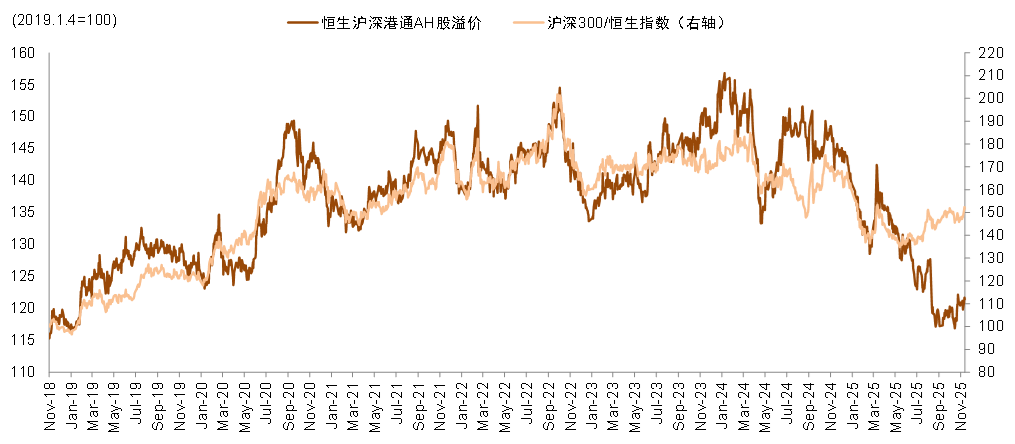
Core Viewpoint - The A-share market is expected to outperform the Hong Kong stock market in the medium term, driven by factors such as liquidity advantages, international monetary order restructuring, and the revaluation of RMB assets [1][6]. Market Performance - From August 18 to December 12, the A-share market showed strong performance with the Shanghai Composite Index rising by 5.2%, the CSI 300 by 9.0%, and the ChiNext Index and STAR 50 increasing by 26.0% and 22.5% respectively. In contrast, the Hong Kong market saw the Hang Seng Index rise by 2.8% and the Hang Seng Tech Index by 1.7% [1][2]. Fundamental Analysis - The A-share market benefits from high-growth sectors such as hard technology and new energy, which are expected to see improved performance in the second half of the year. The hardware sector, particularly semiconductors and electronics, is a strong point for A-shares, while Hong Kong's strengths lie in large internet companies [3][4]. Liquidity Factors - The A-share market is experiencing increased liquidity due to active participation from individual investors, with margin trading balances rising from 2.1 trillion yuan in mid-August to 2.5 trillion yuan by mid-December. Additionally, the trend of "deposit migration" and the activation of bank wealth management products are contributing to this liquidity [4][5]. Overseas Influences - The Hong Kong market is more susceptible to overseas factors, including international liquidity and trade policies. Recent fluctuations in U.S. monetary policy and trade relations have had a more pronounced impact on Hong Kong compared to A-shares, which have shown greater resilience [5][6]. Future Outlook - Looking ahead, the A-share market is expected to maintain its relative advantages, particularly as AI technology begins to see industrial application in 2024. Key areas of focus include computing power, optical modules, and cloud computing, with a continued emphasis on domestic production [6].
中金 | AH比较系列(4):A股优势有望延续
中金点睛· 2025-12-14 23:44
Core Viewpoint - The A-share market is expected to outperform the Hong Kong stock market in the second half of 2025 due to factors such as increased incremental capital, restructuring of international monetary order, and favorable policies that benefit A-share sectors [2][3]. Group 1: Market Performance - From August 18 to December 12, the A-share market showed a significant performance advantage, with the Shanghai Composite Index rising by 5.2%, the CSI 300 by 9.0%, and the ChiNext Index and STAR 50 by 26.0% and 22.5% respectively, while the Hang Seng Index and Hang Seng Tech Index only increased by 2.8% and 1.7% [2]. - The leading sectors in both A-shares and Hong Kong stocks were similar, with notable gains in non-ferrous metals, semiconductors, and electrical equipment [2]. Group 2: Fundamental Factors - A-share advantages stem from high growth in sectors like hard technology and new energy, with A-shares benefiting more from the domestic economic recovery compared to Hong Kong stocks [3]. - The A-share market has a stronger focus on hardware sectors such as semiconductors and electronics, while Hong Kong stocks are more represented by large internet companies [3]. Group 3: Liquidity Factors - The A-share market has seen increased liquidity due to active participation from individual investors, with margin trading balances rising from 2.1 trillion yuan in mid-August to 2.5 trillion yuan by mid-December [4]. - The trend of "deposit migration" continues, with non-bank deposits maintaining high growth rates, contributing to the liquidity in the A-share market [4]. Group 4: Overseas Factors - The Hong Kong market is more sensitive to overseas factors, including international liquidity and trade policies, which have led to greater volatility compared to A-shares [5]. - Recent fluctuations in U.S. monetary policy and trade tensions have had a more pronounced negative impact on the Hong Kong market, while A-shares demonstrated resilience during these periods [5]. Group 5: Future Outlook - The A-share market is expected to maintain its advantages in the medium term, particularly in hardware sectors related to AI and cloud computing, as these areas are projected to see increased industrial application [6]. - Continued liquidity support from long-term capital inflows and favorable policies is anticipated to sustain A-share market activity [6]. - The restructuring of international monetary order and the potential for improved U.S.-China trade relations may further enhance the attractiveness of A-shares compared to Hong Kong stocks [6].

AH比较系列(4):A股优势有望延续
CICC· 2025-12-14 11:27
Core Insights - The report indicates that A-shares are expected to outperform Hong Kong stocks in the second half of 2025, driven by factors such as increased domestic capital inflow, restructuring of international monetary order, and favorable policies for certain sectors [1][2]. Market Performance - From August 18 to December 12, 2025, the Shanghai Composite Index rose by 5.2%, and the CSI 300 increased by 9.0%. In contrast, the Hang Seng Index only gained 2.8% during the same period [1]. - The growth of the ChiNext Index and the STAR 50 was significant, with increases of 26.0% and 22.5% respectively, highlighting the strong performance of growth-oriented stocks in A-shares [1]. Reasons for A-share Outperformance - **Fundamentals**: A-shares have advantages in high-growth sectors such as hard technology and new energy, which are expected to see improved performance in the second half of the year. The report notes that A-shares are more focused on hardware sectors like semiconductors and electronics, while Hong Kong stocks are more represented by large internet companies [2]. - **Liquidity**: The report highlights that the active participation of individual investors and the inflow of medium to long-term funds have provided A-shares with additional liquidity. The margin trading balance increased from 2.1 trillion yuan in mid-August to 2.5 trillion yuan by mid-December [2][4]. - **Overseas Factors**: A-shares are less affected by overseas liquidity and trade policy risks compared to Hong Kong stocks, which have a higher proportion of foreign investment. The report notes that recent fluctuations in U.S. monetary policy and trade relations have had a more pronounced impact on Hong Kong stocks [2][3]. Future Outlook - The report anticipates that A-shares will continue to maintain their relative advantages in the medium term, particularly as AI technology begins to see more widespread industrial application. Key areas of focus include computing power, cloud computing, and domestic production [4]. - The liquidity in the A-share market is expected to remain active, with the potential for further inflows from bank wealth management products and institutional investors [4]. - The restructuring of the international monetary order and the revaluation of Chinese assets are expected to further support the performance of A-shares compared to Hong Kong stocks [4].
中金:如何构建“稳市”监测体系?
中金点睛· 2025-12-08 23:37
Core Viewpoint - The A-share market has experienced a year of upward fluctuations since September 2024, necessitating a focus on preventing market volatility. A methodology for identifying market "tops" has been developed, complementing previous research on "bottom" identification, to form a "stable market" monitoring framework. Current market conditions are deemed relatively healthy, with reasonable valuations and no fundamental changes in the underlying logic for upward movement [2][4]. Group 1: Market Stability and Regulatory Environment - The regulatory environment for capital market stability is evolving, with recent statements from the China Securities Regulatory Commission (CSRC) emphasizing the need for a long-term stability mechanism to prevent significant market fluctuations [3]. - The construction of a "stable market" mechanism is seen as essential for achieving high-quality development in China's capital markets and better serving the real economy [3]. Group 2: Historical Market Cycles - Since the stock reform in 2005, the A-share market has undergone five significant cyclical transitions, with notable upward phases occurring from June 2005 to October 2007, October 2008 to November 2010, December 2012 to June 2015, January 2016 to January 2018, and January 2019 to December 2021 [5]. - The characteristics of these cycles indicate that most upward phases align closely with improvements in economic fundamentals and corporate earnings, except for the 2013-2015 period, which was primarily driven by policy and liquidity [5]. Group 3: Methodology for Identifying Market Tops - The methodology for identifying market tops includes analyzing macroeconomic fundamentals, corporate earnings expectations, policy changes, valuation metrics, liquidity conditions, and investor behavior [8]. - Historical data shows that significant market tops are often accompanied by a combination of these signals, particularly macroeconomic and policy indicators, which are deemed primary signals, while valuation and liquidity metrics serve as auxiliary signals [53][55]. Group 4: Key Indicators and Signals - Key indicators for identifying potential market tops include changes in financial data such as M1 growth, PMI trends, and external macroeconomic shocks, which can significantly impact market sentiment [8][16]. - The analysis of corporate earnings cycles indicates that market tops often precede earnings peaks, with a typical lead time of 1-3 quarters, making it challenging to predict tops based solely on earnings data [16][20]. Group 5: Current Market Assessment - The current market score based on the developed monitoring framework is 22 points, indicating a low likelihood of a market top at this stage, as historical tops typically score above 60 points [57]. - Despite some signs of overheating in trading sentiment, such as high turnover rates and margin trading levels, there has not been a significant outflow of capital, suggesting that the market remains supported by underlying fundamentals [58].

4000点拉锯战还要多久?资金持续布局,上证综指ETF(510760)连续2日净流入
Mei Ri Jing Ji Xin Wen· 2025-11-17 06:37
Core Insights - The overall market has shown strong resilience since the index surpassed 4000 points, with a continuous upward shift despite occasional fluctuations [1] - The calendar effect is expected to re-emerge as the end of 2025 approaches, supported by the ongoing restructuring of international monetary order and significant breakthroughs in the renewable energy battery sector [1] - China's innovative industries are gradually realizing performance results, which is anticipated to continue supporting the performance of Chinese assets [1] Economic and Market Outlook - The domestic economy appears to be in a recovery phase, with the narrative surrounding artificial intelligence continuing to gain traction [1] - The market outlook remains positive, with recommendations for broad-based core allocations, particularly in the CSI A500 ETF (159338) and the SSE Composite Index ETF (510760), which may better withstand the anticipated high volatility in the near term [1]
中金缪延亮:中美经贸关系新阶段意味着什么?
中金点睛· 2025-11-14 00:18
Core Viewpoint - The article discusses the new phase of China-US economic and trade relations, highlighting the transition from conflict to a more balanced dialogue, which may have significant implications for global governance and the international monetary order [2][3]. Group 1: New Phase of China-US Economic Relations - The economic relationship between China and the US has evolved through three distinct phases: "coexistence and win-win" (2005-2016), increasing trade friction (2017-2024), and a new phase of equal dialogue starting in 2025 [4][5][12]. - The "coexistence and win-win" phase was characterized by strong economic interdependence, with China providing cheap labor and the US benefiting from low inflation and financial prosperity [5][7]. - The increasing trade friction phase saw the US imposing tariffs, with the effective tariff rate on China remaining high at 19.3% even after some easing in 2020 [11][12]. Group 2: Characteristics and Policy Implications of the New Phase - The new phase is marked by a balance of power, allowing for negotiations that could lead to mutually beneficial agreements, such as adjustments in tariffs on agricultural products and strategic resources [20][21]. - The US's reliance on China for certain exports and the need for China to maintain its economic growth create a scenario where both countries have incentives to engage in dialogue [20][22]. - The potential for currency adjustments, such as the appreciation of the yuan and the reduction of US tariffs, could help rebalance trade and improve consumer purchasing power in both countries [21][22]. Group 3: International Monetary Order and Asset Implications - The new phase may reinforce the ongoing restructuring of the international monetary order, with a shift away from dollar dominance towards a more fragmented and diversified system [26][28]. - The trend of capital returning to domestic markets, particularly in China, indicates a growing preference for local investments amid global uncertainties [28][30]. - The long-term competition between the US and China is likely to drive increased investment in research and development, impacting various asset classes differently, with strategic resources like rare earths gaining importance [54][55].