
存储超级周期

Search documents
华尔街见闻早餐FM-Radio | 2026年2月18日
Hua Er Jie Jian Wen· 2026-02-17 23:39
Market Overview - Concerns about AI persist, leading to significant fluctuations in the US stock market, with the S&P 500 dropping nearly 1% intraday before closing up 0.1% [2] - The software stock ETF fell by 2.2%, while Apple rose over 3% and Oracle dropped more than 3.8% [2] - US Treasury yields saw a slight increase, with the 10-year yield rising by 1 basis point and the 2-year yield up over 3 basis points [2] - The dollar exhibited a "V" shaped movement, rising nearly 0.5% intraday, while the British pound dropped about 1% due to a five-year high unemployment rate in the UK [2] - Gold prices fell 2.2%, dropping below $4900 per ounce, and COMEX silver futures declined over 5.7% [2] Key News - Apple is accelerating the development of three new wearable devices: AI glasses, a pendant, and a camera version of AirPods, with plans to integrate them with Siri [5] - Meta is increasing its investment in Nvidia, planning to deploy millions of chips over the coming years and will use Nvidia's Grace CPU for the first time [15] - Berkshire Hathaway has reduced its holdings in Apple and Bank of America while initiating a position in The New York Times [15] - Hillhouse Capital has increased its positions in Pinduoduo and Alibaba while reducing holdings in Baidu and Webull, indicating a more concentrated portfolio [16] International Developments - Iran's foreign minister announced an agreement on "guiding principles" for negotiations with the US, leading to a nearly 3% drop in Brent crude oil prices [13] - Former President Trump announced a $550 billion investment in Japan, focusing on oil, power generation, and critical minerals [13] - Anthropic has released the Sonnet 4.6 model, which operates computers nearly as well as flagship models but is priced at only one-fifth of the cost [14] - BHP reported a nearly 30% increase in profits, with copper business surpassing iron ore as the largest profit source for the first time [21]



新一轮存储超级周期来了,一辈子只有一次
Hua Er Jie Jian Wen· 2026-02-17 08:21
Core Insights - The storage industry is entering a "once-in-a-lifetime" super cycle driven by the AI boom, with demand for storage chips skyrocketing due to the requirements of AI applications [1][16]. - Phison Electronics, a leader in NAND flash memory controllers, is at the center of this supply-demand battle, indicating that the market is not just facing shortages but a life-and-death struggle from cloud to endpoint [3][4]. Supply and Demand Dynamics - The demand for storage is quantitatively staggering; for instance, NVIDIA's new GPU, Vera Rubin, requires over 20 TB of SSD per unit, which could consume 200 EB of storage if 10 million units are sold, equating to 20% of last year's global NAND Flash production [4][22]. - The current supply-demand imbalance has led to unprecedented pricing and contract terms, including a requirement for buyers to prepay three years' worth of cash for flash memory, a first in the industry [5][29]. Market Impact on Consumer Electronics - The AI-driven demand for storage is severely impacting traditional consumer electronics, with predictions of a reduction in global smartphone production by 200 to 250 million units this year, alongside significant declines in PC and TV shipments [9][30]. - The cost of components has surged dramatically; for example, the price of an 8GB eMMC chip has skyrocketed from $1.5 to over $20, significantly affecting the bill of materials (BOM) for consumer products [10][31]. Long-term Shortages and Production Challenges - Major manufacturers like Samsung and SK Hynix are adopting a cautious approach to expansion due to past losses, with industry experts predicting that the current shortages could last until 2027 or even 2030 [12][36]. - The physical limitations of production capacity and equipment shortages are exacerbating the situation, as the semiconductor equipment supply is limited and the ramp-up time for new facilities is lengthy [13][43]. Future Opportunities in Space Computing - There is potential for space applications to alleviate some of the AI computing bottlenecks, as space environments can provide solutions for power and cooling challenges faced by terrestrial data centers [14][45]. - Successful developments in this area could lead to significant growth in the next 2-3 years, although the high reliability requirements for space applications present substantial challenges [15][48]. Strategic Positioning of Phison Electronics - Phison is focusing on high-value solutions and long-term investments in R&D, with a 50% increase in R&D spending this year, aiming to transition from a low-margin player to a provider of high-value solutions [16][52]. - The company is leveraging its expertise in AI and space applications to differentiate itself in a highly competitive market, emphasizing the importance of maintaining strong relationships with upstream suppliers [60][62].



一线厂商CEO:这一轮存储超级周期,一辈子只有一次,前无古人后无来者
Hua Er Jie Jian Wen· 2026-02-17 07:49
Core Insights - The storage industry is entering a "once-in-a-lifetime" super cycle driven by the AI boom, with demand for storage chips expected to surge dramatically [1][11]. - Phison Electronics, a leader in NAND flash memory controllers, highlights a critical supply-demand imbalance, indicating that the market is not just facing shortages but a life-and-death struggle across the supply chain [3][4]. Supply and Demand Dynamics - The demand for storage is quantitatively staggering; for instance, NVIDIA's new GPU, Vera Rubin, could consume 200 Exabytes of storage if 10 million units are sold, which is 20% of last year's total NAND Flash production [4][17]. - The AI-driven demand is validated by over $600 billion in capital expenditures from the four major U.S. cloud service providers this year, indicating a robust and ongoing need for storage solutions [4][14]. Market Conditions - The supply chain is experiencing unprecedented pressure, with upstream manufacturers demanding prepayment for three years of orders, a practice not seen before in the electronics industry [5][22]. - Phison Electronics is planning to raise $1 to $2 billion in operational funds to secure upstream supply sources amid these stringent market conditions [5][25]. Impact on Consumer Electronics - The consumer electronics sector is predicted to face a "collapse wave," with global smartphone production expected to decrease by 200 to 250 million units this year due to material shortages [6][7]. - The cost of components has skyrocketed; for example, the price of an 8GB eMMC chip has surged from $1.5 to over $20, significantly impacting the bill of materials for consumer products [7][26]. Long-term Supply Constraints - Major manufacturers like Samsung and Micron are adopting a cautious approach to capacity expansion due to past losses, leading to a belief that shortages could persist until at least 2027, with some reports suggesting as late as 2030 [8][31][32]. - The current shortages are primarily driven by cloud demand, and a potential surge in AI infrastructure development in China could exacerbate the situation further [8][34]. Emerging Opportunities - Space applications are seen as a potential solution to the AI computing bottleneck, as they can leverage solar power and natural cooling, although the reliability requirements are significantly higher [9][10]. - Phison Electronics aims to transition from a traditional memory supplier to a provider of high-value solutions, investing heavily in R&D to adapt to the evolving market landscape [11][47].

存储巨头四季报“五大关键点”:当前周期强度超越2017-18“云繁荣周期”
硬AI· 2026-02-17 03:59
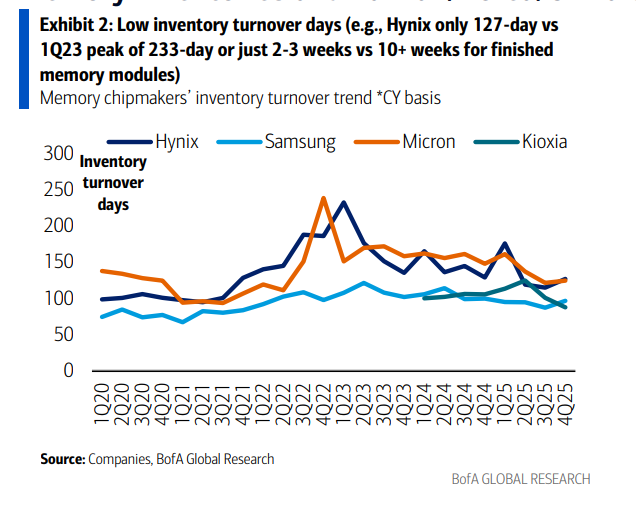
若短缺持续至2027年,价格仍有上涨空间。 作者 | 龙 玥 编辑 | 硬 AI 随着存储巨头们四季度财报的披露,一个清晰的信号正在释放:存储行业不仅走出了低谷,更在AI浪潮的推动下,开启了一轮强度罕见的"超级周期"。 本周,美银美林团队总结了存储巨头财报电话会议的精华,并结合韩国半导体展(Semicon Korea)的一线见闻,指出当前市场正处于库存极低、价格 飙升且资本开支大幅扩张的强劲上升期。 美银美林指出,SK海力士库存周转天数降至127天的低位,成品库存仅剩2-3周。三星DRAM售价环比大涨40%,现货价格创25年新高。行业高管认 为,本轮周期强度已超越2017-18年的云繁荣期,若短缺持续至2027年,价格仍有上涨空间。 他进一步解释道,与高度定制化的晶圆代工不同,存储器仍被视为大宗商品(遵循JEDEC标准),这意味着如果短缺持续到2027年,价格还有进一步 上涨的空间。 美银的"存储指标"(Memory Indicator)也佐证了这一点。该指标在12月已回升至124的"上行周期"水平,而2025年上半年的平均值仅为103。 01 财报季"五大关键信号" 美银美林分析师Simon Woo团队在研 ...

存储巨头四季报“五大关键点”:当前周期强度超越2017-18“云繁荣周期”
Hua Er Jie Jian Wen· 2026-02-16 06:17
Core Insights - The storage industry is emerging from a downturn and entering a "super cycle" driven by AI demand, as indicated by the recent earnings reports from major storage companies [1] Group 1: Key Signals from Earnings Reports - Inventory levels have dropped below the "warning line," with SK Hynix's inventory turnover days decreasing from a peak of 233 days in Q1 2023 to just 127 days, indicating potential supply chain shortages [2] - Average Selling Prices (ASP) are experiencing significant recovery, with Samsung's DRAM ASP soaring by 40% quarter-over-quarter and SK Hynix's NAND prices increasing by 32% [2] - Major companies are aggressively increasing capital expenditures in response to surging demand for High Bandwidth Memory (HBM), with SK Hynix's capital spending projected to rise from 7 trillion KRW in Q4 2024 to 12 trillion KRW by Q3 2025 [2] Group 2: Market Trends and Price Movements - HBM4 production is exceeding expectations, which will influence future market share in AI computing [3] - The industry outlook is extremely optimistic, with projections for a long-term "storage super cycle," as noted by Nanya Tech's president, who claims the current cycle is better than the 2017-2018 cloud server boom [3] - The Memory Indicator from Bank of America has risen to 124, indicating an upward cycle, compared to an average of 103 in the first half of 2025 [4] Group 3: Current Market Conditions - DRAM spot prices remain high, with 16Gb DDR5 prices at $38, a year-on-year increase of 709%, and 16Gb DDR4 prices reaching $78, up 2445% year-on-year [6] - Despite some OEMs indicating temporary assembly line halts due to rising storage costs, overall sales data from Taiwan shows significant month-over-month growth exceeding 20% and year-on-year doubling for several manufacturers [7] - SSD prices have surged, with a weekly increase of 40% and a monthly increase of 60%, reflecting market concerns about potential shortages in the second half of the year [9] Group 4: Insights from Semicon Korea - The recent Semicon Korea event showcased a booming industry, with equipment suppliers benefiting from record capital expenditures by major players like Samsung and SK Hynix [10] - HBM production is time-consuming, requiring extensive equipment to maintain high output levels, which may impact supply timelines [12] - The adoption of Hybrid Bonding technology may face delays, as manufacturers prefer existing methods for HBM production [12]
聚辰股份申请港交所主板上市,打造A+H双融资平台
Jing Ji Guan Cha Wang· 2026-02-13 02:21
Group 1 - The core viewpoint is that Juchen Technology has submitted its mainboard listing application to the Hong Kong Stock Exchange, aiming to create an A+H dual financing platform to seize opportunities in the storage industry, which may enhance the company's valuation expectations and liquidity attention [1] - The CEO indicated that the demand for DDR5 SPD chips is in a ramp-up phase, with significant volume expected in Q3 and Q4 of 2026, and the company is collaborating with Samsung Electronics to advance VPD chip design verification, expanding into the AI server and high-performance computing markets [1] Group 2 - The company's performance continues to grow, with operating revenue of 933 million yuan for the first three quarters of 2025, a year-on-year increase of 21.29%, and an adjusted net profit of 301 million yuan, up 25.9% year-on-year [2] - There is a structural improvement in profitability, with gross margin rising from 46.6% in 2023 to 59.8% in the first three quarters of 2025, and net margin increasing from 20.1% to 32.3% during the same period [2] - Growth drivers are primarily from the demand for SPD chips driven by servers and AI infrastructure, as well as the trend of domestic production of automotive-grade chips, although there is a concentration risk with the top five customers accounting for 59.3% of revenue in the first three quarters of 2025 [2] Group 3 - In the recent stock performance, Juchen Technology's stock price fluctuated by 0.48% over the last seven trading days, with a closing price of 149.22 yuan on February 12, 2026, reflecting a single-day increase of 0.72% [3] - The stock has seen a cumulative increase of 18.83% year-to-date, with a current price-to-earnings ratio (TTM) of 59.23, indicating market attention on the high prosperity cycle of storage chips [3] Group 4 - Industry analysis suggests that Juchen Technology benefits from the DDR5 technology iteration and the explosion of AI demand during the storage super cycle, with the SPD chip business being a core growth engine [4] - However, institutions like Goldman Sachs warn that rising storage prices may suppress consumer electronics demand, predicting a potential decline of 6%-10% in global smartphone shipments in 2026, which could pressure some of the company's consumer electronics chip business [4]

SEMICON-KOREA现场直击-存储超级周期的投资机会和三星-海力士走访
2026-02-13 02:17
Summary of Key Points from the Conference Call Industry Overview - The consumer electronics market is expected to shrink, with mobile phone and PC shipments projected to decline by 6.7% and 10% respectively. However, the semiconductor market is forecasted to grow robustly, potentially reaching $1 trillion by 2026, with storage growth nearing 40% and logic chip growth exceeding 30% [2][3][21]. Core Insights and Arguments - The storage supercycle significantly enhances corporate profits, with DRAM prices expected to rise by 105% to 110% quarter-over-quarter in Q1, far exceeding the previous quarter's increase [2][5]. - The supply side of DRAM is projected to grow by approximately 20% this year, primarily driven by technological upgrades due to cleanroom space limitations. Major new capacity releases are not expected until 2027, indicating a continued supply-demand imbalance unless consumer electronics demand drops significantly [2][6][7]. - South Korea's semiconductor industry benefits from a national system and sustained investment, with Samsung expected to regain its lead in HBM4 technology through vertical integration and favorable diplomatic policies [2][8]. Pricing and Market Dynamics - The pricing model in the memory market is heavily influenced by the channel market, with significant price increases expected in Q1, ensuring strong performance for related companies even if shipment volumes remain unchanged [2][9]. - The semiconductor industry's valuation is currently low, but there is potential for expansion during upward cycles. For instance, the P/E ratios for Hynix, Samsung, and Micron are significantly lower than those of semiconductor equipment companies, suggesting that increased investor confidence could drive valuations higher [4][15]. Competitive Landscape - Samsung and Hynix have a competitive edge in HBM4 technology, utilizing logic-based die processes, while Micron continues to use traditional memory-based die, placing it at a disadvantage [4][11]. - Samsung's storage business is characterized by strong cyclicality, with potential operating profit margins exceeding 40% during peak periods. Current projections indicate a positive trend for Q1 profits compared to Q4 of the previous year [12]. Future Outlook - The global smartphone market's supply-demand balance hinges on a significant drop in terminal demand. A hypothetical 20% decrease in global smartphone sales could lead to substantial declines for other brands, particularly Chinese manufacturers [10]. - The development of advanced packaging technologies, such as CPO (Co-Packaged Optics), is gaining traction, with companies like Samsung and ASE emphasizing the integration of front-end design to enhance performance and efficiency [19][20]. Conclusion - The semiconductor industry, particularly in the storage segment, is poised for significant growth despite challenges in the consumer electronics market. The interplay of supply constraints, technological advancements, and competitive dynamics will shape the industry's trajectory in the coming years [2][3][21].

行情展望-两条主线-看好国内算力需求-半导体设备
2026-02-13 02:17
Summary of Conference Call Notes Industry Overview - The conference call discusses the rapid development of China's large model technology, which is narrowing the gap with the US, leading to global computing power inflation. The domestic demand for computing power leasing is underestimated by the market [2][3]. - The semiconductor equipment sector is expected to benefit from increased capital expenditures by storage manufacturers, although the A-share market's response has been insufficient [2][8]. Key Company Insights Xiechuang Data - Xiechuang Data has signed a price and quantity guarantee contract with Alibaba, securing revenue for the next five years. Each 10 billion RMB in capital expenditure is expected to generate an additional annual revenue of 3.5 to 4 billion RMB and a profit of over 800 million RMB [2][6]. - The company plans to finance further investments through Hong Kong stock offerings, aiming for a market capitalization of 200 to 300 billion RMB [2][7]. - Xiechuang Data's partnerships with major storage manufacturers like SanDisk and Kioxia are expected to enhance its profitability, projecting a profit margin of 15 to 20 billion RMB over the next two years [2][7]. Semiconductor Equipment Sector - The semiconductor equipment sector is currently in a bull market, driven by high profitability cycles in storage manufacturers leading to increased capital expenditures. However, the A-share market has treated this as a short-term event [8][11]. - Recommended companies in this sector include: - **Kema Technology**: Expected to double its production capacity, with a market capitalization of over 500 billion RMB [9][11]. - **Changchuan Technology**: Projected revenue of 8 billion RMB in 2026, with a profit of 2.5 billion RMB, indicating significant growth potential [4][12]. - **Zhongwei Company**: Anticipated to have a market capitalization target of 450 to 500 billion RMB, with substantial orders from storage clients [15][16]. Market Trends - The cloud computing and computing power leasing industries are experiencing a closed-loop demand logic and residual value reassessment. CSP (Cloud Service Provider) businesses are growing faster than expected, enhancing their bargaining power [9][10]. - The scarcity of computing resources is expected to become more pronounced due to slow hardware capacity releases [10]. Financial Projections - Xiechuang Data's capital expenditures are projected to exceed 80 billion RMB in 2026, significantly surpassing previous expectations [10]. - Changchuan Technology's market share in the testing machine market is expected to reach 40-50% by 2030, with a projected revenue of 20 billion RMB and a profit of 7 billion RMB [14]. Conclusion - The semiconductor equipment sector is poised for a significant upward trend, driven by strong demand and capital expenditures. Companies like Xiechuang Data, Kema Technology, Changchuan Technology, and Zhongwei Company are highlighted as key investment opportunities due to their growth potential and market positioning [11][16].
美光HBM4量产“踩油门”,大摩高呼存储超级周期来了!
Ge Long Hui· 2026-02-12 07:22
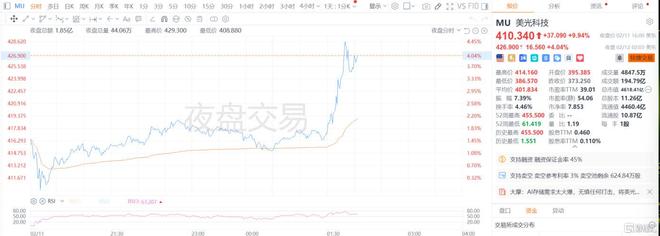
辟谣丢单英伟达、HBM4量产提速,美光引爆全球半导体市场。 隔夜,美股存储板块强势反弹,美光科技收盘暴涨近10%,公司市值飙升至4618亿美元。 目前夜盘交易拉升涨超4%,这反映出市场对美光未来前景日益增长的信心。 受消息提振,今天亚太市场芯片股也集体走强。 韩股三星电子股价再创新高,K海力士和SK Square纷纷跟涨。 港股天数智芯涨约19%、兆易创新大涨超16%,A股东阳光、环旭电子、石英股份、高新发展、博杰股 份等涨停。 | (4,85 | 名称 | 最新价 | 深跌额 | 流跌幅 V | 总市值 | 年初至今涨跌幅 | | --- | --- | --- | --- | --- | --- | --- | | 09903 | 天数智芯 | 229.800 | +36.800 | 19.07% | 584.42 Z | 58.92% | | 03986 | 兆易创新 | 343,400 | +47.400 | 16.01% | 2407.591Z | 111.98% | | 06082 | 壁例科技 | 35.840 | +2.240 | 6.67% | 874.09 Z | 82.86% | | 0 ...
存储超级周期下的关键答卷 联想集团Q3财报成全球硬件行业试金石
Ge Long Hui· 2026-02-10 01:42
Core Viewpoint - The global storage chip industry is experiencing an unprecedented "super cycle" driven by the explosive demand for AI infrastructure, leading to significant price increases in core categories such as DRAM, NAND, and HBM. This situation has made the profitability of end-device and infrastructure manufacturers a focal point for capital markets [1]. Group 1: Lenovo's Financial Performance - Lenovo Group is set to release its Q3 financial report for the fiscal year 2025/26, which is considered a critical indicator of how well end-device manufacturers can withstand cost pressures amid soaring global storage chip prices [1]. - Bloomberg forecasts Lenovo's Q3 revenue to reach approximately $20.76 billion, reflecting a year-on-year growth of about 10.4% from $18.8 billion [1]. - Despite achieving an adjusted net profit of $512 million in Q2 (a 25% year-on-year increase), analysts have lowered the average net profit expectation for Q3 to about $463 million due to significant fluctuations in storage chip costs [2]. Group 2: Supply Chain and Inventory Strategy - Lenovo's unique supply chain strategy has garnered significant market attention, as the company has strategically accumulated storage chips, with inventory levels approximately 50% higher than normal, potentially supporting production until the end of 2026 [3]. - The operational profit margin for Lenovo's Intelligent Devices Group (IDG), which includes personal computers and related businesses, was reported at 7.3% in Q2, and the market is keenly observing whether this performance can be sustained in Q3 [2]. - IDC has warned that hardware inflation caused by storage shortages could lead to a decline in global PC shipments by as much as 8.9% in 2026, highlighting the potential risks in the market [3].
