居民增收

Search documents
上海“十五五”规划建议目标:提高劳动报酬,鼓起百姓“钱袋子”
2 1 Shi Ji Jing Ji Bao Dao· 2026-01-20 01:24
Group 1 - The core viewpoint of the article emphasizes the importance of increasing residents' income as a means to improve livelihoods and stimulate domestic demand, aligning with the goals of the 14th Five-Year Plan [3][4] - The "Suggestions" document outlines that during the 15th Five-Year Plan period, the synchronization of residents' income growth with economic growth and the increase of labor remuneration alongside productivity is a primary objective [2][3] - The document proposes to enhance the proportion of residents' income in national income distribution and to improve the share of labor remuneration in primary distribution, aiming to create a more equitable income distribution system [4][5] Group 2 - The "Suggestions" advocate for a market-based evaluation of contributions to determine remuneration, promoting a system where those who work more, possess higher skills, or innovate are rewarded accordingly [5][6] - Several companies have announced salary increases in response to national policies aimed at boosting residents' income, indicating a positive trend in corporate responsibility and economic health [6][7] - The actions of leading companies like ByteDance and BYD reflect a long-term strategic vision to attract and retain talent, which is crucial for enhancing competitiveness in the global market [7]


2025年中国经济复盘:5%的成绩与发力方向
Yuekai Securities· 2026-01-19 11:45
Economic Performance - In 2025, China's GDP growth reached 5%, with the total economic volume surpassing 140 trillion yuan for the first time[1] - Exports grew by 5.5%, supported by diversification into ASEAN and African markets, offsetting declines in exports to the US[2] - The Shanghai Composite Index rose by 18.4%, with the ChiNext Index and STAR 50 Index increasing by 49.6% and 35.9% respectively[3] Economic Challenges - Real estate investment fell by 17.2%, a larger decline than the previous year's 10.6%[4] - Retail sales growth for the year was 3.7%, lower than the 5% growth in the first half of 2025[5] - The GDP deflator was negative at -1%, indicating nominal GDP growth of only 4% compared to a real growth of 5%[6] Policy Outlook - In 2026, proactive fiscal policies and monetary easing are expected to support economic growth, aiming for a strong start in Q1[7] - The government plans to allocate 625 billion yuan for consumer goods replacement programs and 2.95 trillion yuan for infrastructure projects[8] - Emphasis on increasing residents' income and investing in human capital as key strategies to boost domestic demand[9]
经济日报:精准施策持续扩大消费
Xin Lang Cai Jing· 2026-01-11 01:43
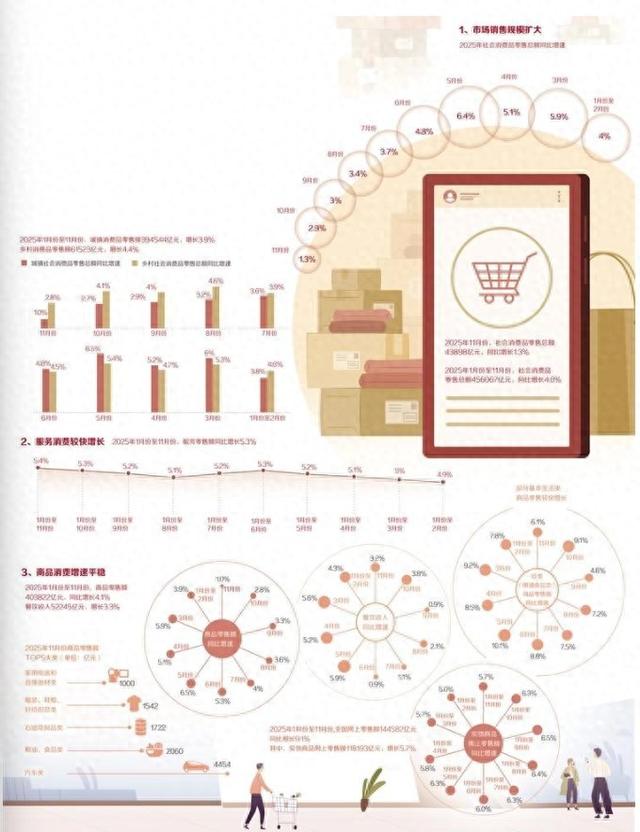
Group 1 - The core viewpoint of the article emphasizes the importance of consumption in economic development and improving people's livelihoods, highlighting a steady performance in China's consumption market with a retail sales total of 45.6 trillion yuan, a year-on-year growth of 4.0%, which is 0.5 percentage points faster than the same period last year [2] - The article discusses the implementation of various policies since the beginning of 2025, such as the "Special Action Plan to Boost Consumption," which aims to create a comprehensive support system for consumption through financial and fiscal collaboration, including government subsidies and financial support [3] - It notes a recent slowdown in consumption growth, particularly in retail sales, which have seen a decline for six consecutive months, indicating that insufficient domestic demand remains a prominent issue in the current economic landscape [3] Group 2 - The article highlights a shift in consumer behavior from primarily goods consumption to a balanced focus on both goods and service consumption, with strong demand in areas such as cultural tourism and elderly care services [4] - It emphasizes the potential for service consumption to drive economic growth, citing examples like immersive cultural experiences and community-based elderly care facilities that cater to evolving consumer needs [4] - The article concludes that expanding domestic demand is a top priority for 2026, with boosting consumption being crucial for this goal, and stresses the need to enhance residents' income and strengthen the service consumption sector to unlock the market's potential [4]
如何让“钱袋子”鼓起来?尹艳林解读“十五五”增收新路径
Zhong Guo Jing Ji Wang· 2026-01-06 01:28
Group 1 - The core viewpoint of the article emphasizes the implementation of the "Rural and Urban Residents' Income Increase Plan" during the "15th Five-Year Plan" period, focusing on enhancing residents' income through various channels [1][2] - Wage income is highlighted as the primary focus for income growth, with an expected increase in the proportion of property income in total income [2][3] - The phrase "those with high skills earn more, and innovators earn more" is noted for its significant guiding implications, promoting income growth driven by innovation [2] Group 2 - There is an acknowledgment that the current proportion of residents' property income is low and growing slowly, indicating a need for better investment opportunities for the public [2][3] - The article discusses the concentration of household wealth in real estate and suggests a gradual shift towards increasing financial assets, while emphasizing the importance of housing as a primary residence [3] - It is anticipated that as the economy stabilizes and the capital market improves, more individuals will begin to allocate assets in the capital market, reflecting a natural market trend [3]
居民增收需破立并举
第一财经· 2025-12-30 00:59
Core Viewpoint - The article emphasizes that increasing residents' income is central to addressing current economic challenges in China, highlighting the need for effective demand and consumer spending to drive economic growth [2][3]. Group 1: Economic Policy and Strategy - The National Financial Work Conference has outlined a more proactive fiscal policy for 2026, focusing on employment support and income growth for residents through various funding channels [2]. - The Central Economic Work Conference has introduced a plan for increasing urban and rural residents' income, underscoring the foundational role of consumption in domestic demand and economic circulation [2][3]. Group 2: Challenges and Solutions - The article identifies insufficient effective demand as a critical bottleneck for the Chinese economy, rooted in the disproportionate distribution of national income among the government, enterprises, and residents [2][3]. - It argues that breaking the long-standing bias that prioritizes investment over consumption is essential for enhancing domestic demand and consumer spending [3]. Group 3: Implementation Mechanisms - The article proposes the establishment of a transparent guarantee system to ensure fair competition and protect the rights of all economic entities, which would facilitate a more equitable distribution of national income [4]. - A protective guarantee system is suggested to provide a safety net for residents, enhancing social security and transfer payment efficiency to foster innovation and risk-taking [4]. Group 4: Employment and Economic Participation - Employment is highlighted as the primary channel for residents to engage in economic activities and share in economic growth, necessitating the removal of barriers to resource mobility and monopolies [5]. - The article stresses the importance of creating a system that allows for the free flow of resources and opportunities, which would lead to increased employment and economic participation [5].

居民增收需破立并举
Di Yi Cai Jing Zi Xun· 2025-12-29 15:19
Core Viewpoint - The central theme of the articles emphasizes the importance of increasing residents' income as a fundamental strategy to boost domestic consumption and address the current economic challenges in China [1][2][4]. Group 1: Economic Policy and Strategy - The National Financial Work Conference held on December 27-28 highlighted the continuation of a proactive fiscal policy into 2026, focusing on increasing residents' income through various financial support measures [1]. - The recent Central Economic Work Conference introduced a plan for increasing urban and rural residents' income, underscoring the foundational role of consumption in domestic demand and economic circulation [1]. - The articles argue that the current economic bottleneck is insufficient effective demand, primarily due to inadequate purchasing power and disposable income among residents, which is exacerbated by an imbalance in income distribution among the government, enterprises, and residents [1][2]. Group 2: Structural Reforms - The articles advocate for a comprehensive reform to eliminate systemic barriers that hinder domestic demand and consumption, emphasizing a shift in policy focus towards human-centered investment [2]. - A transparent guarantee system is proposed to ensure fair competition and protect the rights of all economic participants, which would facilitate a more equitable distribution of national income [2][3]. - The establishment of a protective social safety net is deemed essential for providing economic stability and encouraging innovation and risk-taking among residents [3]. Group 3: Employment and Economic Participation - Employment is identified as the primary channel for residents to engage in economic activities and share in economic growth, highlighting the need for policies that enhance job opportunities and resource mobility [3][4]. - The articles stress the importance of creating an environment where economic opportunities are accessible to all, advocating for the removal of monopolistic barriers and the promotion of resource flow [3][4]. - The concept of "breaking" and "establishing" is introduced, suggesting that addressing existing constraints on income and consumption must go hand in hand with building new economic structures that support growth [4].
一财社论:居民增收需破立并举
Di Yi Cai Jing· 2025-12-29 13:25
Group 1 - The core viewpoint emphasizes that increasing residents' income is essential for economic circulation and requires a combination of breaking down and establishing new institutional frameworks [1][5] - The National Financial Work Conference highlighted that in 2026, a more proactive fiscal policy will be implemented, focusing on supporting employment and entrepreneurship to increase residents' income [2][5] - The recent Central Economic Work Conference underscored the importance of consumer spending as a foundational element of domestic demand and economic circulation, marking the first time a plan for increasing urban and rural residents' income was proposed [2][5] Group 2 - The article discusses the need to reform systemic barriers that hinder domestic demand and consumption, advocating for a shift in perception that prioritizes consumption as a driver of economic growth rather than investment [3][5] - A transparent guarantee system is proposed to ensure fair competition and protect the rights of all economic entities, which would facilitate a more equitable distribution of national income among government, enterprises, and residents [3][4] - The establishment of a protective social safety net is essential for providing security and encouraging innovation, emphasizing the role of social welfare and public transfer payment systems in supporting economic growth [4][5] Group 3 - The article argues that increasing residents' income requires both the courage to break down existing barriers and the establishment of new opportunities for economic participation [4][5] - Employment is identified as the primary channel for residents to engage in economic activities and share in economic growth, necessitating the removal of institutional obstacles that restrict resource mobility [4][5] - The call for a legal framework that restricts power without authorization aims to liberate the flow of resources and create more job opportunities within the complex interactions of the economy [4][5]
超7成省份人均收入不及“全国线”
Mei Ri Jing Ji Xin Wen· 2025-12-28 02:36
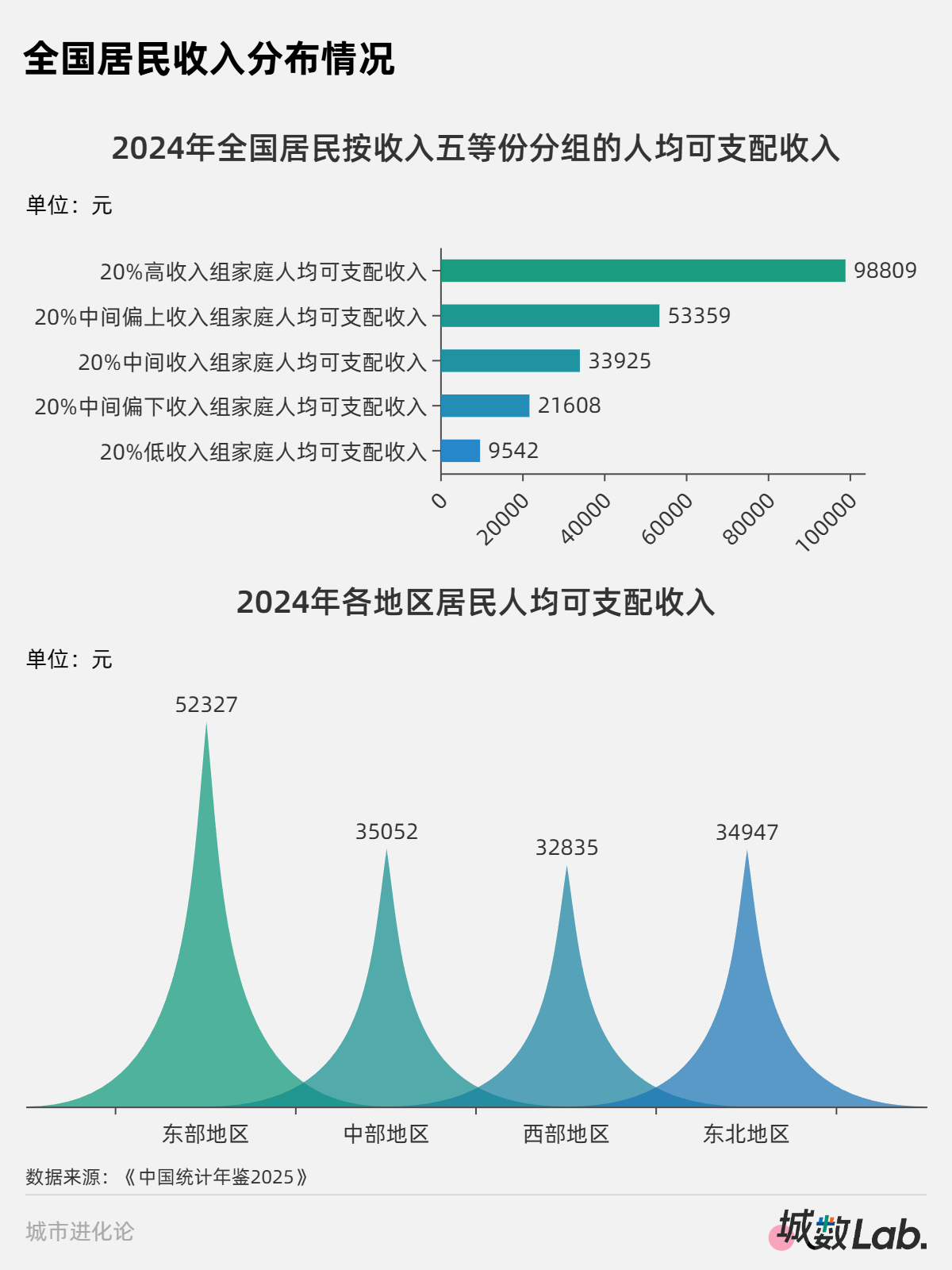
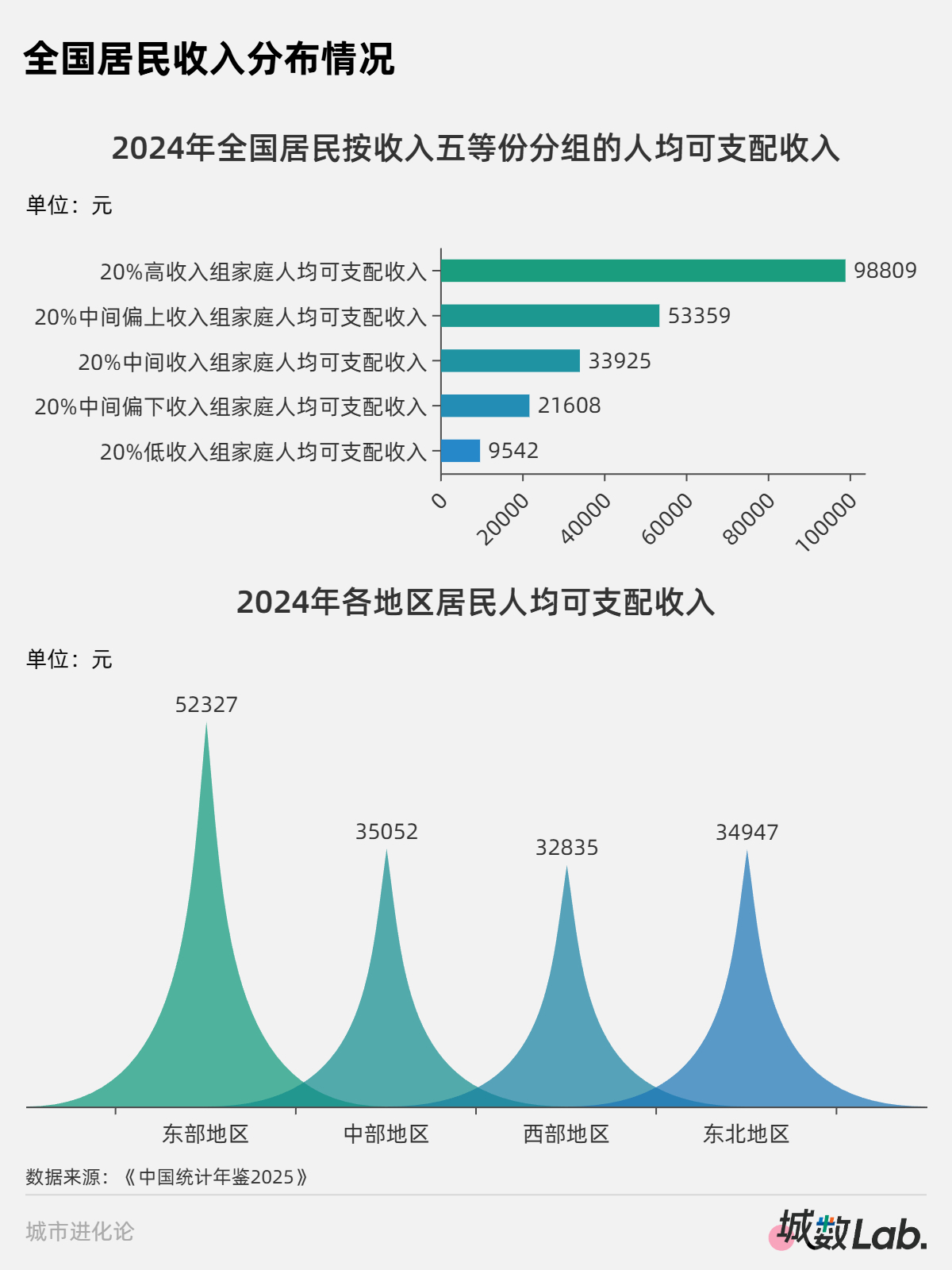
Group 1 - The core viewpoint of the article emphasizes that insufficient domestic demand is a major challenge facing the current economic operation, particularly highlighted by the low resident consumption rate [1] - Experts have analyzed that the low proportion of resident consumption in total demand is primarily due to the low share of resident income in national income, significant income disparity, and a large low-income population [1] - According to the latest data from the National Bureau of Statistics, in 2024, the per capita disposable income of the low-income group is 9,542 yuan, which is only 9.7% of the high-income group (98,809 yuan) and 28.1% of the middle-income group (33,925 yuan) [1] Group 2 - There is a significant regional disparity in per capita disposable income, with the eastern region showing much higher income levels compared to the central, western, and northeastern regions, with a difference exceeding 19,000 yuan between the east and west [6] - In 2024, only eight provinces have a per capita disposable income that meets the national average, including Shanghai, Beijing, Zhejiang, Jiangsu, Tianjin, Guangdong, Fujian, and Shandong, with Shanghai and Beijing exceeding 85,000 yuan [6] - In contrast, provinces like Yunnan, Guizhou, and Gansu have per capita disposable incomes below 30,000 yuan, with Gansu's income being only about 30% of Shanghai's [6] Group 3 - Analyzing the sources of resident income, wage income is the primary source of disposable income, accounting for 56.5% of the national average in 2024, while the other three components (operating net income, property net income, and transfer net income) account for 16.7%, 8.3%, and 18.5% respectively [9] - In regions like Guangdong, Beijing, and Shanghai, the proportion of wage income is even higher, exceeding 60% [9] Group 4 - The significant impact of wage income on overall income levels is evident, with notable disparities among different groups [15] - In 2024, the national average per capita wage income is 23,327 yuan, aligning with the eight provinces that meet the average disposable income level [15] - Shanghai has the highest per capita wage income at 55,999 yuan, while Guizhou has the lowest at 14,632 yuan, making Shanghai's income 3.8 times that of Guizhou [15] Group 5 - This year, the central government has repeatedly emphasized "increasing income," with the Central Economic Work Conference including "formulating and implementing a plan for increasing urban and rural resident income" as a key task for the coming year [19] - The "14th Five-Year Plan" explicitly proposes to "increase the proportion of resident income in national income distribution and raise the share of labor remuneration in primary distribution" [19]
城数Lab. | 超7成省份人均收入不及“全国线”
Mei Ri Jing Ji Xin Wen· 2025-12-28 02:28
Group 1 - The core viewpoint of the article emphasizes that insufficient domestic demand is a major challenge facing the current economic operation, particularly manifested in the low resident consumption rate [1] Group 2 - Experts have analyzed that the low proportion of resident consumption in total demand is primarily due to the low share of resident income in national income, significant income disparity, and a large low-income group with low income [2] - In 2024, the per capita disposable income of the low-income group is 9,542 yuan, which is only 9.7% of the high-income group (98,809 yuan) and 28.1% of the middle-income group (33,925 yuan) [2] Group 3 - There is a significant regional disparity in per capita disposable income, with the eastern region having a notably higher income than the central, western, and northeastern regions, with a difference exceeding 19,000 yuan [7] - In 2024, only eight provinces have a per capita disposable income that meets the national average, including Shanghai, Beijing, Zhejiang, Jiangsu, Tianjin, Guangdong, Fujian, and Shandong, with Shanghai and Beijing exceeding 85,000 yuan [7] - In contrast, provinces like Yunnan, Guizhou, and Gansu have per capita disposable incomes below 30,000 yuan, with Gansu's income being only about 30% of Shanghai's [7] Group 4 - Analyzing the sources of resident income, wage income is the primary source of disposable income, accounting for 56.5% of the national average in 2024, while the other three components account for 16.7%, 8.3%, and 18.5% respectively [11] - In regions like Guangdong, Beijing, and Shanghai, the proportion of wage income exceeds 60% [11] Group 5 - The average per capita wage income in 2024 is 23,327 yuan, with Shanghai having the highest at 55,999 yuan and Guizhou the lowest at 14,632 yuan, making Shanghai's wage income 3.8 times that of Guizhou [15] Group 6 - The central government has repeatedly emphasized "increasing income" this year, with the Central Economic Work Conference including "formulating and implementing urban and rural resident income increase plans" as a key task for the coming year [20] - The "14th Five-Year Plan" explicitly proposes to "increase the proportion of resident income in national income distribution and raise the proportion of labor remuneration in primary distribution" [20]
城乡居民如何实现增收?丨落实会议部署 问答中国经济
证券时报· 2025-12-20 00:14
Core Viewpoint - The Central Economic Work Conference emphasizes expanding domestic demand as the primary task for economic work in the coming year, with a focus on boosting consumer spending as a critical component of this strategy [1]. Group 1: Economic Policies and Consumer Spending - The conference highlights the importance of enhancing consumer spending to meet the public's aspirations for a better life and to mitigate the impacts of external shocks and declining external demand [1]. - Policies such as the trade-in program for consumer goods, increased fiscal investment in people's livelihoods, and financial incentives for loans are seen as significant supports for boosting consumer spending [1]. - To fundamentally enhance consumer spending, it is essential to promote continuous growth in residents' income, thereby solidifying their consumption capacity and confidence [1]. Group 2: Employment and Income Growth - Employment stability is crucial for income stability, with wage income being the largest component of residents' income [2]. - The government plans to implement a broader income growth strategy that includes policies aimed at increasing employment, particularly in the service sector, by removing unnecessary barriers [2]. - Investments in human capital, such as early childhood education and lifelong learning programs, are necessary to improve residents' skills and enable them to seek higher-paying jobs [2]. Group 3: Income Distribution and Public Services - Improving income distribution can be achieved through tax adjustments and transfer payments to enhance the basic public service supply system, thereby reducing quality of life disparities [3]. - Specific public policies, such as cash subsidies for children and waiving fees for public kindergarten, are aimed at directly benefiting residents and enhancing their consumption confidence [3][4]. - The social security system, particularly the pension system, requires further reform to bridge the gaps in funding and benefits between different demographics [4]. Group 4: Long-term Economic Development - The expectation for the "Urban and Rural Residents' Income Growth Plan" reflects a long-term vision for investing in people and promoting comprehensive development for all citizens [4].