
市场风格再平衡

Search documents
市场风格再平衡还将持续
Sou Hu Cai Jing· 2025-11-17 05:40
Core Viewpoint - The market is experiencing a phase of structural "rebalancing," with significant rotation between sectors and within sectors, making it difficult to achieve a directional breakthrough around the 4000-point mark of the Shanghai Composite Index [1][2]. Group 1: Market Trends - Since the end of October, the Shanghai Composite Index has been fluctuating around the 4000-point level, with accelerated rotation between and within sectors [1]. - Multiple research institutions believe that the rebalancing of market styles will continue for some time, indicating a lack of directional breakthroughs [1]. - The recent market behavior reflects a global trend of structural rebalancing, with funds rotating from previously leading technology sectors to lower-performing sectors such as resources, consumption, and pharmaceuticals [1]. Group 2: Sector Analysis - According to Xinyi Securities, the recent market trend is characterized by rapid rotation between sectors, with institutions likely to balance their allocations as the year-end approaches [1]. - China Galaxy anticipates that the A-share market will continue its consolidation pattern, with a focus on balancing sector allocations in preparation for next year's economic outlook [1]. - Zhongyin International Securities suggests that the market will likely maintain a fluctuating trend around the 4000-point level, with a potential recovery in the previously lagging consumption sector as inflation data improves towards year-end [1]. Group 3: Future Outlook - According to Xinda Securities, the current style expansion is driven by valuation, expectations, and capital, which may persist for 1 to 2 quarters [1]. - Open Source Securities believes that the phase of market style rebalancing may last for 1 to 2 months, emphasizing the importance of internal differentiation within the technology sector and highlighting areas such as electric equipment, gaming, and photovoltaic sectors [2].
机构展望 | 沪指争夺4000点关口 机构研判年末风格趋于平衡
Shang Hai Zheng Quan Bao· 2025-11-16 18:14
Core Viewpoint - The A-share market is experiencing a phase of wide fluctuations around the 4000-point mark, with sector rotations becoming more pronounced, but the sustainability of the upward trend remains limited [1][2][3] Market Dynamics - The recent fluctuations in the A-share market are attributed to a combination of internal and external factors, including a decline in risk appetite in overseas markets and resistance at the 4000-point level [1][2] - The market is expected to maintain a range-bound oscillation in the short term, with a potential rebalancing of market styles lasting several months [1][2][3] Sector Performance - The technology sector, particularly TMT and advanced manufacturing, is anticipated to lead the index breakout in the long term, despite current market turbulence [1][4] - Recent trends show a rotation of funds from previously leading technology sectors to lower-performing sectors such as resources, consumption, and pharmaceuticals [2][4] Investment Strategies - Investors are advised to maintain a positive position but avoid blindly chasing index highs, focusing instead on structural configurations around "anti-involution + AI applications" [3][4] - High-dividend, consumer, and cyclical sectors may perform better in the current market phase, while technology remains a strong long-term investment due to its relative profitability and global semiconductor cycle [4][5] Future Outlook - The market is expected to continue its high-level oscillation, with a "high-cut low" phenomenon likely to persist, providing opportunities for investment in sectors with performance support such as energy storage and batteries [5]
沪指争夺4000点关口 机构研判年末风格趋于平衡
Shang Hai Zheng Quan Bao· 2025-11-16 17:55
Core Insights - The A-share market is experiencing fluctuations around the 4000-point mark, with a notable acceleration in the rotation rhythm between and within sectors, including AI, new energy, resource products, and consumer goods, although the sustainability of the upward trend is limited [1][2] - Analysts suggest that the recent wide fluctuations in the A-share market are influenced by both domestic and international factors, including a decline in risk appetite in overseas markets and resistance at the 4000-point level [1][2] - The market is expected to maintain a range-bound oscillation in the short term, with a potential rebalancing of market styles lasting several months, while technology growth sectors like TMT and advanced manufacturing are anticipated to lead index breakthroughs in the longer term [1][3] Market Outlook - The A-share market is likely to continue its oscillation pattern, with rapid sector rotation observed, particularly as funds shift from previously high-performing technology sectors to lower-performing sectors such as resources, consumption, and pharmaceuticals [2][3] - Analysts from various firms indicate that the current market structure reflects a global trend of "rebalancing," with funds moving away from technology stocks due to concerns over AI bubbles and external events impacting risk preferences [2][3] - The investment strategy should focus on structural allocation around themes of "anti-involution" and AI applications, leveraging trends in prosperity, policy direction, and capital flow to achieve excess returns [2][3] Sector Performance - In the context of year-end market style assessments, analysts suggest that sectors that have lagged may perform better during this oscillation phase, with a focus on high-dividend, consumer, and cyclical stocks [3][4] - The technology sector, particularly TMT and advanced manufacturing, is expected to maintain a long-term advantage due to relative profitability and global semiconductor cycles, despite a temporary shift towards value stocks [3][4] - The current market environment is characterized by a high degree of volatility, driven by valuation and expectations, with a potential shift back to technology stocks as the underlying industrial logic strengthens [3][5]
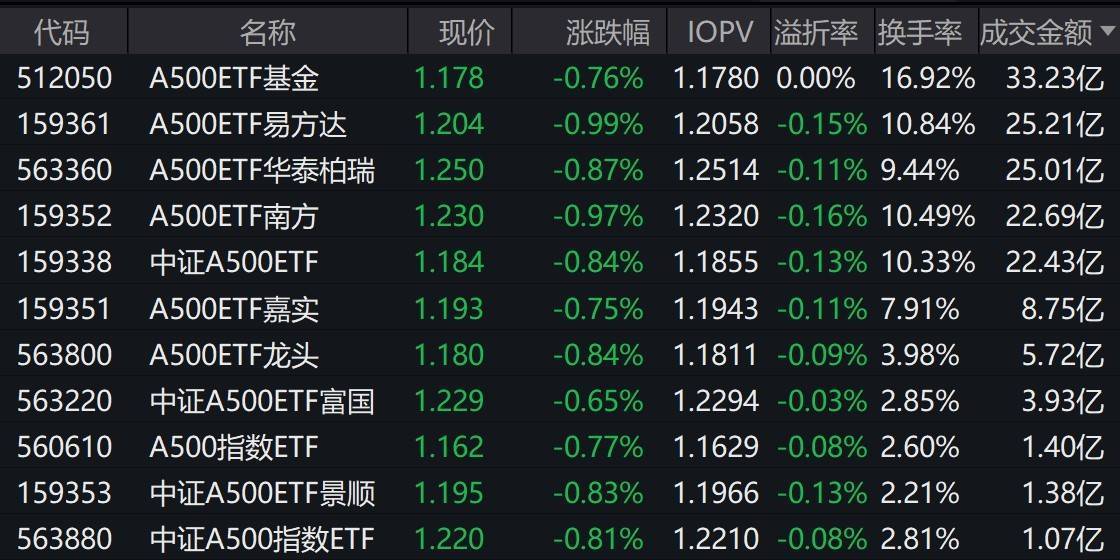
市场早盘震荡分化,中证A500指数下跌0.8%,3只中证A500相关ETF成交额超25亿元
Sou Hu Cai Jing· 2025-11-14 03:48
Market Overview - The market experienced fluctuations in the early session, with the Shanghai Composite Index briefly turning positive, while the CSI A500 Index fell by 0.8% [1] - The Fujian sector continued to rise, the Hainan sector strengthened quickly, flu-related stocks maintained strong performance, and the lithium battery sector was actively traded [1] - Conversely, storage chip stocks collectively declined [1] ETF Performance - As of the morning close, ETFs tracking the CSI A500 Index saw slight declines, with 11 related ETFs having transaction volumes exceeding 100 million yuan, and 3 exceeding 2.5 billion yuan [1] - The transaction amounts for A500 ETFs were as follows: A500ETF Fund at 3.323 billion yuan, A500ETF E Fund at 2.521 billion yuan, and A500ETF Huatai-PB at 2.501 billion yuan [2] Market Sentiment and Predictions - Some brokerages indicated that the A-share market is at a significant turning point, with the Shanghai Composite Index likely to consolidate around the 4000-point mark [1] - The market style is expected to rebalance, with cyclical and technology sectors likely to perform alternately, suggesting a focus on structural opportunities [1] - The short-term market is anticipated to maintain a steady upward trend, with close attention needed on macroeconomic data, overseas liquidity changes, and policy developments [1]

A股,重磅!一则“长钱指引”传闻,突然刷屏!
券商中国· 2025-11-13 07:03
Core Viewpoint - A recent investment guideline from a pension insurance company has circulated, requiring investment managers to reduce growth-style holdings and focus on high-valuation growth targets, indicating a shift in investment strategy as the year-end approaches [1][2]. Group 1: Investment Guidelines - The guideline emphasizes a need to adjust the current holdings to lower the volatility risk associated with growth-style investments, aiming for a stable year-end performance and improved market ranking [2]. - Investment managers are instructed to review their existing portfolios and reduce the proportion of growth-style holdings to a lower tier, particularly scrutinizing high-valuation growth stocks and products with high industry concentration [2]. - The adjustment must be completed within two trading days, by November 17, 2025, with the decision effective until December 31, 2025 [2]. Group 2: Market Implications - The guideline reflects a broader trend towards long-term investment strategies and a focus on stable returns, as pension funds are characterized by their "long money" nature [3]. - Analysts suggest that recent market movements indicate a shift in investment styles, with funds previously concentrated in consumer and new energy sectors now showing signs of reallocation [5]. - The market may experience a rebalancing of styles, moving away from a technology growth model towards a more diversified approach, potentially favoring a "barbell" structure in November [5].

市场分析:金融医疗行业领涨,A股小幅整理
Zhongyuan Securities· 2025-11-12 09:17
Market Overview - On November 12, the A-share market experienced slight fluctuations, with the Shanghai Composite Index facing resistance around 4019 points[2] - The Shanghai Composite Index closed at 4000.14 points, down 0.07%, while the Shenzhen Component Index fell 0.36% to 13420.62 points[7] - Total trading volume for the day was 19,649 billion yuan, slightly lower than the previous trading day[7] Sector Performance - Banking, insurance, pharmaceuticals, and mining sectors performed well, while photovoltaic, wind power, and power grid equipment sectors lagged[3] - Over 60% of stocks in the two markets declined, with mining, insurance, and medical sectors showing the highest gains[7] Valuation Metrics - The average price-to-earnings (P/E) ratios for the Shanghai Composite and ChiNext indices are 16.40 times and 49.44 times, respectively, above the median levels of the past three years[3] - The current market is at a significant transition point, with the Shanghai Composite Index likely to consolidate around the 4000-point mark[3] Investment Strategy - Investors are advised to adopt a balanced allocation strategy focusing on "cyclical + technology growth" to capture structural opportunities[3] - Short-term recommendations include monitoring banking, insurance, medical devices, and non-ferrous metals sectors for investment opportunities[3] Risk Factors - Potential risks include unexpected overseas economic downturns, domestic policy changes, and macroeconomic disturbances[4]

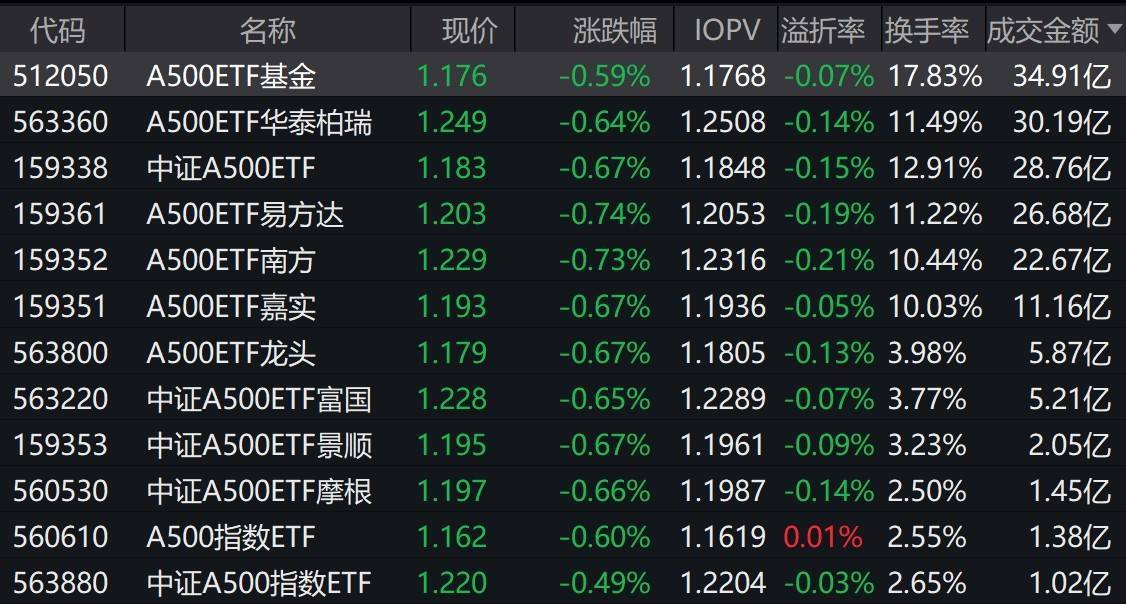
市场早盘震荡调整,中证A500指数下跌0.57%,3只中证A500相关ETF成交额超28亿元
Sou Hu Cai Jing· 2025-11-11 04:25
Core Viewpoint - The A-share market is experiencing a significant transition phase, with the Shanghai Composite Index likely to consolidate around the 4000-point mark, indicating a potential for a balanced market style between cyclical and technology sectors [1] Market Performance - The market opened with fluctuations, with the three major indices starting high but closing lower, and the CSI A500 Index down by 0.57% [1] - The A500 ETFs showed slight declines, with 12 related ETFs having transaction volumes exceeding 100 million yuan, and 3 surpassing 2.8 billion yuan [1] Sector Highlights - Solar energy stocks saw a collective surge, while the lithium battery sector strengthened again, and superhard materials stocks experienced rapid gains [1] - The food and beverage sector showed localized activity, whereas the coal sector faced significant declines [1] ETF Transaction Data - A500 ETF Fund: Current price 1.176, down 0.59%, with a transaction amount of 34.91 million yuan [2] - A500 ETF Huatai-PB: Current price 1.249, down 0.64%, with a transaction amount of 30.19 million yuan [2] - CSI A500 ETF: Current price 1.183, down 0.67%, with a transaction amount of 28.76 million yuan [2]
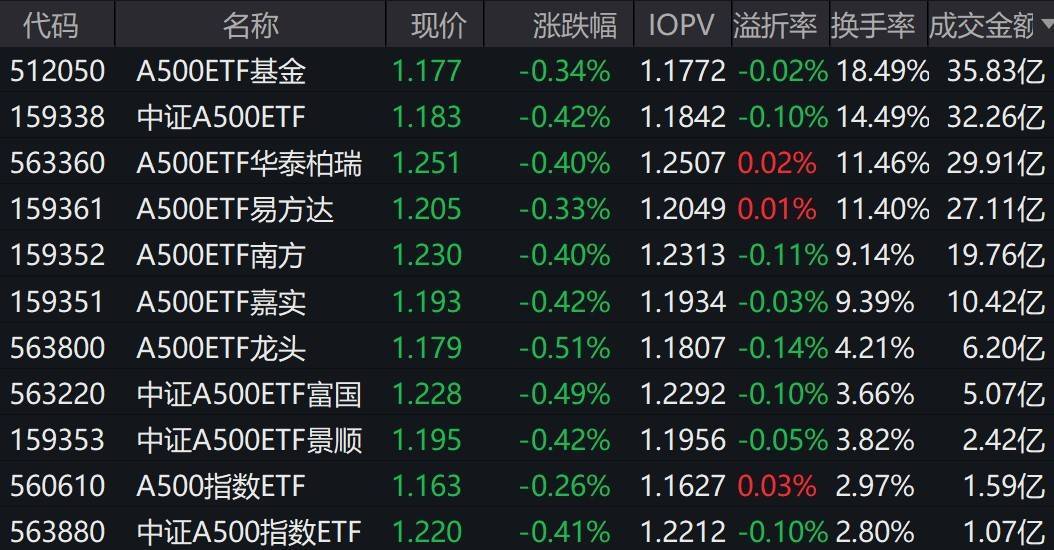
市场早盘震荡下跌,中证A500指数下跌0.33%,3只中证A500相关ETF成交额超29亿元
Sou Hu Cai Jing· 2025-11-10 03:55
Market Overview - The market experienced a volatile decline in early trading, with the ChiNext Index dropping over 2% and the CSI A500 Index down by 0.33% [1] - The lithium battery sector showed repeated activity, while the phosphorus chemical concept continued to be strong, and the consumer sector saw a significant surge [1] - Conversely, computing hardware concept stocks collectively weakened [1] ETF Performance - As of the morning close, ETFs tracking the CSI A500 Index saw slight declines, with 11 related ETFs having transaction volumes exceeding 100 million yuan, and 3 surpassing 2.9 billion yuan [1] - Specific transaction amounts for A500 ETFs included 3.583 billion yuan for A500 ETF Fund, 3.226 billion yuan for CSI A500 ETF, and 2.991 billion yuan for A500 ETF Huatai-PineBridge [2] Institutional Insights - Some brokerages indicated that in the fourth quarter, institutional funds may have the motivation to take profits from high-valuation sectors, suggesting a potential market style rebalancing [1] - In the medium term, factors such as sustained global technology investment enthusiasm, ongoing "anti-involution" policies, and increased household savings entering the market support the foundation of the current slow bull market, indicating that the A-share index still has the basis for further strengthening [1]
机构研究周报:市场风格有望再平衡,货币政策或加快放松
Wind万得· 2025-11-09 22:31
Core Viewpoints - The market style is expected to rebalance in November, potentially returning to a "dumbbell" structure, as liquidity remains relatively loose and external factors like the Fed's interest rate expectations may fluctuate [1][22]. Economic Data - China's October exports fell by 1.1% year-on-year, below the expected 3% growth, while imports grew by 1%. The trade surplus was $90.07 billion, slightly down from the previous month's $90.45 billion. For the first ten months of 2025, total trade value reached $520.46 billion, a 2.7% year-on-year increase [3][4]. - The decline in exports is attributed to a high base from the previous year and a slowing global economy, compounded by increased tariffs from the U.S. [3]. Equity Market Insights - Morgan Asset Management indicates that the global macro environment remains favorable for risk assets, supported by healthy consumer balance sheets, expectations of gradual monetary easing from the Fed, and ongoing fiscal stimulus [5]. - CITIC Securities suggests that resource products may become a new investment focus due to global monetary easing and supply-demand gaps, highlighting strategic resources like rare earths and lithium as having long-term investment value [6]. - China Europe Fund emphasizes the importance of cyclical stocks and technology resonance, suggesting that the market's current valuation recovery is nearly complete, with future growth driven by earnings [7]. Industry Research - CITIC Securities highlights that 2026 will be a critical year for the recovery of real estate companies' balance sheets, with a potential bottoming out of profits. The residential market shows signs of stabilization, and companies with quality investment properties are expected to perform well [11]. - Guotai Junan Securities notes that the liquor industry is undergoing a period of accelerated adjustment, with inventory clearing expected to lead to a rebound in stock prices [12]. - Penghua Fund anticipates that the domestic economy will seek balance between policy support and structural optimization over the next two to three years, favoring high-quality dividend assets [13]. Macro and Fixed Income - Huatai Securities recommends a focus on short-term credit bonds for defensive strategies, as overall credit demand is weakening [18]. - CICC predicts that monetary policy will accelerate easing due to ongoing export pressures, with expectations for rate cuts and reserve requirement ratio reductions [19]. - Bosera Fund indicates that domestic financial policies are favorable for the bond market, enhancing supply-demand dynamics [20].

科技盛宴座无虚席 机构投资欲走还留
Zhong Guo Zheng Quan Bao· 2025-11-09 20:15
Core Insights - The technology sector has become the main battleground for capital, with public funds significantly increasing their holdings in electronics and communications, pushing the TMT sector's allocation to over 40%, nearing historical highs [1][3][4] - Despite concerns about the crowded nature of the tech sector and potential valuation risks, many institutions remain optimistic about the long-term investment value of technology stocks, particularly driven by AI trends [1][6][7] Group 1: Institutional Investment Trends - In Q3, public funds heavily favored the semiconductor industry, which became the largest sector by total market value, exceeding 250 billion yuan, and saw an increase of over 96 billion yuan in holdings [2] - The top ten stocks increased by public funds were predominantly tech stocks, with significant increases in holdings for companies like Zhongji Xuchuang and Xinyi Sheng, which saw increases of 40.17 billion yuan and 36.93 billion yuan respectively [2][6] - The allocation of public funds to the TMT sector rose to 39.9% in Q3, indicating a significant increase in investment focus [4] Group 2: Market Dynamics and Valuation Concerns - The current allocation of technology stocks by A-share institutional investors has reached 40.16%, surpassing previous peaks during the new energy wave [3][5] - There are concerns that the high concentration in the tech sector, particularly with electronics holding 25% of public fund portfolios, may lead to a market correction [5][6] - Some analysts suggest that the high valuations in the tech sector, particularly in software and semiconductors, indicate potential overvaluation risks, with certain segments nearing the 99th percentile of historical valuation levels [6][7] Group 3: Long-term Outlook and Investment Strategies - Despite short-term volatility risks, institutions generally maintain a positive long-term outlook for technology stocks, emphasizing the importance of structural opportunities within the sector [1][8][9] - Investment strategies may shift towards "high cut low" approaches, focusing on sectors like storage chips and industrial software, while also considering the potential for recovery in other areas such as industrial metals and renewable energy [8][9] - The ongoing AI investment momentum in the U.S. is expected to continue influencing the Chinese market, with a focus on quality stocks as potential buying opportunities during market fluctuations [8][9]