
政策风险

Search documents
镍:资金与产业力量博弈,关注结构机会的出现不锈钢:基本面约束弹性,但关注印尼政策风险
Guo Tai Jun An Qi Huo· 2025-12-28 11:19
Report Summary 1. Report Industry Investment Rating No investment ratings are provided in the report. 2. Report's Core View - **Nickel and Stainless Steel**: Industry and capital are in a game, with nickel prices likely to fluctuate widely. Stainless steel is constrained by fundamentals, and its direction depends on the implementation of Indonesian policies in the first quarter [3][5][7]. - **Industrial Silicon and Polysilicon**: Industrial silicon inventories are accumulating, and short - term supply is expected to be disrupted. Polysilicon is in a high - level oscillation. It is recommended to short industrial silicon after a rebound, and polysilicon is expected to oscillate in a high - level range [34][35]. - **Lithium Carbonate**: In the off - season, demand is under pressure, but optimistic expectations are strengthening. The futures main contract price is expected to operate in the range of 120,000 - 140,000 yuan/ton [67][68]. - **Palm Oil and Soybean Oil**: Palm oil is waiting for the December production reduction in Malaysia to confirm the price bottom. Soybean oil is expected to oscillate in a range, waiting for the resonance of themes in the first quarter after the overall stabilization of the oil and fat sector [84][86][87]. - **Soybean Meal and Soybean No.1**: It is expected that the prices of soybean meal and soybean No.1 futures will oscillate, and risks during the New Year's Day holiday should be avoided [101]. - **Corn**: Focus on the performance of the spot market. Pay attention to the inventory accumulation in northern ports, the inventory building of traders, and the amount of supply from the grass - roots level [114]. - **Sugar**: The international sugar market is in a low - level range consolidation. The domestic sugar market maintains a weak basis expectation. Pay attention to Brazil's production and export rhythm, India's production and relevant industrial policies, and domestic import policy changes [137][159]. - **Cotton**: ICE cotton is expected to maintain low - level oscillation in the short term. Domestic cotton futures are expected to maintain a moderately strong oscillation, but the upward space may be limited [167][178]. - **Live Pigs**: Spot prices are expected to oscillate weakly. The LH2601 futures contract may rise rapidly, and attention should be paid to the 3 - 7 reverse spread [182][183]. - **Peanuts**: Spot prices are stable, and futures are expected to oscillate weakly. Pay attention to the purchase strategies of large - scale oil mills [202]. 3. Summary by Relevant Catalogs Nickel and Stainless Steel - **Industry News**: Indonesian government may cut nickel ore quotas to 2.5 billion tons in 2026 and include cobalt in the pricing and taxation system. The cost of pyrometallurgy and hydrometallurgy may increase by about 5% - 10% [3][4]. - **Market Trend**: Nickel prices may fluctuate widely due to the game between industry and capital. Stainless steel is constrained by fundamentals, and its cost center has shifted upward [5][7]. - **Inventory**: On December 26, China's refined nickel social inventory decreased by 263 tons, and LME nickel inventory increased by 1,146 tons. SMM nickel - iron full - industry chain inventory increased by 8% month - on - month [8]. Industrial Silicon and Polysilicon - **Price Movement**: This week, the industrial silicon futures price closed at 8,880 yuan/ton, and the polysilicon futures price closed at 58,955 yuan/ton [29]. - **Supply and Demand**: Industrial silicon inventories are accumulating, with supply expected to decrease and demand remaining weak. Polysilicon supply and demand are both weak, with upstream inventories accumulating [30][31][33]. - **Future Outlook**: Industrial silicon is expected to have its price lifted by sentiment in the short term, but the upward space is limited. Polysilicon is in a high - level oscillation [34][35]. Lithium Carbonate - **Price Fluctuation**: This week, lithium carbonate futures prices rose significantly. The 2601 contract closed at 127,800 yuan/ton, and the spot price rose to 111,900 yuan/ton [64]. - **Supply and Demand**: Overseas shipments are increasing, and short - term production elasticity is limited. Positive electrode factories are starting maintenance, and demand is in the off - season [65]. - **Market Outlook**: In the off - season, demand is under pressure, but optimistic expectations are strengthening. The futures main contract price is expected to operate in the range of 120,000 - 140,000 yuan/ton [67][68]. Palm Oil and Soybean Oil - **Previous Week's Logic**: In December, palm oil production decreased by nearly 10%, and high - frequency export data was good. Soybean oil rebounded following palm oil [82][83]. - **This Week's Logic**: Palm oil production in December decreased by 8%, and exports increased by 2%. It may confirm the price bottom in the short term. Soybean oil is expected to oscillate in a range [84][86]. - **Market Outlook**: Palm oil needs to wait for the December production reduction in Malaysia to confirm the price bottom. Soybean oil is waiting for the resonance of themes in the first quarter [84][86][87]. Soybean Meal and Soybean No.1 - **Previous Week's Market**: Last week, US soybean futures prices fluctuated, with the main 03 - month contract rising 1.16%. Domestic soybean meal futures prices were strongly oscillating, and soybean No.1 futures prices rose slightly [97]. - **Fundamentals**: China's purchase of US soybeans is limited, and Brazilian soybean import costs have decreased. Domestic soybean meal trading volume has increased, and soybean No.1 prices are stable [97][99][100]. - **Future Forecast**: It is expected that the prices of soybean meal and soybean No.1 futures will oscillate, and risks during the New Year's Day holiday should be avoided [101]. Corn - **Market Review**: Last week, corn spot prices fell slightly, and futures prices rebounded. Corn starch inventories increased [109][110][113]. - **Market Outlook**: CBOT corn prices rose, wheat prices fell, and imported corn auctions restarted. Attention should be paid to the performance of the spot market [111][112][114]. Sugar - **Market Review**: Internationally, the New York raw sugar active contract price rose 2.15%. Domestically, the Zhengzhou sugar main contract price rose 197 yuan/ton [135][136]. - **Supply and Demand**: In the 25/26 season, Brazil's sugar production increased by 450,000 tons, India's increased by 1.72 million tons, and Thailand's increased by 1.27 million tons [135]. - **Market Outlook**: The international sugar market is in a low - level range consolidation. The domestic sugar market maintains a weak basis expectation [137][159]. Cotton - **Market Review**: ICE cotton rebounded slightly, and domestic cotton prices rose. Cotton exports from the US improved, and India's CCI continued to purchase [161][166][167]. - **Supply and Demand**: New cotton has been on the market for more than three months, supply is sufficient, and downstream demand is in the off - season. However, the market is not pessimistic about the annual demand in the 2025/26 season [162][178]. - **Market Outlook**: ICE cotton is expected to maintain low - level oscillation in the short term. Domestic cotton futures are expected to maintain a moderately strong oscillation, but the upward space may be limited [167][178]. Live Pigs - **Market Review**: Spot prices were strong, and futures prices oscillated strongly. Supply decreased, and demand was still in the peak season [180][181]. - **Market Outlook**: Spot prices are expected to oscillate weakly. The LH2601 futures contract may rise rapidly, and attention should be paid to the 3 - 7 reverse spread [182][183]. Peanuts - **Market Review**: Spot prices were stable, and futures prices fell. Supply pressure increased, and oil mill开机率 increased [201]. - **Market Outlook**: Spot prices are stable, and futures are expected to oscillate weakly. Pay attention to the purchase strategies of large - scale oil mills [202].
镍:资金与产业力量博弈,关注结构机会的出现,不锈钢:基本面约束弹性,但关注印尼政策风险
Guo Tai Jun An Qi Huo· 2025-12-28 08:48
1. Report Industry Investment Rating No information provided in the content. 2. Core Viewpoints of the Report - The focus on nickel and stainless steel in the capital market is due to changes in the news, including Indonesia's 250 million - ton nickel ore quota target and the consideration of including associated minerals like cobalt in the pricing and taxation system [1]. - The nickel price may fluctuate widely in the short - term due to the game between industry and funds. The key to breaking the situation lies in the implementation of Indonesia's nickel ore news in the first quarter. Options can be considered in trading, and short - term attention can be paid to structural arbitrage opportunities [3]. - The stainless steel market has a pattern of weak supply and demand, with the cost support center moving up. The core contradiction lies in the raw material end. The price is likely to oscillate in a range and may not return to previous lows, and the direction will depend on the implementation of Indonesia's policies in the first quarter [5]. 3. Summary According to Related Catalogs 3.1 News Impact on Nickel and Stainless Steel - **Quota Event**: If Indonesia's 250 million - ton nickel ore quota is implemented, the expected surplus may turn into a shortage. However, considering the "downstream policy", the implementation time is uncertain, and the first quarter of 2026 is an important window for tracking policy implementation [1]. - **Associated Minerals Event**: Indonesia wants to include cobalt in the pricing and taxation system. It is estimated that the cost of pyrometallurgy and hydrometallurgy may increase by about 5% - 10% [2]. 3.2 Market Trends - **Nickel**: The previous trading logic was the surplus pressure and the expected commissioning of hydrometallurgy projects. The Indonesian news has increased market volatility. The nickel price will be in a wide - range oscillation pattern in the short - term [3]. - **Stainless Steel**: The fundamentals are weak in both supply and demand, but the cost center has moved up due to the impact of nickel - related factors. The price will oscillate in a range, and the upper - limit increase may be restricted by the actual delivery profit [5]. 3.3 Inventory Tracking - **Refined Nickel**: On December 26, China's refined nickel social inventory decreased by 263 tons to 56,725 tons, while LME nickel inventory increased by 1,146 tons to 255,696 tons [6]. - **New Energy**: On December 26, the inventory days of SMM nickel sulfate upstream, downstream, and integrated production lines changed to 5, 8, and 7 days respectively; the precursor inventory changed to 13.0 days; and on December 25, the ternary material inventory changed to 6.9 days [6]. - **Nickel - Iron - Stainless Steel**: On December 25, the SMM nickel - iron full - industry chain inventory increased by 8% month - on - month to 132,000 metal tons. The stainless - steel factory inventory in November was 1.588 million tons, and on December 25, the steel - union stainless - steel social total inventory was 1,005,136 tons, a week - on - week decrease of 3.55% [6]. 3.4 Market News - Multiple events have occurred, including Indonesia's forestry working group taking over a nickel - ore mining area, China suspending a non - official subsidy for imported copper and nickel from Russia, Indonesia sanctioning mining companies, and Indonesia planning to adjust the nickel - ore production target and pricing formula [7][8][10][11].
国债与企业债的风险差异是什么?
Sou Hu Cai Jing· 2025-12-21 06:52
Core Viewpoint - The article discusses the significant differences in risk characteristics between government bonds and corporate bonds, emphasizing the importance of understanding these differences for investors [1][2][3]. Credit Risk - Government bonds are backed by the national credit and have no default risk, as per the revised Budget Law of 2025, while corporate bonds depend on the issuing company's financial health, exposing investors to credit risk [1][3]. Interest Rate Risk - Government bonds are considered risk-free and their price fluctuations are primarily influenced by overall market interest rates. In contrast, corporate bonds are affected by both market interest rates and credit spreads, leading to higher price volatility [2]. Liquidity Risk - Government bonds have high liquidity due to their broad investor base and active trading, allowing for quick transactions at reasonable prices. Corporate bonds, however, face higher liquidity risk, particularly those from lower-rated or smaller issuers, which may take longer to sell or require discounts [2][3]. Payment Assurance and Priority of Claims - Government bonds have unconditional payment responsibility from the state, ensuring stability. Corporate bondholders, however, are prioritized after equity holders in bankruptcy scenarios, risking partial or total loss of principal if the company's assets are insufficient [3]. Policy Risk - Government bonds are less affected by policy changes, which typically aim to stabilize the economy. Corporate bonds are more susceptible to industry-specific regulations and policies, which can directly impact the issuing companies' operational and repayment capabilities, increasing credit risk [3].
弹劾特朗普动议被搁置 白银td持续走高
Jin Tou Wang· 2025-12-12 07:01
Group 1 - Silver TD is currently trading above 14861, with an opening price of 14482 and a current price of 14912, reflecting a 3.04% increase [1] - The highest price reached today is 15010, while the lowest was 14464, indicating a short-term oscillating trend in the market [1] - The analysis suggests that the silver TD market is maintaining a high-level oscillation, with a focus on support levels between 14000-14400 and resistance levels between 15000-15500 [3] Group 2 - The U.S. House of Representatives voted 237 to 140 to table the impeachment motion against President Donald Trump, with all Republican members supporting the motion [2] - The White House indicated that the Trump administration will continue dialogue regarding Ukraine, with potential participation in peace talks if they are productive [2] - Analysts from First Abu Dhabi Bank noted that the U.S. interest rate outlook is at a critical turning point, with expectations that any additional rate cuts by the Federal Reserve in 2026 will not exceed 50 basis points [2]
全球供应极度紧绷,白银上演史诗级逼空
Hua Er Jie Jian Wen· 2025-12-02 12:08
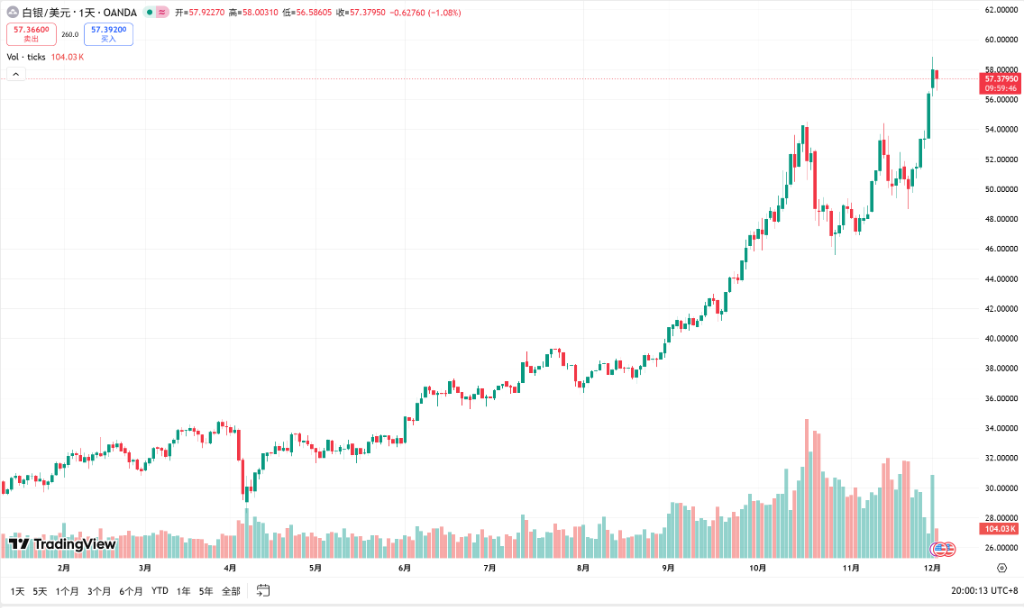
Core Viewpoint - A global silver market storm triggered by physical supply shortages is leading to soaring silver prices, reaching historical highs as Shanghai Futures Exchange inventories plummet to near ten-year lows [1][3]. Group 1: Supply Dynamics - Shanghai silver inventory dropped by 58.83 tons to 715.875 tons, marking the lowest level since July 3, 2016 [4]. - The tight supply is attributed to increased exports from London, with China's silver exports exceeding 660 tons in October, a record high [6]. - The silver futures market in Shanghai is experiencing a deep "spot premium" structure, indicating severe short-term supply pressure [8]. Group 2: Demand Factors - Strong industrial demand, particularly in the solar energy sector, is contributing to the price increase, as Q4 is typically a peak season for solar installations [9]. - Speculative demand is surging, with significant inflows into silver ETFs and rising volatility premiums for silver call options, indicating heightened investor interest [9]. Group 3: Macro and Policy Risks - Economic expectations and potential policy changes are adding uncertainty to the silver market, with rising speculation about possible interest rate cuts by the Federal Reserve [10]. - Concerns about potential tariffs on silver from the U.S. government are causing market tension, as this could lock in already imported silver and exacerbate supply issues [10]. Group 4: Market Reactions - Investor sentiment is high, with silver mining stocks experiencing significant gains; Coeur Mining Inc. rose by 3.5%, Pan American Silver Corp. by 2.5%, and Fresnillo Plc surged over 8% [11].

当黄金悄然创下历史新高,狂热的加密货币却留下了满地伤痕……
Sou Hu Cai Jing· 2025-10-13 17:34
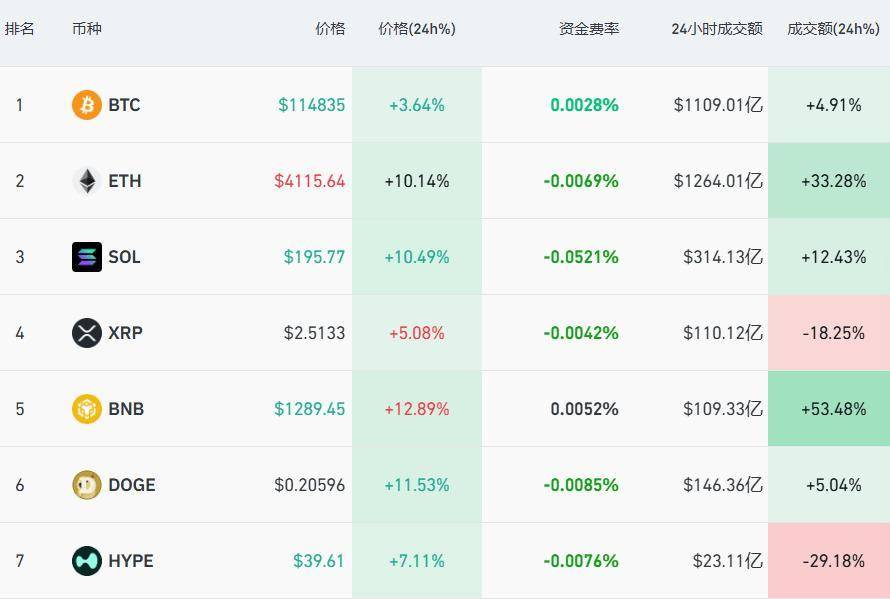
Market Overview - Cryptocurrency market experienced extreme volatility, with Bitcoin dropping from $122,000 to just above $100,000, then rebounding to $114,000, while Ethereum and Dogecoin also saw significant fluctuations [1] - In the past 24 hours, 180,000 traders faced liquidation, resulting in a loss of $632 million, highlighting the speculative nature of the market [1] Cryptocurrency Performance - Bitcoin (BTC) price: $114,835, up 3.64% in 24 hours [2] - Ethereum (ETH) price: $4,115.64, up 10.14% in 24 hours, with a trading volume of $126.4 billion, an increase of 33.28% [2] - Other notable cryptocurrencies include Solana (SOL) at $195.77 (+10.49%), XRP at $2.5133 (+5.08%), and Dogecoin (DOGE) at $0.20596 (+11.53%) [2] Regulatory Environment - The cryptocurrency market is facing increasing scrutiny from regulators, with past incidents like the LUNA crash leading to significant losses for investors [4] - Regulatory actions are seen as inevitable, with the market being compared to a casino, where risks are high and often unpredictable [4] Gold Market Dynamics - Gold prices have surged to a record high of $4,060, driven by rising risk aversion amid global economic uncertainty [3] - The increase in gold ETF holdings and central bank purchases indicates a shift in investor sentiment towards safer assets [3] Federal Reserve Policy - The probability of a Federal Reserve interest rate cut in October is at 97.8%, reflecting market expectations for monetary easing [3] - However, mixed signals from Fed officials suggest potential volatility in future policy decisions [3]
突破3800美元!黄金成最大赢家,但隐藏着三大风险
Sou Hu Cai Jing· 2025-10-01 02:06
Core Viewpoint - The surge in gold prices, reaching a historic high of over $3,800 per ounce, is driven by a combination of political instability in the U.S., expectations of interest rate cuts by the Federal Reserve, and systemic gold purchases by global central banks [1][2][4]. Group 1: Market Dynamics - The political deadlock in Washington, particularly the breakdown of negotiations between the Trump administration and congressional leaders, has heightened risk aversion in capital markets, propelling gold prices [1]. - The London gold market is experiencing a rare phenomenon where traders are rapidly transporting gold bars from the Bank of England to New York to fill physical gaps in the COMEX futures market, indicating deep-seated anxieties about the credibility of the U.S. dollar [1][3]. - The gold ETF market in China has seen a significant increase, with total assets reaching 160 billion yuan, reflecting strong investor confidence in gold as a financial asset [3]. Group 2: Influencing Factors - Strong expectations for interest rate cuts by the Federal Reserve are a key driver, with market predictions showing a 90% chance of a cut in October and a 65% chance in December, reducing the opportunity cost of holding gold [2]. - Geopolitical risks, including potential tariffs on Canada and Mexico, have shifted gold's demand from short-term hedging to long-term strategic allocation [2]. - Central banks globally are increasing their gold reserves, with a projected net purchase of 1,089.4 tons in 2024, indicating a structural shift in gold's role from an investment asset to a strategic reserve [2]. Group 3: Supply and Demand Imbalances - The global supply of gold is constrained, with new discoveries limited and recycling of gold affected by high prices, leading to a structural gap between demand and supply [4]. - The total demand for gold is expected to reach a record 4,974 tons in Q4 2024, while supply is only projected to grow by 1.2%, exacerbating the price increase [4]. - A significant movement of gold worth $82 billion from London to New York has led to a spike in gold leasing rates, indicating tight physical supply [3][4]. Group 4: Market Sentiment and Technical Indicators - The market sentiment is mixed, with institutional investors showing strong confidence in gold, as evidenced by hedge funds holding a record net long position of $73 billion, while some retail investors are taking profits [3]. - Technical indicators suggest that gold is in an overbought territory, with the 14-day Relative Strength Index (RSI) reaching 78, indicating potential for a correction if prices fall below $3,165 per ounce [4]. - The divergence in views on gold's future, with some believing its safe-haven properties are diminished while others see long-term support from central bank purchases, reflects the complex dynamics at play in the market [5].
银行理财有哪些常见风险?
Sou Hu Cai Jing· 2025-08-05 17:18
Core Viewpoint - Bank wealth management serves as a common investment method, providing investors with opportunities to participate in financial markets and achieve asset preservation and appreciation. However, understanding the common risks associated with bank wealth management is crucial for investors [1] Market Risk - Market risk is a significant risk faced by bank wealth management products, influenced by changes in financial markets such as interest rates, exchange rates, and stock and bond market fluctuations. Interest rate risk is a key component; when market interest rates rise, the attractiveness of fixed-income wealth management products declines, potentially lowering their prices. Conversely, when market interest rates fall, the performance of wealth management products may improve. Exchange rate risk mainly affects wealth management products involving foreign exchange, where fluctuations can lead to losses during currency conversion. Additionally, volatility in stock and bond markets can impact related wealth management products, particularly those invested in stocks or equity funds, which may face asset value depreciation during stock market downturns [2] Credit Risk - Credit risk refers to the risk of default or deterioration in the credit status of the entities in which wealth management products invest, leading to potential losses of expected returns or principal for investors. Funds from bank wealth management products may be directed towards various entities, such as corporations and government agencies. If a corporation performs poorly and cannot repay its debts, or if a government faces fiscal difficulties and fails to meet its debt obligations, the returns on wealth management products may be negatively affected. Banks conduct credit assessments and screenings of investment targets when issuing wealth management products, but even with rigorous evaluations, credit risk cannot be entirely eliminated [3] Liquidity Risk - Liquidity risk manifests when investors cannot timely liquidate wealth management products when needed or suffer losses during the liquidation process. Some bank wealth management products have fixed investment terms, preventing investors from redeeming funds early during the product's duration. Even if early redemption is allowed, it may incur fees or be redeemed at prices lower than the purchase price, reducing actual returns for investors. Furthermore, during periods of overall market liquidity stress, banks may face funding pressures, making it difficult to meet investors' early redemption requests, thereby exacerbating liquidity risk [4] Operational Risk - Operational risk encompasses losses arising from inadequate or problematic internal processes, human errors, system failures, or external events during the operation of wealth management products. For instance, bank staff may fail to adequately explain the risk terms and return structures of products during the sales process, leading to misjudgment by investors. In the operational phase, if a bank's internal risk management system malfunctions, it may miss optimal investment opportunities or fail to effectively control risks. Additionally, external factors such as cyberattacks or natural disasters can disrupt normal bank operations, negatively impacting the investment returns of wealth management products [5] Policy Risk - Policy risk arises from changes in national macroeconomic policies and financial regulatory policies. Adjustments in government fiscal and monetary policies can have widespread effects on financial markets. For example, changes in tax policies may affect the return levels of wealth management products, while loose monetary policies may lead to declining market interest rates, impacting the yields of fixed-income wealth management products. Changes in financial regulatory policies are also significant; adjustments by regulatory agencies regarding banks' business scopes and risk management requirements may compel banks to modify the design and investment strategies of wealth management products, potentially affecting their return and risk characteristics, leading to discrepancies between actual investment returns and expectations [6]
信托产品的收益稳定吗?
Sou Hu Cai Jing· 2025-07-29 06:13
Core Viewpoint - Trust products occupy a unique position in the financial market, and their yield stability is a key concern for many investors. Understanding the factors influencing the stability of trust product yields requires a comprehensive analysis [1][2]. Group 1: Factors Affecting Yield Stability - Trust products are based on trust and are a property management system where investors entrust funds to trust companies for management and operation, targeting specific projects such as infrastructure, business operations, and real estate development [1]. - Credit risk is a significant factor in assessing the yield stability of trust products. The credit risk primarily depends on the credit status and repayment ability of the financing party. A financially sound and stable financing party can ensure timely and full payment of yields, thus enhancing yield stability [1]. - Market risk also significantly impacts the yield stability of trust products. Changes in the macroeconomic environment, industry development cycles, and interest rate fluctuations can cause yield volatility. During economic prosperity, trust products often achieve better yields, while economic downturns can adversely affect yield stability [2]. - Policy risk is an unavoidable factor as well. Different industries are affected by policies to varying degrees. For instance, strict real estate regulations can limit financing and development progress for real estate trust projects, impacting their yields [2].
昨夜,黄金突然拉升!
Sou Hu Cai Jing· 2025-07-22 00:04
Market Performance - US stock indices showed mixed results, with the Dow Jones down 0.04%, while the Nasdaq rose 0.38% and the S&P 500 increased by 0.14%, both reaching new highs [1] - Major tech stocks mostly saw gains, with Google up over 2% and Amazon rising more than 1% [1] - Chinese concept stocks had varied performances, with the Nasdaq Golden Dragon China Index down 0.28%, while stocks like Huya surged 16%, NIO rose nearly 3%, and Pinduoduo increased over 2%. However, Li Auto fell over 4% and JD.com dropped more than 1% [1] International Trade and Policy - The international trade situation is under scrutiny, as White House Press Secretary Karine Leavitt indicated that President Trump may issue more tariff letters before August 1. She suggested that more trade agreements could be reached before this deadline [1] - Fitch Ratings expressed concerns over US credit outlook, downgrading the outlook for 25% of US industries to "deteriorating" due to increased uncertainty, slowing economic growth, and expectations of prolonged high interest rates [1] Commodity Prices - International gold prices increased, with COMEX gold futures rising by 1.55% to $3410.3 per ounce, and COMEX silver futures up by 2.02% to $39.24 per ounce [2]