流动性紧缩

Search documents
Cathie Wood Predicts Crypto Liquidity Crunch Will Reverse Within Weeks
Yahoo Finance· 2025-11-27 09:03
Core Viewpoint - ARK Invest CEO Cathie Wood predicts a reversal of the liquidity squeeze affecting crypto and AI markets within weeks, driven by anticipated Federal Reserve policy shifts before year-end [1][2] Group 1: Federal Reserve Policy Expectations - Wood expects the Federal Reserve to end quantitative tightening at its December 10 meeting, which will alleviate one of the liquidity constraints [3] - The conclusion of the government shutdown has returned funds to circulation, further easing liquidity pressures [3] - Wood anticipates another interest rate cut in December as economic data shows signs of weakening [4] Group 2: Current Market Conditions - Bitcoin is currently trading below $88,000, down from an October peak of $126,000, with crypto-linked equities experiencing their sharpest monthly declines since early 2024 [2] - The crypto market has shown sensitivity to liquidity conditions, with Bitcoin dropping below $90,000 for the first time since April, leading to significant outflows from US Bitcoin funds [6] - Average spot ETF investors are currently underwater, with a flow-weighted cost basis around $89,600 [6] Group 3: Inflation and Economic Indicators - Oil prices have fallen below $60 per barrel, contributing to deflationary pressures, while new home prices have declined for about a year [5] - Existing home price inflation has dropped to 1.5%, indicating a potential break in inflation as tariffs are expected to pass through in the next year [5] - Ten-year Treasury yield inflation expectations have decreased to approximately 2.5% [4] Group 4: Crypto as a Liquidity Indicator - Wood emphasized that the crypto ecosystem serves as a leading indicator of liquidity conditions, reflecting changes as liquidity ebbs and flows [7]
外汇期货周度报告:非农数据超预期,美元短期回升-20251123
Dong Zheng Qi Huo· 2025-11-23 10:11
1. Report Industry Investment Rating - The rating for the US dollar is "oscillating" [5] 2. Core View of the Report - The release of the September non - farm payroll data in the US after the government ended the shutdown showed that the job market continued to cool but without significant deterioration. The data did not strengthen the Fed's rate - cut expectation, and the stock market was significantly suppressed. The Fed's stance on a December rate cut is uncertain, and the market's expectation of liquidity tightening has changed, with the probability of a December rate cut exceeding 50% [2][33] 3. Summary by Directory 3.1 Global Market Overview This Week - Market risk appetite declined, most stocks fell, bond yields mostly decreased, and the US bond yield dropped to 4.06%. The US dollar index rose 0.89% to 100.2, non - US currencies depreciated, gold fell 0.5% to $4065 per ounce, the VIX index rose to 23.4, and the spot commodity index declined, with Brent crude oil dropping 2.2% to $62.33 per barrel [1][5][9] 3.2 Market Trading Logic and Asset Performance 3.2.1 Stock Market - Global stock markets mostly declined, with significant drops in US and A - shares. The September non - farm payroll report did not strengthen the Fed's rate - cut expectation, and the Fed's internal differences intensified. The stock market was suppressed, and it is expected that the stock market will continue to oscillate weakly [10][11][13] 3.2.2 Bond Market - Global bond yields mostly declined, with the 10 - year US bond yield dropping to 4.06%. The decline was driven by the inflow of funds from the falling stock market. However, the Fed's hawkish stance limited the downward space of long - term bond yields. The domestic bond market in China oscillated weakly [14][17][20] 3.2.3 Foreign Exchange Market - The US dollar index rose 0.89% to 100.2, and all non - US currencies depreciated. The offshore RMB gained 0.08%, the euro fell 0.94%, the pound fell 0.55%, the yen fell 1.2%, and others also declined [23][24][26] 3.2.4 Commodity Market - Gold fell 0.5% to $4065 per ounce, and it is in an oscillating pattern with a risk of decline. Brent crude oil fell 2.2% to $62.33 per barrel, and the commodity spot index declined due to the weak supply - demand pattern of oil and the strong US dollar [27][29][32] 3.3 Hotspot Tracking - The September US non - farm payroll data exceeded expectations, with the number of new jobs being 119,000, higher than the expected 50,000. The unemployment rate rose to 4.4%, and the wage growth rate remained high at 3.8% year - on - year [2][31][33] 3.4 Next Week's Important Event Tips - Monday: US November Dallas Fed Business Activity Index - Tuesday: US September retail sales, PPI, housing price index; US November Conference Board Consumer Confidence Index - Wednesday: US weekly initial jobless claims, September durable goods orders and new home sales; US November Chicago PMI - Thursday: Eurozone November economic sentiment index; Fed releases the Beige Book; ECB October interest rate meeting minutes - Friday: France and Germany October CPI [35]
市场波动加剧,美元短期走弱
Dong Zheng Qi Huo· 2025-11-16 10:12
Report Industry Investment Rating - The rating for the US dollar is "Oscillating" [5] Core Viewpoints - Market risk appetite is fluctuating, with most global stock markets rebounding, most bond yields rising, and the US dollar index falling. The market is affected by factors such as the end of the US government shutdown, data uncertainties, and changes in tariff policies [1][11] - Liquidity crunch occurs repeatedly, leading to increased market volatility. The market's expectation of a December interest rate cut has changed, and asset prices are sensitive to liquidity changes [33][37] Summary by Directory 1. Global Market This Week Overview - Market risk appetite is wavering. Most stock markets rebound, most bond yields rise, the US dollar index drops 0.31% to 99.3, most non - US currencies appreciate, gold rebounds 2.1% to $4081 per ounce, the VIX index rises to 19.8, the spot commodity index closes higher, and Brent crude oil drops 0.1% to $63.74 per barrel [1][5][9] 2. Market Trading Logic and Asset Performance 2.1 Stock Market - Global stock markets mostly rebound. The S&P 500 in the US rises 0.08%, while the Shanghai Composite Index in China falls 0.18%. The end of the US government shutdown, data uncertainties, and changes in tariff policies affect the market. In China, the weak economic data in October puts pressure on the stock market [10][11] 2.2 Bond Market - Global bond yields mostly rise, with the 10 - year US Treasury yield reaching 4.14%. The end of the US government shutdown and potential fiscal deficit increase pressure on long - term bonds. Developed countries' monetary policies are on hold, and the domestic bond market in China is volatile [14][19][22] 2.3 Foreign Exchange Market - The US dollar index drops 0.31% to 99.3, and most non - US currencies appreciate. Offshore RMB rises 0.38%, the euro rises 0.47%, the British pound rises 0.08%, the Japanese yen drops 0.74%, the Swiss franc rises 1.39%, and some other currencies also show gains [25][27][28] 2.4 Commodity Market - Gold rebounds 2.1% to $4084 per ounce, affected by expectations of the Fed's policy shift. However, after the end of the US government shutdown and hawkish remarks from Fed officials, it gives back some gains. Brent crude oil drops 0.1% to $63.74 per barrel, and the supply - demand pattern for oil remains weak [29][32] 3. Hotspot Tracking - Liquidity crunch occurs repeatedly, causing increased market volatility. The market experiences a significant turnaround from the beginning to the end of the week due to data uncertainties and hawkish signals from the Fed [33][37] 4. Next Week's Important Event Reminders - Monday: Japan's Q3 GDP, US November New York Fed Manufacturing Index - Tuesday: US November NAHB Housing Market Index - Wednesday: UK and Eurozone October CPI - Thursday: US weekly initial jobless claims, November Philadelphia Fed Manufacturing Index, US September non - farm payrolls - Friday: Japan's October CPI, US November University of Michigan Consumer Confidence Index final value [39]
综合晨报:10月金融数据多数不及预期-20251114
Dong Zheng Qi Huo· 2025-11-14 00:47
1. Report Industry Investment Ratings - No specific industry investment ratings are provided in the report. 2. Core Views of the Report - The financial data in October was mostly below expectations, with the household sector deleveraging again and the M1 growth rate turning downward. However, the bond market had fully anticipated this, and it remained in a volatile range [2]. - Multiple Federal Reserve officials made hawkish statements, leading to a liquidity crunch in the market, a significant decline in risk appetite, and a short - term rebound of the US dollar [13]. - In the commodity market, different products showed various trends. For example, the strong reality and weak expectations coexisted in the lithium carbonate market, and the methanol market had a reduced probability of extreme market conditions [6]. 3. Summary by Relevant Catalogs 3.1 Financial News and Reviews 3.1.1 Macro Strategy (Foreign Exchange Futures - US Dollar Index) - Multiple Federal Reserve officials, including Beth Hammack, emphasized high inflation and the need to maintain restrictive policies. This led to a liquidity crunch, a decline in risk appetite, and a short - term rebound of the US dollar [13]. - Investment advice: The US dollar index is expected to rebound in the short term [14]. 3.1.2 Macro Strategy (US Stock Index Futures) - Fed officials were more cautious about future interest rate cuts due to the non - release of economic data. Their overall hawkish statements increased the yield of US Treasury bonds, reduced market risk appetite, and led to greater long - short games in technology stocks, dragging down the index performance [16]. - Investment advice: The US stocks are expected to fluctuate at high levels in the short term, and a mostly bullish approach should be maintained [17]. 3.1.3 Macro Strategy (Stock Index Futures) - In October, M2 increased by 6.2% year - on - year, and the A - share market was booming, but the poor financial data in October and the real - estate adjustment might limit the stock market's rebound space [18][19]. - Investment advice: Allocate evenly among long positions in various stock indices [20]. 3.1.4 Macro Strategy (Treasury Bond Futures) - The financial data in October was weak, which was beneficial to the bond market. However, the bond market had already anticipated this, and it remained in a narrow - range volatile state. The stock - bond seesaw effect was present, but the stock market was unlikely to drive the bond market to fall continuously [22]. - Investment advice: Adopt a volatile trading strategy [23]. 3.2 Commodity News and Reviews 3.2.1 Agricultural Products (Soybean Meal) - The NOAA reported that La Nina might last until the Northern Hemisphere winter. The USDA's weekly export sales report met expectations, and CONAB predicted record - high soybean production and exports in Brazil's 25/26 season [24][26]. - Investment advice: Closely monitor the USDA's monthly supply - demand report, especially the adjustments to US soybean yield and exports [26]. 3.2.2 Agricultural Products (Soybean Oil/Rapeseed Oil/Palm Oil) - Indonesia's palm oil replanting target for small farmers was unlikely to be achieved. Indonesia will start B50 road tests in early December and plans to implement the B50 policy in the second half of next year, which may reduce palm oil exports [27][28]. - Investment advice: The B50 policy will support market sentiment in the short term, but the high inventory will limit the upside of the 01 contract. Consider long positions in the 05 contract [29]. 3.2.3 Agricultural Products (Sugar) - The CAI lowered India's cotton production forecast for the 25/26 season. The international cotton market was weak, and the market had a bearish expectation for the upcoming USDA report [30][32]. - Investment advice: The Zhengzhou cotton futures are expected to fluctuate in the short term (13300 - 13800). Wait for a pull - back to go long in the long term [34]. 3.2.4 Agricultural Products (Red Dates) - The purchase price of red dates in Xinjiang decreased slightly. The futures price of the main contract CJ601 fell, and the supply was increasing while the demand was weak [35][36]. - Investment advice: Wait and see until the harvest is completed, and focus on the price negotiation and purchase progress in the production area [36]. 3.2.5 Agricultural Products (Hogs) - A major shareholder of Muyuan released 64.2 million shares from pledge. The inventory accumulation continued, but whether it would lead to a weak peak season was uncertain. The price might stabilize and rebound with the entry of second - fattening pigs, but the price decline pressure in the fourth quarter was still large [37]. - Investment advice: The near - term contracts may strengthen with the increase in curing demand. Sell on rallies for the 1 and 3 contracts and consider long positions in the far - term contracts on dips [38]. 3.2.6 Black Metals (Steam Coal) - The spot market of imported Australian steam coal was stable. The port coal price was firm, but the pit - mouth price decreased. The 2026 long - term contract price is expected to be 675 yuan, and the coal price is expected to remain high in winter but face resistance at 900 yuan [39]. - Investment advice: The port price is expected to be stable at a high level, and the price may fluctuate around 800 yuan. Monitor the long - term contract negotiation in December and temperature changes [39]. 3.2.7 Black Metals (Iron Ore) - Usiminas' iron ore production and sales increased in the third quarter. The fundamentals were weak, with high hot - rolled coil inventory and weak year - end orders. The steel mills' demand for raw materials was under pressure [40]. - Investment advice: Given the weak fundamentals, the raw material side is still under pressure, but the rate of decline is slow [40]. 3.2.8 Black Metals (Rebar/Hot - Rolled Coil) - India imposed anti - dumping duties on Vietnamese alloy and non - alloy hot - rolled steel plates. The steel price rebounded slightly, but the overall demand was average, and the high inventory of hot - rolled coils limited the price rebound [41][45]. - Investment advice: Adopt a volatile trading strategy for steel prices in the short term [46]. 3.2.9 Agricultural Products (Corn Starch) - The consumption of corn and corn starch in starch sugar products increased slightly. The starch price followed the raw material price, and the futures price spread between rice and starch strengthened slightly [47][49]. - Investment advice: The 01 futures price spread has recovered to some extent. Expect short - term fluctuations and consider band trading [49]. 3.2.10 Agricultural Products (Corn) - The corn inventory of processing enterprises decreased. The spot and futures prices were strong, but there might be selling pressure later. The 07 and 09 contracts are expected to be bullish in the long term [49][50]. - Investment advice: There is uncertainty in the new - season supply - demand. The spot and futures prices may fall later. Wait for a pull - back to go long in the 07 and 09 contracts [50]. 3.2.11 Non - Ferrous Metals (Lead) - The LME lead inventory decreased, and the cash - to - three - month spread widened. The SHFE lead price fluctuated. The delivery volume will be reflected in the warehouse receipts, and the deep - decline possibility is low before the warehouse receipt risk is resolved [52]. - Investment advice: For the industry, consider short - selling at high levels. Observe the virtual - to - real ratio of the 12 and 01 contracts. For arbitrage, wait and see. Consider positive arbitrage between domestic and foreign markets [53]. 3.2.12 Non - Ferrous Metals (Zinc) - The LME zinc cash - to - three - month spread was at a premium, and the domestic zinc inventory decreased. The short - term price fluctuation of SHFE zinc followed the macro trend, and the LME inventory change should be monitored [56]. - Investment advice: For the short - term, observe if the short - selling trend is established and consider short - selling at high levels. Consider positive arbitrage in the medium - term. Be cautious with short - term foreign - domestic reverse arbitrage [56]. 3.2.13 Non - Ferrous Metals (Nickel) - The LME nickel inventory decreased slightly. The raw material price was expected to be stable and strong, and the refined nickel inventory accumulation slowed down [57]. - Investment advice: The market has a consistent expectation of nickel oversupply. Wait and see in the short term and consider long positions after the inventory accumulation inflection point [58]. 3.2.14 Non - Ferrous Metals (Lithium Carbonate) - Rio Tinto shelved the Jadar lithium project in Serbia. The strong reality and weak expectations coexisted. The inventory decline accelerated in the short term, but the supply may increase in the future [59][60]. - Investment advice: Expect a strong and volatile market in the short term and consider range trading. Look for short - selling opportunities at high levels in the medium - term when the demand weakens and the project restart progress is clear [61]. 3.2.15 Energy Chemicals (Carbon Emissions) - The CEA price decreased slightly, and the trading volume remained high. The rigid demand during the compliance peak supported the carbon price, but the overall supply - demand structure was loose [62]. - Investment advice: The CEA has strong short - term support [63]. 3.2.16 Energy Chemicals (Methanol) - China's methanol production and capacity utilization decreased slightly this week. The probability of extreme market conditions for the 01 contract decreased significantly [64]. - Investment advice: Holders of short positions can take profits at around 2100 yuan/ton. If the price rebounds without a fundamental reversal, short positions can be re - established [6]. 3.2.17 Energy Chemicals (Caustic Soda) - The supply of caustic soda increased, and the demand was stable. The low - concentration caustic soda price was stable, and the high - concentration caustic soda price increased slightly [66]. - Investment advice: The fundamentals of caustic soda have little change, with overall supply - demand being relatively loose. Expect short - term fluctuations [68]. 3.2.18 Energy Chemicals (PVC) - The PVC powder market price weakened slightly. The futures price fluctuated, and the inventory decreased slightly. The cancellation of India's BIS certification has limited positive effects [69][70]. - Investment advice: Adopt a short - selling strategy on rebounds for near - term contracts. Consider long - term layout for far - term contracts after a significant price decline [71]. 3.2.19 Energy Chemicals (Pulp) - The price of imported wood pulp increased. The futures price of pulp rose, and the market focused on the reduction of low - price warehouse receipts after December [72]. - Investment advice: The pulp futures are relatively strong in the near term. Monitor the warehouse receipt registration. If a large number of warehouse receipts are registered, the upward risk of the futures price will increase [73]. 3.2.20 Energy Chemicals (Styrene) - China's styrene production and capacity utilization increased this week. The price of styrene rebounded, mainly due to the concentrated short - covering of crowded short positions [74][75]. - Investment advice: Monitor whether short positions will take profits in advance. Adopt a wait - and - see attitude in the short term [76]. 3.2.21 Energy Chemicals (Soda Ash) - The soda ash manufacturer's inventory changed little this week. The futures price rebounded due to cost increases. The near - term contracts are relatively strong, but the far - term contracts may be under pressure with new capacity coming online [77]. - Investment advice: The near - term contracts have some support, and the downward space depends on coal price fluctuations and new capacity release. Adopt a bearish approach in the medium - term [78]. 3.2.22 Energy Chemicals (Float Glass) - The float glass manufacturer's inventory changed little this week, with regional differences. The futures price rebounded due to the strength of soda ash [79]. - Investment advice: The market has intense long - short games and large price fluctuations. It is recommended to wait and see [79]. 3.2.23 Shipping Index (Container Freight Rate) - The Port of Long Beach will develop a new container terminal. The focus of the European line is on the implementation of the December price increase and the adjustment at the EC2502 delivery date [80]. - Investment advice: The market fluctuates greatly. Pay attention to risk management and consider long positions on dips for the 02 contract [80].
外汇期货周度报告:流动性被动紧缩,美元指数下跌-20251109
Dong Zheng Qi Huo· 2025-11-09 09:14
Report Industry Investment Rating - The rating for the US dollar is "oscillation" [4] Core Viewpoints of the Report - The US government shutdown has led to a passive tightening of liquidity, increasing market volatility. Once the shutdown ends, market sentiment is expected to be boosted. The US economy has not yet entered a recession, but the employment market is showing a clear weakening trend, and the economic outlook is pessimistic. The current situation of liquidity tightening may present a good entry opportunity, as it is expected to be temporary. Once the government reopens and the liquidity tightens eases, market risk appetite will recover [2][10][32] Summary by Relevant Catalog 1. Global Market Overview This Week - Market risk appetite declined, most global stock markets fell, and most bond yields rose. The US Treasury yield slightly increased to 4.09%. The US dollar index dropped 0.2% to 99.6, and non - US currencies showed mixed performance. The offshore RMB slightly declined by 0.05%, while the euro rose 0.25%, the pound rose 0.07%, and the yen rose 0.37%. Gold prices fluctuated around $4000 per ounce, the VIX index rose to 19, and the spot commodity index declined. Brent crude oil dropped 2.2% to $63.78 per barrel [1][8] 2. Market Trading Logic and Asset Performance 2.1 Stock Market - Most global stock markets fell. In developed markets, the S&P 500 dropped 1.63%, and the Eurozone stock markets mostly declined. In emerging markets, most stock markets rose, with the Shanghai Composite Index rising 1.08% and the Hang Seng Index rising 1.29%, while the Nikkei 225 index dropped 4.07%. The US government shutdown has dragged down the economy and employment, and the tightening of financial market liquidity has increased market volatility. The US stock market's upward trend has slowed, and concerns about high valuations and potential AI industry bubbles have increased. The domestic stock market is fluctuating at a high level, and the divergence between stock market performance and fundamentals persists [9][10][12] 2.2 Bond Market - Global bond yields showed mixed performance. The 10 - year US Treasury yield rose to 4.09%. The US government's continued shutdown, tightened financial market liquidity, and better - than - expected ADP employment data in October have reduced market expectations for a Fed rate cut in December. The Bank of England kept its policy unchanged, and the yields of major global government bonds tend to rise. The 10 - year Chinese government bond yield rebounded to 1.808%, and the domestic bond market continued to fluctuate [13][16][19] 2.3 Foreign Exchange Market - The US dollar index dropped 0.2% to 99.6, and non - US currencies showed mixed performance. The offshore RMB slightly declined by 0.05%, the euro rose 0.25%, the pound rose 0.07%, the yen rose 0.37%, the Swiss franc dropped 0.07%, the South Korean won dropped 2.2%, the New Zealand dollar dropped 1.8%, and the Australian dollar, Canadian dollar, and Indian rupee closed down, while the peso, real, and ringgit closed up [22][23][25] 2.4 Commodity Market - Spot gold oscillated slightly lower, closing at $4001 per ounce. The international gold price is fluctuating around $4000, with some bottom - fishing signs in the market. However, the uncertainty of a Fed rate cut in December and the temporary liquidity tightening in the US financial market have increased market volatility, and gold lacks upward momentum in the short term. Brent crude oil dropped 2.2% to $63.78 per barrel, and the supply - demand pattern of oil prices remains weak, with the commodity spot index closing down [26][28] 3. Hotspot Tracking - The government shutdown has led to passive liquidity tightening. The balance in the US Treasury's TGA account has significantly increased, resulting in a passive tightening effect, raising overnight interest rates and the US dollar index. This has led to a weakening of market risk appetite, and most assets have declined. It is expected that the government will reopen soon, and once it does, market risk appetite will recover [29][31][32] 4. Next Week's Important Event Tips - Monday: Release of the Bank of Japan's meeting minutes - Tuesday: Release of the US October NFIB Small Business Confidence Index - Wednesday: US Treasury Secretary Besent will give a speech - Thursday: Release of the Bank of Canada's interest rate meeting minutes - Friday: Release of China's October social retail sales and industrial added value [34]
贵金属日报2025-11-06:贵金属-20251106
Wu Kuang Qi Huo· 2025-11-06 01:13
1. Report Industry Investment Rating - There is no information about the report industry investment rating in the provided content. 2. Core Viewpoints of the Report - The recent weak and volatile prices of gold and silver are due to the tight overseas liquidity, but this risk has been reduced for the time being [4]. - The release of the Fed's loose monetary policy expectations still requires a certain period. The October FOMC meeting signaled the uncertainty of a December rate cut and strengthened the subsequent "rate cut + balance - sheet expansion" monetary policy approach [4]. - In the loose monetary policy cycle, combined with the potential tight physical market, it is recommended to go long on silver on dips. The reference operating range for the main contract of Shanghai gold is 880 - 966 yuan/gram, and for the main contract of Shanghai silver is 11,001 - 12,366 yuan/kilogram [4]. 3. Summary According to Related Catalogs 3.1 Market Quotes - Shanghai gold rose 0.63% to 916.38 yuan/gram, and Shanghai silver rose 1.58% to 11,381.00 yuan/kilogram. COMEX gold was reported at 3,990.40 US dollars/ounce, and COMEX silver was reported at 47.86 US dollars/ounce. The US 10 - year Treasury yield was reported at 4.17%, and the US dollar index was reported at 100.16 [2]. - After President Trump's speech on resolving the government shutdown, the market's expectation of liquidity tightening was alleviated. The better - than - expected US October ADP employment data eased the recession trading after the release of the ISM manufacturing PMI, and the price of silver outperformed that of gold [2]. 3.2 Influencing Factors - The accumulation of the TGA account balance due to the US government shutdown is an important reason for the recent tight market liquidity. Trump's speech indicates that liquidity repair will occur soon, and the prices of gold and silver have stabilized [3]. - The number of new ADP employment in the US in October was 42,000, higher than the expected 28,000 and the previous value of - 32,000. The US ISM non - manufacturing PMI was 52.4, higher than the expected 50.8 and the previous value of 50. The overseas recession expectation has eased, and the gold - silver ratio has declined [3]. 3.3 Data Summary - For gold, the closing price of the active COMEX contract increased by 1.25% to 3,990.40 US dollars/ounce, the trading volume decreased by 29.77% to 171,800 lots, the CFTC - reported open interest increased by 2.43% to 528,800 lots, and the inventory remained unchanged at 1,178 tons [6]. - For silver, the closing price of the active COMEX contract increased by 2.06% to 47.86 US dollars/ounce, the trading volume increased by 2.82% to 1,390,900 lots, the open interest decreased by 1.55% to 680,700 lots, and the inventory decreased by 1.42% to 656.17 tons [6].
US Government Shutdown Hits Day 35 – Bitcoin News: Will Liquidity Hunters Push BTC USD Higher In November?
Yahoo Finance· 2025-11-04 15:43
Core Insights - Bitcoin is currently trading around $103,960, nearly 20% below its October high of $126,500, marking its lowest level since late June 2025 [1] - The U.S. government shutdown has entered its 35th day, creating uncertainty in global markets and affecting liquidity [1][2] - The U.S. Dollar Index (DXY) has risen above 100 for the first time since August 1, indicating stronger demand for the dollar, which typically pressures risk assets like Bitcoin [2] Government Shutdown Impact - A U.S. government shutdown occurs when Congress fails to pass funding bills, leading to furloughed employees and halted services, which directly impacts liquidity and cash flow in financial markets [3] - During the shutdown, the U.S. Treasury General Account (TGA) has seen its balance increase to approximately $965 billion, a rise of roughly $150 billion since October, indicating money is being pulled out of circulation [4] - The Reverse Repo Program (RRP) has also increased by about $20 billion this week, further draining liquidity from the market [5] Liquidity Conditions - Bank reserves have dropped to the lower range of what the Federal Reserve considers "ample," leading to tighter funding conditions [6] - Rising SOFR spreads and record usage of the Standing Repo Facility (SRF) indicate a short-term liquidity squeeze, with banks borrowing over $10 billion recently, the highest since the SRF's launch in 2021 [6] - These liquidity pressures are contributing to Bitcoin's struggle to gain momentum and remain trapped in a choppy trading range [5][6]
比特币币本位迎来压力测试,XBIT数据:巨鲸24小时转移1.7万枚BTC
Sou Hu Cai Jing· 2025-11-04 11:23
Core Insights - The Bitcoin market experienced significant volatility, with over 17,000 Bitcoins worth billions being transferred to exchanges like Kraken and Binance, increasing immediate selling pressure [1] - The Federal Reserve's hawkish stance and liquidity tightening are major factors contributing to market declines, with a notable drop in the probability of a rate cut in December [3][12] - Institutional investors are accumulating Bitcoin despite market panic, contrasting with retail investors' fear, as indicated by a drop in the Fear and Greed Index to 21 [5][7] Market Dynamics - A large-scale auction of U.S. Treasury bills totaling $163 billion has drained liquidity from financial markets, putting pressure on risk assets [3] - The probability of a 25 basis point rate cut in December has decreased to 67.3%, while the likelihood of maintaining current rates stands at 32.7% [3] - XBIT's on-chain analysis shows significant selling activity on major exchanges, indicating ongoing selling pressure on Bitcoin [4] Technical Analysis - Bitcoin is currently testing critical support levels around $107,500, with potential further declines if this level is breached [9][10] - Key resistance levels are identified between $111,000-$112,000 and $113,800-$115,000, while support levels are at $108,200-$107,000 and $105,000-$106,400 [9] - Technical indicators suggest a potential for a rebound near current support levels, with a historical probability of over 70% for a rebound following a drop in KDJ values [9] Institutional Behavior - Strategy Company has purchased 397 Bitcoins at an average price of $114,771, increasing its total holdings to 641,205 Bitcoins valued at approximately $69.1 billion [5] - Despite recent stock price declines, 96% of surveyed investors expect Strategy Company to hold onto its Bitcoin, reflecting confidence in long-term value [12] - The divergence in sentiment between institutional and retail investors is notable, with institutions showing a willingness to accumulate while retail investors exhibit fear [6][7] Future Outlook - The recovery of the Bitcoin market hinges on the return of liquidity, with potential catalysts including the resumption of U.S. government operations and adjustments in the Federal Reserve's repurchase operations [12] - Investors are advised to monitor key support levels and the Federal Reserve's policy direction closely, as these factors will significantly influence market dynamics [12][13]


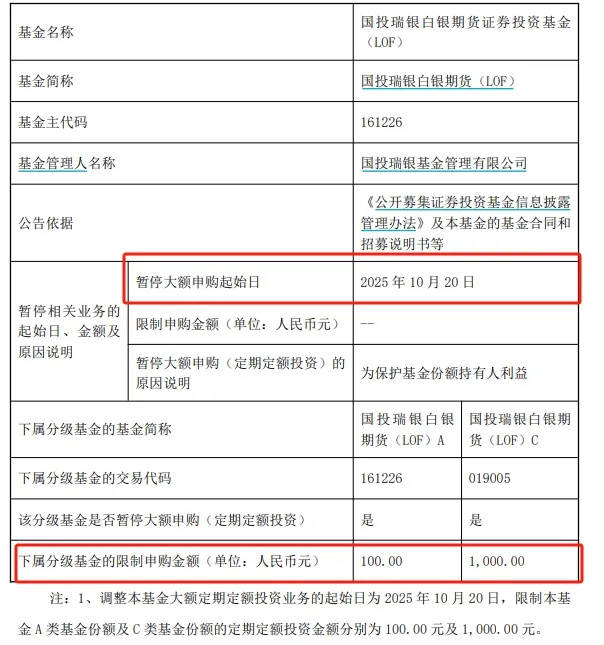
白银涨幅已超黄金,基金机构公告:限购升级
Sou Hu Cai Jing· 2025-10-20 02:56
Core Insights - Precious metal prices, particularly silver, have seen significant increases, with silver prices recently surpassing historical highs [1][4] - The domestic investment market is experiencing a surge in activity, leading fund managers to implement purchase limits to maintain stable operations [1][2] Group 1: Market Dynamics - The international spot silver price has risen more than that of gold this year, with recent prices exceeding $50 per ounce [3][4] - The surge in silver prices is driven by multiple factors, including liquidity tightening in the London market, increased investor risk aversion, and rising industrial demand [4][11] Group 2: Supply and Demand Factors - London silver inventories have decreased by approximately one-third since mid-2021, with a significant portion held by exchange-traded funds (ETFs) [8] - The current freely available silver inventory is around 200 million ounces, down about 75% from the peak of approximately 850 million ounces in 2019 [8] Group 3: Investment Trends - Many traders who previously bet on falling silver prices are now forced to buy back at higher prices to cover their positions, contributing to increased buying pressure [10] - Analysts predict that industrial demand will become the largest source of silver demand this year, estimated at 430 million ounces, with the solar energy sector being a significant driver [13] Group 4: Future Outlook - The CEO of Sprott believes silver is in a "catch-up rally" with substantial upside potential [15] - Goldman Sachs indicates that while the current liquidity tightening is a key factor in silver's price surge, it is expected to be temporary as silver flows back to London from other regions [15]
限购升级!它,涨幅已超黄金
Sou Hu Cai Jing· 2025-10-20 00:54
Core Viewpoint - The recent surge in precious metal prices, particularly silver, has led to significant market activity, prompting fund managers to impose purchase limits on their products to maintain stable operations [1][2]. Group 1: Market Dynamics - Silver prices have seen a substantial increase this year, surpassing gold in terms of percentage growth [3][4]. - The international spot silver price recently broke the $50 per ounce mark, drawing considerable market attention [4]. - The London silver market is experiencing severe liquidity constraints, which is a key driver behind the current price surge [4][10]. Group 2: Supply and Demand Factors - The liquidity of the silver market is heavily reliant on the stock stored in London, which has been depleting due to insufficient mining supply and increased industrial demand [6]. - Since mid-2021, London silver inventories have decreased by approximately one-third, with a significant portion held by exchange-traded funds (ETFs) [8]. - Current freely available silver inventory is around 200 million ounces, a sharp decline of about 75% from the peak of 850 million ounces in 2019 [8]. Group 3: Investment Trends - Many traders who previously bet on falling silver prices are now forced to buy back at higher prices to cover their positions, contributing to increased buying pressure [10]. - The demand for silver is not only driven by its value storage function but also by its industrial applications, particularly in the renewable energy sector [12][14]. - Citigroup forecasts that industrial demand for silver will reach 430 million ounces this year, with the solar energy sector alone accounting for approximately 299 million ounces [14]. Group 4: Future Outlook - The CEO of Sprott believes that silver is in a "catch-up rally" with significant upside potential [16]. - Goldman Sachs indicates that while the current liquidity tightening is a major factor in silver's price rise, it is expected to be temporary as silver flows back to London from other regions [16]. - Analysts warn that silver's volatility and downside risk may be greater than that of gold due to its lack of central bank support [16].