港股估值

Search documents
多数行业估值水平仍低于历史中位数 ——港股牛市观察
2025-08-26 15:02
Summary of Key Points from the Conference Call Industry Overview - The conference call primarily discusses the Hong Kong stock market (港股) and its performance in 2025, with a focus on various sectors including healthcare, non-essential consumer goods, and financial services [1][2][3]. Core Insights and Arguments - **Federal Reserve's Interest Rate Policy**: There is a strong expectation that the Federal Reserve will lower interest rates in September, with a probability exceeding 80% for two or more rate cuts by the end of the year. This is anticipated to lower the U.S. risk-free rate, attracting foreign capital into the Hong Kong market, thus providing liquidity support [1][2][5][6]. - **Sector Performance**: - The healthcare and non-essential consumer sectors have seen significant increases in trading activity in 2025, with healthcare nearly doubling in performance [3][9]. - The financial sector experienced a peak in trading volume in July but saw a decline in August. Despite this, it is the closest to breaking historical highs, with only a 3% gap remaining [3][13][14]. - Most sectors are still valued below the historical 50th percentile, indicating potential investment opportunities [3][11][12]. - **Market Valuation**: The overall valuation of the Hong Kong stock market remains attractive, with high dividend yields providing a safety net for investors. Most sectors have a PE ratio below the 50th percentile, except for real estate, construction, and telecommunications, which are above this threshold [3][11][12]. - **Future Market Outlook**: The expectation is that the Hong Kong stock market will perform better over the next decade compared to the past ten years, with economic growth correlating positively with stock market returns. The market is anticipated to rebound ahead of the real estate sector during downturns [3][8][16]. Other Important but Potentially Overlooked Content - **Inflation Risks**: The Federal Reserve views the impact of tariffs as likely temporary, but there are concerns about rising wages and consumer inflation expectations that could pose long-term inflation risks. Current data suggests these risks are low [7]. - **Real Estate Sector Challenges**: The real estate and construction sectors are currently the furthest from historical highs and face challenges despite recent policy support aimed at stabilizing the market [15]. - **Investment Preferences**: There is a noted preference among large funds, such as insurance companies, for high dividend yield assets in a low-interest-rate environment, which enhances the attractiveness of these investments [12]. This summary encapsulates the key points discussed in the conference call, providing insights into the current state and future outlook of the Hong Kong stock market and its various sectors.
中泰国际每日晨讯-20250820
ZHONGTAI INTERNATIONAL SECURITIES· 2025-08-20 02:08
Market Overview - On August 19, the Hong Kong stock market showed a lack of direction for two consecutive days, with the Hang Seng Index falling by 54 points or 0.2% to close at 25,122 points. The Hang Seng Tech Index decreased by 0.7% to 5,542 points. The total market turnover reached HKD 278.2 billion, with a net inflow of HKD 18.57 billion into the Hong Kong Stock Connect, primarily into index ETFs [1] Interest Rates and Liquidity - The one-month HIBOR has risen to 2.57%, a two-month high, as the Hong Kong Monetary Authority continues to withdraw HKD liquidity. The Hong Kong-US interest rate spread has narrowed to 1.76%, leading to a strengthening of the Hong Kong dollar. The rising cost of funds in Hong Kong directly impacts corporate financing and investors' margin borrowing costs, potentially reducing the willingness to use leverage [2] - In the medium term, global liquidity is expected to ease, and if the Federal Reserve resumes preventive rate cuts in September, the one-month HIBOR may rise to around 3% before likely reversing downward [2] Automotive Sector - In the automotive sector, Li Auto (9863 HK) reported a half-year vehicle delivery volume of 221,000 units, a year-on-year increase of 155%, with revenue of CNY 24.25 billion, up 174% year-on-year. The company achieved a gross margin of 14.1%, an increase of 13 percentage points year-on-year, and a net profit of CNY 30 million, marking its first profitable half-year. The management has raised the annual sales target to 580,000-650,000 units, a year-on-year increase of 97%-121% [3] Healthcare Sector - The Hang Seng Healthcare Index fell by 1.6%, attributed to a pullback after consecutive gains. Hansoh Pharmaceutical (3692 HK) exceeded market expectations, with a year-on-year revenue increase of 14.3% and a net profit increase of 15.0%. The company's innovative drug product revenue grew rapidly, contributing to a 13.2% increase in total product sales revenue. The sales expense ratio and management expense ratio both decreased, leading to better-than-expected performance [4] Real Estate Sector - The transaction volume of new homes in 30 major cities reached 1.23 million square meters, a year-on-year decline of 15.5%, which is worse than the previous week's decline of 12.3%. The cumulative transaction volume in first-tier cities showed a slight narrowing of declines, with Beijing down 5.4%, Shanghai down 1.5%, Guangzhou up 12.4%, and Shenzhen up 6.3% [5][6] - The inventory-to-sales ratio for commodity housing in ten major cities rose to 121.5, higher than the previous year's 98.7 and the prior week's 119.0 [7] - The land transaction volume in 100 major cities fell by 66.4% year-on-year, with a total area of 7.35 million square meters [8] - Various supportive measures for the real estate market have been introduced across multiple regions, including new initiatives in Tianjin and Fuzhou [9] Policy Outlook - The National Bureau of Statistics reported disappointing figures for July, with new housing starts and completed projects down 15.2% and 29.5% year-on-year, respectively. The overall performance of the real estate market remains weak, but recent policy measures may provide some support [10][12]
全球第一!刚刚,港股重磅!
券商中国· 2025-07-06 15:22
Core Viewpoint - The Hong Kong stock market has shown strong performance in the first half of the year, with significant increases in IPO activities and overall market indices, indicating a positive outlook for the second half of the year [1][3][4]. IPO Market - In the first half of the year, Hong Kong completed 42 IPOs, raising over HKD 107 billion, which is approximately 22% more than the total for the previous year, making it the top global market for IPOs [1][3]. - There has been a rapid increase in IPO applications, with around 200 applications received so far, doubling from the beginning of the year, including interest from companies in the Middle East and Southeast Asia [4]. Market Performance - The Hang Seng Index rose by 20% in the first half of the year, marking the largest increase in points ever recorded for this period [1][3]. - Despite a recent pullback, the absolute valuation of Hong Kong stocks remains relatively low, suggesting strong medium to long-term investment potential [2][7]. Exchange-Traded Products (ETPs) - There are over 210 ETPs listed in Hong Kong, with total managed assets nearing HKD 510 billion, a 30% increase since 2020, and daily trading volume has increased fivefold to approximately HKD 40 billion [5][6]. - The Hong Kong Stock Exchange is actively promoting the listing of various themed ETFs, including those focused on innovative technology, climate change, renewable energy, and biotechnology [6]. Sector Analysis - The technology sector is highlighted as having significant investment value, with strong policy support and growth potential, while consumer sectors are expected to improve due to domestic consumption policies [7][8]. - The Hang Seng Index and Hang Seng Tech Index show attractive valuation metrics, with the former having a TTM P/E ratio of 10.68, indicating a favorable investment environment compared to other major markets [8].

[6月6日]指数估值数据(港股科技、医药估值如何;港股估值表更新;抽奖福利)
银行螺丝钉· 2025-06-06 13:51
Core Viewpoint - The article discusses the performance and recovery of the Hong Kong stock market, highlighting its recent growth driven by earnings recovery and valuation improvements, particularly in the technology and healthcare sectors. Group 1: Market Performance - The Hong Kong stock market has seen significant gains this year, benefiting from a recovery in fundamentals [3][4] - The Hang Seng Index experienced a substantial decline in previous years, dropping to a low rating of 5.9 stars, with a peak decline of around 50% [7] - In 2023-2024, the Hong Kong stock market is gradually returning to growth, with the first quarter of 2025 marking the best earnings growth period in four years [8][9] Group 2: Earnings Growth - The earnings growth in Hong Kong stocks is primarily driven by technology and healthcare sectors, which have outperformed their A-share counterparts by 20-30% in short-term gains [16][21] - The earnings growth observed this year is largely a rebound from the previous years' low performance, indicating a cyclical nature of economic performance [13][15] Group 3: Valuation Insights - The article reiterates the fundamental formula for index investment: Index Net Value = Valuation * Earnings + Dividends, emphasizing that earnings growth is the engine driving index increases over time [5][6] - The technology and healthcare indices in Hong Kong have returned to normal valuation levels after recent increases, with the Hong Kong Technology Index rising from approximately 2800 points to around 3100 points [22][23] Group 4: Investment Considerations - Despite the positive performance, the article warns that the Hong Kong market experiences greater volatility in earnings and valuations, influenced by a high proportion of foreign and institutional investors [24][25] - Investors should be prepared for significant downturns during periods of earnings stagnation, as seen in 2021-2022, and should focus on undervalued investments while being mentally prepared for market fluctuations [26][28]
美联储暂停降息,港股会怎么变?这些流动性指标告诉你答案
Sou Hu Cai Jing· 2025-05-13 02:40
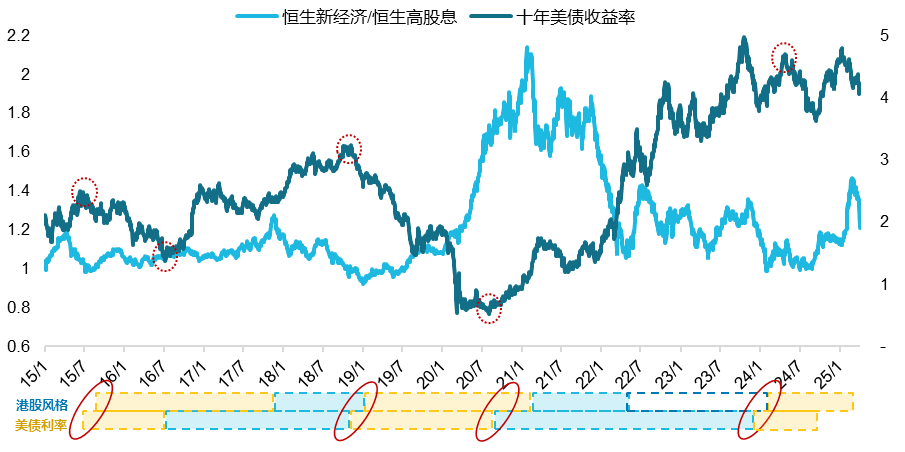
Group 1 - The Federal Reserve has maintained the federal funds rate target range at 4.25% to 4.50%, marking the third consecutive time this year that rates have remained unchanged [1] - The performance of the Hong Kong stock market is closely linked to global liquidity, particularly U.S. dollar liquidity, influenced by the Federal Reserve's monetary policy, dollar exchange rates, and U.S. Treasury yields [1][2] Group 2 - Changes in U.S. Treasury yields significantly impact cross-border capital flows and the valuation of Hong Kong stocks, with rising yields leading to reduced investment in Hong Kong assets [3] - The monetary policy cycle of the Federal Reserve affects the Hong Kong stock market differently, with initial rate cuts improving liquidity and benefiting the market, while rate hikes can complicate market dynamics [5][4] Group 3 - The U.S. dollar index influences international capital allocation preferences, with a stronger dollar increasing the cost of holding non-dollar assets, thereby pressuring Hong Kong stocks [8][9] - Fluctuations in the exchange rate, particularly the USD/CNY rate, affect the earnings of Chinese companies listed in Hong Kong, indirectly impacting stock valuations [9][10] Group 4 - The Hong Kong-Macau interest rate differential directly affects local liquidity, with the Hong Kong Monetary Authority managing the exchange rate through an automatic interest rate adjustment mechanism [14][15] - Changes in the Libor-Hibor spread influence local liquidity conditions, with widening spreads leading to increased financing costs and pressure on high-valuation growth stocks [15][16] Group 5 - The overall impact of overseas liquidity on Hong Kong stocks can be summarized as follows: U.S. Treasury yields, U.S.-China interest rate differentials, and Hong Kong-Macau interest rate differentials drive style shifts through valuation and capital flow effects, while the dollar index and exchange rate fluctuations influence market preferences [19]
中金:港股还能买吗?
中金点睛· 2025-03-09 23:37
Core Viewpoint - The Hong Kong stock market has rebounded strongly, driven by positive sentiment from government reports and technological advancements, particularly in AI, leading to significant gains in major indices and sectors [1][2][4]. Valuation Analysis - The Hang Seng Index's dynamic PE has recovered from 9.1x to around 10.8x, which is near the historical average, while the Hang Seng Tech Index's dynamic PE has risen from 15.6x to 19.3x, still below historical averages [5][6]. - Compared to global markets, Hong Kong's dynamic PE remains low, with a dividend yield of approximately 3.2%, significantly higher than the 10-year Chinese bond yield of about 1.8% [6][10]. - New economy sectors have seen a PE recovery to 16.7x, while traditional sectors have reached 6.1x, both below their averages since 2015 [10][12]. - The valuation of Hong Kong stocks is lower than that of comparable US stocks, with the dynamic PE of China's "Tech Giants" averaging 21.9x, compared to the US "Tech Seven" at 28.4x [12][30]. Drivers of Valuation Rebound - The valuation rebound is primarily driven by a shift in market sentiment, with the Hang Seng Index and Hang Seng Tech Index experiencing valuation expansions of 18.0% and 24.1%, respectively, largely due to a decrease in risk premium [14][17]. - The risk premium for the Hang Seng Index has decreased to 5.7%, approaching the high point of 5.4% seen in early 2021, indicating improved investor sentiment [15][16]. - The influx of southbound capital has significantly influenced Hong Kong's pricing, with a cumulative purchase of 313.9 billion HKD since the beginning of the year, five times that of the same period last year [17][18]. Future Valuation Expansion Potential - Traditional sectors have a relative valuation expansion potential of about 5% compared to A-shares, while technology sector valuations are closely aligned with return on equity (ROE) expectations [21][23]. - The current valuation of technology stocks appears reasonable, but further expansion will depend on improved profitability, as the dynamic PE of Chinese tech leaders is significantly lower than that of their US counterparts [27][30]. - If the ROE for Chinese tech leaders can exceed 30%, there is potential for valuation to double, but this is contingent on upward revisions of profit expectations [30][31]. Investment Strategy - The current market rebound is based on optimistic sentiment regarding technological trends, and the extent of this sentiment will determine future market potential [31][32]. - The company suggests focusing on sectors with strong fundamentals and structural trends, particularly technology, while also considering dividend-paying stocks for balance [32][33].

港股估值到底如何?
雪球· 2025-03-08 05:30
Core Insights - The valuation of the Hang Seng Index and the Hang Seng China Enterprises Index appears high, especially since they began including internet giants like Tencent Holdings from 2018, making historical comparisons less relevant [3] - Recent increases in valuations are largely driven by the performance of internet and AI-related stocks [5] - The Hang Seng Technology Index's valuation is relatively low at 25 times earnings compared to the NASDAQ's 37 times, indicating potential investment opportunities [7] - The Hang Seng Healthcare Index's valuation is difficult to assess due to many innovative drug companies being unprofitable; however, using price-to-sales ratios suggests there are still opportunities in Hong Kong's innovative drug sector [8] - The Hang Seng Consumer Index appears to be undervalued compared to its historical levels [9]