
算力金属

Search documents
【锡价】腊八节锡价狂飙至 437000 元 / 吨!AI需求爆发锡稀缺性彻底引爆 产业链现状全揭秘!
Xin Lang Cai Jing· 2026-01-26 04:32
Core Viewpoint - The recent surge in tin prices is driven by a combination of macroeconomic factors, geopolitical tensions, industry dynamics, and financial market conditions, marking a significant revaluation of tin as a critical resource in the context of AI and renewable energy demand [1][2]. Macroeconomic Resonance - Tin price rebound is rooted in a broader narrative shift, with the US dollar index falling below 97, significantly reducing the global holding cost of tin priced in dollars [1] - Positive signals from the domestic economy, including a return to expansion in manufacturing PMI and improved logistics efficiency, have solidified the demand foundation for tin [1]. Geopolitical Concerns - Supply anxiety has been exacerbated by disruptions in the Democratic Republic of Congo, the largest source of tin imports for China, where heavy rainfall has hindered mining operations [2] - Ongoing conflicts and regulatory delays in the region, along with issues in other major tin-producing countries, have highlighted the fragility of the global tin supply chain [2]. Supply-Demand Dynamics - The current tin price surge reflects unprecedented structural supply-demand imbalances, with a static reserve-to-production ratio of only 16 years indicating resource depletion risks [2] - While traditional demand is suppressed by high prices, emerging sectors like AI servers and electric vehicles are experiencing explosive growth, fundamentally altering tin's pricing logic [2]. Industry Chain Disparities - The soaring tin prices have created a split in the industry chain, with upstream miners enjoying high profits while midstream smelters and downstream processors face significant cost pressures [2] - The rising raw material costs have led to a situation where downstream companies struggle to maintain operations, with some reporting drastically reduced operating rates [2]. Investment Outlook - Market participants are advised to balance trends and risks, as macro sentiment and geopolitical uncertainties may lead to price fluctuations at high levels [3] - Investors should focus on companies with upstream resource control and high-end product capabilities, while utilizing futures for risk management or waiting for price corrections to align with supply-demand dynamics [4]. Conclusion - The current tin market dynamics reflect a transformative era driven by green energy and AI, challenging traditional resource paradigms [5] - The ongoing revaluation process, characterized by scarcity and strategic importance, will test the resilience and wisdom of all market participants [5].


长江有色:23日锡价大涨 锡价飙涨高端抢货普货遇冷
Xin Lang Cai Jing· 2026-01-23 08:34
Core Viewpoint - The recent surge in tin prices is driven by a combination of macroeconomic factors, geopolitical issues, and strong industrial demand, leading to a structural supply-demand imbalance in the market [2][3]. Group 1: Market Performance - The Shanghai tin contract 2603 experienced a significant increase, closing at 429,570 yuan/ton, up 19,310 yuan, or 4.71% [1]. - The trading volume for the main contract reached 378,618 lots, with an open interest of 56,254 lots, an increase of 7,129 lots from the previous day [1]. - The average price for 1 tin in the Changjiang market rose by 20,000 yuan, reaching 423,300 yuan/ton [1]. Group 2: Supply and Demand Dynamics - The current tin price increase is attributed to simultaneous structural tensions on both the supply and demand sides [2]. - Supply constraints are exacerbated by natural disasters and policy issues in major producing regions like the Democratic Republic of Congo, Myanmar, and Indonesia, alongside a long-term bottleneck with only 16 years of static resource reserves left [2]. - Demand for tin is surging due to its critical role in AI and renewable energy sectors, leading to a significant increase in high-end demand [2]. Group 3: Market Sentiment and Behavior - The tin market is currently characterized by a deep interplay of industry structure, market sentiment, and financial behavior, moving beyond simple price speculation [3]. - Leading companies in the industry, such as Yunxi Co. and Shengtun Mining, are positioned to benefit significantly from the high-price cycle due to their resource advantages and strategic market positioning [3]. - There is a notable divergence in the spot market, with high-end tin experiencing tight supply and limited negotiation space, while ordinary tin materials see weaker demand and trading activity [3]. Group 4: Future Outlook - The short-term outlook suggests a continuation of high price volatility, supported by ongoing supply disruptions and pre-holiday stocking demands [4]. - However, there are accumulating risks in the market, including potential regulatory responses to rapid price increases and the possibility of reduced speculative activity if short-term favorable conditions change [4].
长江有色:锡价狂飙!“算力金属”引爆新一轮商品牛市 23日锡价或大涨
Xin Lang Cai Jing· 2026-01-23 02:25
Core Viewpoint - The commodity market is entering a new cycle driven by macroeconomic policies and supply-demand dynamics, with tin prices experiencing significant increases due to a combination of factors including Federal Reserve policies and strong demand from emerging technologies [1][2]. Group 1: Supply Side - Global tin supply is facing long-term constraints and short-term disruptions, with a static reserve-to-production ratio of approximately 16 years, and insufficient capital expenditure leading to limited new capacity [2]. - Key mining regions are experiencing increased tension: Myanmar's production recovery and ore quality are below expectations, while Indonesia's new mining permit policies are delaying export quotas, tightening spot market supply [2]. - Domestic processing fees for tin concentrate remain low, limiting smelting capacity, and some smelters are opting for maintenance ahead of holidays, contributing to restricted refined tin output [2]. Group 2: Demand Side - The demand structure for tin is undergoing a significant transformation, with traditional electronics showing weakness while emerging technologies like AI, semiconductors, and new energy vehicles are driving strong growth [2]. - The tin usage per unit in AI servers and new energy vehicles is significantly higher than in traditional products, sustaining high demand for high-end tin materials [2]. - Recent adjustments in export tax policies for photovoltaic products have triggered a "rush to export" in the domestic market, further amplifying the demand for tin in photovoltaic solder strips [2]. Group 3: Industry Chain and Market - The tight supply-demand balance is causing significant differentiation across the industry chain, with upstream mining companies enjoying high profits and a reluctance to sell, particularly for high-grade tin [3]. - The midstream smelting sector is facing profit compression due to high raw material costs and low processing fees, leading to limited operating rates [3]. - The downstream processing sector is experiencing a "two extremes" scenario, where small solder companies are constrained by high raw material prices, while leading firms in photovoltaic and semiconductor sectors maintain a strong demand for high-purity tin [3]. Group 4: Market Outlook - Tin prices are expected to maintain a strong oscillating pattern in the short term, supported by rigid supply, emerging demand, and macro liquidity expectations [3]. - While support factors are clear, risks such as potential regulatory measures to curb excessive speculation and the cumulative demand suppression effect of high prices should be monitored [3]. - Long-term, tin's strategic position as a key "computing metal" in new information technology and energy transitions remains solid, with a tight supply-demand balance likely to persist, keeping price levels relatively high [3].
长江有色:16日锡价大跌 看跌氛围浓厚询盘谨慎
Xin Lang Cai Jing· 2026-01-16 08:48
Core Viewpoint - The tin market is experiencing a significant downturn due to a combination of macroeconomic pressures, regulatory interventions, and easing geopolitical risks, leading to a rapid correction of previously inflated speculative expectations [2]. Group 1: Market Performance - The Shanghai tin contract 2602 saw a substantial decline, closing at 405,240 yuan/ton, down 27,760 yuan, or 6.41% [1]. - The trading volume for the main contract was 429,257 lots, with open interest decreasing by 7,193 lots to 31,288 lots [1]. - The average price for 1 tin in the Changjiang market dropped by 20,500 yuan from the previous trading day, settling at 414,750 yuan/ton [1]. Group 2: Supply Dynamics - The tin market is showing signs of supply easing, breaking the previous narrative of rigid supply shortages, which is a key factor in the current price adjustment [2]. - Inventory levels, previously at historical lows, are now stabilizing, with domestic hidden inventories becoming more visible, alleviating extreme concerns about supply shortages [2]. - Major producing countries are seeing a relaxation of supply constraints, with production in Myanmar exceeding expectations and Indonesia's exports stabilizing [2]. Group 3: Demand Challenges - The demand side is facing a significant contradiction, with strong expectations but weak realities, particularly as traditional consumption sectors enter a seasonal lull [3]. - Orders in the consumer electronics and home appliance sectors are weakening, leading to low operating rates in downstream soldering enterprises [3]. - High tin prices have created substantial cost pressures for small to medium-sized manufacturers, forcing some to halt orders or reduce production [3]. Group 4: Industry Structure and Outlook - The tin industry is undergoing a painful rebalancing process, with significant differentiation across the supply chain [4]. - Upstream mining companies are still profitable, but the tightest supply phase may be over, while midstream traders are facing increased pressure [4]. - Downstream manufacturers, particularly small solder factories, are experiencing the most significant strain, leading to attempts to use lower-cost substitute materials or recycled tin [4]. - The current market is characterized by cautious trading, with a potential downward trend in prices as macro pressures and weak fundamentals persist [4].
狂欢与警示:如何看待锡价的史诗级上涨?
对冲研投· 2026-01-15 09:34
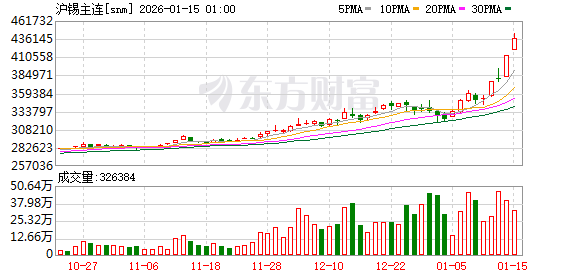
Core Viewpoint - The article discusses the recent surge in tin prices, driven by a combination of supply disruptions, structural supply concerns, and a re-evaluation of tin's value as a "strategic metal" linked to future technological demands [2][12][28]. Group 1: Price Surge and Market Dynamics - The main tin futures contract in Shanghai saw a significant increase, reaching a historical high of 443,400 yuan/ton, with a cumulative rise of over 33% since 2026 [2]. - The rapid price increase is characterized as a "lightning battle" driven by large-scale capital, rather than gradual improvements in the fundamentals [3]. - There is a strong consensus and enthusiasm in the market, evidenced by a 311% increase in the price of call options for tin on a single trading day [3]. Group 2: Supply Concerns - A recent landslide in the Democratic Republic of Congo, a major tin mining region, has heightened fears about global tin supply vulnerabilities [4]. - Long-standing concerns about tin supply include slow recovery in Myanmar's production, which is lagging behind expectations, with only about two-thirds of the mines expected to resume operations [7]. - Indonesia's mining policies have also contributed to ongoing uncertainties, with a 21.7% year-on-year decline in tin imports to China from January to November 2025 [8]. Group 3: Long-term Demand Narrative - Tin is being redefined as a "computing metal," with its demand linked to high-growth technology sectors such as AI and renewable energy [12]. - The growth rates for tin consumption in sectors like photovoltaics and AI server production are projected to be significant, with contributions to overall demand expected to rise [13]. - The narrative positions tin as a critical material for the digital and green energy infrastructure, enhancing its valuation ceiling and attracting long-term investment [15]. Group 4: Market Realities and Risks - High tin prices are beginning to suppress actual consumption, with downstream manufacturers facing cost pressures and some reducing procurement frequency [16]. - There is a noticeable accumulation of visible inventory, with total stocks exceeding 13,000 tons, higher than levels during previous price peaks [18]. - Regulatory bodies have raised concerns about speculative trading, with increased transaction fees for tin futures and calls for market rationality from industry associations [20]. Group 5: Future Outlook - The article highlights a tension between optimistic future narratives and current market realities, suggesting that the balance of power may shift depending on the realization of demand growth and supply recovery [24]. - Estimates indicate that even with high growth in AI servers, the additional tin demand may only reach 2,000-3,000 tons by 2026, while traditional sectors may see reduced demand due to high prices [27]. - The current price levels are significantly above the cash cost line for most global production, indicating a market driven by sentiment and speculation rather than fundamentals [28].

开年已涨33%!锡价创历史新高
Shang Hai Zheng Quan Bao· 2026-01-15 04:58
Core Viewpoint - The strong performance of tin prices is driven by supply disruptions and increasing demand from sectors such as consumer electronics, automotive electronics, and AI, leading to a significant rise in trading activity and market interest [1][3][4]. Group 1: Price Performance - As of January 15, the main tin contract on the Shanghai Futures Exchange reached a record high of 443,400 CNY per ton, marking a year-to-date increase of 33.5% [1][3]. - The London Metal Exchange (LME) tin contract also saw a year-to-date increase of approximately 33% [3]. Group 2: Supply Disruptions - Recent natural disasters, such as landslides in the North Kivu province of the Democratic Republic of Congo, have raised concerns about potential disruptions in tin mining and transportation, further fueling market sentiment [3][4]. - The market is also reacting to the slower-than-expected recovery of tin production in Myanmar, despite some analysts predicting an acceleration in recovery by late January [4]. Group 3: Demand Drivers - Tin is increasingly recognized as a "technology metal" and "computing metal," with significant applications in solder for electronics, solar cells, and electric vehicles, contributing to rising demand [1][6]. - The International Tin Association reports that over half of the tin produced is used for soldering, a trend expected to continue in the next decade [6]. Group 4: Future Demand Projections - The demand for tin solder is projected to grow at a compound annual growth rate (CAGR) of 7% from 2024 to 2030, driven by advancements in AI, smart devices, and the electrification of vehicles [7]. - Overall global tin demand is expected to grow at a CAGR of 4.3% during the same period [7]. Group 5: Supply Constraints - The global static reserve-to-production ratio for tin is only 16 years, indicating a scarcity of this metal [7]. - Major tin-producing countries, including China, Indonesia, Myanmar, Peru, and Brazil, are facing various challenges that limit supply, such as resource depletion and regulatory changes [7][8]. - The International Tin Association warns that the lack of investment in new mines over the past two decades could lead to significant supply challenges in the future [8].
沪锡期价一度突破44万元/吨,行业协会发文→
Qi Huo Ri Bao· 2026-01-15 01:12
Core Viewpoint - The recent surge in tin prices is driven by optimistic macroeconomic sentiment and fundamental expectations, with significant demand from emerging industries such as electric vehicles, photovoltaics, and artificial intelligence [1][2]. Group 1: Market Dynamics - Tin futures on the Shanghai Futures Exchange (SHFE) have seen a strong increase, with the main contract reaching 413,170 yuan/ton and later surpassing 440,000 yuan/ton, marking an increase of over 9% [1]. - The London Metal Exchange (LME) also reported a rise in tin prices, peaking at 52,495 USD/ton [1]. - The market is experiencing a "rush for exports" due to the recent cancellation of export tax rebates on photovoltaic products, which is expected to significantly boost tin demand in the short term [1]. Group 2: Supply and Demand Factors - The supply side remains constrained, with expectations of a supply gap despite the resumption of tin mining in Myanmar [1][2]. - The demand for tin is being driven by strategic investments in sectors like semiconductor and AI technologies, which are anticipated to support consumption growth [2][3]. - Current market conditions indicate a low acceptance of high tin prices among downstream and end-user enterprises, leading to issues with price transmission [4]. Group 3: Regulatory and Industry Responses - The Shanghai Futures Exchange has implemented multiple risk warnings and control measures to guide rational market participation amid rising volatility in metal prices [2]. - Industry associations have issued initiatives to promote rational pricing and discourage speculative behavior, aiming to stabilize the market environment [3]. - Analysts suggest that while the current demand outlook is optimistic, there are concerns that the anticipated demand growth in the semiconductor sector may be overestimated, and traditional demand may be underestimated [3].
凌晨暴涨!沪锡期价一度突破44万元/吨 行业协会发文
Qi Huo Ri Bao· 2026-01-15 00:22
Group 1 - The core viewpoint of the articles highlights the strong upward trend in tin prices driven by macroeconomic sentiment and external market influences, with the Shanghai Futures Exchange tin futures reaching over 400,000 yuan/ton and the London Metal Exchange tin prices peaking at 52,495 USD/ton [2] - Recent optimism in the market is attributed to dual factors: expectations of U.S. fiscal and monetary easing, and a weaker dollar, alongside domestic policy expectations for increased measures in the new five-year plan [2] - The resumption of tin mining in Myanmar is expected to improve supply, but there remains a projected supply gap for the year, while demand from emerging industries such as electric vehicles, photovoltaics, and artificial intelligence is significantly increasing [2] Group 2 - The continuous rise in tin prices reflects long-term supply disruptions centered around the restructuring of Myanmar's Wa State tin industry and the strategic metal premium driven by investments in smart chips and semiconductors [3] - The Shanghai Futures Exchange has issued multiple risk warnings and control measures since December to guide rational market participation amid rising volatility in non-ferrous and precious metal prices [3] - Industry associations have called for a rational approach to maintain market order and stability, urging participants to avoid speculative behaviors and to collaboratively guide prices back to reasonable levels [4] Group 3 - The market currently views tin as a "computing metal," with optimistic demand forecasts, particularly as AI investments are expected to support tin consumption growth through 2026 [4] - However, there are concerns that the acceleration in tin prices may have already priced in long-term demand increases, and the cancellation of export tax rebates for photovoltaic products may only provide a short-term boost to tin consumption [5] - The current market fundamentals have not changed significantly, with stable production from domestic smelters and rising inventories due to weakened consumption, although overall inventory levels remain low [5]
凌晨暴涨!沪锡期价一度突破44万元/吨,行业协会发文
Sou Hu Cai Jing· 2026-01-15 00:12
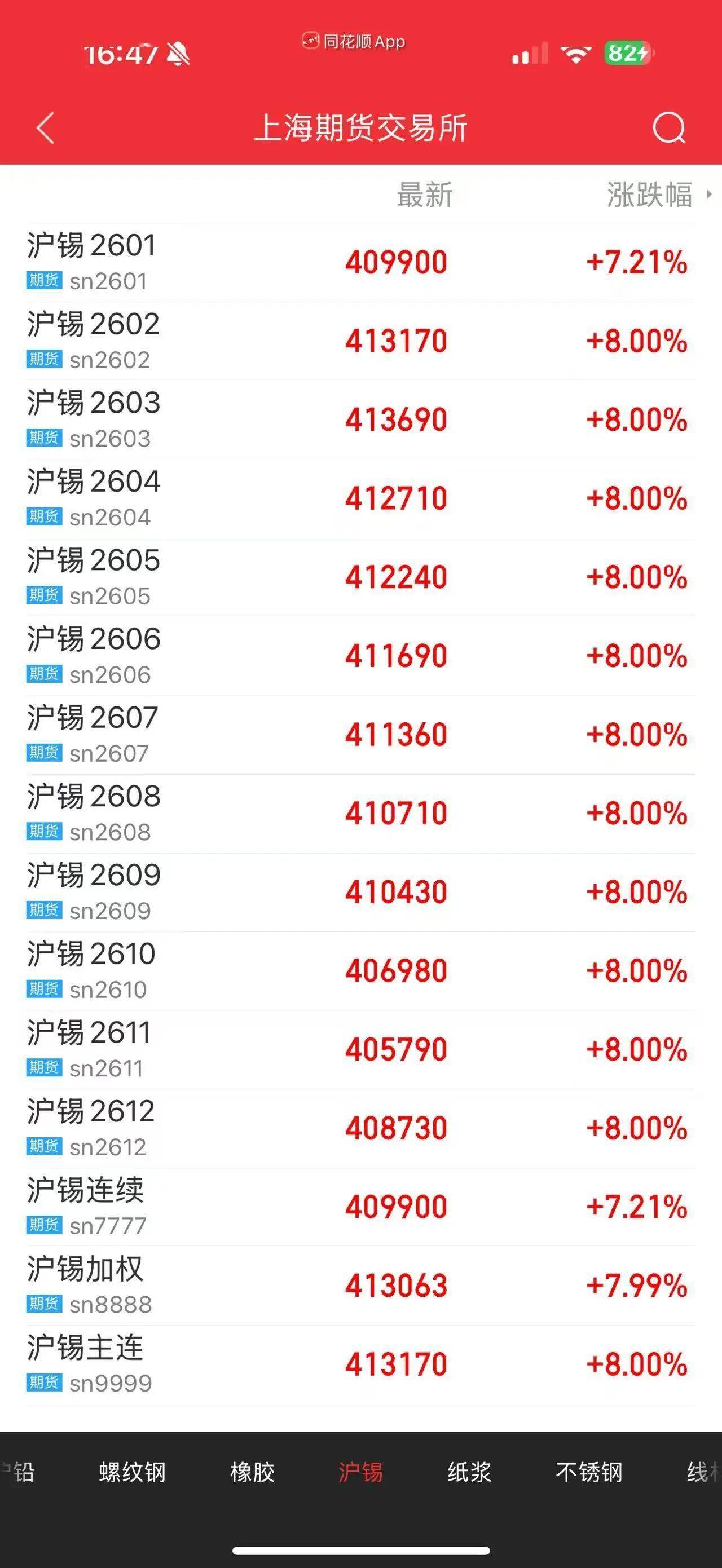
Core Viewpoint - The recent surge in tin futures prices on the Shanghai Futures Exchange (SHFE) is driven by optimistic macroeconomic sentiment and strong demand from emerging industries, despite potential supply concerns from Myanmar's tin mines [1][9]. Group 1: Price Movements - On January 14, the SHFE tin futures main contract (2602) surpassed 400,000 yuan/ton, closing at 413,170 yuan/ton, with the London Metal Exchange (LME) tin reaching a peak of 52,495 USD/ton [1]. - The SHFE tin futures contracts have shown consistent upward movement, with the main contract closing at 413,170 yuan/ton, reflecting an increase of 8 yuan [2][3]. - In the latest trading session, the SHFE tin futures main contract saw a significant rise, briefly exceeding 440,000 yuan/ton, closing up over 9% [3]. Group 2: Market Sentiment and Demand - Analysts attribute the strong performance of tin to a combination of macroeconomic factors, including expectations of U.S. fiscal and monetary easing, and a weaker dollar [9]. - The domestic market anticipates new policies as the "14th Five-Year Plan" begins, which could further stimulate demand for tin [9]. - Emerging industries such as electric vehicles, photovoltaics, and artificial intelligence are significantly driving demand for tin, with expectations of increased consumption [9][10]. Group 3: Supply Dynamics - Despite the anticipated recovery of tin supply from Myanmar, there remains a projected supply gap for the year [9]. - The recent cancellation of export tax rebates for photovoltaic products may lead to a short-term surge in tin demand as companies rush to export before the policy takes effect [9][10]. - Current market conditions indicate stable operations at domestic smelting plants, with minimal fluctuations in production levels, although there is a noticeable accumulation of inventory due to weaker consumption [11]. Group 4: Speculation and Risks - The market is experiencing a speculative atmosphere, with active trading in futures contracts, which could lead to rapid price fluctuations if bullish sentiment shifts [11]. - Analysts caution that while the current price increases reflect long-term demand expectations, there is a risk of overestimating demand in the semiconductor sector and underestimating declines in traditional sectors [11].
突发!特朗普:对伊朗贸易伙伴征收25%关税!鲍威尔“遭查”引爆金属市场,十余名美前财经要员联名批评并警告
Qi Huo Ri Bao· 2026-01-12 23:56
Group 1: Market Performance - The US stock market saw a slight increase, with the S&P 500 and Dow Jones indices reaching all-time highs, closing at 6,977.27 and 49,590.20 points respectively [1] - The Nasdaq China Golden Dragon Index rose by 4.26%, with notable gains in Chinese stocks such as Alibaba, which increased by over 10% [1] Group 2: Precious Metals - Precious metals prices surged to record highs, with spot gold exceeding $4,600 per ounce and silver prices rising over 8% to surpass $86 per ounce [1][7] - Analysts suggest that the investigation into Federal Reserve Chairman Powell could undermine the Fed's independence, providing long-term support for precious metal prices [7][9] Group 3: Oil Prices - Oil prices reached their highest levels since December 2025, with WTI crude oil futures closing at $59.50 per barrel, up 0.64% [1] - Concerns over potential supply disruptions from Iran have contributed to the rise in oil prices [1] Group 4: Federal Reserve and Political Influence - The Trump administration's threat of a criminal investigation against Powell has raised concerns about the independence of the Federal Reserve, with former financial officials criticizing this move [5][6] - The potential appointment of a new Fed chair could influence future monetary policy, with differing views on interest rate strategies among candidates [8][9] Group 5: Tin Market - Tin prices have seen significant increases, driven by positive macro sentiment and speculative buying, with expectations of continued high demand in semiconductor and electric vehicle sectors [11][12] - Analysts predict that the tin market will remain supported by macroeconomic conditions, although caution is advised regarding potential market corrections [12]