
货币政策紧缩

Search documents
市场分析:日本央行只是松开油门,而非紧急刹车
Xin Lang Cai Jing· 2025-12-19 13:17
Core Viewpoint - The Bank of Japan's delayed interest rate hike is seen as easing off the accelerator rather than applying the brakes, with further rate hikes expected next year [1] Group 1: Interest Rate Policy - The Bank of Japan emphasizes that even after the rate hike, interest rates will remain significantly low [1] - Future interest rate trends will largely depend on the annual spring labor negotiations that set the tone for wage growth, indicating that another rate hike is unlikely before June [1] - The pace of monetary policy tightening will continue to be very slow, despite the Bank of Japan lagging behind the current economic situation [1]
分析师:日本央行未清晰阐述加息路径 短期日元偏弱但波动有限
Zhi Tong Cai Jing· 2025-12-19 11:29
Core Viewpoint - The Japanese yen weakened against the US dollar due to the Bank of Japan's lack of clear guidance on future monetary tightening, despite raising the benchmark interest rate to its highest level since 1995 [1] Group 1: Bank of Japan's Policy Actions - The Bank of Japan raised the benchmark interest rate, leading to an increase in Japanese government bond yields, with the 10-year yield surpassing 2% for the first time since 2006 [1] - Analysts suggest that the Bank of Japan is cautious in tightening monetary policy, aiming to avoid negative market impacts [2] - The central bank's current estimate of the neutral interest rate range is between 1% and 2.5%, indicating potential for further rate increases [3] Group 2: Market Reactions and Predictions - The yen's depreciation is seen as a response to the Bank of Japan's unclear stance on future interest rate adjustments, with many investors hesitant to take long positions on the yen [2][3] - Analysts predict that the dollar/yen exchange rate could reach 160, but some express surprise if it exceeds this level [2] - The stock market has reacted positively, with the Tokyo Stock Exchange index rising 40% year-to-date, suggesting a potential shift in investment focus [2] Group 3: Future Outlook - Some analysts expect the Bank of Japan to raise rates further by 2026, but the yen may lag behind other G10 currencies in the coming year due to unfavorable interest rate differentials [5] - The market anticipates that the next rate hike may not occur until mid-2024, reflecting a gradual approach to policy adjustments [8] - Concerns remain about the potential need for more aggressive rate hikes if the economy overheats, which could lead to increased interest rate risks [7]
宽松浪潮中独行!日本央行加息为何救不了日元?
Xin Lang Cai Jing· 2025-12-18 15:16
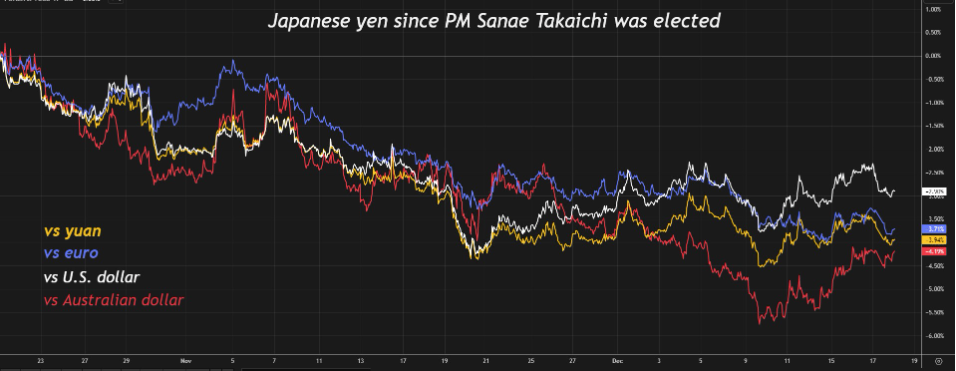
Core Viewpoint - The Japanese yen is expected to remain the weakest major currency against the US dollar in 2025, despite the Bank of Japan being the only major central bank expected to raise interest rates [1][7]. Group 1: Monetary Policy and Interest Rates - The Bank of Japan is anticipated to continue its gradual tightening cycle by raising interest rates by 25 basis points, bringing the policy rate to 0.75%, the highest in 30 years [1][7]. - Market expectations suggest an additional increase of approximately 40 basis points next year, positioning the Bank of Japan among the most hawkish central banks in the G10 alongside the Reserve Bank of New Zealand and the Reserve Bank of Australia [1][7]. - Despite potential rate hikes, there is no guarantee that the yen will rebound in 2026, as most major central banks are nearing the end of their easing cycles [1][7]. Group 2: Economic Conditions and Debt Market - Japan's economy appears to be rebounding from a contraction caused by US tariffs, with corporate confidence reaching a four-year high and labor market indicators showing tight conditions [9][10]. - Inflation has exceeded the Bank of Japan's 2% target for three consecutive years, prompting officials to consider accelerating the pace of interest rate hikes [9][10]. - Japan holds the highest public debt globally, approximately 250% of GDP, which poses challenges for the bond market [10][13]. Group 3: Foreign Investment and Bond Market Dynamics - Foreign ownership of Japanese government bonds and short-term bonds stands at 12.2%, more than double the level in 2010 and close to the historical high of 14.4% in March 2022 [10][12]. - The Japanese bond market is currently the worst-performing major bond market globally, with 10-year government bond yields at their highest since 2007 [4][10]. - The recent rise in bond yields may attract foreign demand, particularly from private pension funds and central bank reserve managers seeking to diversify away from dollar assets [10][12]. Group 4: Currency Intervention and Market Pressures - The yen has shown weakness despite favorable changes in the yield differential, with the exchange rate against the euro hitting historical lows and the dollar-yen rate approaching the critical 160 level [6][12]. - Japanese finance officials have issued intervention warnings but have shown no willingness to act unless the dollar-yen rate remains below 160 [12][13]. - The Japanese government's recent approval of an 18.3 trillion yen (approximately 118 billion USD) supplementary budget represents the largest stimulus plan since the pandemic, primarily financed through new bond issuance [13].


宽松浪潮中独行!日本央行加息为何救不了日元?
Jin Shi Shu Ju· 2025-12-18 15:13
Group 1 - The Japanese yen is expected to remain the weakest major currency against the US dollar in 2025, even if the Bank of Japan is the only major central bank to raise interest rates [2] - The Bank of Japan is anticipated to raise its policy rate by 25 basis points to 0.75%, the highest level in 30 years, with further increases expected next year [2] - The Japanese economy is showing signs of recovery from a contraction caused by US tariffs, with corporate confidence at a four-year high and a tight labor market supporting wage growth and consumer spending [4] Group 2 - Japan's public debt is the highest globally, at approximately 250% of GDP, which poses challenges for the bond market [5] - Foreign ownership of Japanese government bonds has increased to 12.2%, more than double the level in 2010, indicating growing interest from overseas investors [5] - The Japanese bond market is currently the worst-performing major bond market globally, with 10-year bond yields at their highest since 2007 [5][7] Group 3 - The yen has been under pressure, with the exchange rate against the euro hitting historical lows and the dollar-yen rate approaching the intervention threshold of 160 [7] - The Japanese government has passed a significant supplementary budget of 18.3 trillion yen (approximately 118 billion USD), marking the largest stimulus plan since the pandemic [7]
加息周期开启,日本国债成家庭理财“新宠”:零售销售额创18年纪录
Zhi Tong Cai Jing· 2025-12-18 01:15
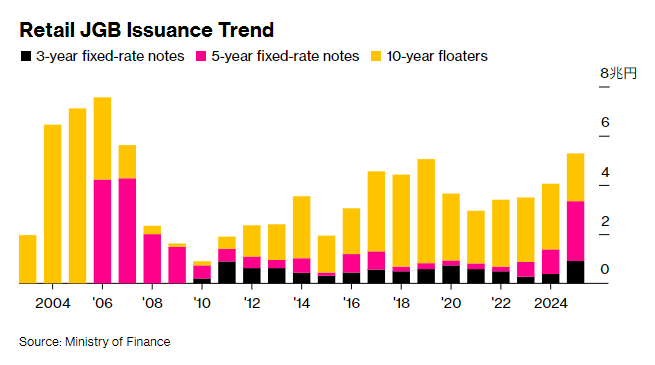
Core Insights - The Bank of Japan's tightening policy is driving household funds from bank deposits to the government bond market, with sales to individual investors surpassing 5 trillion yen (approximately 32 billion USD), marking the highest level since 2007 [1] - The total issuance of government bonds from January to December reached 5.28 trillion yen, with the five-year retail bond issued in November having a coupon rate of 1.22%, nearly 2.7 times the 0.46% rate from the previous year [1] Group 1 - The issuance of government bonds this year includes approximately 1.9 trillion yen of ten-year floating-rate bonds, which adjust their coupon rates based on overall market interest rates, providing unique investment value during the monetary tightening cycle [2] - A household investor expressed that government bond rates are higher than bank deposit rates, and the floating interest structure offers the potential for increasing returns over time, despite acknowledging that these returns may not outpace inflation [2] - The interest rate for ten-year fixed deposits at banks like Mizuho is only about 0.5%, explaining why some savers are shifting their funds to significantly higher-yielding government bonds [2] Group 2 - The coupon rates for retail government bonds set for settlement in January next year are confirmed: 1.1% for three-year fixed-rate bonds, 1.35% for five-year fixed-rate bonds, and 1.23% for ten-year floating-rate bonds, with the five-year rate reaching a new high since 2007 and the ten-year floating rate hitting the highest since its introduction in 2003 [2] - The final issuance scale of retail government bonds will be determined based on the cumulative subscription amounts from individual investors [2]
关税阴霾渐消?日本对美出口8个月来首度转正,汽车、药品出口增幅明显
Hua Er Jie Jian Wen· 2025-12-18 00:39
Core Viewpoint - Japan's exports in November increased by 6.1% year-on-year, surpassing market expectations, with exports to the U.S. turning positive for the first time in eight months, indicating a recovery from the impact of U.S. tariffs [1] Group 1: Export Performance - Japan's exports to the U.S. grew by 8.8% year-on-year in November, reversing a previous downward trend [1] - The recovery in exports was driven primarily by a rebound in automotive and pharmaceutical shipments, with automotive exports to the U.S. increasing by 1.5% and pharmaceutical exports more than doubling compared to the same month last year [3] - Japan recorded a trade surplus of 322.2 billion yen (approximately 2.08 billion USD) in November, significantly exceeding the market expectation of 71.2 billion yen, marking the first trade surplus in five months [1] Group 2: Economic Implications - The improvement in export performance has strengthened market expectations for monetary policy tightening, with predictions that the Bank of Japan may raise the short-term policy interest rate from 0.5% to 0.75% [1] - The decline in tariff rates and a weaker yen have enhanced the price competitiveness of Japanese automakers, contributing to a faster-than-expected recovery in automotive exports [2] Group 3: Regional Export Trends - Japan's overall export growth of 6.1% in November continued from October's 3.6% increase and was significantly higher than the 4.8% market forecast [3] - Exports to Asia grew by 4.5%, while exports to Europe surged by 19.6%, indicating strong demand outside the U.S. market [3]
旧金山联储行长:支持本周降息决定 货币政策过于紧缩可能不利于家庭
Sou Hu Cai Jing· 2025-12-12 21:41
Core Viewpoint - The decision to lower interest rates by the Federal Reserve was challenging, but ultimately supported by the President of the San Francisco Federal Reserve Bank, Mary Daly [1] Group 1: Economic Expansion - Real wage growth is derived from long-term stable economic expansion, which is still in the relatively early stages [1] - The Federal Reserve must continue to reduce inflation to the target level of 2% while being cautious to protect the labor market [1] Group 2: Policy Implications - Overly tight policies could unnecessarily harm American households, leading to two issues: inflation above the target level and a weak labor market [1]
美联储官员保尔森:关税推高2025年通胀 明年有望回落
Xin Hua Cai Jing· 2025-12-12 15:17
Group 1 - The core viewpoint expressed by Anna Paulson, President of the Federal Reserve Bank of Philadelphia, is her concern regarding the risks in the labor market, emphasizing that she is more worried about labor market weakness than inflationary pressures [1] - Paulson indicated that the recent interest rate cut by the Federal Reserve provides "some assurance" against further deterioration in the job market, highlighting a proactive approach to economic risks [1] - She described the current federal funds rate range of 3.5% to 3.75% as "slightly tight," suggesting that the cumulative effects of previous tightening policies should be sufficient to continue suppressing inflationary pressures [1] Group 2 - Paulson holds a relatively optimistic view on inflation prospects, suggesting that high inflation in 2025 will be largely driven by trade tariffs, with a likelihood of inflation decreasing in 2026 as these effects diminish [1] - The current state of the labor market is characterized as "bending but not broken," indicating a cautious outlook while awaiting more information from the Federal Open Market Committee (FOMC) meeting in January 2026 to better assess economic prospects and policy risks [1] - The dual logic in the Federal Reserve's current decision-making is highlighted, where preventive interest rate cuts are aimed at addressing potential economic and employment downturn risks, while maintaining a tight policy stance to uphold anti-inflation credibility [2]
澳洲联储转向鹰派释放紧缩信号 国债收益率应声飙至13个月新高
Zhi Tong Cai Jing· 2025-12-09 07:53
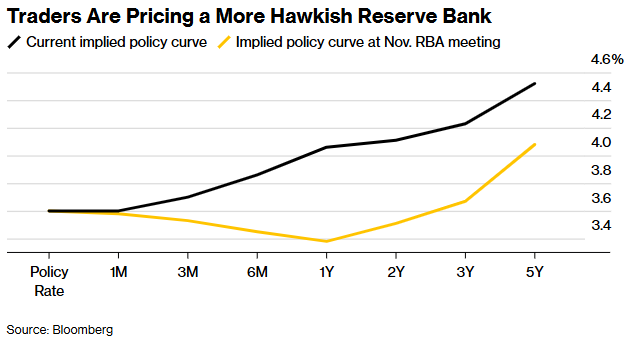
Core Viewpoint - The Reserve Bank of Australia (RBA) has ended a shortened rate-cutting cycle and is now assessing whether to extend the pause on interest rates or shift towards tightening, as inflation risks have shifted to the upside [1][3]. Group 1: Interest Rate Decisions - RBA Governor Michele Bullock announced the decision to maintain the cash rate at 3.6%, indicating that the risk of rising prices has led to a surge in bond yields to a 13-month high [1]. - The RBA is closely monitoring whether to extend the pause on interest rates or consider a potential rate hike, with no immediate plans for rate cuts in the foreseeable future [1][5]. - The RBA's decision to keep rates unchanged follows three rate cuts earlier in the year, making it one of the shortest easing cycles among developed countries [3]. Group 2: Economic Indicators - Australia's economy is nearing full capacity, with unemployment at historical lows and inflation exceeding the target range of 2-3%, prompting the RBA's cautious stance [3]. - Recent data has shown unexpected upward trends, putting pressure on the RBA to consider rate hikes if inflation continues to rise [3]. - The latest consumer price index (CPI) stands at 3.8%, with forecasts suggesting inflation may not return to target levels until mid-2027 [4]. Group 3: Market Reactions - Following the RBA's hawkish guidance, the Australian dollar rose by 0.3%, and government bond yields increased by up to 12 basis points, reaching their highest levels since November 2024 [1]. - The divergence in monetary policy between Australia and the U.S. has led to significant selling of Australian bonds, with the yield premium over U.S. Treasuries widening at the fastest pace since early 2020 [3].
美银经济学家预测日本央行12月加息后将启动“半年一次”紧缩周期
Xin Hua Cai Jing· 2025-12-05 04:33
该经济学家进一步预测,若12月如期加息,日本央行将开启一个循序渐进的紧缩周期,并以"每六个月 加息一次"的节奏推进。根据其预判,后续加息时点将分别落在2026年6月、2027年1月和2027年7月。 (文章来源:新华财经) 新华财经北京12月5日电美国银行(Bank of America)经济学家Takayasu Kudo表示,日本央行在即将于 12月召开的货币政策会议上进一步加息的可能性正在上升。他预计,日本央行将把当前0.5%的政策利 率上调至0.75%。 Kudo指出,支撑此次加息预期的主要因素包括:企业盈利状况持续改善、春季薪资谈判结果积极、日 元汇率长期处于贬值态势,以及日本央行与政府之间在政策协调方面取得进展。 ...
