资金流动

Search documents
全球股市立体投资策略周报1月第4期:地缘风险频发,避险资产领涨-20260127
GUOTAI HAITONG SECURITIES· 2026-01-27 09:17
Market Performance - Emerging markets saw a narrowing increase, while developed markets declined, with MSCI Global down 0.4%, MSCI Developed Markets down 0.6%, and MSCI Emerging Markets up 0.9% [9][15] - In the bond market, Japan's 10Y government bond yield rose significantly by 7.1 basis points, while France's yield saw the largest decline of 2.3 basis points [9][17] - Commodities like COMEX silver and gold experienced notable increases, with silver up 14.5% [9][15] Trading Sentiment - Global trading sentiment showed divergence, with increased trading volumes in Japan and South Korea, while trading volumes in Hong Kong and the US decreased [21] - The short-selling ratio in Hong Kong rose to 13.1%, indicating a high level of investor sentiment, while North American sentiment remains historically elevated [21][23] Economic Expectations - The US economic surprise index increased, influenced by easing geopolitical tensions and dovish expectations regarding the Federal Reserve's leadership [9][52] - The European economic surprise index decreased amid renewed trade tensions between the US and Europe [9][52] Earnings Expectations - The earnings forecast for the Hang Seng Index for 2026 was marginally revised down from 2069 to 2065, with the financial sector seeing the largest upward revision [71] - The S&P 500's earnings forecast for 2025 was adjusted up from 273 to 274, with the financial sector also showing the most significant upward revision [71]
投资者微观行为洞察手册?1月第4期:ETF 资金大幅流出,主动外资流入边际抬升
GUOTAI HAITONG SECURITIES· 2026-01-27 08:00
Market Pricing Status - The market transaction activity has moderately decreased, while the profit effect has increased. The average daily trading volume across the A-share market has dropped to 2.8 trillion yuan, with the proportion of stocks rising by 76.7% and the median weekly return increasing to 2.7% [4][7][14]. A-share Liquidity Tracking - Financing funds have slightly flowed out, while ETF funds have continued to experience significant outflows. The new issuance scale of equity funds has risen to 26.12 billion yuan, and foreign capital has flowed into the A-share market at 39 million USD [4][18][26]. - The net outflow of ETF funds has reached 326.47 billion yuan, primarily due to state-owned enterprises selling ETFs to optimize their capital structure [4][18][26]. - The net selling amount of financing has increased to 6.89 billion yuan, with the trading volume proportion decreasing to 9.8% [4][18][26]. A-share Industry Allocation - There is a clear divergence in the behavior of foreign capital, ETFs, and financing funds. Foreign capital has seen net inflows in the metals (+27.3 million USD) and computer sectors (+12.8 million USD), while banks (-35.1 million USD) and telecommunications (-20.8 million USD) have seen net outflows [4][18][26]. - In terms of financing, the electronics sector has seen a net inflow of 20.65 billion yuan, while the beauty and construction materials sectors have experienced net outflows [4][18][26]. - The ETF sector has seen widespread outflows, particularly in electronics (-48.7 billion yuan), banks (-33.28 billion yuan), and non-banking financials (-32.33 billion yuan) [4][18][26]. Hong Kong and Global Fund Flow - Southbound funds have accelerated their inflow, with net purchases rising to 23.52 billion yuan, representing the 71.0 percentile since 2022 [4][18][26]. - Global foreign capital has marginally flowed into the US and Asian markets, with the US receiving a net inflow of 2.9 billion USD and China 2.07 billion USD [4][18][26].
️政策暖风吹热1月:A股日历效应的变与不变
Xin Lang Cai Jing· 2026-01-26 11:09
Core Viewpoint - The article discusses the changing dynamics of the A-share market in January 2026, highlighting the impact of policy easing and liquidity on market behavior, contrasting it with historical trends and emphasizing the importance of understanding market rhythms rather than strictly adhering to calendar patterns [1][4]. Group 1: Market Dynamics - January 2026 is characterized by a shift from the usual tight liquidity to a more relaxed environment due to ongoing policy easing, with funds quietly flowing into the market [1][4]. - The "calendar effect" in A-shares reveals that historical patterns are not absolute but can reflect underlying trends in funds, sentiment, and policy [1][4]. Group 2: Cautionary Months - January and April are identified as months requiring caution; January sees funds withdrawing from the market due to year-end cash needs and concentrated earnings disclosures, leading to potential risks for underperforming stocks [5][6]. - April is noted for the "annual report crisis," where companies reveal their performance, often resulting in panic selling and mispricing of stocks, necessitating a focus on blue-chip and high-dividend stocks as safer options [6]. Group 3: Opportunities in the Market - February is highlighted as a "spring excitement" period, with capital returning post-Spring Festival and positive policy expectations, leading to increased interest in emerging industries and small-cap stocks [2][6]. - Other months like May, July, and November present unique opportunities; May often sees policy support, July allows for recovery of undervalued stocks, and November is a crucial month for institutional fund managers aiming to boost year-end performance [2][6]. Group 4: Market Adaptability - The article emphasizes that market patterns are reflections of the interplay between funds, sentiment, and policy over time, suggesting that rigid adherence to calendar dates can lead to missed opportunities [3][6]. - Understanding the underlying logic of market movements, being cautious during high-risk months, and seizing opportunities when they arise is deemed more effective than a confrontational approach to market fluctuations [3][6].
帮主郑重收评:震荡放量,主力在打什么牌?
Sou Hu Cai Jing· 2026-01-26 08:57
Core Viewpoint - The market is experiencing a divergence where indices are down while trading volume remains high, indicating significant shifts in investor sentiment and strategy [1][3]. Group 1: Market Dynamics - The market shows a stark contrast with resources like gold and energy commodities performing well, while previously popular sectors such as commercial aerospace and semiconductors are declining [3]. - There is a substantial amount of capital reallocating from high-growth sectors to resource-based and lower-valued sectors, suggesting a "high-low switch" in investment strategies [3]. Group 2: Trading Strategy Recommendations - Investors should avoid chasing after the high-performing resource sectors due to elevated sentiment and instead focus on maintaining positions in these areas while being cautious about new entries [4]. - For the technology growth sectors experiencing deep corrections, it is advised to remain calm and differentiate between irrational sell-offs and genuine fundamental issues, as this could present buying opportunities for fundamentally strong stocks [4]. - A critical task for investors is to reassess their portfolios, shifting away from speculative holdings towards sectors with clear growth prospects and strong company fundamentals, using market volatility as an opportunity for "health checks" and "blood transfusions" in their asset allocations [4].


全球股市立体投资策略周报1月第3期:地缘事件与财报季交织,科技结构冲高
GUOTAI HAITONG SECURITIES· 2026-01-20 03:15
Market Performance - Emerging markets continued to rise, with MSCI Global up by 1.9%, MSCI Developed up by 1.3%, and MSCI Emerging up by 6.8%[9] - The Hang Seng Index showed the best performance among emerging markets, increasing by 4.0%[9] - The 10Y U.S. Treasury yield rose significantly, indicating a shift in bond market dynamics[9] Investor Sentiment - Trading volume in the Chinese stock market surged, with the Shanghai Composite Index trading 4.054 billion shares worth $9.94 billion, a week-on-week increase[24] - The short-selling ratio in Hong Kong fell to 12.9%, below the 10-year average, indicating heightened investor confidence[24] Earnings Expectations - U.S. earnings expectations for 2025 were revised upward, with the S&P 500's EPS forecast increasing from +10.3% to +10.4%[68] - The Hang Seng Index's EPS forecast for 2025 was downgraded from -1.8% to -1.9%[68] - European earnings expectations remained stable, with the STOXX50 index's EPS forecast unchanged at -4.6%[69] Economic Outlook - The U.S. economic surprise index rose, influenced by lower-than-expected CPI data and uncertainties regarding the new Federal Reserve chair[9] - The Chinese economic surprise index also increased, supported by the central bank's monetary policy adjustments[9] Capital Flows - Global liquidity showed signs of tightening, with expectations for the Federal Reserve to cut rates decreasing slightly to 1.8 times in 2026[56] - Recent capital inflows into Hong Kong amounted to HKD 240 billion, with significant contributions from the Stock Connect program[65]
投资者微观行为洞察手册·1月第2期:主动外资大幅流入A股与港股
GUOTAI HAITONG SECURITIES· 2026-01-19 08:34
Market Pricing Status - The market trading activity has significantly increased, but the profit-making effect has decreased, with the average daily trading volume rising to 3.5 trillion yuan and the proportion of stocks rising to 54.1% [5][9] - The trading concentration in secondary industries has increased, with 22 industries having turnover rates above the 90th percentile, particularly in computer and media sectors [5][19] A-Share Liquidity Tracking - Financing funds have continued to flow in significantly, while ETF funds have seen substantial outflows, with net buying of financing funds rising to 913.1 billion yuan [5][28] - The issuance of new public equity funds has decreased to 6.72 billion yuan, indicating a reduction in overall stock positions [5][30] - Foreign capital has flowed into the A-share market, with a net inflow of 10.7 million USD [5][28] A-Share Industry Allocation - Foreign capital and ETF funds have notably flowed into the non-ferrous metals sector, with net inflows of 42.0 million USD and 75.7 billion yuan respectively [5][28] - The computer and electronics sectors have seen the highest net inflows from financing, with 123.7 billion yuan and 103.9 billion yuan respectively [5][28] Hong Kong Stock and Global Fund Flow - The inflow of southbound funds has slowed, with net buying decreasing to 10.05 billion yuan, while global foreign capital has marginally flowed into developed markets and the Chinese market [5][28] - The Hang Seng Index rose by 2.3%, with the Korean market leading gains at 5.5% [5][28]

韩国投资者上周净卖出逾2.8亿美元美股,结束连续四个月净买入势头
Xin Lang Cai Jing· 2025-12-30 05:13
周二公布的数据显示,随着韩国政府采取措施将资本回流到国内股市,韩国投资者上周转为净卖出美 股,是大约四个月来的首次。 根据韩国证券存托结算院(KSD)的数据,12月22日至26日期间,当地投资者净卖出了2.814亿美元的 美国股票。 这是自8月第三周以来韩国投资者首次净抛售美国股票,当时韩国投资者净抛售了2.079亿美元。 韩国政府正努力遏制国内投资者持续的资本净流出,这在一定程度上导致韩元兑美元跌至近16年来的最 低水平。 金融当局要求证券公司减少海外投资营销活动。周三,韩国政府甚至对出售海外股票再投资于本地市场 的个人推出了一项临时税收减免。 然而,市场观察人士表示,韩国投资者是否会重返国内市场还有待观察,因为外汇市场波动和年底获利 了结等其他因素可能是近期投资者情绪好转的原因。 现代汽车证券(Hyundai Motor Securities)分析师Kim Jae-eung表示:"如果出现了'资金流动',那么上 周基准的韩国综合股价指数(KOSPI)市场上来自散户的购买压力应该更为明显。" 上周,散户投资者净抛售了7万亿韩元(合49亿美元)的韩国股票。但KSD的数据显示,他们的存款, 即等待投资的现金,上 ...
白银LOF闪崩后的资金启示
Sou Hu Cai Jing· 2025-12-26 19:12
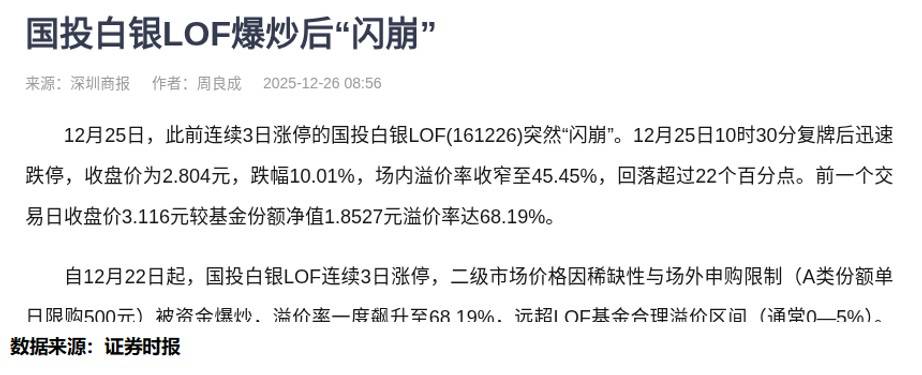
Group 1 - The core point of the article is that the recent volatility of Guotou Silver LOF is driven by the dynamics of capital flow, particularly the actions of arbitrage funds, which led to a rapid price drop after a period of significant gains [2][3]. - The price surge of Guotou Silver LOF was due to a combination of limited external subscription and scarcity of on-market shares, resulting in a peak premium of 68% [2]. - The drop in price on December 25 was a result of arbitrage funds exiting the market as the premium decreased from 68% to 45%, indicating a narrowing profit margin for early sellers [2]. Group 2 - Liquidity is described as the "water" of the market, with stock prices being the "boats" floating on it, emphasizing that capital is the primary driver of price movements in both A-shares and US stocks [3]. - Historical examples are provided, such as the liquidity influx in 2014 and 2020 that led to significant market rallies in A-shares, demonstrating the importance of capital flow in driving market trends [5]. - The volatility of Guotou Silver LOF reflects the principle that increased buying leads to price increases, while increased selling results in price declines, highlighting the importance of capital quality over quantity [7]. Group 3 - The article discusses the example of the white liquor stocks' decline in May 2025, which was misinterpreted as a "black swan" event, while institutional funds had already signaled their lack of interest through trading behavior [9]. - It is noted that institutional participation is crucial for sustaining market trends, as retail and arbitrage funds often lead to short-term fluctuations rather than long-term stability [11]. - Conversely, some stocks can rise despite negative news if institutional funds are actively buying, indicating that institutional behavior can outweigh negative sentiment [11]. Group 4 - The article emphasizes the importance of using data to understand capital flows and avoid being caught in market traps, such as the sudden drop in Guotou Silver LOF or the decline in white liquor stocks [13]. - Data tools are likened to a "mirror" that reveals the true behavior of institutional funds, allowing investors to make more informed decisions based on market dynamics [14]. - The article concludes that understanding capital movement is essential for identifying market opportunities and avoiding pitfalls, advocating for the use of data to enhance investment decision-making [14].
全球股市立体投资策略周报 12月第3期:欧美股指成交显著放量-20251223
GUOTAI HAITONG SECURITIES· 2025-12-23 11:24
Market Performance - Developed markets outperformed last week, with MSCI Global at +0.0%, MSCI Developed Markets at +0.2%, and MSCI Emerging Markets at -1.5% [9] - Among developed markets, the UK FTSE 100 showed the strongest performance at +2.6%, while the South Korean Composite Index was the weakest at -3.5% [9] - In the emerging markets, the Shanghai Composite Index performed best at +0.0%, while the ChiNext Index was the worst at -2.3% [9] Trading Sentiment - Significant increase in trading volume for European and American stock indices, while Hong Kong and A-share trading volumes decreased [23] - The short-selling ratio in Hong Kong rose to 17.5%, indicating low investor sentiment, while North American sentiment reached a historical high with the NAAIM Manager Exposure Index at 100.7% [23][27] - Volatility decreased in Hong Kong, US, and European markets, while Japanese market volatility increased [23] Earnings Expectations - Hong Kong's earnings expectations for 2025 were slightly revised upward, with the Hang Seng Index's EPS forecast adjusted from 2064 to 2065 [73] - The S&P 500's EPS forecast for 2025 remained stable at 273, with the technology sector seeing the largest upward revision [73] - European earnings expectations for the STOXX50 index remained unchanged at 330, with telecommunications showing the most significant upward revision [74] Economic Expectations - Economic sentiment indicators showed a decline across major markets, with the Citigroup Economic Surprise Index for the US, Europe, and China all decreasing [5] - Factors contributing to the decline include cautious Fed rate cut expectations, lower inflation data, and disappointing employment figures [5] Fund Flows - The Federal Reserve's cautious stance on rate cuts for 2026 was noted, with market expectations for two rate cuts remaining unchanged from the previous week [58] - Global liquidity trends indicated a tightening of dollar liquidity, with significant inflows into mainland China, the US, Japan, India, and South Korea [66] - In Hong Kong, a total of 55 billion HKD flowed into the stock market, with flexible foreign capital inflows of 97 billion HKD [68]
金价一夜变天?12月22日报价揭秘,各地差价背后有原因!
Sou Hu Cai Jing· 2025-12-23 09:43
Group 1 - The recent surge in gold prices has led to increased discussions about gold, with varying prices reported across different cities and stores due to factors like rental costs, labor expenses, and brand premiums [1] - The gold market has seen a significant increase, with prices rising by approximately 50% since the beginning of the year, leading some investors to consider taking profits and potentially reducing market demand [2][4] - Several challenges exist for gold prices to continue rising, including potential changes in U.S. Federal Reserve policies, heavy profit-taking by investors, and a decrease in geopolitical tensions that previously drove demand for gold as a safe haven [4][5] Group 2 - Key price levels to monitor include approximately $4,300 per ounce as a psychological barrier, translating to around 960 yuan per gram in the domestic market, which, if maintained, indicates market strength [5] - For ordinary consumers, the decision to buy gold should depend on their purpose, whether for immediate use or as an investment, with a recommendation to approach gold as a long-term asset rather than a short-term trading opportunity [6][7]