通胀预测

Search documents
美国经济 - 政府停摆期间需关注的数据-US Economics Analyst_ What Data to Watch During the Government Shutdown (Walker_Phillips)
2025-10-09 02:00
Summary of Key Points from the Conference Call Industry Overview - The conference call discusses the implications of the federal government shutdown that began on October 1st, 2025, and its impact on economic data availability and forecasts. Core Insights and Arguments - **Shutdown Duration Predictions**: Prediction markets indicate an 85% probability that the shutdown will last at least ten days, with potential implications for military pay and pressure on Congress to reach a compromise before October 15th [3][5][6]. - **Data Release Delays**: Nearly all federal economic data releases are postponed until after the shutdown ends, with exceptions for the Federal Reserve, the Daily Treasury Statement, and some state-level jobless claims data [9][14]. - **Labor Market Indicators**: The job growth tracker rebounded to 80,000 jobs per month in September, following a trough of 0 in April and May. The labor market tightness indicator suggests conditions are looser than in 2018-2019 [19][26]. - **Inflation Forecasting**: The preliminary estimate for September core CPI indicates a moderation in inflation to 0.26% month-over-month, down from 0.35% in August. This forecast is based on alternative data sources [30][31]. - **Impact on GDP Growth**: The direct effect of federal furloughs is estimated to reduce the quarter-on-quarter annualized growth rate of real GDP by approximately -0.11 percentage points for each week of the shutdown [42][43]. Additional Important Content - **Historical Context**: The longest previous shutdown lasted 34 days, and past shutdowns have shown that data releases are typically delayed longer than the duration of the shutdown [4][14]. - **Quality of Data**: An extended shutdown could impact the quality of data collected, as seen in previous shutdowns where data collection was significantly reduced [40][41]. - **Labor Market Effects**: The shutdown may temporarily raise the unemployment rate, but the overall impact on employment measures is expected to be minimal. Furloughed federal workers may be misclassified in employment reports [51][55]. - **Alternative Data Sources**: In the absence of government data, private-sector data will continue to provide insights into the labor market and inflation, although the reliability of alternative data varies [33][35]. This summary encapsulates the critical points discussed in the conference call regarding the economic implications of the government shutdown, focusing on labor market conditions, inflation forecasts, and the expected delays in data releases.
给特朗普辩护指鹿为马?“新美联储通讯社“批联储主席大热人选哈塞特
智通财经网· 2025-10-04 03:06
Core Viewpoint - The article discusses the controversy surrounding Kevin Hassett's defense of the Federal Reserve's independence while simultaneously justifying President Trump's criticisms of it, highlighting the complex stance within the Trump administration regarding the Fed's independence and its implications for future monetary policy direction [1]. Group 1: Criticism of the Federal Reserve - Hassett's first accusation is that the Federal Reserve's inflation predictions in 2021 demonstrate partisan bias, claiming that the Fed allowed inflation to spiral out of control under the Biden administration [2]. - Timiraos points out that during Biden's presidency, five out of six Federal Reserve governors were appointed during Trump's first term, including current Chair Jerome Powell, indicating a lack of partisan bias in the Fed's composition [2]. Group 2: Monetary Policy Adjustments - Timiraos notes that the Federal Reserve began significantly raising interest rates once it recognized that its monetary policy was off track, with Biden-appointed governors filling positions starting in the second quarter of 2022 [3]. - The Fed announced a tapering of bond purchases on November 3, 2021, prior to Biden's reappointment of Powell, suggesting that the decision to tighten policy was not solely dependent on the timing of Powell's nomination [4]. Group 3: Election-Year Rate Cuts - Hassett's third claim is that the Fed unexpectedly cut rates before the last election to aid the Democratic candidate Kamala Harris, a viewpoint that Hassett did not express at the time and later defended as a wise decision based on available data [5].
给特朗普辩护指鹿为马?“新美联储通讯社”批联储主席大热人选
Hua Er Jie Jian Wen· 2025-10-03 23:21
Core Viewpoint - The article discusses the controversy surrounding Kevin Hassett's defense of the Federal Reserve's independence while simultaneously justifying President Trump's criticisms of it, highlighting the complexities within the Trump administration regarding this sensitive topic [1]. Group 1: Criticism of the Federal Reserve - Hassett's first accusation is that the Federal Reserve's inflation predictions in 2021 demonstrate partisan bias, claiming that the Fed allowed inflation to spiral out of control under the Biden administration [2]. - Timiraos points out that during Biden's presidency, five out of six Federal Reserve governors were appointed during Trump's first term, including current Chair Jerome Powell, indicating a lack of partisan bias in the appointments [2]. Group 2: Monetary Policy Adjustments - Timiraos notes that once the Federal Reserve recognized its monetary policy was off track, it began to raise interest rates significantly, with Biden-appointed governors filling positions starting in the second quarter of 2022 [3]. - The first significant rate hike of 75 basis points occurred in June 2022, with subsequent hikes also supported by the newly appointed governors [3]. Group 3: Timing of Policy Tightening - Hassett's second claim is that the Federal Reserve only began tightening monetary policy after Biden nominated Powell for a second term, which was announced on November 22, 2021 [4]. - Timiraos counters that the Fed had already announced a tapering of bond purchases on November 3, 2021, indicating that the decision to tighten was not solely dependent on Biden's nomination [4]. Group 4: Election-Year Rate Cuts - Hassett's third accusation is that the Federal Reserve unexpectedly cut rates before the last election to aid Democratic candidate Kamala Harris [5]. - Timiraos highlights that Hassett did not express this view at the time and had previously defended the rate cut as a wise decision based on available data [5]. Group 5: Historical Perspective on Decisions - Hassett acknowledged in a later interview that while the rate cut might be viewed as a mistake in hindsight, it is essential to consider the context in which policymakers made their decisions [6].
给特朗普辩护指鹿为马?"新美联储通讯社"批联储主席大热人选哈塞特
Hua Er Jie Jian Wen· 2025-10-03 20:19
Core Viewpoint - The article discusses the controversy surrounding Kevin Hassett's defense of the Federal Reserve's independence while simultaneously supporting President Trump's criticisms of it, highlighting the complexities within the Trump administration regarding this sensitive topic [1]. Group 1: Criticism of the Federal Reserve - Hassett's first accusation is that the Federal Reserve's inflation predictions in 2021 demonstrate partisan bias, claiming that the Fed allowed inflation to spiral out of control under the Biden administration [2]. - Timiraos points out that during Biden's presidency, five out of six Federal Reserve governors were appointed during Trump's first term, including current Chair Jerome Powell, indicating a lack of partisan influence from the Biden administration [2]. Group 2: Monetary Policy Adjustments - Timiraos notes that the Federal Reserve began significantly raising interest rates once it recognized that its monetary policy was off track, with Biden-appointed governors filling positions starting in the second quarter of 2022 [3]. - The first rate hike of 75 basis points occurred in June 2022, with subsequent hikes also supported by the newly appointed governors [3]. Group 3: Timing of Policy Tightening - Hassett's second claim is that the Federal Reserve only began tightening monetary policy after Biden nominated Powell for a second term, which was announced on November 22, 2021 [4]. - Timiraos counters that the Fed had already announced a tapering of bond purchases on November 3, 2021, indicating that the decision to tighten policy was not solely dependent on Biden's nomination [4]. Group 4: Election-Year Rate Cuts - Hassett's third accusation is that the Federal Reserve unexpectedly cut rates before the last election to aid Democratic candidate Kamala Harris [5]. - Timiraos highlights that Hassett did not express this view at the time and had previously defended the rate cut as a wise decision based on available data [5][6].
前日本央行官员:不能排除10月加息的可能性
Jin Shi Shu Ju· 2025-09-24 08:04
Core Viewpoint - The Bank of Japan is likely to raise its economic and inflation forecasts in the upcoming quarterly assessment, potentially paving the way for an interest rate hike in October, with a market expectation of about 50% probability for such a move [2][3]. Economic Forecasts - The Bank of Japan is expected to review its current economic growth forecast of 0.6% for the fiscal year and 0.7% for fiscal year 2026 during the meeting on October 29-30 [3]. - Recent data shows that Japan's annualized economic growth rate for the second quarter reached 2.2%, exceeding initial estimates, primarily due to robust consumption [3]. Inflation Projections - The Bank of Japan anticipates a core consumer inflation rate of 2.7% in 2025, followed by a slowdown to 1.8% in 2026 [3]. - The potential inflation rate in Japan is currently estimated at around 1.7%, with a possibility of reaching the Bank's 2% target if the five-year inflation expectations from the short-term business survey rise from 2.3% to 2.5% [4]. Interest Rate Decisions - The Bank of Japan maintained its interest rate at 0.5%, but two committee members proposed raising it to 0.75%, which led to an increase in Japanese government bond yields [3]. - There is a divergence among economists regarding the timing of the next interest rate hike, with expectations ranging from October to January of the following year [4].
西班牙央行上调经济与通胀预测,财政赤字及债务率有望持续改善
Sou Hu Cai Jing· 2025-09-16 13:22
Core Insights - The Bank of Spain forecasts a quarter-on-quarter GDP growth of 0.6% to 0.7% for the third quarter, indicating a sustained robust expansion trend [1] - The GDP growth forecast for 2025 has been revised upward from 2.4% to 2.6%, while the forecasts for 2026 and 2027 remain unchanged at 1.8% and 1.7% respectively [1] - The inflation rate forecast for 2025 has been slightly increased to 2.5%, up from the previous estimate of 2.4%, although it remains lower than the actual inflation rate of 2.9% in 2024, suggesting a gradual easing of overall inflationary pressures [1] - The fiscal situation shows positive improvement, with the forecast for the government budget deficit as a percentage of GDP for 2025 revised down from 2.8% to 2.5%, indicating strengthened fiscal discipline and a trend towards a more stable fiscal situation [1]
日央行本周继续“按兵不动”?贸易条件改善 何时加息成最大看点
Hua Er Jie Jian Wen· 2025-07-30 09:37
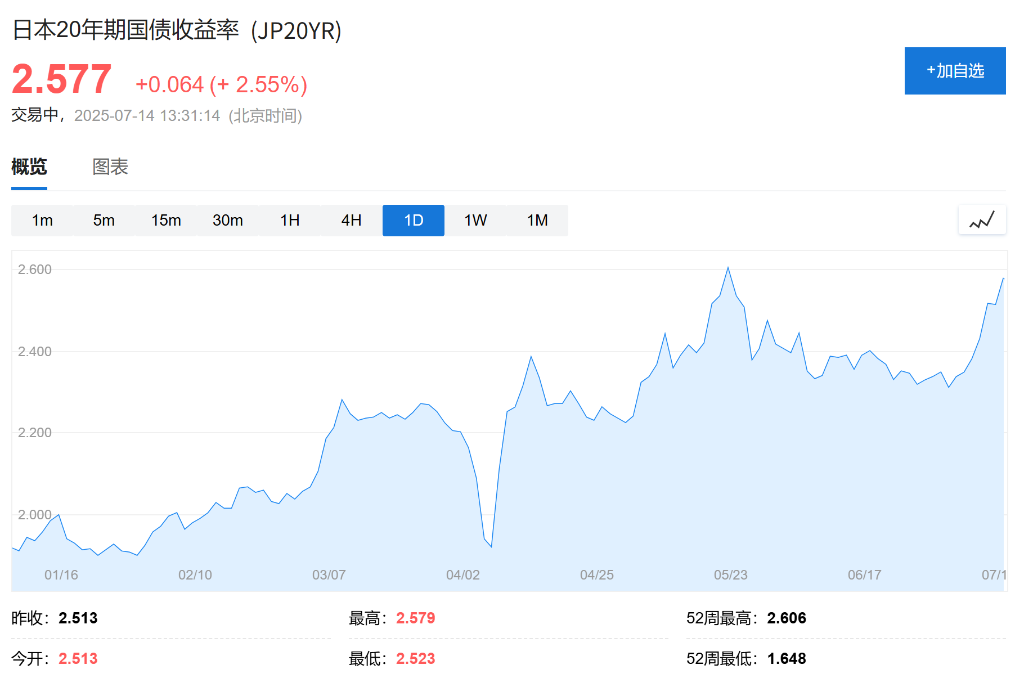
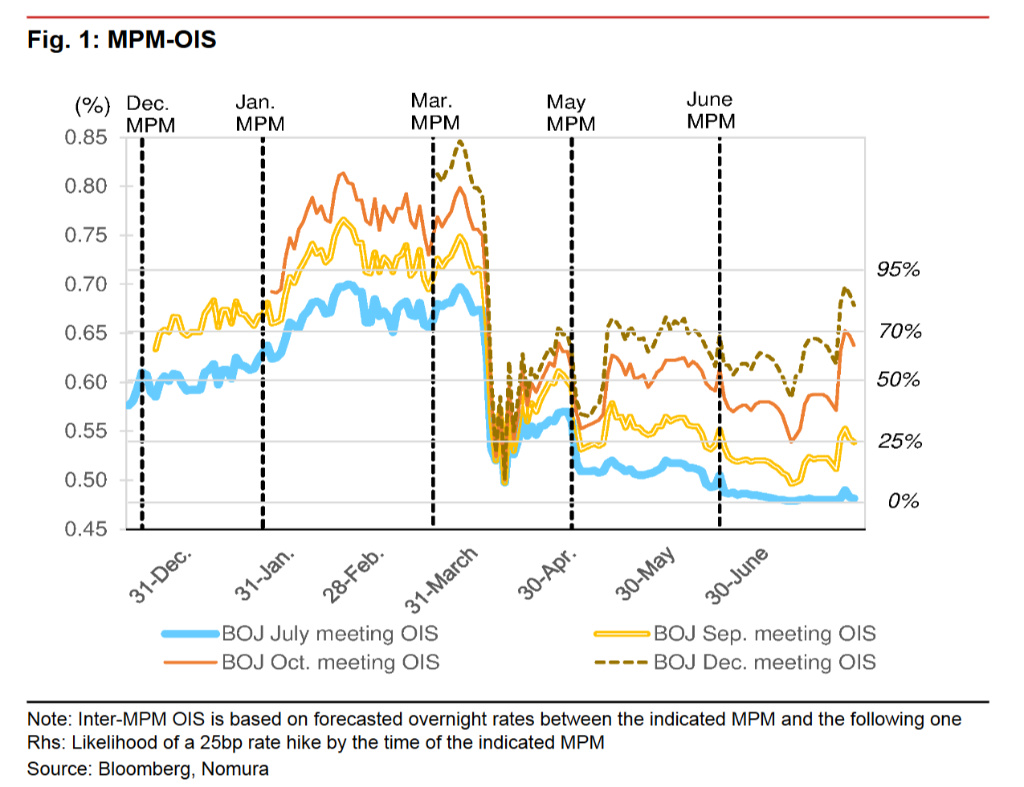
Core Viewpoint - The Bank of Japan is expected to maintain its interest rate at 0.5% during the upcoming monetary policy meeting, with a potential upward revision of inflation forecasts for the current fiscal year due to improved US-Japan trade uncertainties [1][14]. Group 1: Interest Rate Expectations - Market pricing indicates an approximately 80% chance of an interest rate hike by the end of the year, with October emerging as a favored time for the next increase [2][9]. - Following the US-Japan trade agreement, expectations for a rate hike have significantly rebounded, with a 65% probability for the October meeting and 80% for December [5][10]. - Despite the increased expectations, some analysts, including Goldman Sachs, caution that the Bank of Japan may adopt a wait-and-see approach due to ongoing negotiations and the absence of urgent inflationary pressures [8][9]. Group 2: US-Japan Trade Agreement - The US-Japan trade agreement has notably reduced uncertainties, with the US agreeing to impose a 15% tariff on Japanese goods, including automobiles, down from a previous 25% [3][4]. - Japan has committed to establishing a fund of up to $550 billion for direct investment in the US as part of the trade deal [3]. Group 3: Inflation Outlook - The Bank of Japan is likely to revise its short-term inflation forecast upward, anticipating a core CPI increase from 2.2% to approximately 2.5% for the fiscal year 2025 due to rising food prices [15][16]. - Despite the short-term adjustments, the medium-term inflation trajectory is expected to remain stable, with projections indicating a return to below 2% by the fiscal year 2026 [16]. Group 4: Bond Market Dynamics - Political uncertainties in Japan are currently pushing up long-term yields, but these premiums are expected to gradually ease as political clarity improves [17][18]. - The 10-year Japanese government bonds remain attractive, with expected holding and rolling yields surpassing capital losses, even with anticipated interest rate hikes [18].

每日机构分析:7月29日
Xin Hua Cai Jing· 2025-07-29 13:48
Group 1: Trade Agreements and Market Impact - The agreement between the US and EU includes a 15% baseline tariff on European imports, while the EU will increase purchases of US energy and technology products, ending months of uncertainty and positively impacting market expectations [1] - Following the trade agreement, the euro to dollar exchange rate fell to a one-month low due to concerns over the potential negative economic impact of the tariffs [3] - The market's focus has shifted from trade tensions to the Federal Reserve's monetary policy, with expectations of a slight rate cut in September [4] Group 2: Federal Reserve and Economic Conditions - The Federal Reserve's decision to lower interest rates hinges on three conditions: signs of weakness in the job market, inflation returning to target levels, and confidence in these assessments [1] - Morgan Stanley predicts that the Federal Reserve is unlikely to cut rates this year, but acknowledges that changes in economic conditions could lead to deviations from expected policy paths [2] - Standard Chartered highlights that the real threat to the dollar comes from the Fed potentially adopting a more dovish stance, rather than the resolution of trade tensions [4] Group 3: Inflation and Economic Forecasts - BMI has revised its inflation forecast for 2025 down from 2.1% to 1.9% due to lower-than-expected inflation data in May [2] - Analysts expect that improvements in the European economy, alongside a slowdown in the US economy, will support the euro against the dollar in the medium term [3]
贵金属数据日报-20250715
Guo Mao Qi Huo· 2025-07-15 07:14
Group 1: Report Industry Investment Rating - No relevant content provided Group 2: Core Viewpoints of the Report - On July 14, the main contract of Shanghai gold futures closed up 1.06% to 781.4 yuan/gram, and the main contract of Shanghai silver futures closed up 2.11% to 9207 yuan/kg [5]. - Trump's "Reciprocal Tariffs 2.0" boosts the demand for precious metals and stimulates their prices. The silver price has risen strongly due to factors such as the technical breakthrough and the expected recovery of overseas manufacturing, with the COMEX silver breaking through $39 per ounce and the Shanghai silver main contract breaking through 9200 yuan/kg [5]. - In the short - term, tariff risks may support the precious metals prices to remain strong, especially silver. In the long - term, considering the background of trade war, the probability of the Fed's interest rate cut, global geopolitical uncertainties, and central bank gold purchases, the long - term upward trend of gold remains unchanged, and the strategy of buying on dips is recommended [5]. Group 3: Summary by Relevant Catalogs Price Data - **Spot and Futures Prices**: On July 14, 2025, London gold spot was $3367.33 per ounce, London silver spot was $38.90 per ounce, COMEX gold was $3380.10 per ounce, and COMEX silver was $39.31 per ounce. Compared with July 11, gold prices rose by about 1.1% and silver prices rose by 3.5% - 4.3%. The AU2508 contract was 778.98 yuan/gram, and the AG2508 contract was 9179 yuan/kg, with increases of 1.0% - 1.8% [5]. - **Price Spreads and Ratios**: The gold TD - SHFE active price spread on July 14 was - 2.18 yuan/gram, with a 18.5% change compared to July 11. The silver TD - SHFE active price spread was - 3 yuan/kg, with a - 40.0% change. The gold and silver price ratios also had corresponding changes [5]. Position Data - **ETF and COMEX Positions**: As of July 11, 2025, the gold ETF - SPDR held 947.64 tons, with a - 0.12% change compared to July 10. The silver ETF - SLV held 14758.51984 tons, with a - 0.88% change. COMEX non - commercial long and short positions of gold and silver also had different degrees of changes [5]. Inventory Data - **SHFE and COMEX Inventories**: On July 14, 2025, SHFE gold inventory was 28857 kg, a 17.38% increase compared to July 11. SHFE silver inventory was 1223982 kg, a - 6.11% decrease. COMEX gold and silver inventories also had slight decreases [5]. Interest Rate, Exchange Rate and Stock Market Data - **Exchange Rates and Indexes**: On July 14, 2025, the dollar/yuan central parity rate was 7.15, with a 0.02% change compared to July 11. The dollar index was 97.87, with a 0.29% increase. The yields of 2 - year and 10 - year US Treasuries also increased, and the VIX increased by 3.93% [5].
日本央行可能考虑上调通胀预测,7月会议成焦点
Hua Er Jie Jian Wen· 2025-07-14 06:09
Group 1 - The Bank of Japan is considering raising its inflation forecast during the policy meeting on July 31, primarily due to rising food and energy prices, with a specific focus on the significant increase in rice prices [1][4] - The current fiscal year's inflation forecast may be adjusted from 2.2%, reflecting the unexpected surge in food prices, particularly rice, which has doubled in the past year [4] - The geopolitical tensions in the Middle East have also contributed to rising oil prices, providing further justification for the potential adjustment in inflation forecasts [4] Group 2 - Market observers expect the Bank of Japan to maintain the benchmark interest rate at 0.5% despite the possible upward revision of short-term inflation forecasts [4] - The Bank of Japan does not anticipate making significant adjustments to the overall economic and inflation outlook, believing that price trends will align with sustainable inflation targets in the latter half of the three-year outlook period ending March 2028 [4] - The Bank of Japan is closely monitoring the impact of U.S. President Trump's tariff policies on upcoming data to determine the timing of future interest rate hikes [4][5] Group 3 - The Bank of Japan will not consider the impact of the recently announced 25% tariffs on Japanese and South Korean products in its forecasts, as trade negotiations are ongoing and tariff levels may change [5] - The Bank of Japan emphasizes the need to observe the actual data to assess the specific effects of tariff policies, which will be crucial for future monetary policy decisions [5]