
AI泡沫论

Search documents
2026年基金经理投什么
Guo Ji Jin Rong Bao· 2026-01-10 05:36
Core Viewpoint - The article discusses the potential for continued investment opportunities in technology stocks, particularly in the AI sector, while also addressing concerns about market saturation and the need for careful risk management [1][3][14]. Group 1: Economic Outlook and Technology Innovation - The global economy in 2025 will face external shocks such as tariffs and geopolitical conflicts, with a shift towards innovation-driven growth in China [3]. - The "14th Five-Year Plan" emphasizes high-quality growth and the integration of technological and industrial innovation [3]. - High-tech industries are expected to be a significant driver of economic growth, with a focus on quality over speed [4][3]. Group 2: Market Trends and Investment Strategies - The A-share market showed strong growth in 2025, with the Shanghai Composite Index rising by 18.41% and the ChiNext Index by 49.57% [6]. - Investment strategies for 2026 are expected to shift from valuation-driven to profit-driven, with a more balanced market style [6][7]. - The focus will remain on high-quality growth companies with substantial earnings support, particularly in the AI sector [7][6]. Group 3: AI as a Central Investment Theme - AI is identified as the core investment theme for 2026, with a focus on applications, semiconductors, and storage sectors [9][8]. - Investment strategies will include a comprehensive approach across the AI value chain, from infrastructure to application [9][11]. - The AI infrastructure market is projected to grow significantly, with a compound annual growth rate of 31% from 2024 to 2030 [14][15]. Group 4: Market Sentiment and Risk Management - There are concerns about potential market saturation and high valuations in the tech sector, leading to increased volatility [16][14]. - Investment firms emphasize the importance of thorough research to identify companies with sustainable earnings and technological advantages [16][19]. - A balanced investment approach is recommended, focusing on long-term strategies and avoiding impulsive decisions based on market trends [18][19].
AI芯片2025:巨头血拼,权力鼎革
Tai Mei Ti A P P· 2025-12-31 11:13
Core Viewpoint - The AI chip industry is undergoing significant changes, with increasing competition and the emergence of new players, leading to a potential shift in market dominance from established leaders like NVIDIA to other companies such as AMD, Google, and domestic Chinese firms [4][5][6]. Group 1: Industry Dynamics - The AI chip market is expected to see over 10 million units shipped globally by 2025, with NVIDIA currently holding over 90% market share in the GPU sector, but the competitive landscape is changing [5][6]. - The Chinese AI chip market is projected to grow at a compound annual growth rate of 53.7% from 2025 to 2029, with market size expected to increase from 142.54 billion yuan in 2024 to 1.34 trillion yuan by 2029 [6][20]. - Geopolitical factors are influencing the AI chip landscape, with U.S. export restrictions impacting NVIDIA and AMD's presence in China, leading to a rise in domestic chip production [19][20]. Group 2: Competitive Strategies - The competition is shifting from a focus on product supply to ecosystem integration, with companies like NVIDIA expanding their CUDA ecosystem while others like AMD and Google are forming partnerships to enhance their market positions [8][10]. - NVIDIA's investments in various AI companies, including OpenAI and Anthropic, indicate a strategy to maintain its competitive edge through ecosystem expansion [14][15]. - AMD is aggressively pursuing market share in the GPU sector, with new AI chips that claim to outperform NVIDIA's flagship products and a strategic partnership with OpenAI for significant hardware procurement [15][16]. Group 3: Technological Trends - The competition between GPU and ASIC technologies is intensifying, with a potential shift towards ASIC chips as the market's focus moves from training to application inference, emphasizing cost efficiency [26][27]. - Google is advancing its self-developed ASIC chips (TPU) and aims to create a competitive ecosystem against NVIDIA, with significant cost advantages reported [18][27]. - Domestic Chinese companies like Huawei and Cambrian are rapidly advancing in AI chip technology, with Huawei's roadmap for its Ascend AI chips and Cambrian's significant revenue growth indicating a strong competitive presence [21][23]. Group 4: Future Outlook - The AI chip market is expected to continue its rapid growth, with predictions of a 45% increase in market size by 2026, driven by the demand for high-efficiency ASIC chips [24][26]. - The year 2026 is anticipated to be pivotal for the AI chip ecosystem, with a focus on building robust domestic capabilities in China and enhancing the usability of local chips [29].

(年终特稿)中国经济这一年:A股期待实现新突破
Zhong Guo Xin Wen Wang· 2025-12-31 09:33
Core Viewpoint - In 2025, China's A-share market experienced a significant journey, achieving key breakthroughs in index levels, structural optimization, quality enhancement, and institutional development, leading to a more mature and resilient capital market [2] Market Performance - The Shanghai Composite Index closed at 3968 points on December 31, 2025, with a daily increase of 0.09% and an annual gain of over 18% [1] - The Shenzhen Component Index reported 13525 points, down 0.58% for the day but up over 29% for the year [1] - The ChiNext Index ended at 3203 points, with a daily decline of 1.23% and an annual increase of over 49% [1] - The overall market trend in 2025 was characterized by "oscillating upward and structural differentiation," influenced by various external and internal factors [1] Sector Performance - The AI wave, particularly in the first quarter, led to a "spring surge" in the market, with technology growth sectors, especially robotics, performing exceptionally well [1] - In 2025, the synchronous reluctance motor sector recorded an impressive annual increase of over 122%, leading all A-share concept sectors [2] Future Outlook - Analysts predict that A-shares are likely to achieve new breakthroughs in 2026, driven by four main factors: 1. Economic improvement, supported by clear policy directions and structural adjustments [3] 2. New industries emerging, with top-level policy support for sectors like renewable energy and aerospace [3] 3. Ongoing reforms aimed at enhancing the investment and financing landscape, which will stabilize the market [3] 4. Expected growth in corporate earnings, with major foreign institutions forecasting an upward shift in profitability for A-shares in 2026 [3]
赚钱效应明显 网上打新者创阶段新高
Zheng Quan Shi Bao· 2025-12-26 22:50
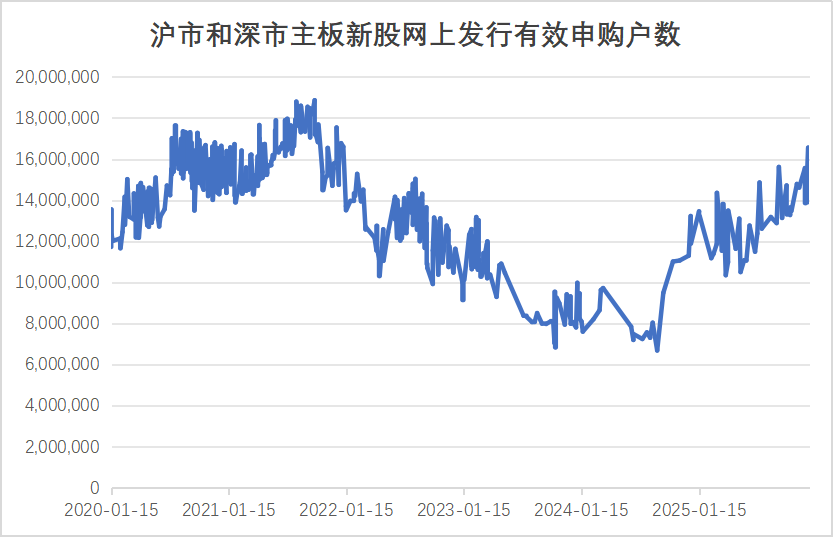
Group 1 - The A-share market is experiencing a surge in new stock listings, such as Moer Thread and Muxi Co., which has stimulated investor enthusiasm for new stock subscriptions [1] - The number of online subscription participants for new stocks has reached a record high, with 16.55 million investors participating in the online issuance of Shuangxin Environmental Protection, marking the highest since January 2022 [2] - The ChiNext and STAR Market are also seeing increased investor interest, with the number of subscription participants for new stocks reaching new highs [3] Group 2 - The significant profit potential from new stocks has driven investor enthusiasm, with Moer Thread's stock price soaring by 468.78% on its first day of trading, allowing investors to earn nearly 270,000 yuan per subscription [4] - Muxi Co. also provided substantial returns, with its stock price increasing by 568.83% on its debut, resulting in potential earnings of around 300,000 yuan per subscription [4] - Despite the high enthusiasm for new stocks, the subscription rate has decreased, with several recent new stocks having a subscription rate as low as 0.01% [4] Group 3 - The overall market activity has increased, with A-share market transactions exceeding 2 trillion yuan, and the Shanghai Composite Index showing a nearly 2% increase in December [7] - The market sentiment has improved significantly after a period of adjustment, with expectations for a continued upward trend in 2026 driven by a loose liquidity environment [7] - Analysts suggest that while the market outlook remains positive, investors should temper their return expectations and focus on defensive strategies while seeking opportunities in technology and advanced manufacturing sectors [8]
增近1000万户!网上打新人数创新高 新股赚钱效应显著
Zheng Quan Shi Bao· 2025-12-26 09:48
Group 1: Market Overview - The A-share market has seen a surge in new stock listings, such as Moer Thread and Muxi Co., which has stimulated investor enthusiasm for new share subscriptions [1][10] - The number of online subscription participants for the Sci-Tech Innovation Board has reached nearly 6.7 million, setting a historical high, while the Main Board has over 16.5 million participants, increasing by nearly 10 million in the past year [1][11] - The ChiNext Board has also attracted close to 14 million online subscription participants, returning to levels seen at the end of 2021 [1][4] Group 2: Subscription Data - The recent IPO of Shuangxin Environmental Protection on the Main Board attracted 16.55 million investors, with effective subscriptions reaching 335.23 billion shares, marking a record for the year [2] - The ChiNext Board's new stock, Xinguangyi, reported 13.92 million effective subscriptions, also a new high for the year and since the end of 2021 [4] - The Sci-Tech Innovation Board's new stock, Yuxun Co., attracted 6.69 million investors, the highest since its inception [6] Group 3: New Stock Performance - Moer Thread's stock price surged by 468.78% on its first day, reaching 650 yuan per share, with potential earnings exceeding 410,000 yuan for investors who held onto their shares [10] - Muxi Co. also saw a significant increase of 568.83% on its debut, with a peak price of 895 yuan per share, allowing investors to earn nearly 400,000 yuan [10] - The strong performance of these new stocks is attributed to their solid fundamentals and the current market's high recognition and demand for new shares [10] Group 4: Market Dynamics - The increase in new stock subscription participants has led to a decline in the new stock winning rate, with some recent IPOs having a winning rate as low as 0.01% [11] - Despite the enthusiasm for new stocks, analysts emphasize the importance of understanding the fundamentals of new companies to avoid unnecessary risks [1][11] - The overall market activity has improved, with A-share trading volumes exceeding 2 trillion yuan recently, indicating a recovery in market sentiment [12]
黄仁勋200亿美金接盘Groq,中东王爷和特朗普都笑了
3 6 Ke· 2025-12-26 08:48
Core Insights - Groq has entered into a $20 billion technology licensing agreement with NVIDIA, which is not a legal acquisition but a non-exclusive technology licensing deal allowing NVIDIA to use Groq's hardware and architecture designs [2][3] - Groq's CEO Jonathan Ross and nearly all key members will join NVIDIA, while Groq will continue to operate as an independent company, retaining its core intellectual property [2] - The deal's significance extends beyond the monetary value, as it reflects NVIDIA's strategic positioning in the AI landscape amid regulatory challenges and market pressures [3][28] Group 1: Transaction Details - The transaction is valued at approximately $20 billion, which is enough to acquire GlobalFoundries entirely or represents a quarter of Intel's market value [3] - NVIDIA will acquire all of Groq's physical assets but not its intellectual property, indicating a focus on talent acquisition rather than a traditional acquisition [2] - Groq has raised a total of $1.8 billion in funding, with significant investments from entities like the Saudi sovereign wealth fund [5][27] Group 2: Groq's Technology and Market Position - Groq's core product, initially named TSP and later LPU, utilizes a unique architecture with 144-wide VLIW design, offering advantages in speed and efficiency [5][9] - The architecture's reliance on on-chip SRAM instead of external memory allows for fast access speeds but limits storage capacity, posing challenges for deploying larger AI models [6][7] - Groq's architecture is distinct from traditional ASICs and TPUs, focusing on deterministic system behavior and low latency, which are appealing for real-time inference scenarios [10][11] Group 3: Industry Context and Strategic Implications - The deal is seen as a strategic move by NVIDIA to solidify its position in the AI infrastructure market, especially in light of increasing regulatory scrutiny and competition [28][31] - The transaction may also serve as a means for NVIDIA to gain favor with U.S. and Middle Eastern stakeholders, potentially easing export restrictions on AI products [28][30] - The broader context includes a trend of large tech companies engaging in high-value agreements with promising startups to secure technology and talent without formal acquisitions [26][27]


恒生科技投资复盘与展望
2025-12-24 12:57
恒生科技投资复盘与展望 20151223 同时公司基本面走出底部开始回升也是支撑因素之一。 美联储降息力度和节奏对权益投资有哪些影响? 降息对于权益类资产定价影响主要体现在分母端,即无风险利率下降会降低整 体市场对资产要求的回报率,从而推升资产价格。因此,降息本身对于权益类 资产是利好的。 具体到美联储降息节奏和影响,目前大方向上仍处于一个大的 降息通道中。从今年(2025 年)到明年(2026 年),预计将持续降息,美联 储可能还有 300~400 个基点的政策空间。分歧点在于降息节奏和快慢,而不 是方向,因此未来资产价格上涨方向较为确定,只是时间长短的问题。 现阶段, 美联储点阵图显示明年可能一次降息,但海外投资者预期更乐观,认为有 2~2.5 次降息预期。最终结果需结合美联储官员换届、美国宏观经济情况及政 府政策需求来综合判断,但整体上仍保持积极态度。 恒盛科技近期回调的主要原因有哪些? 恒盛科技今年整体市场表现不错,上涨一半来自估值提升,一半来自基本面改 善。本轮回调最直接原因是港股流动性的边际收缩,这种收缩并非永久性,而 是阶段性的变化。因此,本轮回调只是长维度投资中的一小段波动。 具体来说, 本轮 ...
东方港湾董事长但斌:“AI泡沫论”是噪音,远离融资炒股
Hua Er Jie Jian Wen· 2025-12-22 10:51
Core Viewpoint - The risk of missing out on an era is far greater than the risk of prematurely worrying about a bubble in AI technology, according to Dan Bin, Chairman of Dongfang Hongyuan, at the Xueqiu Carnival held on December 20 [1] Group 1: AI Market Outlook - Dan Bin asserts that concerns regarding an AI bubble are premature, stating that the upcoming year will witness significant advancements in both foundational and application layers of AI, driving mutual growth [1] - He emphasizes that the current state of AI does not indicate an oversupply or bubble formation [1] Group 2: Investment Strategies - Ordinary investors are advised to focus on high-quality companies, referred to as "the crown jewels," and consider using ETFs for investment if assessing specific companies is challenging [1] - Suggested ETFs include those tracking global technology trends, such as the S&P or NASDAQ ETFs, as well as industry-specific ETFs focused on AI [1] Group 3: Investment Principles - A critical investment principle highlighted is to never borrow money for investments and to avoid leveraged trading, which is considered a major taboo in investing [1] - Dongfang Hongyuan's ability to navigate multiple market cycles is attributed to their strict adherence to not using financing leverage [1] - The recommendation is to invest in the best companies or ETFs without leveraging, making it difficult to incur losses [1]
美股策略周报:信息技术行业盈利上修7.7%驱动美股上涨-20251222
Eddid Financial· 2025-12-22 06:14
Labor Market - October non-farm employment decreased by 105,000, primarily due to a significant decline in government jobs[6] - November non-farm employment increased by 64,000, exceeding market expectations of 50,000; unemployment rate rose to 4.6%, the highest since October 2021[6] - November average hourly wage growth year-on-year was 3.5%, the lowest since June 2021, but outpaced inflation (November CPI at 2.7%)[6] Inflation Data - November CPI decreased to 2.7%, below the expected 3.1%; core CPI fell to 2.6%, also below expectations of 3.0%[9] - The market reacted positively, with the S&P 500 rising by 0.8% on the day of the inflation release[9] Market Sentiment - The S&P 500 index fluctuated, maintaining a "neutral" sentiment throughout the week; VIX closed at 14.91, below the critical value of 20[13] - Global equity markets saw a weekly change of 0.0%, with developed markets up by 0.1% and emerging markets down by 1.5%[17] U.S. Stock Market Performance - S&P 500 rose by 0.1% for the week, with a year-to-date increase of 16.2%; Nasdaq increased by 0.6% (year-to-date up 20.6%)[18] - The information technology sector saw a significant earnings upgrade of 7.7%[28] Sector Analysis - Strong sectors included software services, automotive, and pharmaceuticals; software services had an estimated daily fund intensity of approximately $22.7 billion, ranking first[28] - The performance of small-cap stocks represented by the Russell 2000 decreased by 0.9% for the week, with a year-to-date increase of 13.4%[18] Earnings Revisions - Earnings for the Nasdaq 100 and S&P 500 were revised upwards by 1.8% and 0.4%, respectively; PE ratios were adjusted downwards by 1.2% and 0.3%[28] - The overall market sentiment remains bullish, particularly for the information technology sector, amid ongoing earnings upgrades[28]



金鹰基金:春季躁动布局正当时 聚焦科技+制造主线
Xin Lang Cai Jing· 2025-12-22 02:47
Group 1: Market Overview - The A-share market experienced a fluctuating recovery pattern last week, with a divergence in index performance, characterized by a stronger Shanghai market compared to Shenzhen [7] - Under the expectation of "expanding domestic demand" policies and high dividend defensive attributes, consumption and non-bank financial sectors became the leading gainers, while previously active AI applications and hardware saw a pullback [7] - The average daily trading volume in the A-share market decreased to 1.76 trillion yuan, indicating a decline in market activity [7] Group 2: Economic Indicators - November consumption showed a significant slowdown due to high base effects and policy exhaustion, while fixed asset investment continued to decline, and the real estate market remained sluggish [7] - External demand was noted as a rare bright spot, but there are expectations for monetary stimulus and fiscal pre-positioning to improve domestic economic conditions in early next year [7] Group 3: Global Economic Context - The Bank of Japan's interest rate hike has led to a moderate recovery in market risk appetite, while the U.S. non-farm employment rate is expected to rise, and CPI is projected to be below market expectations [8] - Despite these indicators, the Federal Reserve is unlikely to take further directional actions in the short term, with expectations that it will not lower interest rates in January [8] Group 4: Industry Focus - The focus is shifting towards technology and manufacturing sectors, with a potential bottoming out of the recent global tech pullback [9] - Key factors for the future strength of the tech sector include improvements in large model capabilities and advancements in AI commercialization [9] - The manufacturing sector is expected to benefit from fiscal and monetary easing, with a focus on export-oriented manufacturing and real estate chains related to emerging markets [9]